Page 1 :
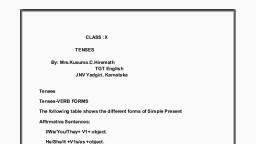
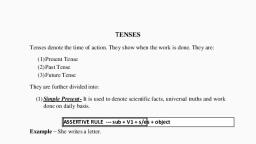
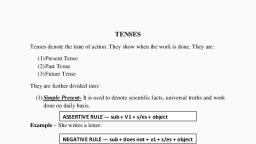
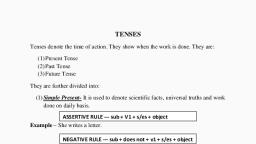
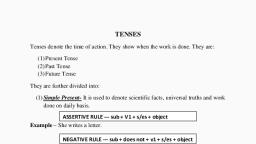
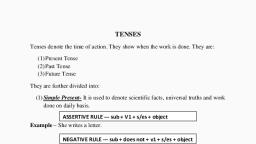
CLASS :X, TENSES, By: Mrs.Kusuma.C.Hiremath, TGT English, JNV Yadgiri, Karnataka, Tenses, Tenses-VERB FORMS, The following table shows the different forms of Simple Present, Affirmative Sentences:, I/We/You/They+ V1+ object., He/She/It +V1s/es +object., Negative Sentences:, I/We/You/They+do not + V1+ object., He/She/It + does not +V1 +object., Interrogative Sentences:, Do/Does + subject + V1 +object + ?, Wh-family +do/does + subject +V1 + object + ?, Usage :, Simple Present is used to express things happening in the present, e.g. She teaches in a private school., express a habitual action, e.g. I wake up at five daily., express a universal truth, e.g. The Sun rises in the east, I drink milk every morning
Page 2 :
Express subordinate clause if the principal, clause is the Simple Future, e.g. If she prepares well, she will score, good marks., Used in commentaries for sports, e.g. Martin passes the ball, kicks it, Ah! It is a goal., Key time words that are generally used for simple present, Always, often, usually, regularly, often, everyday, rarely, scarcely,, (once, twice, three times a day,, a week, a month, a year), daily,, weekly, monthly, yearly., General facts., The following table shows the different forms of Present Continuous, Affirmative Sentences:, subject+ is/am/are+v1+-ing +object., Negative Sentences:, subject+ is/am/are+not +v1+-ing +object., Interrogative sentences:, is /am/are+subject+v1+-ing +object+?, Present Continuous/ Progressive :, It is used to, indicate an action that is taking place at, the moment of speaking, e.g. I am teaching grammar., express an activity happening around but not, necessarily at that moment., e.g. Ganesh is studying very hard for his exams, these days.
Page 3 :
express activities happening in the near future, especially a planned future event., e.g. I am attending the meeting., I am teaching grammar now, Do all verbs have continuous/progressive form?, No!, Verbs referring to mental states(emotions) like know, love, want, feel,, desire……, the senses like smell, taste, see……. Don’t have, continuous/progressive form, e.g. I am respecting you. (incorrect), I respect you. . (correct), My son loves to draw and paint. (correct), My son is loving to draw and paint. (incorrect), Present Continuous/ Progressive, Key words / phrases, now, right now, at the moment,, (this week, month, semester, term, season, year), today, look, listen, be, careful, be quiet,, Forms of Present Perfect, Affirmative Sentences:, Subject+ have/has+ v3 +object., Negative Sentences:, Subject+ have/has+ not+ v3 +object., Interrogative Sentences:, Have/ Has+subject+v3 +object+?, Present Perfect
Page 4 :
It is used to, express an action recently completed, it is, used with ‘just, e.g. The train has just arrived., describe a past action which is important for its effect in the present and, not in itself., e.g. I have stopped smoking., I have finished my home work, Words often used with the Present Perfect tense are :, Yet, so far, never, ever, already, since, just ,, just now , several times, Forms of Present Perfect Continuous, Affirmative Sentences: Subject+have/has+been+v1+ing+object., Negative Sentences: Subject+have/has+not+been+v1+ing+ object., Interrogative Sentences:, Has+subject+been+v1+ing+object+?, , Have/, , Present Perfect Continuous :, It is used to, Express an action that began in the past and has been in progress till the time, of speaking., e.g. I have been teaching since 9-00 a.m., Words often used with the Present Perfect Continuous, since/for, since : suggests the “point of time”, for : suggests the “period of time”, The following table shows the different forms of Simple Past
Page 5 :
Affirmative Sentences:, Subject + V2 + object., , Negative Sentences:, Subject + did not +V1+ object., Interrogative Sentences:, Did + subject V1 +object + ?, Wh-family +did+ subject +V1 + object + ?, Simple Past :, It is used to, express an action that was completed at a, definite point in the past., e.g. Yesterday, she visited her aunt., express a past habit or routine., e.g. He used to eat with his left hand when, he was young., I drank coffee yesterday., You will often find the past simple used with time expressions such as these, •, , Yesterday, , •, , three weeks ago, , •, , last year, , •, , in 2002, , •, , from March to June (past months), , •, , for a long time, , •, , for 6 weeks, , •, , in the 1980s, , •, , in the last century
Page 6 :
•, , in the past, , The following table shows the different forms of Past Continuous, Affirmative Sentences:, Subject + was /were +v1+ing+object., Negative Sentences:, Subject +was /were+not+v1 +ing +object., Interrogative sentences:, Was/ Were+subject +v1+ing +object+?, Past Continuous/ Progressive, It is used to :, express an action in progress before the moment of speaking., e.g. It was pouring heavily at 6 o’clock this morning., express when two actions were going on, simultaneously in the past., e.g. While I was playing, my sister was studying., I was drinking coffee when I got a phone call, , Forms of Past Perfect, Affirmative Sentences :, Subject + had+ v3+ object., Negative Setences:, Subject + had+ not + v3+ object., Interrogative Sentences:, Had+ subject +v3+object ?, Past Perfect :, It is used to
Page 7 :
describe an action which was completed just before or sometime before the, second action in the past., e.g He had done his duty before the next shift started., , My mother had cooked before I woke up., Forms of Past Perfect Continuous, Affirmative Sentences: Subject+had+been+v1+ing+object., Negative Sentences:, Subject+had+ not +been+v1+ing+object., Interrogative Sentences:, Had +subject+been+v1+ing+object?, Past Perfect Continuous Tense, It is used to, Express an action that was finished at some definite time in the past but, which had been going on before it was finished or had recently finished., e.g. Suresh had been working in this bank since he came to Dharwad., The following table shows the different forms of Simple Future, Affirmative Sentences:, Subject + shall/will + V1+ object., Negative Sentences:, He/She/It +shall/will not +V1+ object., Interrogative Sentences:, Shall/Will + subject V1 +object + ?, subject +V1 + object + ?, Simple Future, It is used to :, , Wh-family +shall/will +
Page 8 :
describe an action that will take place in the future., e.g. I shall see you shortly., He will win the match., express announcements of future plans and weather forecast., The flood water will continue to recede now., Words often used with the Simple Future are, tomorrow, next, The following table shows the different forms of Future Continuous, Affirmative Sentences: Subject+shall/will+be+v1+ing+object., Negative Sentences:, Subject + shall/will+be+not+v1+ing+object, Interrogative sentences:, Shall/Will +subject+be+v1+ing+object?, Future Continuous Tense:, , It is used with a point of time., It expresses an action that will be going on, , at the time of speaking., , e.g. I shall be giving a lecture on Google, Meet tomorrow., Forms of Future Perfect, Affirmative Sentences:, Subject+ shall/will+ have+ v3+ object., Negative Setences:, Subject+ shall/ will+ not + have+ v3+ object., Interrogative Sentences: Shall/Will+subject+have+v3+object+ ?, Future Perfect, It is used to
Page 9 :
Express an action that will have been completed in the future by a certain, time., e.g. By tomorrow, I shall have bought the new mobile., Forms of Future Perfect Continuous, Affirmative Sentences:, Subject+shall/will +have been+v1+ing +object., Negative Sentences:, Subject+shall/will + not +have been+v1+ing +object., Interrogative Sentences:, Will/Shall +subject+ have been +v1+ing object ?, Future Perfect Continuous :, It is used to, denote an action that will be finished at some definite time in the future, but, which had been going on before it was finished., e.g. He will have been celebrating his birthday tomorrow this time., TENSES in different type of sentences