Page 1 :
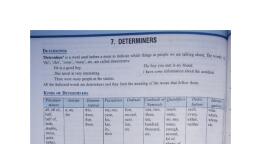
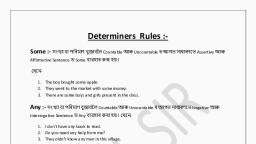
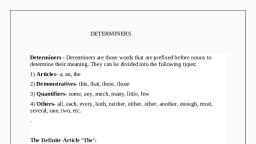
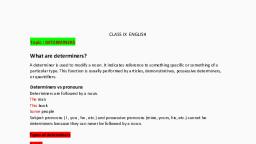
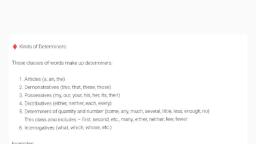
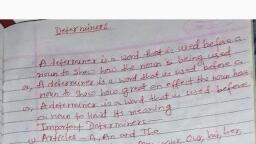
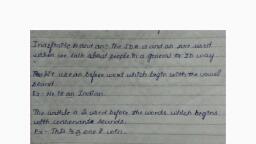
5. Determiners, , are words which come before, nouns. They limit the noun by giving additional, information about the noun. Determiners and, nouns together make moun phrases., Ag: a boy,,every bow, he following are the most commonly used, , , , , , , , , , , , , , , , 6 = my. our, your, his, its, their., PS = this, that, these, those., , i 8 = which, whose (not where, when, it, umiess they are followed by a noun)., , mS : few, a few, many, much, each,, ne, any, little, a little., , sone, two, forty., , arst, second, last, next., , z all, both, half, either, neither, each,, , s of Quantity : |, only with plural nouns and to show, , with uncountable nouns indicating, , show not a very large quantity., e books in the bag., ygative or negative sentences., , y children in the park ?, , There aren't any children in the park., , Each and every indicate single units in a group., Each refers to individual members of a small, group, while every to members of a large group., e.g.: We can help each other., , Every student wants to participate in the, , quiz show., All is used to indicate the whole group rather, than its components., e.g. : All the children in this building like to play., Few means not many (hardly any). Negative in, sense., A few means not but at least some number., Positive in sense., The few means very small specific numbers. It, gives both positive and negative sense., e.g. Few students are interested in reading books, (hardly any)., A few students are good at Mathematics (at least, some)., The few students who scored good marks (very, few are good, all scored good marks)., Similarly, little, a little and the little denote, quantity., He had little milk. (Not much, negative), He had a little milk. (Some at least), He drank the little milk I had. (Implies negative, and affirmative)