Notes of Class 9th, Economics Economics Food Security - Study Material
Page 1 :
Class 9 NCERT Economics Chapter 4, Overview, , Food Security in India, , → Food security, → Public Distribution System (PDS), → Government vigilance, → Government action at times, when this security is threatened., , What is food security?, • Food is as essential as air. Food security means availability of food to all, and, available food is accessible to all and accessible food is affordable to all people at, all times., , → Here, food availability refers to availability of food in countries., → Accessibility of food means food is within people’s reach., → Affordability for food refers to people are able to buy it., → Creation of “Buffer stock” is also done in this system.
Page 2 :
Why food security?, • Food security is helpful at the time of natural disaster when there is lack of, food., → At the time of natural disaster like earthquake, flood, or drought etc., production of foodgrains decreased which, creates a situation of decrease in food, availability., → The attainment of food security therefore involves eliminating current hunger and reducing the risks of future, hunger, ., → Famine of Bengal in 1943 was the most devastating, famine., Who are foodinsecure?, → In rural areas, landless and small farmers, traditional artisans like blacksmith, providers of services like, washermen, petty self-employed workers and destitute are came under the category of foodinsecure., → In urban areas, persons who employed in ill-paid occupations and casual labourers are food insecure, these, labour came under seasonal workers and have low, wages., → Children under the age of 5 years, large proportion of pregnant and nurshing mothers are also came under the, category of foodinsecure., → Person who is not able to fulfil their daily requirements or people came below poverty line are also foodinsecure., → People belonging to some scheduled castes and OBC are also came under the head of food, insecure., → In India, some states has large number of food-insecure like, Bihar, Orissa, Uttar Pradesh, Jharkhand, West, Bengal, Chhattisgarh, parts of Madhya Pradesh and, Maharasthra., → Hungers are also came under the category of food insecure. It has chronic and, seasonal, dimensions, .
Page 3 :
Seasonal hunger, , • When a person is unable to get work for entire year, then they came under the category of, seasonal hunger., , • It is related to cycles of food growing and harvesting. This is prevalent in rural areas because of, the, seasonal nature of agricultural activities and in urban areas because of the casual labour that is, there is less work for casual construction labour during the rainy season., , • This type of hunger exists when a person is unable to get work for the entire, year., Chronic hunger, , • Chronic hunger is a consequence of diets persistently inadequate in terms of quantity and/or, quality, ., • A person who has low level of income is came under the category of chronic hunger.
Page 4 :
Food Security in India, , Production of Foodgrains in India (Million Tonnes), , → This table shows different year production of foodgrains in India., → During the period of 1965-1995 production of wheat increased by more than four times in the state of, Punjab and Harayana., → Because of availability of sufficient foodgrains the government of India introduce food security system, like, Public Distribution System, buffer stock.
Page 5 :
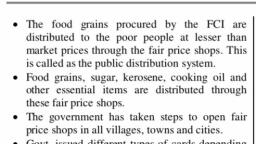
What is Buffer stock?, → The farmers Sale theirs foodgrains at minimum supply price i.e. pre-announced price of the, government., , → This foodgrains stored in the warehouse of “Food Corporation of India”. This stock of foodgrains is, called Buffer stock., What is the Public Distribution System?, • Public Distribution System (PDS) is the system of providing foodgrains from Food Corporation of India to, the poor section of the society at subsidized rate., • This programme was launched in 1992 in 1,700 backward blocks in the country. This is a food security, programme., • For the implementation of this system many programmes are launched by the government of India like, the Antyodaya Ann Yojana which is for poorest of the poor and the Annapurna schemes which is for needy, senior citizens. These two programmes are launched in 2000., • For take the benefit of Public Distribution System the government of India provide three type of ration, card:, , (i) Antyodaya cards for the poorest of the poor, (ii) BPL card for the people living below poverty line, (iii) APL card for other all people., • About 5.5 lakh ration shops or fair price shops are here all over the Country for implementation of this, system.
Page 6 :
Current Status of Public Distribution System, • At the time of introducing of Public Distribution system, it was for all category of, people i.e there was no discrimination between the poor and non poor., • In 1992, Government of India decided to launch Revamped Public Distribution, System (RPDS) in 1992 with the aim to start it in 1,700 blocks in the country., • Again in 1997, Public Distribution System revised as Targeted Public Distribution, System (TPDS) which was only for the poor section of the society.
Page 7 :
Merits of Public Distribution System:, → It helps to keep food price stable by providing food at concessional rate., , → It helps to prevent large number of hunger and the famine by the way of supplying food from, surplus region to deficit ones., → Public Distribution System is purchased foodgrains from Food Corporation of India and, created buffer stock., → Poor section of the society can easily buy food at subsidized rates from fair price shop and it, has been possible through Public Distribution System., → It assuring to the farmers by the way of purchasing food at minimum sport price., , • Demerits of Public Distribution System:, , → In this system foodgrains are stored as buffer stock which became wasteful due to gradually, decrease in the quantity of foodgrains due to deterioration, wear and tear, and rotting etc., → Sometimes products of the Public Distribution System is malpracticed by the PDS dealers, through selling the foodgrains in the open marked for getting better margin.
Page 8 :
Role of cooperatives in food security, • Cooperative opens many fair price shops to sell foodgrains at concessional rate., , • Academy of Development Science is an organization of training and capacity building, programmes on food security for NGOs in Maharashtra. It facilitates a network of NGO for, setting up bank of grains. It is a successful food security intervention., • In Tamil Naidu, 94 per cent fair price shop are being run by the cooperatives., • Mother Dairy is a success story of cooperatives in milk and vagetables in Delhi., • Amul is also a success story of cooperatives in milk and milk products in Gujarat., , National Food for Work Programme, • This programme was started on November 14, 2004 in 150 most backward districts of the, country., • The programme is for those rural people who are needy of wage employment and desire to, do manual unskilled work., , • The aim of this programme is to intensify the generation of supplementary wage employment., • It is 100 per cent centrally sponsored scheme. In this programme, the foodgrains are provided, to States free of cost., • At district level nodal officer is the collector in this programme.
Page 9 :
Antyodaya Anna Yojana (AAY), • This yojana was started in December 2000., • One crore of the poorest among the BPL families are came, under Public Distribution System in this programme., , • In this programme, poorest people were identified through, Below Poverty Line survey., • Now, 2 crore families have been covered under the AAY with, the increment of 50 lakh each in June 2003 and in August, 2004, .Subsidy, , • It is a form of financial aid made by the government to a, producer to fix the price of a commodity., • It leads to a fall in price of subsidized product with, maintaining producer’s profit.
Page 10 :
Excercis, e, 1. How is food security ensured in, India?, Answe, r, Food security is ensured in a country when the three dimensions of food security are taken care of. The three dimensions, are:, Availabilityof food - Presence of enough food for all the, persons, Accessibilityof food - Absence of barrier on access to, food, Affordabilityof food - Capability of all persons to buy food of acceptable, quality, 2. Which are the people more prone to food, insecurity?, Answe, r, A large section of people suffer from food and nutrition insecurity in India. However, the worst affected groups areas, follows:, → Landless and land-poor households, traditional artisans, providers of traditional services, petty self-employed workers and, destitute including beggars (in the rural, areas)., → People employed in ill-paid occupations and casual labourers engaged in seasonal activities (in the urban areas)., → People belonging to the backward sections of society, namely SCs, STs and, OBCs, → People belonging to economically-backward states with high incidence of poverty, tribal and remote areas and regions more, prone to natural, disasters., → People affected by natural disasters who have to migrate to other areas in search of, work., → Large proportion of pregnant and nursing mothers, and children under the age of 5, years.
Page 11 :
3. Which states are more food insecure in India?, , Answer, The economically-backward states with high incidence of poverty are more, food insecure in India. The states of Uttar Pradesh (eastern and southeastern parts), Bihar, Jharkhand, Orissa, West Bengal, Chattisgarh, parts, of Madhya Pradesh and Maharashtra account for the largest number of, food insecure people in the country., , 4. Do you believe that Green Revolution has made India self-sufficient in, food grains? How?, , Answer, In the late 1960s, the Green Revolution introduced the Indian farmer to the, cultivation of high-yielding varieties (HYVs) of seeds. The HYVs (coupled, with chemical fertilisers and pesticides) led to a growth in the productivity of, food grains (especially wheat and rice), thereby helping India attain selfsufficiency in food grains. Since the advent of the Green Revolution, the, country has avoided famine even during adverse weather conditions.
Page 12 :
5. A section of people in India are still without food. Explain., , Answer, Despite large increase in foodgrain production we find people without food, in India. Poor people suffer from chronic hunger. They find themselves, unable to buy food. Over one-fifth of the country’s population still suffers, from chronic hunger., , 6. What happens to the supply of food when there is a disaster or a, calamity?, Answer, , When there is a disaster or a calamity, the production of food grains, decreases in the affected area. This in turn creates a shortage of food in, the area. Due to the food shortage, the prices go up. The raised prices of, food materials affect the capacity of many people to buy the same. When, the calamity occurs in a very wide spread area or is stretched over a long, period of time, it may cause a situation of starvation. A massive starvation, can take the form of, famine.
Page 13 :
7. Differentiate between seasonal hunger and chronic hunger., Answer, , • Seasonal hunger is related to cycles of food growing and harvesting. This is, , prevalent in rural areas because of the seasonal nature of agricultural activities, and, in urban areas because of the casual labour (e.g., there is less work for casual, construction labour during the rainy season). This type of hunger exists when a, person is unable to get work for the entire year., , • Chronic hunger is a consequence of diets persistently inadequate in terms of, , quantity and/or quality. Poor people suffer from chronic hunger because of their, very low income and in turn, inability to buy food even for survival., , 8. Why is a buffer stock created by the government?, , Answer, A buffer stock of food grains is created by the government so as to, distribute the procured food grains in the food-deficit areas and among the, poorer strata of society at a price lower than the market price. A buffer, stock helps resolve the problem of shortage of food during adverse, weather conditions or during periods of calamity.
Page 14 :
9. What has our government done to provide food security to the poor? Discuss any two schemes launched by the, government, ?, Answe, r, The food security is ensured in India by the Government by carefully designed food security system. This system is, composed of two, components:, (a) Maintaining a Buffer Stock of food, grains,, (b) Through the distribution of these food grains among the poorer sections of the society with the help of a Public, Distribution System, (PDS)., In addition to the above, the Government has launched several Poverty Alleviation Programmes (PAP) that comprise a, component of food security. Some of these programmes are - Mid-Day Meals, Antyodaya Anna Yojana (AAY), and, For-Work, (FFW) etc., Food-, , Two schemes launched by the government to provide food security to the poor are:, , → Antyodaya Anna Yojana (AAY): This scheme was launched in December 2000. Under this scheme one crore of the, poorer among the BPL families, covered by the Public Distribution System (PDS) were identified. Twenty-five kilograms, of food grains were made available to each of the eligible family at a highly subsidized rate. After about two years, the, quantity was enhanced from 25 kg to 35 kg. In June 2003, and August 2004, additional 50 lakh families were added to, this scheme twice. In this way about 2 crore families have been brought under the AAY., , → Food for Work (FFW): This programme was launched in November 2004 in 150 most backward districts of the, country. The main objective of this scheme is to intensify the generation of supplementary wage employment. This, scheme is open to all rural poor who are willing to do unskilled labour. In return of the work, the workers are supplied, foodgrains or money as they, like.
Page 15 :
10. Write notes, on:, (a) Minimum support price, (b) Buffer stock, , (c) Issue price, (d) Fair-price shops, Answer, (a) Minimum Support Price (MSP) - This is the pre-announced price at which the government purchases, foodgrains particularly, wheat and rice from the farmer in order to crate a buffer stock. This price is announced by, the government every year before the sowing season to give incentive to the farmers to raise the production of the, desired crop. The rising MSPs have raised the maintenance cost of procuring food grains by the government as, well as induced farmers to divert land from production of coarse grains to the production of these, crops., (b) Buffer Stock - It is the stock of food grains particularly, wheat and rice which the government procures through, the Food Corporation of India (FCI). The FCI purchases these cereals directly from the farmers of those states, where they are in surplus. The price of these commodities is much before the actual sowing season of these crops., The food grains thus purchased by the FCI are kept in big granaries and are called Buffer Stock. Maintaining buffer, stock is a step taken by the government in order to ensure food security in the country., , (c) Issue Price - In order to help the poor strata of the society, the government provides them food grains from the, buffer stock at a price much lower than the market price. This subsidized price is known as the Issue, Price., (d) Fair Price Shops - The foodgrains procured by the government through FCI is distributed to the poor section of, the society through ration shops. The Ration Shops are called Fair Price Shops because food grains are supplied, to the poor through these shops at much reasonable and a fair price than the market price which is often high. Any, family with a ration card can purchase stipulated amount of food grains, sugar, kerosene etc. every month from the, nearby fair price, shop.
Page 16 :
11. What are the problems of the functioning of the ration shops?, Answer, , There are various problem of the functioning of ration shops such as ;, → Ration cards are issued only to those people who have their proper residential, addresses. Hence a large number of homeless poor fail to get ration from these, shops., → The owners of these shops sell ration in the open market at higher prices., → Sometimes shopkeepers make bogus entries in the ration cards., 12. Write a note on the role of cooperatives in providing food and related items., Answer, The cooperatives are playing an important role in food security in India, especially in, the southern and western parts of the country. The cooperative societies set up, shops to sell goods to the poor people at lower prices. For example, out of all fair, price shops operating in Tamil Nadu, nearly 94 percent are being run by the, cooperatives. In Delhi, Mother Dairy is providing milk and vegetables to the, consumers at controlled prices which are decided by the Delhi Government. Amul is, another example in this regard. It has brought about the White Revolution in the, country. There are many more cooperatives and NGOs also working intensively, towards this direction.



 Learn better on this topic