Page 3 :
GOVERNMENT OF KARNATAKA, , INFORMATION AND, COMMUNICATION TECHNOLOGY, (ICT), Support Material, , 9, NINETH STANDARD, , LEVEL IV, , Karnataka Residential Educational Institutions Society, No-8, M.S.B -1, 6th and 7th Floor, Cunningham Road,, Bengaluru – 560 052
Page 4 :
PREFACE, M.R. Hiremath K.A.S, Executive Director, KREIS, Bengaluru-20, Computers have become a way of life in the present day world. Everyone need to be, educated about the implications of this technology. Now the Karnataka Residential, Educational Institutions Society (KREIS) has proposed a course/textbook in this regards. The, course outlined for this textbook is an attempt to design a generally friendly course that, would not only be contemporary but also leaves sufficient scope for expansion into unknown, realms of computer activity that may emerge in future., The National Curriculum Framework 2005 recommends that theoretical component of, Higher Secondary stage should emphasise on problem-solving methods and that the, awareness of the historical development of key concepts be judiciously integrated into the, content of a subject. It also recommends that given the pervasive impact of information and, communication technology (ICT), a course related to this, should address this infrastructure, challenge seriously and explore viable and innovative alternatives with regard to hardware,, software and connectivity technologies appropriate for rural schools., NCF 2005 speaks about the tremendous effectiveness of the information and, communication technology in shaping modern society which has created the need for an, educated public that can utilise such technology most effectively for the betterment of society, and humankind. This book is aligned with these broad guidelines of NCF., The book has been conscientiously designed and is the result of the renewed efforts of, the textbook team comprising of computer teachers and subject experts. Some of the, members worked at the advisory level while others worked towards the actual developmental, activity. It is hoped that the students will appreciate the beauty and logic of information and, communication technology. It has truly been a team work., A conceptual coherence is derived with the pedagogy, the use of easily, understandable language, simple mathematical formulations in a logical fashion. This book, has some features which, we earnestly hope will enhance its usefulness to the students. Each, chapter is provided with learning outcomes in the beginning and the worksheets at the end of, each chapter.
Page 5 :
I thank Dr. Shalini Rajanish,, , I.A.S,, , Principal Secretary, Former Department of, , Backward Classes and the then Vice Chairman, KREIS, Bengaluru, a National awardee on, Sakala and Panchayat Raj whose spontaneous and continuous support for initiating this work, with distinct guidelines and made it happen. We express our gratitude to Sri E.Venkataiah Retd, I.A.S,, , Former Principal Secretary, Department of Social Welfare and the east while Vice, , Chairman of KREIS, Bengaluru who was the path maker for KREIS. Sri Gangaram Baderiya, I.A.S,, , Principal Secretary, Department of Social Welfare and Vice Chairman, KREIS,, , Bengaluru. Sri Naveen Raj Singh, I.A.S, Principal Secretary, Department of Backward Classes, and Dr. S.C Sharma, Former Vice Chancellor, Tumkur University, Karnataka, Prof. Rajaram, Sharma, Joint Director, CIET, NCERT, New Delhi, Prof. A.N Ramachandra, Former Joint, Commissioner, Navodaya Vidyalaya Samiti, New Delhi and also to the Director, DSERT, for, supporting us with the task of preparing these textbooks. I thank our core team of computer, teachers who worked restlessly for formulation of these text books in the leadership of Sri., A.T Chamaraja, Retd. Joint Director, Department of Public Education, Mr. Santosh Elemmi,, Mr. Sunil C.S and Mr. Keerthi Kumar H.M., We welcome suggestions and comments from our valued users, especially students, and teachers. We wish our young readers a happy journey to the exciting realm of ICTSupport Material., (M.R. Hiremath K.A.S)
Page 6 : FOREWORD, A N Ramachandra, Formerly- Joint Commissioner Acad, Navodaya Vidyalaya Samiti,, Min of HRD, Govt of India,
[email protected], It is well said by Sir Winston Churchill that “Men occasionally stumble over truth,, but most of them pick themselves up and hurry off as if nothing ever happened”. Computers, have entered into classrooms so naturally than expected. While a decade ago teaching the, school children about the use of computers was a challenge. Now children in even remote, areas also know that a lot of fun can be understood by the touch of mobile screen. The 21 st, century digital children are at par with the pace of the Technology and its multiple, dimensions affecting all spheres of their life., What is planned to teach the children through this support material is to engross the, children towards understanding the computer and its functional competency. This effort, surely enhances the learning pattern and desired outcomes. Parting computer in the school, curriculum brings paradigm shift from teaching to learning and also:, a., b., c., d., , Use of computer by teacher increases their efficiency and quality of teaching., Integration of ICT in curricular activities makes children learning a joyful event, Inter-disciplinary approach in learning brings higher order concepts, Computer aided learning gives impetus to Multiple Intelligence such as; Creative, thinking and problem solving skills., , Let me also caution that this support material does not contain material to learn, specific software. Further, learning computers is not designed as a substitute for learning core, subjects. However, by association with the computer and with the help of this set of support, material students will be able to explore the possibilities of using computer as a tool in, enhancing knowledge, understanding of subjects and skills and concepts dealt in core, subjects. I am happy to be associated with the team in developing this material to assist the, teachers and children in Karnataka Residential Educational Institutions Society (KREIS)., The team involved in this work has also taken into account the constraint like availability of, time of the children in the Residential school pattern. Hence, lot of activities could be, planned to be conducted after the class hours through a formal interaction with the computer, teacher and the subject teachers, using the techniques explained in this support material. With, this material it is expected to enhance collaborative activities and interdisciplinary, approaches. The support material in this series has links from level to level. Over a period of, 5 years students are expected to integrate ICT tools in their core subjects at ease. Although, teachers can use their own methods to evaluate themselves the efficacy of use of this material, from time to time , learning concepts explained in this set of support material is not expected, to be evaluated through a formal set of examinations. The fun of learning the skills is, incorporated in various exercises and activities recommended.
Page 7 :
Special features maintained in series of support material are:, , , , , , , , Minimum skills required at the age group for operation have been attempted to be, incorporated, Time share of 100-120 periods (80 hrs per year) is planned, Exercises and materials are designed in such a way that children Learn through, independent operation and collaborative work, Play-way/Conversation /interactive approaches are adopted, Brand neutrality is maintained to avoid specific alignment to any particular brand, Kannada compliant inputs are exhaustively attempted, , I wish that teachers will make use of this material more informally to have full, participation of the students in productive manner. I thank the Karnataka Residential, Educational Institutions Society (KREIS) for reposing confidence in our entire team in, developing the material. Thanks are also due to the team members who have invested, valuable time and expertise., , (A N Ramachandra)
Page 10 :
Karnataka Residential Educational Institutions Society, , 9th Standard, , HOW TO USE THIS BOOK, This book is prepared for teaching about the computer to children. The teachers’ role is, primarily that of a facilitator encouraging active learning. Specific guidelines can be found in the, Teachers’ Corner at the end of the book. The teachers’ should read all the books in a series before, starting any class and understand the flow of content to ensure that the contents are comfortably, transacted inside the classroom. Ensure that the conceptual understanding is mastered before, proceeding to the skills. Use the Group Activities and Projects to stimulate creativity and knowledge, sharing. The book can easily be covered in one year, with four classes (40 minutes) per week. See the, table below for an overview of the concepts, objectives covered in each lesson along with periods., Sl, No, , Topic Name, , 01, , Overview of, Level III, , 02, , More on word, processor, , 03, , More on, spreadsheet, , 04, , Introduction to, Presentation, , 05, , Introduction to, Internet, , 06, , Electronic Mail, , 07, , Online Services, , 08, , Computer, Networks, , 09, , HTML, , Concepts, 1., 2., 3., 4., 5., 1., 2., 3., 4., 1., 2., 3., 1., 2., 3., 4., 5., 6., 7., 1., 2., 3., 4., 1., 2., 3., 4., 1., 2., 3., 1., 2., 3., 4., 5., 1., 2., 3., 4., , Classification of computer, Block diagram of computer, Computer memory, Word Processor, Spreadsheet, Tables, Picture ,clipart, and shapes, Word art and textbox, Header and footer, Page Layout, Setup, Background, Filtering and sorting, Charts, Functions and formula, Introduction, Creating a Presentation, Formatting toolbar, Saving the Presentation, Insert Picture/Clip Art, Insert Movie/Sounds, Animations, Introduction, History of Internet, Browsing in internet, Searching the information, About E-Mail, Creation of E-Mail Account, How to send E-Mail, Attaching files to E-Mail, E-Governance, E-Commerce, Social Networking, Introduction, Types of Network, Network Topologies, Network and Data Security, Advantages of Networks, Introduction to HTML, Document Structure, Basic Tags, Formatting, Images, Tables, Lists, , Objectives, , Periods, , , , Recall and apply what was learnt in Level III., , 12, (4+8), , , , , , Work with tables., Insert pictures, clipart and word art., Set Pages, color, and border., , 16, (3+13), , , , , , Perform filtering and sorting on records., Create charts for analysis of data., Use more functions and formulas., , 16, (3+13), , , , , , , Create a Presentation., Enter content into the presentation application., Use design options., Print the presentation., , 22, (4+18), , , , , , , , , , , , , , Define Internet., Open websites using a browser., Use a search engine tool., Use keywords to search for information., Define e-mail., Create an e-mail account., Send and receive e-mail., Send attachments with e-mail., Define E-governance and E-Commerce., List the advantages and disadvantage of E-Commerce., Use social networking., , , , , , , Define computer network., List types of network., Identify network components., List the advantages of the network., , 16, (14+2), , , , , , , Define HTML., Write the structure of HTML., Use the HTML tags., Design a basic HTML web page., , 22, (10+12), , 16, (4+12), , 10, (2+8), , 10, (5+5), , II
Page 11 :
Karnataka Residential Educational Institutions Society, , 9th Standard, , CONTENTS, SL.NO, , NAME OF THE LESSON, , PAGE NO, , 01, , Overview of Level III, , 01, , 02, , More on Word Processor, , 13, , 03, , More on Spreadsheet, , 26, , 04, , Introduction to Presentation, , 34, , 05, , Introduction to Internet, , 48, , 06, , Electronic-Mail, , 56, , 07, , Online Services, , 62, , 08, , Computer Networks, , 72, , 09, , HTML, , 83, , III
Page 12 :
9th Standard, , Karnataka Residential Educational Institutions Society, Word Processor, , Cable, , Spread Sheet, , Hub, Switch, , Network, Hardware, , Software, , Hardware, , Presentation, , Router, , HTML, , Modem, , Usage Skills, , LAN, WAN, MAN, , Types of, Network, , 9th Standard, Level 4, , Wireless, , Networking, BUS, RING, STAR, , Network, Topologies, , MESH, HYBRID, , Safety and Security, , Helpline, , Network Security, , Presentation, , Data Security, , Websites, , Internet Safety, , HTML, , Word Processor, Inserting Tables, Charts, Word Art, Spread Sheet, Creating Charts, Applying Formulae, Presentation, Creating Simple Presentation, Inserting Images, Charts, Sounds, Animations, E-Mail, Creating an E-mail Account, Sending an E-mail, Receiving an E-mail, Online Services, Applying an Online Application, Searching & Browsing, Using Social Networks, HTML, Designing a Simple Web Pages, Using HTML tags, , IV
Page 13 :
Chapter 1: Overview of Level III, , Inside, Revise the topics learned in the previous class., , Classification of computer, Block diagram of computer, Computer memory, Word Processor, Spreadsheet, , Learning Objectives:, After you have studied this lesson you will be able to:, , , Recall and apply what was learnt in Level III.
Page 14 :
9th Standard, , Chapter 1: Overview of Level III, , , Classification of Computer, Computers differ based on their data processing abilities. They are classified according, , to purpose and data handling., According, , to, , purpose, computers are, , either, , general, , purpose, , or, , specific, , purpose. General purpose computers are designed to perform a range of tasks. They have, the ability to store numerous programs but lack in speed and efficiency. Specific purpose, computers are designed to handle a specific problem or to perform a specific task., According to data handling, computers are classified into three types, 1. Analog Computer:, , , Analog computers work upon continuous data., , , , Computations are carried out with the physical quantities, such as voltages,, length, current, temperature etc., , , , The device that measures such quantities is analog devices., , , , The main advantage of analog computers is that all calculations take place in, parallel and hence these are faster., , 2. Digital Computer, , , The digital computer works upon discontinuous data., , , , They convert the data into digits (Binary Digit 0 and 1) and all operations, carried out on these digits at extremely fast rates., , , , Digital Computers are much faster than an analog computer and far more, accurate. Computers used for business and scientific applications are digital, computers., , , , Digital computer can be classified into four types:, Mini Computers: This type of computers is usually designed for real-time, dedicated applications or as high performance, multiple user applications., Example: Digital Alpha, IBM RS/6000, IBM 8000 series, Sun Ultra and, PDP 11, Micro Computers: Also know as PC (Personal Computer), this is the most, prevalent form of computers. Sitting on a standard desktop(or laptop),, today PC’s are single/Multiprocessor systems which can perform simple, tasks such as word processing or spreadsheet calculations or demanding, , Karnataka Residential Educational Institutions Society, , 2|Page
Page 15 :
9th Standard, , Chapter 1: Overview of Level III, , task such as graphic. Example: Desktops (PC, Macintosh), Laptops,, Notebooks, Tablets, Palmtops, Smart Phones, etc., Mainframe: Applications which require high performance and/or generate, and process large numbers of truncations are generally hosted on the, mainframe. Most major banks rely heavily on mainframes. Example: CDC, 6600, IBM ES000 series, IBM S/390 etc., Supercomputers: Supercomputers are designed for ultra-high performance, tasks such as weather analysis, encryption cracking, and the creation of, animation. Supercomputers are large, expensive, massively parallelprocessing machines usually owned by government agencies or large, corporations. Example: IBM Roadrunner, IBM Blue Gene, PARAM, Padma, etc., 3. Hybrid Computer, , , Hybrid, , computers, , incorporate, , the, , measuring, , feature, , of, , an, , analog computer and counting feature of a digital computer., , , For computational purposes, these computers use analog components and for, storage, digital memories are used., , , , Block diagram of a computer, , Memory Unit, , Input Unit, , Control Unit, , Output Unit, , Arithmetic &, Logic Unit, Fig: Block Diagram, CPU of Computer, , Karnataka Residential Educational Institutions Society, , 3|Page
Page 16 :
Chapter 1: Overview of Level III, , , 9th Standard, , Input Unit, a) It accepts the instructions and data from the user., b) Converts those instructions and data into computer understandable format., c) Supplies the converted instructions and data to CPU for further processing., , , , Central Processing Unit (CPU), It is the main part of a computer system like the heart of a human being. The function of, , the CPU is to interpret the instructions in the program and execute them one by one. It, consists of two major units., 1. Control Unit: It controls and directs the transfer of program instructions and data, between various units. The main activity of the control unit is to maintain order and, direct the operations of the entire system., 2. Arithmetic and Logic Unit (ALU): Arithmetic and Logic Unit performs arithmetic, and logical operations and controls the speed of these operations., , , Memory Unit, The data and the instructions required for processing has to be stored in the memory unit, , before the actual processing starts. In a similar manner, the results generated from processing, has to be preserved before it is displayed. The memory units thus provide space to store input, data, intermediate results and the final output generated., , , Output Unit, a) It receives the results from the CPU., b) Converts those results into the human understandable format., c) Supplies the converted result to the user., , , , Computer Memory, Memory is an essential component of any digital computer. It is storing device. It stores, , programs and data, which is required by the CPU, and the results generated after processing., There are two kinds of memory are commonly used in computers., 1. Primary Memory (Semi-Conductor Memory), 2. Secondary Memory ( Magnetic Memory), , Karnataka Residential Educational Institutions Society, , 4|Page
Page 17 :
9th Standard, , Chapter 1: Overview of Level III, , Computer Memory, , Secondary Memory, , Primary Memory, , RAM, , , , ROM, , HDD, , CD/DVD, D, , Pen Drive, , Word Processor, Word processing is an application program that allows you to create letters, reports,, , newsletters, tables, form letters, brochures, and Web pages. Using this application program, you can add pictures, tables, and charts to your documents. You can also check spelling and, grammar. There are many flavors of Word Processing programs like Microsoft Word, Open, Office Writer, Libre Writer etc,, , , Starting with Word Processor, Step 1: Click the Start Button - then Start Menu appears, Step 2: Select All Programs, Step 3: Go to Microsoft Office, Step 4: Select Microsoft Office Word, , , , Structure of Word Processor Window, , Karnataka Residential Educational Institutions Society, , 5|Page
Page 18 :
Chapter 1: Overview of Level III, , , 9th Standard, , Operations on Word Processor document, The Word Processor basic operations are, Creating a New Document, 1. Click the Office button, 2. Click the New option and then select Blank Document., Saving New Document, 1. Click the Save button on the title bar. (Or), 2. Click the Office button, 3. Select the Save option, Open the Existing Document, 1. Click the Office button, 2. Select the Open option, 3. Select the drive that contains the document. The list of folders and, , files are, , displayed. Select the document name., 4. Click on Open button. Then selected document will be opened., Closing/ Exit From Word, 1. Click the Office button, 2. Select the Close option, Exit from Word, 1. Click the Office button, 2. Select the Exit word option, , , , Clipboard, The clipboard is a temporary holding area for information. It, , contains:, Cut the selection from the document and put it on clipboard, Copy the selection and put it on clipboard, Paste the contents of the clipboard., Format Painter: copy formatting from one place and apply to another., , , , Formatting Text, Formatting means changing the style and design of text and objects in the document in a, , proper way and this can be achieved using the formatting toolbar., , Karnataka Residential Educational Institutions Society, , 6|Page
Page 19 :
9th Standard, , Chapter 1: Overview of Level III, , Font: It is a style to change the appearance of character/text. Font clipboard is, located in home ribbon tab., Font Face: Selecting a different font is called changing the font type. Some of the, commonly used fonts are Calibri, Times New Roman, Arial and Dejavu sans., , Font Size: It is used to change the size of the text ., Font style: Bold, Italic, and Underline, for Bold (Keyboard shortcut Ctrl + B), for Italic (Keyboard shortcut Ctrl + I), for Underline (Keyboard shortcut Ctrl + U), Superscript and Subscript:, Superscript refers to numbers that are positioned slightly higher than the text on, the line. Example: 23, (a+b)2 etc., Subscript refers to numbers that are positioned slightly lower than the text on the, line. Example: 10(2), H2O etc., Change case: This option changes all the selected text to uppercase, lowercase or, other common capitalization., Change the text color:, , , , Aligning the Text, Alignment is a way of arranging text and objects in the document. We can arrange text, , and objects in four ways., Align Text Left, Center, Align Text Right, , , , Bullets and Numbering, 1. Click the Bulleted List button, , (or) Numbered List button, , from the, , paragraph tab., 2. Type the first entry and press ENTER key. This will create a new bullet or a number, on the next line., , Karnataka Residential Educational Institutions Society, , 7|Page
Page 20 :
Chapter 1: Overview of Level III, , , , 9th Standard, , Find and Replace, Find: It is used to quickly search for every occurrence of a specific, word or phrase., Replace: It is used to automatically replace a word or phrase with, another., , , , Spreadsheet, Spreadsheets are designed to record and analyze numbers and data. Spreadsheets are, , very widely used for accounting and financial purposes. A spreadsheet is a grid of rows and, columns and is also called as a worksheet. There are many spreadsheet programs available, like Open Office Calc, Microsoft Excel, Libre Calc, etc., , , Starting with Spreadsheet, 1. Click the Start Button, 2. Select All Programs, 3. Go to Microsoft Office, 4. Select Microsoft Office Excel, , , , Structure of Spreadsheet Window, , Karnataka Residential Educational Institutions Society, , 8|Page
Page 21 :
Chapter 1: Overview of Level III, , , 9th Standard, , Creating a Workbook, Spreadsheet creates documents as workbooks. Each workbook can contain many, , spreadsheets. Each spreadsheet has a tab on the bottom marked Sheet1, Sheet2, etc. These, sheets can be added, deleted, rearranged, and the tabs renamed., To create a new workbook, you can open a blank workbook. The steps involved in creating a, new document are, 1. Click the Office Button, 2. Click the New option and then select Blank Workbook., , , Worksheet Modification, Insert a Worksheet, By default, Spreadsheet provides 3 worksheets Sheet1, Sheet2, and Sheet3.To insert, , a new worksheet in front of an existing worksheet do the following steps, 1. Select the worksheet, then on the Home tab Cells group., 2. Click Insert and select Insert Sheet., Rename a Worksheet, To give a worksheet a more specific name, execute the, following steps., 1 Right-click on the sheet tab of any sheet you want to, rename., 2 Choose Rename. Then type a name and Press Enter., Delete a Worksheet, To delete a worksheet, right click on a sheet tab and choose Delete., , , Inserting Rows and Columns, When you insert a row, the new row will be positioned above the row containing the, , active cell., 1. Select a cell in the row above which you want to insert a new row., 2. On the Home ribbon, find the Cells group and click Insert followed by Insert Sheet, Rows., Karnataka Residential Educational Institutions Society, , 9|Page
Page 22 :
Chapter 1: Overview of Level III, , 9th Standard, , 3. A new row will be inserted above the current row., When you insert a column, the new column will be positioned to the left of the column, containing the active cell., 1. Select a cell in the column to the left of which you want to insert a new column., 2. On the Home ribbon, find the Cells group and click Insert followed by Insert Sheet, Columns., 3. A new column will be inserted to the left of the current column., , , Deleting Rows and Columns, To delete a row, do as follows:, 1. Select a cell in the row that you want to delete., 2. On the Home ribbon, find the Cells group and click Delete followed by Delete, Sheet Rows., 3. The row containing the active cell will be deleted. All the rows below it, will move up by one., To delete a column, do as follows:, 1. Select a cell in the column that you want to delete., 2. On the Home ribbon, find the Cells group and click Delete followed by Delete, Sheet Columns., 3. The column containing the active cell will be deleted. All the columns on its right, will move left by one., , , , Wrapping Text within a Cell, 1. Select the cell or range of cells you wish to format, 2. Locate the Alignment area of the Home ribbon, 3. Click on the button labeled Wrap Text, , , , Merge Cells, Merging joins the selected cells into one larger cell. To merge several cells, 1. Select the cell or range of cells you wish to format, 2. Locate the Alignment area of the Home ribbon, , Karnataka Residential Educational Institutions Society, , 10 | P a g e
Page 23 :
9th Standard, , Chapter 1: Overview of Level III, , 3. Click on the down-facing arrow located next to the button labeled Merge & Centre, 4. From the list that appears, select the formatting you wish to apply (example Merge, and Centre), , , Calculation Operators, Operators specify the type of calculation that you want to perform on the elements of a, , formula. There are four different types of calculation operators: arithmetic, comparison, text, concatenation, and reference., , , Arithmetic operators, To perform basic mathematical operations such as addition, subtraction, or, , multiplication, combine numbers and produce numeric results, use the following arithmetic, operators., Arithmetic operator, , , , Meaning, , Example, , + (plus sign), , Addition, , =3+3, , – (minus sign), , Subtraction, , =3–1, , * (asterisk), , Multiplication, , =3*3, , / (forward slash), , Division, , =3/3, , % (percent sign), , Percent, , 20%, , Basic functions, Some of the most commonly used functions include:, Functions Name, SUM( ), AVERAGE( ), , Description, To calculate the sum(total) of a set of numbers, To calculate the average of a set of numbers, , MAX( ), , To calculate the maximum value within a set of numbers, , MIN( ), , To calculate the minimum value within a set of numbers, , COUNT( ), , To count the number of cells selected, , Karnataka Residential Educational Institutions Society, , 11 | P a g e
Page 24 :
9th Standard, , Chapter 1: Overview of Level III, , , SUM( ): The SUM function adds all the numbers that you specify as arguments., Each argument can be a range., The general form of Sum function is, , =SUM (Starting Cell: Ending Cell), , Use this function to add the numbers in selected cells, 1. Type ‘=’ sign., 2. Type SUM and open the left bracket ‘(‘., 3. Select the range of cells for which you want to add., 4. Close the right bracket ‘)’., 5. Press Enter key to get the result., , , AVERAGE( ): This function gives you the average of series of numbers., The general form of this function is, , =AVERAGE (Starting Cell: Ending Cell), , Type the formula as shown and press enter key. You will get the average of series of, numbers., , , COUNT( ): This function counts the number of selected cells that contain data., The general form of this function is, , , , =COUNT (Starting Cell: Ending Cell), , MAX( ): This function is used for finding the largest value from a given series of, numbers., The general form of this function is, , , , =MAX (Starting Cell: Ending Cell), , MIN( ): This function gives the smallest value from a set of values., The general form of this function is, , =MIN (Starting Cell: Ending Cell), , Karnataka Residential Educational Institutions Society, , 12 | P a g e
Page 25 :
Chapter 2: More on Word Processor, , Inside, Tables, Picture, Clipart, and Shapes, Word art and Textbox, Symbols, Header and Footer, Page Layout, Page Setup, Page Background, , Learning Outcomes:, After you have studied this lesson you will be able to:, , , Work with Tables., , , , Insert Pictures, clipart, and Word art., , , , Set Pages, color, and border.
Page 26 :
Chapter 2: More on Word Processor, , , , 9th Standard, , Tables, A combination of rows and columns is called a table., , , It is used to display data in rows and columnar format., , , , Tables make the data look simple and are used in the design of calendars, report, cards and school timetables., , , , Inserting table, There are two ways to add a table to the document., Step 1:, 1. Place the cursor in the document where you would, like to add a table., 2. Click on the Insert ribbon tab., 3. Select the Table button just on the Insert tab. A blank, table grid will appear., 4. Position the mouse pointer on the top left a square of, the table grid., 5. Click the left button, and hold it down while dragging the mouse down and to the, right., 6. Release the left mouse button, and the required table is included in the document., Step 2:, 1. Click where you want to insert a table., 2. On the Insert tab, in the Tables group, click, Table, and then click Insert Table., 3. Under Table size, enter the number of columns, and rows., , , , Adding text to table, 1. After the table is created, the cursor will be blinking in the first cell. You can begin, typing here., 2. To move on to the next cell, press the [TAB] key on the keyboard., 3. To move on to the above or below cells, use direction keys (Arrow keys)., , Karnataka Residential Educational Institutions Society, , 14 | P a g e
Page 27 :
Chapter 2: More on Word Processor, , , 9th Standard, , Inserting rows and columns, In the Layout ribbon tab can perform following operation., 1. Place the cursor in the row or column on the table., 2. Click Layout ribbon tab and Select one of the Rows & Columns options., 3. The new row or column will be included in your table., , , , Deleting rows and columns, 1. Place the cursor in the row or column that you want to get rid, of., 2. Click on the Layout ribbon tab., 3. Click on the Delete button, and a drop-down menu will appear., 4. Select an option to delete cells, columns, rows, or even the entire table., , , , Merge Cells, Merge Cells option is used to combine two or more cells into, one cell., 1. Select two or more cells to be merged., 2. Click on the Layout ribbon tab., 3. Click on the Merge Cells button., , , , Splitting Cell, Split Cells option is used to split the cell(s) into two or more rows or columns., 1. Select the cell to be divided., 2. Click on the Layout ribbon tab., 3. Click on the Split Cells button and enter the number, of rows and columns to split the cell into., , Karnataka Residential Educational Institutions Society, , 15 | P a g e
Page 28 :
9th Standard, , Chapter 2: More on Word Processor, , , Formatting Cells, For formatting; select the cells of a table that you want to, format., To Change the Text Alignment in a Cell, 1. Place the cursor in a cell or select multiple cells or select the whole table., 2. Select the appropriate text alignment from the Layout ribbon tab., , , , Auto Fit, To fit the cell automatically in a table, 1. Select the table., 2. Click on the Layout ribbon tab., 3. Select AutoFit button and a drop-down menu will appear., 4. Select any option to entire table, , , , Converting existing text to a table, Convert the existing text to a table format without drawing a table and entering the data, again., 1. Select the text to convert it to a table., 2. Select Table, , Convert to table option., , 3. Choose the number of columns and number of rows to be divided, 4. Choose OK, Example:, , , , Organism, , Lifespan, , Organism Lifespan, , Lion, , 20-25 yrs, , Lion, , 20-25 yrs, , Horse, , 25-30 yrs, , Horse, , 25-30 yrs, , Converting a table to ordinary text, You can convert an existing table to ordinary text without having to re-type the data., 1. Select the entire table, 2. Select Convert to text option on Layout., 3. Choose OK., , Karnataka Residential Educational Institutions Society, , 16 | P a g e
Page 29 :
Chapter 2: More on Word Processor, , , 9th Standard, , Design the table, After you create a table, you can format the entire table by using Table Styles. By, , resting your pointer over each of the preformatted table styles, you can preview what the table, will look like., , 1. Click in the table that you want to format., 2. Under Table Tools, click the Design tab., 3. In the Table Styles group, rest the pointer over each table style. To see more styles,, click the More arrow, , ., , 4. Click the style to apply it to the table., 5. In the Table Style Options group, select or clear the check box; to apply or remove, the selected style., , , Add or remove borders, You can add or remove borders to format a table the way that you want., Add table borders, 1. Under Table Tools, click the Layout tab., 2. In the Table group, click Select, and then click Select Table., 3. Under Table Tools, click the Design tab., 4. In the Table Styles group, click Borders, 5. Click one of the predefined border sets. Or Click Borders and Shading, click the, Borders tab, and then choose the options that you want., Remove table borders, 1. Under Table Tools, click the Layout tab., 2. In the Table group, click Select, and then click Select Table., 3. Under Table Tools, click the Design tab., 4. In the Table Styles group, click Borders, and then click No Border., , Karnataka Residential Educational Institutions Society, , 17 | P a g e
Page 30 :
Chapter 2: More on Word Processor, , , , 9th Standard, , Picture and ClipArt, Pictures and clip art can be inserted or copied into, , a document from many different sources, including, downloaded from a clip art or inserted from a file where, you save pictures., Inserting Images, 1. Click on the Insert ribbon tab., 2. In the Illustrations group, select the Picture button., 3. Locate the picture that you want to insert., 4. Double-click the picture that you want to insert or Click insert button, Inserting ClipArt, 1. Click on the Insert ribbon tab., 2. Select the ClipArt button., 3. A ClipArt pane will open on the right side of, the document., 4. Type a descriptive term in the Search for, field. For example Sports., 5. Then click Go or press ENTER key., 6. The ClipArt Gallery will show you all the available graphics related to this theme., 7. Clicking on a picture you want., , , , Shapes, You can add a variety of shapes to your document, including, , arrows, callouts, squares, stars, and flow chart symbols. For, inserting Shapes:, 1. Select the Insert tab., 2. Click the Shape command., 3. Left-click a shape from the menu. Your cursor now, becomes cross-shaped., 4. Left-click your mouse and while holding it down, drag, , Karnataka Residential Educational Institutions Society, , 18 | P a g e
Page 31 :
Chapter 2: More on Word Processor, , 9th Standard, , your mouse until the shape is the desired size., 5. Release the mouse button., The Shapes are used to draw many geometrical shapes,, arrows, flowcharts symbols, stars and banners on the, Know This!, , document., , To change the shapes fill color, 1. Select the shape. A new Format tab appears with Drawing, Tools., 2. Click the Shape Fill command to display a drop-down list., 3. Choose the color., To change the shape outline:, 1. Select the shape. A new Format tab appears with Drawing Tools., 2. Click the Shape Outline command to display a drop-down list., 3. Select a color from the list, choose No Outline, or choose one of the other options., To change shadow effects:, 1. Select the Format tab., 2. Left-click the Shadow Effects command., 3. Select any shadow options., , To change 3D effects:, 1. Select the Format tab., 2. Left-click the 3-D Effects command., 3. Move your mouse over the menu options., , Karnataka Residential Educational Institutions Society, , 19 | P a g e
Page 32 :
Chapter 2: More on Word Processor, , , , 9th Standard, , Word Art, The WordArt feature helps to create artistic text, , that makes the document look attractive. It is very useful, in creating posters and greeting cards., 1. Click the WordArt button on the Insert ribbon., 2. A selection of WordArt design options will, appear., 3. Click on a Design option to select it., 4. The Edit WordArt Text dialog box allows you to change the font style and size., 5. Click OK to accept the settings., , , , Textbox, 1. Click on the Insert ribbon tab., 2. Click on the Textbox button., 3. A selection of TextBox design options, will appear., 4. Click on a design option to select it., 5. Edit the text in TextBox and you can, position the TextBox anywhere in the, document., , , , Symbols, At some point or other, you will need to insert symbols or special characters in your, , word document. Symbols and characters like foreign currency symbols, some mathematical, and scientific symbols don't appear on a computer keyboard., , Karnataka Residential Educational Institutions Society, , 20 | P a g e
Page 33 :
9th Standard, , Chapter 2: More on Word Processor, Symbols group contains two options. They are Equations and Symbols, Equation, , You can type an equation in your document or insert an equation in the following ways:, 1. On the Insert tab, in the Symbols group, 2. Click the arrow next to Equations, and then select the Built-in Equations., Insert a symbol, 1. On the Insert tab, in the Symbols group, click Symbol., 2. Do one of the following:, , , Click the symbol that you want in the drop-down list., , , , If the symbol that you want to insert is not in the list, click, More Symbols., , , , Select the symbol and click Insert., , 3. Click Close., , , , Header and footer, A header is a text that is added to the top margin of every page., The footer is the text added to the bottom margin of every page., The header or footer can include text or graphics. For example Page number, Date, a, , company logo, the document title or file name or the author’s name., Steps to Insert or edit the Header and Footer in the document., 1. On the Insert Ribbon, click the Header/Footer button., 2. The Header/Footer menu will drop down., 3. Select a layout by clicking on it., 4. The, , Header/Footer, , area, , will, , appear, , above/below document., 5. A text placeholder in the Header/Footer area, will be seen. Click on it and then type the text, that you want to appear in the Header/Footer., , Karnataka Residential Educational Institutions Society, , 21 | P a g e
Page 34 :
Chapter 2: More on Word Processor, , 9th Standard, , To edit an existing header, just double-click anywhere in the header area, To remove the, header, Click the Header/Footer button and then select Remove Header/Footer from the, bottom of the drop-down menu., Page number, 1. On the Insert tab, in the Header & Footer group, click, Page Number., 2. Click Top of Page or Bottom of Page, depending on, where you want page numbers to appear in your, document., 3. Choose a page number design from the gallery of designs, , , , Page Layout, You can use section breaks to change the layout or formatting of a page or pages in your, , document. For example, you can lay out part of a single-column page as two columns. You, can also create a different watermark or page color and page border for a section of your, document., The Page Layout Tab controls the look and feel of the document., , , It helps to apply design to the document by using available themes and color, schemes., , , , It also helps in changing the document orientation, page size, margins,, indentation, line spacing and paragraph settings., , , , Page setup:, The page setup group consists of margins, orientation, size and columns options., Page margin: Page margins are the blank space around the edges of the page., , , In general, you can insert text and graphics in the printable area between the, margins., , , , Some text and objects can be inserted in the margins like header and footer., , Karnataka Residential Educational Institutions Society, , 22 | P a g e
Page 35 :
Chapter 2: More on Word Processor, , 9th Standard, , To Change or set page margins, 1. Select Page Layout tab, in the Page Setup group, click Margins., 2. Select the Margins type that you want., , , For common margin width, click Normal., , , , When you click the margin type that you want, your, entire document automatically changes to the margin, type that you have selected., , 3. You can also specify your own margin settings. Click, Margins, click Custom Margins, and then in the Top,, Bottom, Left, and Right boxes, enter new values., Page Orientation, You can choose either portrait (vertical) or landscape (horizontal) orientation for all or, part of your document., 1. Select the Page Layout ribbon tab, 2. Select the Orientation, 3. Choose the Portrait or Landscape, Page Size, You can change the Page Size of the document., 1. Select the Page Layout ribbon tab, 2. Select the Size option, 3. Choose the Paper size in the list or, 4. Click More Paper size option., Page Columns, Page columns option splits text into two or more columns. To set the Page Columns., 1. Select Page Layout tab, in the Page Setup group, click, Columns., 2. Click One, Two, Three, Left, Right etc., , Karnataka Residential Educational Institutions Society, , 23 | P a g e
Page 36 :
9th Standard, , Chapter 2: More on Word Processor, , , , Page Background, Page Background group consists of the watermark, Page, , color and Page borders options for the document., Watermark, Watermarks are text or pictures that appear behind document text. You can type, your own text or insert pictures., Adding a Watermark to document, 1. Select, , Page Layout, , tab,, , in, , the, , Page, , Background group, click Watermark., 2. Do one of the following:, , , Choose a predesigned Watermark, such as, Confidential or Urgent, in the gallery of, watermarks., , , , If you want to add your own watermark,, then Select Custom Watermark, choose, Text/Picture watermark, , , , You can also format the text of the, watermark., To view a watermark as it will appear on the, printed page, use Print Layout view., Note, , Page Color, You can apply a different color, apply a texture or picture a page of the document., 1. On the Page Layout tab, in the Page Background group, click Page Color., 2. Do one of the following:, , , Select Theme Colors/Standard Colors/More Colors., , , , Select Fill Effects to change or add special effects, such, as gradients, textures or patterns., , Karnataka Residential Educational Institutions Society, , 24 | P a g e
Page 37 :
Chapter 2: More on Word Processor, , 9th Standard, , Page Borders, A page border can serve as a graphic enhancement for a variety of documents, such as, letters, flyers, notices, and signs., , , Borders can be added to pages, text, tables and table cells, graphic objects, and, pictures., , , , Borders are applied to any or all sides of each page in a document, to pages in a, section, to the first page only, or to all pages except the first., , , , Border Style, Color, Width, Setting, and Options can be changed., , Shading, Using the Shading tab, you can select a background color, and/or pattern. The Apply To field lets you specify whether this, should be applied to the whole paragraph or to selected text. Click, OK to see the effect., , Karnataka Residential Educational Institutions Society, , 25 | P a g e
Page 38 :
Chapter 3: More on Spreadsheet, , Inside, Filtering and Sorting, Charts, Functions and Formula, , Learning Objectives:, After you have studied this lesson you will be able to:, Perform filtering and sorting on records., Create charts for analysis of data., Use more functions and formulas.
Page 39 :
Chapter 3: More on Spreadsheet, , , , 9th Standard, , Filtering and Sorting, A filter is a list of conditions that each entry has to meet in order, , to be displayed, Sorting rearranges the visible cells on the sheet. . Sorts are handy, when you are searching for a particular item, and become even more, powerful after you have filtered data., In addition, sorting is often useful when you add new information. When a list is long, it, is usually easier to add new information at the bottom of the sheet, rather than inserting rows, in the proper places. After you have added the information, you can sort it to update the sheet., , , Filtering, The filtering command is used to filter and view only the required data., Steps to Filter:, 1. Select the entire data., 2. Click on the On the Home ribbon, select Sort & Filter, 3. Select the Filter option., 4. In the first row of your data table, a drop-down arrow, will appear on the right of each column heading., 5. When you click on a drop-down arrow, you will see a, list of all the values occurring in that column., 6. If you want to view records with a particular value only,, click to uncheck the Select All option, and then check, one or more values that you want to view. Click the OK, button., 7. All rows that do not contain the value(s) you checked, will be hidden from view. A column that has been, filtered will show a funnel icon next to the drop-down, arrow on the heading., 8. Repeat the filtering process for as many columns as you, need. You can remove a column filter by checking its, Select All option., , Karnataka Residential Educational Institutions Society, , 27 | P a g e
Page 40 :
9th Standard, , Chapter 3: More on Spreadsheet, , , Removing Filter, To clear your previous filter settings,, 1. Select Sort & Filter, and then Clear., 2. To turn off filtering, select Sort & Filter, and then Filter., , , , Sorting, Sorting means arranging the data in a given order. You can sort either numeric data, , (1,2,3,4….) or character data (A,B,C,D,…)., Text, Numbers or dates either in ascending or descending order. Blank cells are always, placed last in a sort., Steps to Sort:, If you want to sort an entire data table:, 1. Select the data to sort., 2. On the Home ribbon, select Sort & Filter., 3. Choose either Sort A to Z (Ascending) or Sort Z to A (Descending) order., Your data will be sorted based on the value in the column that you initially clicked on., If you want to sort on two or more criteria (columns), or if you want to sort a range of, cells, then you need to do a custom sort:, 1. Click in the data table, or, select the cells to be sorted., 2. On the Home ribbon, select, Sort & Filter, and choose, Custom, , Sort., , The, , Sort, , Window will open., 3. In the Sort By field, use the drop-down arrows to select the column that you want to, sort by and the order (ascending or descending) to be used., 4. If you want to add another sort criterion, then click the Add Level button, and a, second details row will appear in the window. Again, choose the sort column and, sort order., 5. Add or delete levels as required., 6. Click the OK., Karnataka Residential Educational Institutions Society, , 28 | P a g e
Page 41 :
9th Standard, , Chapter 3: More on Spreadsheet, , , , Charts, Charts and graphs can be powerful ways to convey information to the reader. Using a, , spreadsheet, you can customize charts and graphs to a considerable extent. Many of these, options enable you to present your information in the best and clearest manner., The graphical representation of data is called chart. Charts allow you to present, information contained in the worksheet in a graphic format. Excel offers many types of charts, including Column, Line, Pie, Bar, Area, Scatter and more., , , Creating a Chart:, To create a chart, 1. Select all the cells containing data including labels., 2. Click the Insert tab. Select any type of the Charts, group. A list of chart sub-types appears., 3. Click any Chart option., The chart will be created depending upon your choice., , Strength, 60, 50, 40, 30, 20, 10, 0, , Strength, 6th, 7th, Strength, , 9th, 6th 7th 8th 9th 10th, , , , 8th, , 10th, , Functions and Formula, A Function is a pre-defined formula for performing a particular task. Spreadsheet, , programs provide a wide range of built-in functions that can be included in formulas to avoid, detailed calculations., Formulas are equations using numbers and variables to get a result. In a spreadsheet, the, variables are cell locations that hold the data needed for the equation to be completed. A, , Karnataka Residential Educational Institutions Society, , 29 | P a g e
Page 42 :
Chapter 3: More on Spreadsheet, , 9th Standard, , function is a predefined calculation entered in a cell to help you analyze or manipulate data in, a spreadsheet. All you have to do is add the arguments, and the calculation is automatically, made for you., Examples:, ‘+’ this operator adds two numbers together for a result. SUM() on the other hand adds, groups of contiguous ranges of numbers together., ‘*’ this operator multiplies two numbers together as a result. PRODUCT() does the, same for multiplying that SUM() does for adding., Each function has a number of arguments used in the calculations. These arguments, may or may not have their own name. Your task is to enter the arguments needed to run the, function., , , , Mathematical Functions, , , , PRODUCT(): The product function is used to multiply all the numbers given as, arguments and returns the product., Syntax, , =PRODUCT(number1,number2,...), , Arguments:, number1, number2, ... are numbers that you want to multiply. The number can be text, strings, numbers, or single-cell references, , , MOD(): The Mod function returns the remainder after a number is divided by the, divisor. The result has the same sign as divisor., Syntax, , = MOD(number, divisor), , Arguments:, number, is the number for which you want to find the remainder., divisor, is the number by which you want to divide number., , , ROUND(): The round function rounds a number to a specified number of digits., Syntax, , = ROUND(number, count), , Arguments:, number, is the number you want to round., count (optional) is the number of the places to which the value is to be rounded. If the, count parameter is negative, only the whole number portion is rounded, , Karnataka Residential Educational Institutions Society, , 30 | P a g e
Page 43 :
9th Standard, , Chapter 3: More on Spreadsheet, , , SQRT(): It is used to find the square root of the given value., Syntax, , = SQRT (number), , Arguments:, number, is the number for which you want the square root., , , FACT(): It returns the factorial of a given number. The factorial of a number is equal to, 1*2*3*...* number., Syntax, , = FACT(number), , Arguments:, number, is the nonnegative number for which you want the factorial. If the number is, not an integer, it is truncated., , , , Date and Time Functions, , , , TODAY(): It returns the serial number of the current date., Syntax, , , , = TODAY(), , NOW(): It returns the serial number of the current date and time., = NOW( ), , Syntax, , , , String/Text Functions, , , , UPPER(): It is used to converts the string to all upper case letters., = UPPER(text), , Syntax, , Argument: Text is the text you want to be converted to uppercase., , , LOWER(): It is used to converts the string to all lower case letters., = LOWER (text), , Syntax, , Argument: Text is the text you want to convert to lowercase. LOWER does not change, characters in the text that are not letters., , , , Logical Functions, , , , IF(), Syntax, , = IF( [logical_test], [if_value_is_true],[if_value_is_false]), , Karnataka Residential Educational Institutions Society, , 31 | P a g e
Page 44 :
9th Standard, , Chapter 3: More on Spreadsheet, The IF function checks whether a logical_test is met, and returns one value if TRUE and another value if FALSE., Select the cell and enter the following function. The Marks is, greater than 30 IF function returns pass otherwise NC (Not, Completed)., , , AND(), Syntax, , = AND(logical1,logical2,….), , The AND Function returns TRUE if all logical conditions are true and returns FALSE if, any of the conditions are false., , , OR(), = OR(logical1,logical2,….), , Syntax, , The OR function returns TRUE if any of the logical conditions are TRUE and returns, FALSE if all conditions are false., , The AND and OR function can check up to 255, conditions., Note, , Important Functions, Remember, AND, , Logical Functions, Returns TRUE if all its arguments are TRUE, , IF, , Specifies a logical test to perform, , NOT, , Reverses the logic of its argument, , OR, , Returns TRUE if any argument is TRUE, , DATE, , Date and Time Functions, Returns the serial number of a particular date, , DATEDIF, , Calculates the difference between two dates., , DAY, , Converts a serial number to a day of the month, , HOUR, , Converts a serial number to an hour, , Karnataka Residential Educational Institutions Society, , 32 | P a g e
Page 45 :
Chapter 3: More on Spreadsheet, , 9th Standard, , MINUTE, , Converts a serial number to a minute, , MONTH, , Converts a serial number to a month, , NOW, , Returns the serial number of the current date and time, , TIME, , Returns the serial number of a particular time, , TODAY, , Returns the serial number of today's date, , WEEKDAY, , Converts a serial number to a day of the week, , YEAR, , Converts a serial number to a year, , EVEN, , Mathematical Functions, Rounds a number up to the nearest even integer, , FACT, , Returns the factorial of a number, , GCD, , Returns the greatest common divisor, , INT, , Rounds a number down to the nearest integer, , LCM, , Returns the least common multiple, , MMULT, , Returns the matrix product of two arrays, , MOD, , Returns the remainder from division, , ODD, , Rounds a number up to the nearest odd integer, , PI, , Returns the value of Pi, , POWER, , Returns the result of a number raised to a power, , PRODUCT, , Multiplies its arguments, , QUOTIENT, , Returns the integer portion of a division, , ROUND, , Rounds a number to a specified number of digits, , SUM, , Adds its arguments, , Text Functions, CONCATENATE Joins several text items into one text item, EXACT, , Checks to see if two text values are identical, , FIND, , Finds one text value within another (case-sensitive), , LEFT, , Returns the leftmost characters from a text value, , LEN, , Returns the number of characters in a text string, , LOWER, , Converts text to lowercase, , REPLACE, , Replaces characters within text, , RIGHT, , Returns the rightmost characters from a text value, , TRIM, , Removes spaces from text, , UPPER, , Converts text to uppercase, , Karnataka Residential Educational Institutions Society, , 33 | P a g e
Page 46 :
Chapter 4: Introduction to Presentation, , Inside, Introduction, Creating a Presentation, Creating a New Slide, Text Box, Formatting toolbar, Saving the Presentation, View Presentation, Insert Picture/Clip Art, Insert Movie/Sounds, Animations, Printing the Presentation, , Learning Outcomes:, After you have studied this lesson you will be able to:, , , Create a presentation., , , , Enter content into the presentation application., , , , Use design options., , , , Print the presentation.
Page 47 :
Chapter 4: Introduction to Presentation, , , , 9th Standard, , Introduction, A presentation program is a software used to perform computer-based presentations., , There are various situations in which a presentation is made, for example, a student can make, it for a class seminar, a teacher can use it for being more interesting and persons working in a, company can use it for routine meetings or talk with regular clients. A presentation is made up, of slides. Individual pages of a presentation are called Slides., Some of the presentation programs available are OpenOffice.org Impress, Microsoft, PowerPoint, LibreOffice Impress, etc., Steps to open Presentation, , , Click on Start Button on taskbar, , , , Click on All Programs, , , , Click on Microsoft Office then select Microsoft Office PowerPoint, This will open the PowerPoint window., , , , Creating a Presentation, Presentation involves the creation of a series of slides with text, images, charts, graph,, , tables, audio and video displayed on them. You can create a new presentation using several, options. A dialog box that appears when you start presentation offers four options:, , Karnataka Residential Educational Institutions Society, , 35 | P a g e
Page 48 :
Chapter 4: Introduction to Presentation, , 9th Standard, , 1. Using the Auto Content Wizard, 2. Using a Design Template, 3. Using a Blank Presentation, 4. Open an Existing Presentation, , , The Auto Content Wizard, The Auto Content Wizard provides templates and ideas for a variety of presentation, , types. You will be walked through a series of questions about the presentation you are, making, including a category for the type of information being presented and the method of, delivery. The Wizard then applies a background and text as well as an outline of text you may, use as a guide. This is the preferred method for creating a presentation in the least of the, amount of time., 1. Click on the Office Button, and click New., 2. A new window will appear, with several categories of, templates to choose from., Click, , on, , the, , Installed, , templates style that you wish, to use and click the Create, button. This will allow us to easily a consistent background and style to our, presentation., 3. Slides will be added automatically to your slide presentation. Instructions will be, included on each slide explaining how to add content to your slideshow., , , Design Template, The presentation provides many templates or predefined options with different, , backgrounds and text formatting to begin your presentation., Design templates contain color schemes, slide and title masters with custom formatting, to give a particular look to a presentation. When you apply a design template replaces the slide, master, title master, and color scheme of the original presentation. After you apply a design, template, each slide has the some look. Since you will be applying only the background using, the design template, you can the design of a presentation at any time., Karnataka Residential Educational Institutions Society, , 36 | P a g e
Page 49 :
Chapter 4: Introduction to Presentation, , 9th Standard, , 1. Click on the Office Button and click New., 2. A new window will appear, with several categories of, themes to choose from. Click, on the Installed Themes that, you wish to use and click the, Create button. This will allow, us to easily a consistent, background and style to our, presentation., 3. Slides, , will, , be, , added, , automatically to your slide presentation., , , Blank Presentation, Select this option to open a presentation to build the presentation with no preset graphics, , or formatting. The user can use this option to develop a presentation using his imagination., This method gives you the most freedom, but also requires the most amount of time to, complete., 1. Click on the Office Button, and click New., 2. A new window will appear in, that click on Blank and, Recent option., 3. Select the Blank Presentation, and then click on Create, button., , , Open an existing presentation, Select this option to open a presentation that already exists. Select the folder where the, , file is located in from the look in the drop-down menu and highlight the file on the list. Click, Open to open the presentation., , Karnataka Residential Educational Institutions Society, , 37 | P a g e
Page 50 :
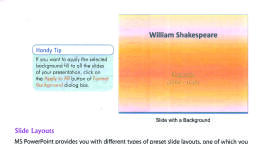
9th Standard, , Chapter 4: Introduction to Presentation, , , , Creating a new slide, Once you have opened a new presentation, the next step is to add and format the content., , The presentation provides a selection of pre-defined slide layouts based on different types of, content that you can use to quickly add content to the slides. For each of the 9 Slide Layouts, provided, Presentation combines the four types of placeholders in different combinations; each, placeholder will be replaced with the following type of content:, Placeholder:, , Replaced with:, , Title, , A title, , Subtitle, , A subtitle, , Text, , A bulleted list, , Content, , +Slide Layout Placeholders, , Using a Slide Layout ensures that the text and other elements you enter into the, placeholders will have consistent spacing and be optimally arranged., , Note, , , , Placeholders are boxes with dotted borders that are part of all, slide layouts. These boxes hold title and body text or objects, such as Smart Art graphics, charts, tables, and pictures., , Inserting a New Slide, 1. Click the New Slide button on the Home Ribbon Tab., 2. From the list of Slide Layouts, select the layout you want to apply to the new slide., 3. You may now begin adding content using the placeholders in the layout., , , , Changing the layout of an existing slide:, 1. Select the slide you want to change., 2. Click the Layout button on the Home tab. A, menu appears with your options., 3. Click an option to select it. The slide will, change in the presentation., , Karnataka Residential Educational Institutions Society, , 38 | P a g e
Page 51 :
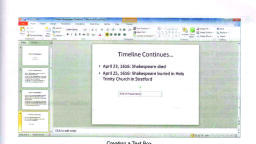
Chapter 4: Introduction to Presentation, , , , 9th Standard, , Text Box, Text boxes are the basic slide elements necessary for creating a professional looking, , presentation. Your template has provided you with these basic design elements for each slide,, but you will need to change them or add more of them to create your presentation., , , Adding and editing text, , 1. Click on the text area of the slide., 2. Start typing., 3. When typing in a bulleted list area, press the Enter key on your keyboard to create, another bulleted line., , , Inserting additional text boxes, , 1. On the Insert Ribbon tab, in the Text group click on Text Box., 2. The cursor will turn into what looks like an upside down. Click on the slide and drag, the mouse diagonally on the slide to create a new text box of whatever size and, shape you need and release the mouse button., , 3. Click on the new text box to begin typing text into it., , , , Formatting Tool Bar, , , , Format Text, You can change the appearance of text by changing its font, size, style, and color. You, , can format text in the Outline tab or the Slide pane. To format text:, , 1. Select the text you want to format., 2. To change the font, select a new font from the Font drop-down list on the Home, , Karnataka Residential Educational Institutions Society, , 39 | P a g e
Page 52 :
Chapter 4: Introduction to Presentation, , 9th Standard, , Ribbon Tab., , 3. To change the size, select a new size from the Size drop-down list on the Home, Ribbon Tab., , 4. To change the style, click the Bold, Italic, or Underline button on the Home Ribbon, Tab., , 5. To change the color, select a new color from the Font Color button's drop-down, palette. (The Font Color button is on the Drawing toolbar)., , , Align Text, Alignment determines the position of the text within its text object box on a slide. Text, , can be left-aligned, right-aligned, centered, or justified as follows:, , 1. Select the text you want to align., 2. Click on Home Ribbon Tab, 3. Select the alignment option you want:, , , Align Left - Aligns text at the left edge of the text object box., , , , Center - Aligns text between the left and right edges of the text object box., , , , Align Right - Aligns text at the right edge of the text object box., , , , Justify - Begins text at the left edge and ends the text at the right edge of the text, object box., , , , Deleting a Slide, As you look at your presentation you may find that there is a slide you really don’t need., , The presentation allows you to delete any unnecessary slide., 1. Select the slide you want to delete., 2. Press the Delete button, OR, 1. Right-click on the slide you want to delete from slide list., 2. Click on delete slide option, , , , Saving the Presentation, If you are saving a document for the first time, you will need to use the Save As, , command; however, if you have already saved a presentation, you can use the Save command., , Karnataka Residential Educational Institutions Society, , 40 | P a g e
Page 53 :
Chapter 4: Introduction to Presentation, , 9th Standard, , To use the Save As command:, 1. Click the Office Button., 2. Select Save As. A menu will appear. Select the type of file you want to save the, presentation., 3. The Save As dialog box will appear. Select the location where you want to save the, document using the drop-down menu., 4. Enter a name for the document., 5. Click the Save button., To use the Save command:, 1. Click the Office Button., 2. Select Save from the menu., , Some of the presentation file extension are, “.odp”, “.ppt”, “.sdd”, Know This!, , , , View presentation, A view is simply a way of managing and representing your slide. Since in presentation, , you are writing text, inserting objects and creating layouts for slides, you may want to look, closely at specific aspects of a presentation to see the effect. The presentation comes with, different views to help you to create your presentation better. It offers different types of views., 1. Normal View, 2. Slide Sorter View, 3. Slide Show View, , , Normal view, Normal view is the main editing view, where you write and design your presentation., , This view has four working areas:, 1. Outline tab: This is a great place to start writing your content — to capture your ideas, plan, how you want to present them, and move slides and text around. The Outline tab shows your, slide text in outline form., , Karnataka Residential Educational Institutions Society, , 41 | P a g e
Page 54 :
Chapter 4: Introduction to Presentation, , 9th Standard, , 2. Slides tab: This is a great, place to view the slides in your, presentation as thumbnail-sized, images while you edit. The, thumbnails make it easy for you, to, , navigate, , through, , your, , presentation and to see the, effects of any design changes., You can also easily rearrange,, add, or delete slides here., 3. Slide pane: In the upperright section of the window, the, Slide pane displays a large view of the current slide. With the current slide shown in this view,, you can add text and insert pictures, tables, Smart Art graphics, charts, drawing objects, text, boxes, movies, sounds, hyperlinks, and animations., 4. Notes pane: In the Notes pane below the Slide pane, you can type notes that apply to the, current slide. Later, you can print your notes and refer to them when you give your, presentation. You can also print notes to hand out to your audience or include the notes in a, presentation that you send to the audience or post on a Web page., , , Slide sorter view, A small image of each slide is, , displayed in Slide Sorter View. In, Slide Sorter view, you see the, thumbnail representations of the, slides comprising your slide show., This is a great way to see the whole, presentation at once, in the order in, which they will appear in the slide, show. After you are finished, creating, , and, , editing, , your, , presentation, you can come to Slide, , Karnataka Residential Educational Institutions Society, , 42 | P a g e
Page 55 :
Chapter 4: Introduction to Presentation, , 9th Standard, , Sorter view to shuffle slides around, and copy, delete, or hide slides until you've got it right., Slide Sorter view also allows you to set up special effects to the slides in the presentation., As you look through your slides in Slide Sorter view and find a slide that you need to, further edit, just double-click on that slide and it will be displayed in the Normal view., Rearranging Slides in Slide Sorter View, You can often make a presentation better by playing with the order in which the slides, appear. Sometimes, you may wish to entirely hide a slide that doesn't apply to your audience., All of this happens in Slide Sorter view. To rearrange slides in Slide Sorter view:, 1. Click on the Slide Sorter view button (or choose View/Slide Sorter)., 2. Click on the slide you wish to move, copy, delete or hide to select it., 3. Now move, copy, delete, or hide the slide:, , , To move a slide, press and hold the mouse button, drag the slide to where you, want it to go, and release the mouse button., , , , To copy a slide, press and hold the [Ctrl] key and drag the slide to where you, want it to go., , , , , , To delete a slide, press [Delete] or [Backspace]., , , , To hide a slide, right-click in the slide thumbnail and choose Hide Slide., , Slideshow view, Use the Slide Show view to see the slide show on your computer screen one slide at a, , time, using the full screen, as you will when actually presenting the show. You can move the, subsequent slides by either clicking your mouse button, clicking the [Page Up] and [Page, Down] buttons, or by using the left and right arrow keys on your keyboard., To view the Slide Show:, 1. When you use the Slide Show view button, Presentation starts the show at the, currently selected slide. So, go to the first slide in your presentation., 2. Click the Slide Show view button.(Or Press F5), 3. To move to the next slide, click the mouse button or push the right arrow key. At the, end of the show, PowerPoint will display, "End of slide show, click to exit"., 4. You can exit a slide show at any point by pressing the [Esc] key., , Karnataka Residential Educational Institutions Society, , 43 | P a g e
Page 56 :
Chapter 4: Introduction to Presentation, , , , 9th Standard, , Insert Picture/ Clip Art, Effective visuals emphasize the key content points in a presentation. It provides a, , selection of professionally designed pictures, or clip art, that you can use in your, presentations. These clip art images include many different themes such as animals, people,, buildings, food, holidays, business, and more., , , To Insert a Picture/Clip Art Image:, 1. Move to the slide on which you want to place clip art., 2. Apply a Slide Layout that includes content or clip art placeholder., 3. Open the Select a Picture dialog box by:, , , Clicking on the Clip Art button on the content placeholder (OR), , , , Double-clicking on the clip art placeholder, , 4. In the Search box, type a word or phrase that describes the clip you want., 5. Click Search. It displays the search results in the Select Picture List., 6. Click on the clip art image you want and click OK., , , To Resize a Clip Art Image, Once you have added a clip art object to your slide, you can resize it to make it fit better, , into your presentation., 1. Click on the Clip Art object to select it., 2. Put the arrow on one of the resize handles at the corner of the picture until the cursor, changes to a double-headed arrow., 3. Press the mouse button and drag the handle toward or away from the center to make, the image larger or smaller., , , , Insert a Movie/ Sound, 1. Select the slide where you want to insert the movie., 2. Select the Insert tab., 3. Click the drop-down arrow on the Movie/Sound button in the, Media Clips group., 4. Select Insert a Movie/Sound from File from the menu. The Insert Movie/Sound, dialog box will appear., , Karnataka Residential Educational Institutions Society, , 44 | P a g e
Page 57 :
Chapter 4: Introduction to Presentation, , , , 9th Standard, , Animations, Animations refer to the manner in which individual text or other objects appear as they, , enter or exit a slide. Normally, all objects on a slide appear at the same time when you display, the slide. However, you can have different objects appear and exit at different times under, your control as the show proceeds., , , Applying Transition, Transitions affect the way one slide goes to the next slide. Transitions add interest to, , your slide show., 1. Select the slide you want to modify., 2. Select the Animations tab., 3. Locate the Transition to This Slide group. By default, No Transition is applied to, each slide., , 4. Click the More drop-down arrow to display all available transition effects., 5. Click a slide transition effect to apply it to the selected slide., If you want to apply the transition to all slides in presentation click Apply to All, , , Setting slide Transition Speed/Sound:, 1. Apply a slide transition effect to a slide., 2. Click the Transition Speed/Sound drop-down menu in the Transition to This Slide, group on the Animations tab., 3. Select a menu option transition speed/sound to apply it to the selected slide., , , , Printing the Presentation, 1. You may want to print copies of your slides for the people who view your, presentation or for yourself., 2. There are three print options available from the Office button menu: Print, Quick, Print, and Print Preview., , Karnataka Residential Educational Institutions Society, , 45 | P a g e
Page 58 :
Chapter 4: Introduction to Presentation, , , , 9th Standard, , OpenOffice.org Impress, Impress is OpenOffice.org presentations component. You can create slides that contain, , many different elements, including text, bulleted and numbered lists, tables, charts, clip art,, and a wide range of graphic objects. Impress, in common with the other components of, OpenOffice.org, has access to the spelling checker and thesaurus and comes with prepackaged text styles, background styles, and a handy online help., , The main Impress window has three parts: the Slides pane, the Workspace, and the, Tasks pane. Additionally, several toolbars can be displayed or hidden during the creation of a, presentation., , , Slides pane, The Slides pane contains thumbnail pictures of the slides in your presentation; in the, , order, they will be shown. Clicking a slide in this pane selects it and places it in the, Workspace. While it is there, you can apply any changes desired to that particular slide., , , Tasks pane, The Tasks pane has five sections: Master Pages, Layout, Table Design, Custom, , Animation, and Slide Transition., , Karnataka Residential Educational Institutions Society, , 46 | P a g e
Page 59 :
9th Standard, , Chapter 4: Introduction to Presentation, , , Workspace, The Workspace has five tabs: Normal, Outline, Notes, Handout, and Slide Sorter. These, , five tabs are called View Buttons. There are also many toolbars that can be used during slide, creation; they are revealed by selecting them with View > Toolbars., , , Toolbars, The various Impress toolbars can be displayed or hidden by clicking View > Toolbars, , and selecting from the menu. You can also select the icons that you wish to appear on each, toolbar., , , Status Bar, The status bar, positioned at the bottom of the Impress window, contains information, , that you may find useful when working on a presentation., , Keyboard Shortcut Keys, Remember, Ctrl + D, Ctrl + K, , Insert a Duplicate Slide, Open the Insert/Edit Hyperlink, dialog box, , Save, , Ctrl + S, , Print, , Ctrl + P, , F5, , Start Slide Show, , Esc, , End the Slide Show, , Karnataka Residential Educational Institutions Society, , 47 | P a g e
Page 60 :
Chapter 5: Introduction to Internet, , Inside, Introduction, History of Internet, Browsing the internet, Searching the information, , Learning Objectives:, After you have studied this lesson you will be able to:, , , Define Internet., , , , Open websites using a browser., , , , Use a search engine tool., , , , Use keywords to search for information., , , , Follow safety rules while browsing and searching.
Page 61 :
Chapter 5: Introduction to Internet, , , 9th Standard, , Introduction, The term internet is derived from two words Interconnection and Network. The, , Internet is a combined collection of many interconnected computer networks around the, world. Each network consists of multiple numbers of computers connected through cables,, wireless or any other media. Using these computers people can share and exchange, information. A connection to the Internet is needed to access the Internet., , , , Know This!, , , , , , A computer network is a set of computers connected, together for the purpose of sharing resources., The most common resource shared today is a connection, to the Internet., Other shared resources can include a printer or a file, server. The Internet itself can be considered as a, computer network., , History of Internet, The foundation of internet laid in 1969 when the Department of Defense (DOD) of the, , United States of America started a network called ARPANET (Advanced Research Projects, Agency Network). The basic aim behind ARPANET was to develop a network that could, continue to function efficiently even during a nuclear attack., Later in 1980, the ARPANET project was assigned to National Science Foundation, (NSF) created a new network of computers based on ARPANET called NSFNET which, turned out to be more efficient and capable. Over time, it expanded to include sites for, business, universities, government and so on, and finally became a network consisting of, millions of computers now known as Internet, Karnataka Residential Educational Institutions Society, , 49 | P a g e
Page 62 :
Chapter 5: Introduction to Internet, , , , 9th Standard, , Browsing the internet, , Browser: A web browser, or simply "browser," is an application used to access and, view websites. It enables the user to view web pages, navigates websites, and move, from one website to another. Popular Web browsers are Internet explorer, Mozilla, Firefox, Google Chrome, Netscape navigator, Opera etc., , WWW: The World Wide Web is also called as “WWW”, it allows computer users, to locate and access any information over the internet. The Web is a collection of, millions of pages of information. The information can include text, pictures,, animations, sound and video. We can usually find information about any topic on, the Internet., Web site: The location where the information is available on the web is called a, website. A website is a collection of web pages. The Web pages are organized on a, website like the pages of a book. Each Website is owned and updated by an, individual, company or organization., , Karnataka Residential Educational Institutions Society, , 50 | P a g e
Page 63 :
Chapter 5: Introduction to Internet, , 9th Standard, , Web page: The documents available on WWW are known as web pages. A web, page is a file containing information in text, graphics, Audio and Video., HTTP: The internal structure of the World Wide Web is built on a set of rules, called Hypertext transfer protocol (HTTP)., URL: A website is accessed by using the website address called the URL (Uniform, resource locator). HTTP uses internet addresses in a URL format., URLs look like this: type://address/path/, Example: http://www.karnataka.gov.in or http://www.kreis.kar.nic.in, Hyperlink: A hyperlink is a connection that allows you to move easily from one, web page to another related web page. Text, images can be made into hyperlinks., A hyperlink is usually underlined. Clicking on the hyperlink takes you to a, different page., Web server: The WebPages on the internet are stored on the, computers that are connected to the internet these computers are, known as web servers. Any computer that has a server software, installed on it and is connected to the internet can act as a web, Know This! server., We can browse the information on any subjects. For example, enter the URL, www.wikipedia.org in the address bar. This is a website where you can find the information, on many subjects., , Karnataka Residential Educational Institutions Society, , 51 | P a g e
Page 64 :
9th Standard, , Chapter 5: Introduction to Internet, , Information on the web is created by many, people. Anyone can create the information and, share it on the web., , Hint, , , , Advantages of Internet / Internet Services, , , , , , , , , Sharing information & resources, , , , , E-Mail, Audio /Video Conferencing, , , , , Video on Demand, Real-time broadcasting, , , , Playing On-line games, Newsgroups, Enhanced learning, Chat groups, On-line shopping, , Disadvantages of Internet / Internet services, , , , , Misuse of resources, Hackers, Uploading virus to network through the Internet, , Remember, , Know This!, , Domain Name, , Meaning, , .com, , Commercial, , .gov, , Government, , .mil, , Military, , .ac, , Academic, , .in, , Country (India), , .org, , Organization, , .edu, , Education, , Homepage: On our computer, you can choose a web page that, opens immediately when you launch your web browser by using a, command in your web browser, which is known as a homepage., , Karnataka Residential Educational Institutions Society, , 52 | P a g e
Page 65 :
Chapter 5: Introduction to Internet, , , , 9th Standard, , Searching the information, A web search engine is a software system, , that is designed to search for any information on, the World Wide Web. The information may be a, web page, images, and other types of files., A web search engine uses three tools for, searching namely a spider or a crawler, an indexer and a search algorithm. A crawler searches, the internet for new terms and stores the searched terms in a database. An Indexer then, indexes all the terms in the database to make the searching process fast. A search algorithm is, simply a method by which the search engine performs a search based on the keywords entered, by the user. Some of the popular search engines are Google, Yahoo, Msn, and Alta Vista., , Searching, 1. Open the Browser and go to the search engine website., 2. Enter the word, phrase or sentence related to the information that you want to search, for., 3. Click on the hyperlinks that the search engine shows results., 4. Usually, the most relevant sites are provided in the first few pages., , Karnataka Residential Educational Institutional Society, , 53 | P a g e
Page 66 :
Chapter 5: Introduction to Internet, , , , 9th Standard, , Tips to search the web, Use specific words., Use many words to get relevant sites., Example:, , “Respiratory systems in humans” gives information on only human, , Respiratory systems., To include the complete phrase in the search use double quotes (“ ”)around the, phrase. Example: “Air and water pollution” gives websites which contain the phrase, air and water pollution., If you want a word to be included in the search then add + before the word., If you want a word to be excluded from the search then add – before the word., Karnataka Residential Educational Institutional Society, , 54 | P a g e
Page 67 :
Chapter 5: Introduction to Internet, , , , 9th Standard, , Safety Measures for Internet Browsing and Searching, Seek permission of your teachers before using The Internet., Don’t give your real identity to anyone you meet online. This includes your real, name, address, school information, e-mail address, password, and bank account, information., Don’t fill out any survey, membership, or application forms asking for your personal, information from an unsecured site., Do close the web browser immediately if you see any images of violence, nudity,, and any other contents that aren’t right for your age., Close the pop-up. Do not perform any action requested by the pop-up. This may, cause the applications on your computer to stop working., , Karnataka Residential Educational Institutional Society, , 55 | P a g e
Page 68 :
Chapter 6: Electronic-Mail, , Inside, About E-Mail, Creation of E-Mail Account, How to send E-Mail, Attaching files to E-Mail, , Learning Objectives:, After you have studied this lesson you will be able to:, , , Define e-mail., , , , Create an e-mail account., , , , Send and receive e-mail., , , , Send attachments with e-mail.
Page 69 : 9th Standard, , Chapter 6: E-Mail, , , About E-Mail, Electronic mail (also known as email or e-mail) is one of the most commonly used, , services on the Internet, allowing people to send messages to one or more recipients. The, email was invented by V.A Shiva Ayyadurai in 1972., , , Why use E-Mail?, The operating principle behind email is relatively simple, which has quickly made it the, , most popular service used on the Internet., As with a traditional postal service, for your message to reach your recipient, all you, need to know is their address. Its two main advantages over "paper mail" are the speed at, which the email is sent (practically instantaneous) and the lower cost (included with the cost, of an Internet connection)., , , Email addresses, Email addresses (both for senders and recipients) are two strings separated by the, , character "@" (" at sign"): user@domain, The right-hand part describes the domain name involved, and the left-hand part refers to, the user who belongs to that domain., An email address can be up to 255 characters long and can include the following, characters:, , , Lowercase letters from a to z;, , , , Digits, , , , The characters ".","_" and "-" (full stop, underscore, and hyphen), , In practice, an email address often looks something like this:,
[email protected], , , Free E-Mail service providers, A number of websites provide e-mail service. No fee is charged from the users until they, , are using advanced features. Some of the websites that provide e-mail service are as listed, here., , Karnataka Residential Educational Institutions Society, , 57 | P a g e
Page 70 :
9th Standard, , Chapter 6: E-Mail, , , , , , http://www.gmail.com, , , , http://www.yahoo.com, , , , http://www.rediffmail.com, , , , http://www.hotmail.com, , Creation of E-Mail Account, To avail e-mail service of any website a user must have an e-mail account on that, , website. To create an e-mail account follows these steps:, Step 1: Start web browsers like (Internet Explorer, Mozilla Firefox, and Google Chrome, etc)., Step 2: Type the address of any e-mail service, provider. For example “www.gmail.com” in the, address bar of web browser and press Enter key., Step 3:, Click Sign In:, A web page appears which allows the new users to, create their mail accounts and the existing users to login, into their accounts., , Step 4:, If you a new user, Click on Create an account for, registration., , , , Step 5:, Fill up all necessary details in the given text boxes., , Some of the entries are compulsory (indicated by a * sign), and some optional. It is necessary to fill up all the, compulsory entries., , Karnataka Residential Educational Institutions Society, , 58 | P a g e
Page 71 :
Chapter 6: E-Mail, , 9th Standard, , Step 6:, Click on next button to complete the process of registration., , The confirmation page appears displaying your e-mail ID. Now you can send or, receive e-mail using this e-mail ID., Step 7:, Click on next button to complete the process of, registration., Step 8:, To check the emails click on inbox, a list of received e-mails is displayed along with, the information: Sender’s name, Subject of the message, date/time on which it is received., , , , How to Send E-Mail, You can send the E-mail; you must know the recipient's e-mail address. To send an E-, , Mail follows these steps., Step 1: Click on Compose button the new window will appear where we can enter the To, address, Cc (Carbon Copy), BCC (Blind Carbon Copy), subject and message box., , , To: Type the recipient email id, , , , Cc: (Carbon Copy) -If you are sending the same message to multiple recipients, , , , Bcc: (Blind Carbon Copy) -If you are sending them a Copy and you don't wish, the other recipients to see that you sent it to this contact, , Karnataka Residential Educational Institutions Society, , 59 | P a g e
Page 72 :
Chapter 6: E-Mail, , , Subject: Subject of the message., , , , Message box: The message to be sent., , 9th Standard, , Step 2: Click on the send button, you can see the sent successful message., , , , Attaching files to E-Mail, Along with text message, if you want to send files, you have the option that is an, , attachment. To attach files follow these steps:, 1. Open your e-mail account, 2. Compose your e-mail, 3. Click on attach option; select the file to be sent., 4. After all attached file appears along with the message click on send button, , Karnataka Residential Educational Institutions Society, , 60 | P a g e
Page 73 :
Chapter 6: E-Mail, , , , 9th Standard, , Do’s and Don’ts of e-mail, Do not give out any of your passwords to friends or, anyone you meet online., Check your emails regularly., While sending emails make sure the subject field accurately portrays the content of, your email., Be courteous. Remember you are not talking to the screen of a computer but with a, human being. For example, if you are angry with a mail received, do not reply, immediately. Cool down and relax first., Avoid writing a sentence in CAPs in your email except where it is synthetically, correct., Do not send emails to multiple addresses if it is not required., Don’t open, reply or download attachments from spam or from unknown senders., These may contain viruses or other threats that can harm your computer., Don’t reply to or start a conversation with people you don’t know. Don’t accept gift, offerings from them., Don’t download any files that are given to you by people you’ve met online. Don’t, download any files from your e-mail unless they are solicited., Do avoid posting your personal profile on the web. This may be used by online, predators against you., , Karnataka Residential Educational Institutions Society, , 61 | P a g e
Page 74 :
Chapter 7: Online Services, , Inside, E-Governance, E-Commerce, Social Networking, , Learning Objectives:, After you have studied this lesson you will be able to:, , , Define E-governance and E-Commerce., , , , List the advantages and disadvantage of E-Commerce., , , , Use social networking.
Page 75 :
9th Standard, , Chapter 7: Online Services, , , , Introduction to E-Governance, E-Governance also called Electronic Governance means using Information and, , Communications Technology (ICT) to transform functioning of the Government., It differs from E-Government as Governance is wider than Government. E-governance, may refer to governance of a Country, or the governance of an institution and also governance, of a Household by a housewife., , , , What is E-Government?, E-Government, , i.e., , Electronic Government, , is, , the use of Information, , and, , Communications Technology (ICT) to run or carry on the business of the Government of a, Country., A Government is a group of people responsible for the administration and control of a, Country/State. It involves people like the Heads of States, Ministers, Government Employees,, etc. It also involves public participation., , Karnataka Residential Educational Institutions Society, , 63 | P a g e
Page 76 :
9th Standard, , Chapter 7: Online Services, , , , Objectives of E-Governance, Following are the objectives/aims of E-Governance:, 1. To build an informed society, 2. To increase Government and Citizen Interaction, 3. To encourage citizen participation, 4. To bring transparency in the governing process, 5. To make the Government accountable, 6. To reduce the cost of Governance, 7. To reduce the reaction time of the Government, , , , Categories in E-Governance, •, , Government to Citizen (G2C) initiatives, , •, , Government to Business (G2B) initiatives, , •, , Government to Employee (G2E) initiatives, , •, , Government to Government (G2G) initiatives, , G2C, , , G2B, , G2E, , G2G, , Government to Citizen (G2C) initiatives, •, , Communication link between a government and private individuals or residents., , •, , G2C can take place at the central, state and local levels. Examples: India.gov.in, , •, , Computerization of Land Records (Department of Land Resources, Government of, India), Examples: Online Delivery of Land Records, , , Bhoomi Project in Karnataka, , , , Gyandoot in Madhya Pradesh, , , , Project FRIENDS in Kerala, , , , Jan Mitra Project in Rajasthan, , , , e-Seva (Andhra Pradesh), , Karnataka Residential Educational Institutions Society, , 64 | P a g e
Page 77 :
Chapter 7: Online Services, , , 9th Standard, , Government to Business (G2B) initiatives, •, , Encompasses all activities of government which imposes upon business, organizations., , •, , Includes registrations under different statutes, licenses under different laws and, exchange of information between government and business., , •, , The objective of bringing these activities under e-Governance is, , , To provide a friendly environment to business., , , , Speed up various processes ., , , , Provide relevant information to the business., Example: Business.gov.in, , , , , e-Procurement Project in Andhra Pradesh and Gujarat, , Government to Employee (G2E) initiatives, G2E is a transaction between government and Employee. It Includes,, , , Online training and conference for the employee., , , , Employee information., Example: The example of Government to Employee is that e-training for employees, , www.egovonline.net., , , Government to Government (G2G) initiatives, , , The electronic sharing of data and/or information systems between government, agencies, departments or organizations., , , , The goal of G2G is to support e-government initiatives by improving, communication, data access, and data sharing., , , , G2G initiatives help in making the internal government processes more efficient., , , , Many a time G2C and G2B processes necessitate the improvements in G2G, processes., Examples: http://egovstandards.gov.in, •, , Khajane Project ( Karnataka), , •, , SmartGov (Andhra Pradesh), , Karnataka Residential Educational Institutions Society, , 65 | P a g e
Page 78 :
9th Standard, , Chapter 7: Online Services, , , , Advantages of E-Governance, 1. Speed: Technology makes communication speedier. Internet, Phones, Cell Phones, have reduced the time taken in normal communication., 2. Cost Reduction: Internet and Phones make communication cheaper saving valuable, money for the Government., 3. Transparency: All the information of the Government would be made available on, the internet. The citizens can see the information whenever they want to see., 4. Accountability: Accountability is answerability of the Government to the people. It, is the responsibility for the activities of the Government., , , , E-Commerce, E-Commerce (or electric commerce) refers to the, , buying and selling of goods and services using, electronic channels, primarily the Internet. E-Commerce, is a division of trade or production which deals with the, exchange of goods and services from producer to final, consumer., , E-Commerce is, , commonly, , known, , as, , electronic marketing., , Karnataka Residential Educational Institutions Society, , 66 | P a g e
Page 79 :
Chapter 7: Online Services, , , , 9th Standard, , E-commerce vs. E-business, We use the term e-business to refer primarily to the digital enablement of, transactions and processes within a firm, involving information systems under the, control of the firm., E-commerce includes commercial transactions involving an exchange of value, across organizational boundaries, , , , E-Commerce Process, A consumer uses a Web browser to connect to the home page of a merchant's Web, site on the Internet., The consumer browses the catalog of products featured on the site and selects items, to purchase. The selected items are placed in the electronic equivalent of a shopping, cart., When the consumer is ready to complete the purchase of selected items, it provides a, bill to and ship to address for purchase and delivery, When the credit card number is validated and the order is completed at the, Commerce Server site, the merchant's site displays a receipt confirming the, customer's purchase., The Commerce Server site then forwards the order to a Processing Network for, payment processing and fulfillment., , Karnataka Residential Educational Institutions Society, , 67 | P a g e
Page 80 :
Chapter 7: Online Services, , , , 9th Standard, , Different types of E-Commerce, Business-to-Business (B2B), Business-to-Consumer (B2C), Business-to-Government (B2G), Business-to-Consumer (C2C), , , , Business-to-Business: B2B e-commerce is simply defined as e-commerce between, companies. About 80% of e-commerce is of this type., Examples: Intel selling microprocessor to Dell, , , , Business-to-Consumer: B2C e-commerce is between companies and consumers, it, involves customers gathering information; purchasing physical goods or receiving, products over an electronic network., Example: Dell selling me a laptop, , , , Business-to-Government: B2G e-commerce is generally defined as commerce between, companies and the public sector. It refers to the use of the Internet for public, procurement, licensing procedures, and other government-related operations, Example: Business pays taxes, file reports, or sell goods and services to Govt. agencies., , , , Consumer-to-consumer: C2C e-commerce is simply commerce between private, individuals or consumers., Example: Ram buying smartphone from Sam using OLX, , , , Advantages of e-commerce, Faster buying/selling procedure, as well as easy to find products., More reach to customers, there is no theoretical geographic limitations., Low operational costs and better quality of services., Customers can easily select products from different providers without moving, around physically., , , , Disadvantages of e-commerce, Unable to examine products personally and not everyone is connected to the Internet, There is the possibility of credit card number theft., Mechanical failures can cause unpredictable effects on the total processes., Karnataka Residential Educational Institutions Society, , 68 | P a g e
Page 81 :
Chapter 7: Online Services, , , , 9th Standard, , Social Networking, A social Networking Sites (SNS) is an online platform that allows users to create a, , public profile and interacts with other users on the website., SNS lets you stay connected to friends and family. You can also find old friends with, whom you may have lost touch. SNS are popular because they are very easy to use. All the, SNS provide some basic features like profile creation, content uploading, and content sharing., , , , Some Social Networking Sites, , For example, , , Flicker has photo sharing as the main focus, , , , YouTube has audio and video file sharing as the main focus., , , , Google+ provides photo upload, video upload, chat room, instant messaging and, email., , , , Category name and examples, Reference websites: Reference websites are an online encyclopedia,, where users or subject matter experts create content on any topic., , Karnataka Residential Educational Institutions Society, , 69 | P a g e
Page 82 :
Chapter 7: Online Services, , 9th Standard, , Video sharing: Video sharing sites allow users to upload video, files. Other users can watch, share and comment on these files., Networking with friends: Friends’ sites allow users to create profiles,, belong to groups, list friends. A user can create content and keeps in, touch with family and friends., , , , Basic features of Social Networking Sites(SNS), Register/Create profile:, Each user fills in information in a given form with data on age, education, location,, , likes, dislikes and hobbies. The user can add friends, categorize them into groups, decide how, his/her profile is viewed and by whom it is viewed., Security settings:, The user can configure settings where he/she decides which content on his/her page is, public or private. The user can block content from being viewed by a list of users, can report, SPAM and flag content., , , , Other activities that the user can perform with SNS:, Chat with other users., Instant messaging with other online users., Upload photos, videos so that they can be viewed by others., Play games., Enter comments on content generated by other users., Send email., , , , Safety Measures and Guidelines for Online Services, Never buy anything over the Internet without your parent or guardian's approval., On the Internet, people can pretend to be who they are not, and they may go to great, lengths to sound convincing., Internet friendships, relationships, and conversations can never be as true, personal,, and rewarding as they are in person. If you really need to talk to someone, find a, friend, family member, or adult you trust., Karnataka Residential Educational Institutions Society, , 70 | P a g e
Page 83 :
Chapter 7: Online Services, , 9th Standard, , Be wary of anyone who wants to know personal information about you., Sometimes when you are on the Internet, you may accidentally meet bad people or, see things that are bad, but it's not your fault! If something you read or look at is, upsetting, stop looking at it, and go tell an adult, you trust or parent., Ensure privacy settings on activated on all of the social media websites you use. If, you are using instant messaging or entering chat rooms, don’t allow others to harass, you or put you in an uncomfortable situation., Always be kind to others online. Do not do anything that may hurt others including, joining in conversations discussing other people’s problems., With access to information at the click of a button, people are increasingly spending, more and more time on SNS. Spending time on activities like writing comments and, playing games are not always productive., As SNS content is not strictly monitored; it might prove harmful if young adults, have access to inappropriate content., Do avoid posting your personal profile on the web. This may be used by online, predators against you., , Karnataka Residential Educational Institutions Society, , 71 | P a g e
Page 84 :
Chapter 8: Computer Networks, , Inside, Introduction, Types of Network, Network Topologies, Network and Data Security, Advantages of Networks, , Learning Objectives:, After you have studied this lesson you will be able to:, , , Define computer network., , , , List types of network., , , , Identify network components., , , , List the advantages of the network.
Page 85 :
Chapter 8: Computer Networks, , , 9th Standard, , Introduction, A network consists of two or more computers that are linked in order to share resources, , (such as printers and CD-ROMs), exchange files, or allow electronic communications. The, computers on a network may be linked through cables, telephone lines, radio waves, satellites,, or infrared light beams., , , Basic Communication Model, Communication model is used for exchanging data between two parties. For example,, , the communication between a computer server and telephone (through a modem)., , , , Source: Data to be transmitted is generated by this device. For example Telephones,, Personal Computers etc., , , , Transmitter: The transmitter transforms and encodes the information in such a form, to produce electromagnetic waves or signals., , , , Transmission System: A transmission system can be a single transmission line or a, complex network connecting source and destination., , , , Receiver: Receiver accepts the signal from the transmission system and converts it, to a form which is easily managed by the destination device., , , , , Destination: Destination receives the incoming data from the receiver., , Data Communication, The exchange of data between two devices through a transmission medium is Data, , Communication. The data is exchanged in the form of 0’s and 1’s. The transmission medium, used is the cable. For data communication to occur, the communication device must be part of, a communication system. Data Communication has two types Local and Remote., , , Local: Local communication takes place when the communicating devices are in the, same geographical area, same building, face-to-face between individuals etc., , , , Remote: Remote communication takes place over a distance i.e. the devices are, farther., , Karnataka Residential Educational Institutions Society, , 73 | P a g e
Page 86 :
Chapter 8: Computer Networks, , 9th Standard, , Effectiveness of a Data Communication can be measured through the following features:, 1. Delivery: Delivery should be done to the correct destination., 2. Timeliness: Delivery should be on time., 3. Accuracy: Data delivered should be accurate., , , Components of Data Communication, , , Message: It is the information to be delivered., , , , Sender: Sender is the person who is sending the message., , , , Receiver: Receiver is the person to him the message is to be delivered., , , , Medium: It is the medium through which message is to be sent for example modem., , , , Protocol: A protocol is a set of rules that governs the communications between, computers on a network. The most common protocols are:, 1., , Ethernet, , 2., , Token Ring, , Protocol rules are guidelines that regulate the access method,, allowed physical topologies, types of cabling, and speed of data, Know This!, , , , transfer., , Types of Networks, The network is classified into the following categories:, 1. Local Area Network (LAN), 2. Metropolitan Area Network (MAN), 3. Wide Area Network (WAN), , , , Local Area Network (LAN), A network is said to be Local Area Network (LAN) if, , it is confined relatively to a small area. It is generally, limited to building or a geographical area, expanding not, more than a mile apart to other computers., , Karnataka Residential Educational Institutions Society, , 74 | P a g e
Page 87 :
Chapter 8: Computer Networks, , 9th Standard, , LAN Configuration consists of:, , , A File Server: Stores all of the software that controls the network, as well as the, software that can be shared by the computers attached to the network., , , , A Workstation: Computers connected to the file server. These are less powerful, than the file server., , , , Cables: Used to connect the network interface cards on each computer., , LAN networks are also widely used to share resources, like printers, shared hard-drive etc., Know This!, , , Wireless Local Area Network (WLAN), It is the fastest growing segment of the, , computer. They are becoming very important in our, daily life because wired connections are not, possible in cars or airplane. We can access the, Internet at any place avoiding wire related troubles., These can be used also when the telephone systems, get destroyed due to some calamity/disaster., , , Metropolitan Area Network (MAN), Metropolitan Area Network (MAN) covers larger, , geographic areas, such as cities. Frequently used by, local, libraries and government agencies connect to citizens and, private industries., , , Wide Area Network (WAN), Wide Area Network (WAN) connects larger geographic, , areas, like the connection between India and America or the world., In this type of network dedicated transoceanic cabling or satellite, uplinks may be used., , Karnataka Residential Educational Institutions Society, , 75 | P a g e
Page 88 :
Chapter 8: Computer Networks, , , , 9th Standard, , Network Topologies, Network Topology is the schematic description of a network arrangement, connecting, , various devices (sender and receiver) through lines of connection. Network topologies can be, classified as follows:, , , , 1., , Bus Topology, , 2., , Ring Topology, , 3., , Star Topology, , 4., , Mesh Topology, , 5., , Hybrid Topology, , Bus Topology, , Bus topology is a network type in where every computer, and the network device is connected to single cable. It is, cost effective and used in small networks., , , Ring Topology, It is called ring topology because it forms a ring as each, , computer is connected to another computer, with the last one, connected to the first. Exactly two neighbors for each device and it, is cheap to install. The Failure of one computer disturbs the whole, network, , , Star Topology, In this type of topology, all the computers are connected to a, , single hub through a cable. This hub is the central node and all, others nodes are connected to the central node., , , Mesh Topology, It is a point-to-point connection to other nodes or devices., , Traffic is carried only between two devices or nodes to which it is, connected. This topology is robust, provides security and privacy., , Karnataka Residential Educational Institutions Society, , 76 | P a g e
Page 89 :
9th Standard, , Chapter 8: Computer Networks, , , Tree Topology, It has a root node and all other nodes are connected to, , it forming a hierarchy. It is also called hierarchical, topology. It should, at least have three levels of the, hierarchy., , , Hybrid Topology, It is two different types of topologies which are a, , mixture of two or more topologies. For example, if one, office is using bus topology and another office is using, star topology then connecting these topologies will result, in Hybrid Topology., , , , Client and Server, Computers connected together to create a network fall into two categories: Client and, , Servers. The client-server connection is established through a network or the Internet., , , Client: A “client” is a program that runs on the computer which you access in the first, place. For example Desktop computer, laptops, tablets, and mobile phone., , , , Server: Each client provides an interface to each of the “services” (databases, online, files, e-mail etc.) that are made available by other systems, which are called “servers.”, Servers are built to be reliable. They are much more expensive than clients., For, , example, , Mail, , servers, , like, , Gmail,, , information servers like Wikipedia, Online commerce, servers like Flipkart, online banking servers, and, online travel management servers like IRCTC., , , , Network Hardware, , , , Networking cables, They are used to connect one network device to other network devices or to connect two, or more computers to share printer, scanner etc. Different types of network cables, , Karnataka Residential Educational Institutions Society, , 77 | P a g e
Page 90 :
9th Standard, , Chapter 8: Computer Networks, , like Twisted Pair cables, Coaxial cable, Optical fiber cable, are used depending on the, network's topology, protocol and size., , ., Twisted cable, , , Coaxial cable, , Optical fiber cable, , Hubs, Hub is a device that splits a network connection into multiple, , computers. It is a distribution center. When a computer requests, information from a network or a specific computer, it sends the request to, the hub through a cable. The hub will receive the request and transmit it, to the entire network., , , Switch, The switch is a telecommunication device grouped as one of computer network, , components. The switch is like Hub but built in with advanced features.The switch connects, the source and destination directly which increases the speed of the network., , , Router, A router is a network device that connects together two or, , more networks. A common use of a router is to join home or, business network (LAN) to the internet (WAN). The routers, have the internet cable plugged into it, as well as a cable, or, cable to computer or switch on the LAN., , , Modem, MOdulator/DEModulator is a device that converts digital, , signals into an analog signal and analog signals into digital, signals for transmission over telephone lines., , Karnataka Residential Educational Institutions Society, , 78 | P a g e
Page 91 :
9th Standard, , Chapter 8: Computer Networks, , , , Network and data security, , , , Network Security, Firewall: A firewall is a system designed to prevent, , unauthorized access to, , or, , from, , a, , private network., , Firewalls can be implemented in both hardware and software, or a combination of both., Software Firewall: The software firewall is monitors the applications that access the, internet and allows only those that are approved by the user., , Karnataka Residential Educational Institutions Society, , 79 | P a g e
Page 92 :
9th Standard, , Chapter 8: Computer Networks, , Hardware Firewall: The hardware firewall is protecting the whole LAN from people, on the Internet, a hardware firewall device (similar to a router) is placed between the LAN and, the Internet connection., , , , Data Security, Data security is protecting data from the destructive force and from unwanted actions of, , the unauthorized user., , , Encryption: It is the process of converting to plain text into a form that cannot be, easily understood by the unauthorized user., , , , Decryption: It is the process of converting ciphertext back into its original form, so, it can be understood by the user., , , , Cipher: Cipher is the code or the algorithm used in the encryption and decryption of, data., , , , Key: Key is the secret of the cipher known only to the authorized people., , Encryption Example, Plain: ABCDEFGHIJKLMNOPQRSTUVWXYZ, Key: Replace each letter by 3th after, Cipher: CDEFGHIJKLMNOPQRSTUVWXYZAB, Clear text: Hello good morning, Cipher text: JGNNQ IQQF OQTPKPI, , Decryption Example, Cipher: CDEFGHIJKLMNOPQRSTUVWXYZAB, Key: Replace each letter by 3th previous, Plain: ABCDEFGHIJKLMNOPQRSTUVWXYZ, Cipher text: JGNNQ IQQF OQTPKPI, Clear text: Hello good morning, , Karnataka Residential Educational Institutions Society, , 80 | P a g e
Page 93 :
Chapter 8: Computer Networks, , , , 9th Standard, , Advantages of Networks, Speed: Sharing and transferring files within networks are very rapid. Thus, saving, time while maintaining the integrity of the file., Cost: Individually licensed copies of many popular software programs can be costly., Networkable versions are available at considerable savings. Shared programs, on a, network, allows for easier upgrading of the program on one single file server, instead, of upgrading individual workstations, Security: Sensitive files and programs on a network are passwords protected or, designed as “copy inhibit” so that you do not have to worry about illegal copying of, programs., Centralized Software Management: Software can be loaded on one computer (the, file server) eliminating that need to spend time and energy installing updates and, tracking files on independent computers throughout the building., Resource Sharing: Resources such as Printers, Fax machines and Modems can be, shared., Flexible Access: Access their files from computers throughout the firm., Workgroup Computing: Workgroup software allows many users to work on a, document or project concurrently., , Karnataka Residential Educational Institutions Society, , 81 | P a g e
Page 94 :
Explore!, CELLULAR NETWORKS, Mobile telephony is the provision of telephone services to phones which may move, around freely rather than stay fixed in one location. Mobile phones connect to a, terrestrial cellular network of base stations (cell sites), whereas satellite phones connect to, orbiting satellites. Both networks are interconnected to the public switched telephone, network (PSTN) to allow any phone in the world to be dialed., 0G Mobile radio telephone (also known as “0G”). Mobile radio telephone systems, preceded modern cellular mobile telephony technology., 1G refers to the first generation of wireless telephone technology, mobile, telecommunications. The main difference between two succeeding mobile telephone systems,, 1G and 2G is that the radio signals that 1G networks use are analog while 2G networks are, digital.2G is short for second-generation wireless telephone technology., Second generation 2G cellular telecom networks were commercially launched on the, GSM standard in Finland by Radiolinja (now part of Elisa Oyj) in 1991. 2G technologies, enabled the various mobile phone networks to provide the services such as text messages,, picture messages and MMS (multimedia messages). All text messages sent over 2G are, digitally encrypted, allowing for the transfer of data in such a way that only the intended, receiver can receive and read it. These digital signals consume less battery power, so it helps, in saving the battery of mobiles., 3G stands for third-generation and refers to technology that allows mobile phones to, access the internet – from surfing web pages to making video calls and downloading music. It, was first used in Japan in the year 2001. 3G telecommunication networks support services, that provide an information transfer rate of at least 200kbit/s. 3G finds an application in, wireless voice telephony, mobile Internet access, fixed wireless Internet access, video calls,, and mobile TV. General Packet Radio Service (GPRS) is a packet oriented mobile data, service on the 2G and 3G cellular communication system’s global system for mobile, communications (GSM). GPRS provides data rates of 56-114 kbit/second., 4G is the fourth generation of mobile phone mobile, communication technology standards. A 4G system provides, mobile ultra-broadband Internet access. Conceivable applications, include amended mobile web access, IP telephony, gaming, services, high-definition mobile TV, video conferencing, 3D, television, and cloud computing., 5G (5th generation mobile networks or ess systems) projects to denote the next major, phase of mobile telecommunications standards beyond the current 4G/IMT-Advanced, standards. 5G is also referred to as beyond 2020 mobile communications technologies., Karnataka Residential Educational Institutions Society, , 82 | P a g e
Page 95 :
Chapter 9: HTML, , Inside, Introduction to HTML, Document Structure, Basic Tags, Formatting, Images, Tables, Lists, , Learning Outcomes:, After you have studied this lesson you will be able to:, , , Define HTML., , , , Write the structure of HTML., , , , Use the HTML tags., , , , Design a basic HTML web page.
Page 96 :
9th Standard, , Chapter 9: HTML, , , Introduction to HTML, HTML stands for Hypertext Markup Language, and it is the most widely used, , Language to write Web Pages. Hypertext refers to the way in which Web pages (HTML, documents) are linked together. Thus, the link available on a web page is called Hypertext., As its name suggests, HTML is a Markup Language which means you use HTML to, simply "mark up" a text document with tags that tell a Web browser how to structure it to, display., Originally, HTML was developed with the intent of defining the structure of documents, like headings, paragraphs, lists, and so forth to facilitate the sharing of scientific information, between researchers. Now, HTML is being widely used to format web pages with the help of, different tags available in HTML., , , , HTML Document Structure, A typical HTML document will have following structure: Document declaration tag, <html>, <head>, Document header related tags, </head>, <body>, Document body related tags, </body>, </html>, , , , HTML Tags, As told earlier, HTML is a markup language and makes use of various tags to format the, , content. These tags are enclosed within angle braces <Tag Name>. Except few tags, most of, the tags have their corresponding closing tags. For example <html> has its closing tag, </html> and <body> tag has its closing tag </body> tag etc., Tags, <html>, , Description, This tag encloses the complete HTML document and mainly comprises, of document header which is represented by <head>...</head> and, , Karnataka Residential Educational Institutions Society, , 84 | P a g e
Page 97 :
9th Standard, , Chapter 9: HTML, , document body which is represented by <body>...</body> tags., <head>, , <title>, , <body>, , , , This tag represents the document's header which can keep other HTML, tags like <title>, <link> etc., The <title> tag is used inside the <head> tag to mention the document, title., This tag represents the document's body which keeps other HTML tags, like <h1>, <div>, <p> etc., , Executing an HTML program, The first step in creating an HTML document is to write code in the text editor. The, , commonly used text editor is notepad. The notepad can be opened in the following sequence., , , Click on Start Button, , , , Type Notepad in search programs and files and, press Enter., , , , Notepad window will appear. Type your HTML, program and save it with the filename.htm (html), extension., , , , Open the web browser, type the address of the, HTML file in address bar press Enter., , , , The <!DOCTYPE> Declaration, The <!DOCTYPE> declaration tag is used by the web browser to understand the version, , of the HTML used in the document. Current version of HTML is 5 and it makes use of the, following declaration, <!DOCTYPE html>, , Karnataka Residential Educational Institutions Society, , 85 | P a g e
Page 98 :
9th Standard, , Chapter 9: HTML, , , Basic HTML Document, In its simplest form, following is an example of an HTML document:, , <!DOCTYPE html>, <html><head>, <title>This is document title</title>, </head>, <body>, <h1>This is a heading</h1>, <p>Document content goes here.....</p>, </body>, </html>, Let's save it in an HTML file test.htm using your favorite text editor. Finally, open it, using a web browser like Internet Explorer, Google Chrome, or Firefox etc. It shows the, following output:, , , , HTML Basic Tags, , , , Heading Tags, Any document starts with a heading. You can use different sizes for your headings., , HTML also has six levels of headings, which use the elements <h1>, <h2>, <h3>, <h4>,, <h5>, and <h6>. While displaying any heading, the browser adds one line before and one, line after that heading., Example, , <body>, <h1>This is heading 1</h1>, <h2>This is heading 2</h2>, <h3>This is heading 3</h3>, <h4>This is heading 4</h4>, <h5>This is heading 5</h5>, <h6>This is heading 6</h6>, </body>, , Karnataka Residential Educational Institutions Society, , 86 | P a g e
Page 99 :
9th Standard, , Chapter 9: HTML, This will produce the following result:, , , , Paragraph Tag, The <p> tag offers a way to structure your text into different paragraphs. Each, , paragraph of text should go in between an opening <p> and a closing </p> tag as shown, below in the example:, <body>, <p>Here is a first paragraph of text.</p>, <p>Here is a second paragraph of text.</p>, <p>Here is a third paragraph of text.</p>, </body>, , Example, , This will produce the following result:, , , , Line Break Tag, Whenever you use the <br /> element, anything following it starts from the next line., , This tag is an example of an empty element, where you do not need opening and closing tags,, as there is nothing to go in between them. The <br /> tag has a space between the characters, br and the forward slash., Example, , <body>, <p>Hello<br />, You delivered your assignment on time.<br /> Thanks<br />, Mahnaz</p>, </body>, , This will produce the following result:, , Karnataka Residential Educational Institutions Society, , 87 | P a g e
Page 100 :
9th Standard, , Chapter 9: HTML, , , Horizontal Lines, Horizontal lines are used to visually break up sections of a document. The <hr> tag, , creates a line from the current position in the document to the right margin and breaks the line, accordingly., For example, you may want to give a line between two paragraphs as in the given, example below:, Example, , <body>, <p>This is paragraph one and should be on top</p>, <hr />, <p>This is paragraph two and should be at bottom</p>, </body>, , This will produce the following result:, , , , Generic Attributes, Here's a table of some other attributes that are readily usable with many of the HTML, , tags., Attribute, , Options, , Align, , right, left, center, , Valign, , top, middle, bottom, , Bgcolor, , numeric, hexadecimal, RGB, , Background, , URL, , Function, Horizontally aligns tags, Vertically aligns tags within, an HTML element., values Place a background, color behind an element, Places a background image, behind an element, , , , HTML Formatting, , , , Bold Text: Anything that appears within <b>...</b> element is displayed in bold as, shown below:, Example, , <body>, <p>The following word uses a <b>bold</b> typeface.</p>, </body>, , Karnataka Residential Educational Institutions Society, , 88 | P a g e
Page 101 :
9th Standard, , Chapter 9: HTML, This will produce the following result:, , , , Italic Text: Anything that appears within <i>...</i> element is displayed in italicized as, shown below:, Example, , <body>, <p>The following word uses a <i>italicized</i> typeface.</p>, </body>, , This will produce the following result:, , , , , , Text Formatting Tags, Tag, , Description, , <b>, , Defines bold text, , <big>, , Defines big text, , <em>, , Defines emphasized text, , <i>, , Defines italic text, , <strong>, , Defines strong text, , <small>, , Defines small text, , <sub>, , Defines subscripted text, , <sup>, , Defines superscripted text, , <ins>, , Defines inserted text, , <del>, , Defines deleted text, , <u>, , Underline, , HTML Images, Images are very important to beautify as well as to depict many complex concepts in a, , simple way on your web page. This will take you through simple steps to use images in your, web pages., , , Insert Image, You can insert any image in your web page by using <img> tag. Following is the, , simple syntax to use this tag. <img src="Image URL" ... attributes-list/>, Karnataka Residential Educational Institutions Society, , 89 | P a g e
Page 102 :
9th Standard, , Chapter 9: HTML, , <body>, <p>Simple Image Insert</p>, <img src="test.png" alt="Test Image" />, </body>, This will produce the following result:, , You can use PNG, JPEG or GIF image file based on your comfort but make sure you, specify correct image file name in src attribute. Image name is always case sensitive., The alt attribute is a mandatory attribute which specifies an alternate text for an image,, if the image cannot be displayed., , , , HTML Tables, The HTML tables allow web authors to arrange data like text, images, links, other, , tables, etc. into rows and columns of cells., The HTML tables are created using the <table> tag in which the <tr> tag is used to, create table rows and the <td> tag is used to create data cells., Example, , <body>, , <table border="1">, <tr>, <th>Name</th>, <th>Salary</th>, </tr>, <tr>, <td>Ramesh Raman</td>, <td>5000</td>, </tr>, <tr>, <td>Shabbir Hussein</td>, <td>7000</td>, </tr></table>, , </body>, , Karnataka Residential Educational Institutions Society, , 90 | P a g e
Page 103 :
9th Standard, , Chapter 9: HTML, This will produce the following result:, , , , Table Tags, Tag, <table>, , Defines a table, , <th>, , Defines a table header, , <tr>, , Defines a table row, , <td>, , Defines a table cell, , <caption>, <colgroup>, <col>, , , , Description, , Defines a table caption, Defines groups of table columns, Defines the attribute values for one or more columns in a table, , <thead>, , Defines a table head, , <tbody>, , Defines a table body, , <tfoot>, , Defines a table footer, , HTML Lists, HTML offers web authors three ways for specifying lists of information. All lists must, , contain one or more list elements. Lists may contain:, 1. <ul> - An unordered list. This will list items using plain bullets., 2. <ol> - An ordered list. This will use different schemes of numbers to list your items., 3. <dl> - A definition list. This arranges your items in the same way as they are, arranged in a dictionary., , , Unordered Lists, An unordered list is a collection of related items that have no special order or sequence., , This list is created by using HTML <ul> tag. Each item in the list is marked with a bullet., Example, , <ul>, <li>Beetroot</li>, <li>Ginger</li>, <li>Potato</li>, <li>Radish</li>, </ul>, , Karnataka Residential Educational Institutions Society, , 91 | P a g e
Page 104 :
9th Standard, , Chapter 9: HTML, This will produce following result:, , , , The type Attribute, You can use type attribute for <ul> tag to specify the type of bullet you like. By default, , it is a disc. Following are the possible options:, 1. <ul type="square">, 2. <ul type="disc">, 3. <ul type="circle">, Example: Following is an example where we used <ul type="square">, <body>, <ul type="square">, <li>Beetroot</li>, <li>Ginger</li>, <li>Potato</li>, <li>Radish</li>, </ul>, </body>, This will produce the following result:, , , , Ordered Lists, If you are required to put your items in a numbered list instead of bulleted list then, , HTML ordered list will be used. This list is created by using <ol> tag., The numbering starts at one and is incremented by one for each successive ordered list, element tagged with <li>., <ol>, Example, , <li>Beetroot</li>, <li>Ginger</li>, <li>Potato</li>, <li>Radish</li>, </ol>, , Karnataka Residential Educational Institutions Society, , 92 | P a g e
Page 105 :
9th Standard, , Chapter 9: HTML, This will produce following result:, , , , The type Attribute, You can use type attribute for <ol> tag to specify the type of numbering you like. By, , default it is a number. Following are the possible options:, 1. <ol type="1"> - Default-Case Numerals., 2. <ol type="I"> - Upper-Case Roman Numerals., 3. <ol type="i"> - Lower-Case Roman Numerals., 4. <ol type="a"> - Lower-Case Letters., 5. <ol type="A"> - Upper-Case Letters., Example: Following is an example where we used <ol type="1">, <body>, <ol type="1">, <li>Beetroot</li>, <li>Ginger</li>, <li>Potato</li>, <li>Radish</li>, </ol>, </body>, This will produce the following result, , , , List Tags, Tag, , Description, , <ol>, , Defines an ordered list, , <ul>, , Defines an unordered list, , <li>, , Defines a list item, , <dl>, , Defines a definition list, , <dt>, , Defines a definition term, , <dd>, , Defines a definition description, , <menu>, , Deprecated. Use <ul> instead, , Karnataka Residential Educational Institutions Society, , 93 | P a g e
Page 106 :
9th Standard, , Chapter 9: HTML, , , , HTML Hyper Links, A web page can contain various links that take you directly to other pages and even, , specific parts of a given page. These links are known as hyperlinks., Hyperlinks allow visitors to navigate between Web sites by clicking on words, phrases,, and images. Thus you can create hyperlinks using text or images available on a web page., <A href=”filename.html” title=”Next page”> Next page</A>, Anchor element allows you to link various WebPages or different sections on the, same page. The syntax of Anchor element is given below:, <A>………</A>, The various attributes of the Anchor element are HREF, NAME, TITLE, TARGET, and ALT, , , Href: The href (hyperlink reference) attribute specifies the location of the file or, resource that you want to provide a link to., , , , Name: The name attribute specifies a location within the current or the existing, document., , , , Title: The title attribute specifies a title for the file which you are providing a link., , , , Target: The target attribute specifies a position in the web page where the browser, displays a file., , , , Alt: The alt attribute specifies the alternative text which is displayed when an, image used as a hyperlink is not displayed., , , , Tools used to create HTML files:, The following are the tools used to create HTML files., 1. Notepad, 2. Edit Plus, 3. FrontPage, 4. Textpad, 5. Dreamviewer, , Karnataka Residential Educational Institutions Society, , 94 | P a g e
Page 107 :
Teachers’, Corner, , , The objective of the spreadsheet is to teach features for organizing data,, performing calculations using functions, and representing data in multiple ways., You can follow the examples to teach the concept and skill of sorting, performing, calculations and drawing graphs., , , , Students already know how to calculate sum and percentage. Revise this and teach, them the new skills included. Students need to understand what kind of graph is, suitable for a given example. You can encourage them to try alternate graphic, representations, and ask questions on which kind of graph is more suitable than, the other. Teach students how to draw a pie chart. For this, you can take an, example of how the government spending the amount on various items., , , , While discussing presentation ask students if they have seen presentations on the, computer. Show them the icon of the presentation application. Tell the students, that just as word processor consists of pages, presentation software consists of, slides. Ask them to note the similarities and differences in the options under the, menu and toolbar of a word processor, spreadsheet, presentation applications., , , , Tell the students that they will learn how to make their presentations more, interesting by adding sounds, video, and audio. Demonstrate how to insert a sound, file into the presentation. Inform the students, that similar steps would be followed, to insert video files., , , , Ask students to explore how they can view all the slides at a glance. You can give, hints on where to look for the icon. Demonstrate the use of slide sorter view to the, class. Teach the students how to print the slides. Inform them about the different, views and a number of slides they can print on each page., , , , The purpose of Internet is to teach about how Internet applications work. Students, should develop an understanding of how the Internet works to provide vast, amounts of information conveniently. In addition, students should know how to, use a web browser for information search., , Karnataka Residential Educational Institutions Society, , 95 | P a g e
Page 108 :
, , Explain how the Internet facilitates sharing of information. Summarize the, discussion and tell the students about what is the web. Open an Internet, application and teach them about the browser, URL, website, web page. You can, open Wikipedia and teach them about hyperlinks. This will give them an, opportunity for exploratory learning., , , , Give a demonstration on the computer of using a typical search engine. You can, ask students to suggest the topic for searching information and enter it as a, keyword. Now click on the different options such as images, video, map, to show, the different search results. Tell them that not all the information on the Internet is, authentic and they should take the assistance of an adult before trusting any, information. Emphasize that young students need to be cautious while surfing the, Internet., , , , Explain the purpose of the email. You can mention that it is a quick, convenient, and low-cost way of keeping in touch with others., , , , Begin with a free web-based email account like those provided by Google’s Gmail, or Yahoo! or another local service provider. Demonstrate the steps to create an, email account. Familiarize them with the email interface and the jargon such as, compose, entering an email address, inbox, sent mail box and so on., , , , Tell the students that it is important to safeguard the secrecy of password in order, to avoid misuse. At the same time, mention that it is inappropriate to look at the, keyboard when another person is entering a password., , , , The present generation of students is already aware of social networking. The, objective of social networking is to inform the students about correct practices, associated with the use of social networking. Begin by discussing various means, of communications. You can specifically focus on mass media communication, and discuss tools that are used to communicate with several people, simultaneously., , , , The objective networks are to teach students about how the Internet connection is, set up. The students have been enjoying seamless Internet connectivity without, realizing how it works. These bring out the technical details of what it takes to be, able to access the Internet., , Karnataka Residential Educational Institutions Society, , 96 | P a g e