Page 1 :
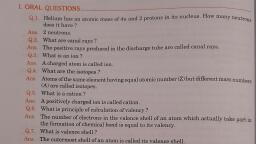
Science, , (Chapter — 4) (Structure Of The Atom), , Answer 8:, (i) Atomic number, , The atomic number of an element is the total number of protons present in the atom of that element., For example, nitrogen has 7 protons in its atom. Thus, the atomic number of nitrogen is 7., , (ii) Mass number, , The mass number of an element is the sum of the number of protons and neutrons present in the, atom of that element. For example, the atom of boron has 5 protons and 6 neutrons. So, the mass, number of boron is 5 +6=11., , (iii) Isotopes, , They are atoms of the same element and have same atomic number but different mass, number/atomic mass. For example:, , Carbon: 12¢ and '4C, , (iv) lsobars, , They are atoms of different elements having same mass number but different atomic number., For example calcium, atomic number 20 and argon, atomic number 18., , The number of electrons in these atoms is different, but the mass number of both these elements is, 40. That is, the total number of neutrons is the same in the atoms of this pair of elements., , Two uses of isotopes are as follows:, (i) An isotope of uranium is used as a fuel in nuclear reactors., , (ii) An isotope of cobalt is used in the treatment of cancer., , Question 9:, , Na has completely filled K and L shells. Explain., , Answer 9:, , Na has atomic number 11, so its electronic configuration is = 2, 8, 1, , When it gives away its outermost shell single electron it changes to Na+ =10= 2, 8, , The above configuration indicates completely filled K, L shells., , Question 10:, , If bromine atom is available in the form of, say, two isotopes 32Br (49.7%) and 84Br (50.3%), calculate, the average atomic mass of bromine atom.