Page 1 :
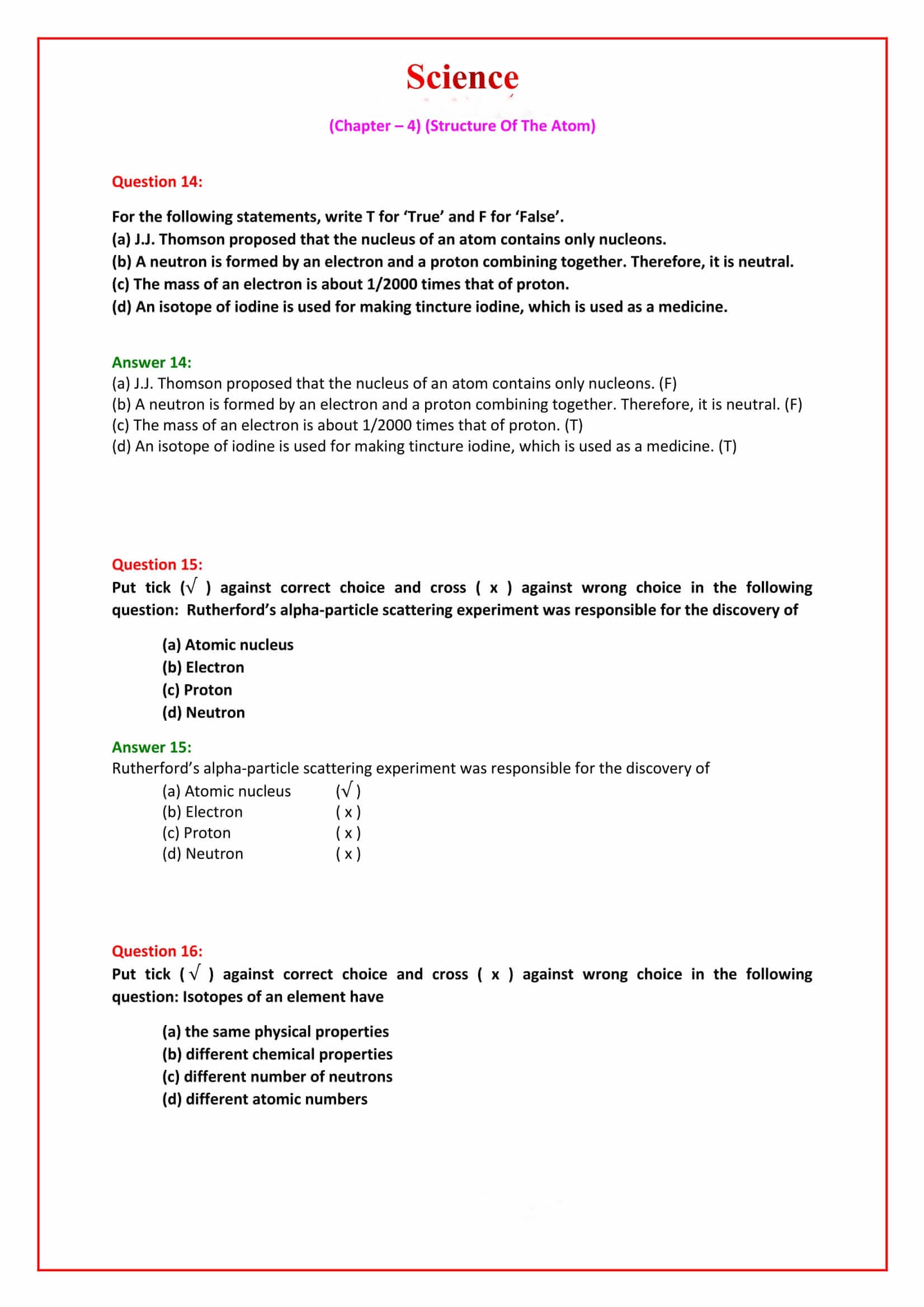
Science, , (Chapter — 4) (Structure Of The Atom), , Question 14:, , For the following statements, write T for ‘True’ and F for ‘False’., , (a) J.J. Thomson proposed that the nucleus of an atom contains only nucleons., , (b) A neutron is formed by an electron and a proton combining together. Therefore, it is neutral., (c) The mass of an electron is about 1/2000 times that of proton., , (d) An isotope of iodine is used for making tincture iodine, which is used as a medicine., , Answer 14:, , (a) J.J. Thomson proposed that the nucleus of an atom contains only nucleons. (F), , (b) A neutron is formed by an electron and a proton combining together. Therefore, it is neutral. (F), (c) The mass of an electron is about 1/2000 times that of proton. (T), , (d) An isotope of iodine is used for making tincture iodine, which is used as a medicine. (T), , Question 15:, Put tick (Vv ) against correct choice and cross ( x ) against wrong choice in the following, question: Rutherford’s alpha-particle scattering experiment was responsible for the discovery of, , (a) Atomic nucleus, (b) Electron, , (c) Proton, , (d) Neutron, , Answer 15:, Rutherford’s alpha-particle scattering experiment was responsible for the discovery of, (a) Atomic nucleus (Vv), (b) Electron (x), (c) Proton (x), (d) Neutron (x), , Question 16:, Put tick (Vv ) against correct choice and cross ( x ) against wrong choice in the following, question: Isotopes of an element have, , (a) the same physical properties, (b) different chemical properties, (c) different number of neutrons, (d) different atomic numbers