Page 1 :
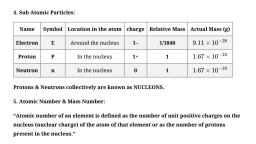
CHEMISTRY, , CLASS- IX, , STRUCTURE OF THE ATOM, NCERT EXERCISES, , 1. Compare the properties of electrons, protons and neutrons., , , Property, , Electrons, , Protons, , Neutrons, , Charge, , Negatively charged, , Positively charged, , No charge., , Location, , Located outside the, nucleus, , Located within the, nucleus, , Located inside the nucleus, of an atom, , Weight, , Mass is negligible, , 1 a.m.u, , 1 a.m.u, , Affinity, , Attracted towards, positively charge, , Attracted towards, negatively charge, , Do not get attracted to, any charged particle, , 2. What are the limitations of J.J.Thomson’s model of the atom?, The limitations of J.J Thomson’s model of atom are: The model failed to explain the outcome of alpha particle scattering which was, conducted by Rutherford., It did not provide any experimental evidence and was established on imagination., 3. What are the limitations of Rutherford’s model of the atom?, The limitations of Rutherford’s model of the atom are:There is no expected stability in the revolution of the electron in a circular orbit, Charged particles radiate energy when accelerated thus causing the revolving electrons to, lose energy and would fall into the nucleus, Hence atoms must be highly unstable. Matter would not exist in their known form which, clearly is an assumption as atoms are highly stable, 4. Describe Bohr’s model of the atom., , , The main postutulates of Bohr’s model are: An atom holds the nucleus at the centre., Negatively charged electrons revolve around the nucleus., The electrons revolve in distinct orbits called energy levels., Electrons do not radiate energy when they are in their orbits.
Page 2 :
The distinct orbits are named as K, L, M, N orbits. Numbers used to denote them are n=1,, 2, 3, 4, 5. Compare all the proposed models of an atom given in this chapter, , property, , Thomson’s model, , Rutherford’s model, , Bohr’s model, , Location of positive, chargre, , A sphere of uniform, positive charge, , A positively charged, heavy, core called, nucleus, , A positively charged,, heavy nucleus, , Location of negative, charge, , Negatively charged, electrons are, embedded in to the, sphere of positive, charge, , Electrons moving, around the nucleus in, different shells, , Electrons moving, around the nucleus in, certain fixed shells ,, called orbits, , Location of mass, , Uniformly distributed, , The entire mass of an, atom is concentrated, in the nucleus, , The entire mass of an, atom is concentrated, in its nucleus, , Nature of atom, , Neutral, , Neutral, , Neutral, , 6. Summarise the rules for writing of distribution of electrons in various shells for the first, eighteen elements., The rules for writing of distribution of electrons in various shells for the first eighteen, elements are : Maximum number of electrons that can be accommodated in a shell is given by the, formula: 2n2 , where n= 1, 2, 3…, , , Maximum number of electrons in different shells are:, K shell – n=1 ; 2n2 = 2(1)2 = 2, L shell – n=2 ; 2n2 = 2(2)2 = 8, M shell – n=3 ; 2n2 = 2(3)2 = 18, N shell- n=4 ; 2n2 = 2(4)2 = 32, , The outermost orbit can be accommodated with 8 electrons at the maximum., The electrons are not taken in unless the inner shells are filled which are filled step-wise., , , 7. Define valency by taking examples of silicon and oxygen., The definite combining capacity of the atoms of each element, wherein electrons are lost,, gained or shared to make the octet of electrons present in the outermost shell is defined as
Page 3 :
valency. The valency of an element is given by the number of valence electrons or (8- valence, electrons), Example :, To find the valency of silicon:, The atomic number of silicon is 14, The distribution of electrons in silicon atom is K – 2, L – 8, M – 4, Hence, from the distribution of silicon it is clearly evident that to fill the M shell 4 electrons are, required. Therefore its valency is 8-4=4., To find the valency of oxygen:, The atomic number of oxygen is 8, The distribution of electrons in oxygen atom is K – 2, L – 6, Hence, from the distribution of oxygen it is clearly evident that to fill the M shell 6 more, electrons are required. Therefore its valency is 8-6=2., 8. Explain with examples, (i) Atomic number, The number of positively charged protons present in the nucleus of an atom is defined as the, atomic number and is denoted by Z., Example: Hydrogen has one proton in its nucleus, hence its atomic number is one., (ii) Mass number, ) The total number of protons and neutrons present in the nucleus of an atom is known as the, mass number. It is denoted by A., Example: 20Ca40 . Mass number is 40. Atomic number is 20., (iii) Isotopes, The atoms which have the same number of protons but different number of neutrons are, referred to as isotopes., Example Carbon molecule exists as 6C12 and 6C14, (iv) Isobars., : Isobars are atoms which have the same mass number but different atomic number., Example:, , 40, 40, 20Ca and 18Ar, , Give any two uses of isotopes., , The isotope of Iodine atom is used to treat goiter, an iodine deficient disease., In the treatment of cancer, an isotope of cobalt is used., Fuel for nuclear reactors is derived from the isotopes of the Uranium atom.
Page 4 :
9. Na+ has completely filled K and L shells. Explain., The atomic number of sodium is 11. It has 11 electrons in its orbits. Hence, its electronic, configuration is K-2 ; L-8 ; M-1 ; The one electron in the M shell is lost and it obtains a positive, charge since it has one more proton than electrons, and obtains a positive charge, Na + . The new, electronic configuration is K-1 ; L-8., 10. If bromine atom is available in the form of, say, two isotopes 35Br79 (49.7%), and 35Br81 (50.3%), calculate the average atomic mass of Bromine atom., The atomic masses of two isotopic atoms are 79 (49.7%) and 81 (50.3%)., Thus, total mass = 79 x, , ., , + 81 x, , ., , = 39.263 + 40.743 = 80.006 u, , 11. The average atomic mass of a sample of an element X is 16.2 u. What are the percentages, of isotopes 8X16 and 8X18 in the sample?, Let the percentage of 8X16 be ‘a’ and that of 8X18 be ‘100-a’., As per given data,, 16.2u = 16 X, , + 18 X, , 1620 = 16a + 1800 – 18a, 1620 = 1800 – 2a, a = 90%, Hence, the percentage of isotope in the sample 8X16 is 90% and that of, 18, 8X, , = 100-a = 100- 90=10%, , 12. If Z=3, what would be the valency of the element? Also, name the element., Given: Atomic number, Z = 3, The electronic configuration of the element = K-2; L-1,, Hence its valency = 1, The element with atomic number 3 is Lithium., 13. Composition of the nuclei of two atomic species X and Y are given as under, X, , Y, , Protons =, , 6, , 6, , Neutrons =, , 6, , 8, , Give the mass numbers of X and Y. What is the relation between the two species?, Mass number of X: Protons + neutrons = 6+6 = 12, Mass number of Y: Protons + neutrons = 6+8 = 14, They are the same element as their atomic numbers are the same., They are isotopes as they differ in the number of neutrons and hence their mass numbers.
Page 5 :
16. For the following statements, write T for true and F for false., (a) J.J. Thomson proposed that the nucleus of an atom contains only nucleons., False, (b) A neutron is formed by an electron and a proton combining together. Therefore it is, neutral, False, (c) The mass of an electron is about 1/2000 times that of proton., True, (d) An isotope of iodine is used for making tincture iodine, which is used as a medicine., False, 17. Put a tick(✓) against correct choice and cross(x) against wrong choice in questions 15, 16, and 17., 15. Rutherford’s alpha – particle scattering experiment was responsible for the discovery of, (a) Atomic nucleus, (b) Electron, (c) Proton, (d) Neutron, (a) Atomic nucleus, 16. Isotopes of an element have, (a) The same physical properties, (b) Different chemical properties, (c) Different number of neutrons, (d) Different atomic numbers., (c) Different number of neutrons, 17. Number of valence electrons in Cl– ion are:, (a) 16, (b) 8, (c) 17, (d) 18, (b) 8, 18. Which one of the following is a correct electronic configuration of Sodium?, (a) 2, 8
Page 6 :
(b) 8, 2, 1, (c) 2, 1, 8, (d) 2, 8, 1, (d) 2, 8, 1, 19. Complete the following table., Atomic, number, , Mass, number, , Number of, neutrons, , Number of, Protons, , Number of, electrons, , Name of the, atomic species, , 9, 16, , –, 32, , 10, –, , –, –, , –, –, , –, Sulphur, , –, , 24, , –, , 12, , –, , –, , –, , 2, , –, , 1, , –, , –, , –, , 1, , 0, , 1, , 0, , –, , Atomic, number, , Mass, number, , Number of, neutrons, , Number of, Protons, , Number of, electrons, , Name of the, atomic species, , 9, 16, , 19, 32, , 10, 16, , 9, 16, , 9, 16, , Fluorine, Sulphur, , 12, , 24, , 12, , 12, , 12, , Magnesium, , 1, , 2, , 1, , 1, , 1, , Deuterium, , 1, , 1, , 0, , 1, , 0, , Hydrogen ion, , , , IN –TEXT QUESTIONS, 1. What are the canal rays?, Canal rays are the positively charged radiations moving from the anode to the perforated, cathode in the specially designed discharge tube., 2. If an atom contains one electron and one proton, will it carry any charge or not?, No, atom will not carry charge as –ve charge of electron and +ve charge of proton will, neutralize each other. Thus an atom is electrically neutral., 3. On the basis of Thomson’s model of an atom, explain how the atom is neutral as a whole.
Page 7 :
As per Thomson’s model of an atom, electrons and protons are equal in magnitude hence an, atom on the whole is electrically neutral., 4. On the basis of Rutherford’s model of an atom, which subatomic particle is present in the, nucleus of an atom?, As per Rutherford’s model of an atom, the positively charged protons are present in the, nucleus of an atom., 5. Draw a sketch of Bohr’s model of an atom with three shells., , , 6. What do you think would be the observation if the ∝– particle scattering experiment is, carried out using a foil of a metal other than gold?, In the ∝ – particle scattering experiment, when any other metal foil is used instead of gold the, number of α particles showing scattering through the coil would be much lesser., 7. Name the three subatomic particles of an atom., An atom consists of three subatomic particles:, Protons – positively charged, Electrons – negatively charged, Neutrons – neutral ( no charge ), 8. Helium atom has an atomic mass of 4 u and two protons in its nucleus. How many neutrons, does it have?, , , Given: Atomic mass of helium atom = 4u, 2 protons in helium nucleus, Atomic mass = number of protons + number of neutrons, 4 = 2 + number of neutrons, Number of neutrons = 4 – 2 = 2, Hence, Helium has 2 neutrons., 9. Write the distribution of electrons in Carbon and Sodium atoms.
Page 8 :
Distribution of electrons in Carbon atoms:, The atomic number of Carbon is 6, Number of electrons is equal to the number of protons in carbon atom i.e., 6, The distribution of electrons in carbon atom is K – 2, L – 4, Distribution of electrons in sodium atoms:, The atomic number of Sodium is 11, Number of electrons is equal to the number of protons in sodium atom i.e., 11, The distribution of electrons in sodium atom is K – 2, L – 8, M – 1, 10. If K and L shells of an atom are full, then what would be the total number of electrons in, the atom?, K shell can hold 2 electrons, L shell can hold 8 electrons, Hence, when both the shells are full, the total number of electrons present in the atom = 2+8 = 10, electrons., 11. How will you find the valency of chlorine, sulphur and magnesium?, To find the valency of chlorine:, The atomic number of chlorine is 17, Number of electrons is equal to the number of protons in chlorine i.e., 17, The distribution of electrons in chlorine atom is K – 2, L – 8, M – 7, Hence, from the distribution of chlorine it is clearly evident that to fill the M shell only one, electron is required. Therefore its valency is -1., To find the valency of sulphur:, The atomic number of sulphur is 16, Number of electrons is equal to the number of protons in sulphur i.e., 16, The distribution of electrons in sulphur atom is K – 2, L – 8, M – 6, Hence, from the distribution of sulphur it is clearly evident that to fill the M shell two more, electrons are required. Therefore its valency is -2., To find the valency of magnesium:, The atomic number of magnesium is 12, Number of electrons is equal to the number of protons in magnesium i.e., 12, The distribution of electrons in magnesium atom is K – 2, L – 8, M – 2, Hence, from the distribution of magnesium it is clearly evident that to fill the M shell six more, electrons are required. But M shell has two electrons only. It possesses lesser electrons than, needed to fill the shell.
Page 9 :
Thus, we say that the magnesium atom is not stable as the M shell has 2 electrons. Its valency is, +2., 12. If the number of electrons in an atom is 8 and number of protons is also 8, then, (i) What is the atomic number of the atom? and, (ii) What is the charge on the atom?, Given: Number of electrons = 8, Number of protons = 8, (a) The atomic number of an atom is the same as the number of protons in that atom, hence its, atomic number is 8., (b) In an atom, the number of protons is equal to the number of electrons. Hence both the charges, – positive and negative neutralize each other. Therefore, the atom does not possess any charge., 13. With the help of Table 4.1, find out the mass number of oxygen and sulphur atom., To find the mass number of Oxygen:, Number of protons = 8, Number of neutrons = 8, Atomic number = 8, Atomic mass number = Number of protons + number of neutrons = 8 + 8 = 16, Therefore, mass number of oxygen = 16, To find the mass number of Sulphur:, Number of protons = 16, Number of neutrons = 16, Atomic number = 16, Atomic mass number = Number of protons + number of neutrons = 16 + 16 = 32, 14. For the symbol H, D and T, tabulate three subatomic particles found in each of them., The following table depicts the subatomic particles in Hydrogen (H), Deuterium (D), and, Tritium(T)., Isotope, , Symbol, , Mass, no., , Atomic, no., , No. of, electrons, , No. of, protons, , No. of, neutrons, , Hydrogen, , H, , 1, , 1, , 1, , 1, , 0, , Deuterium, , D, , 2, , 1, , 1, , 1, , 1, , Tritium, , T, , 3, , 1, , 1, , 1, , 2
Page 10 :
15. Write the electronic configuration of any one pair of isotopes and isobar., (a) Isotopes: Isotopes are atoms which have the same number of protons but the number of, neutrons differs. This leads to the variation in mass number too., Example: Carbon molecule exists as 6C12 and 6C14 but when their electronic configuration is, noticed, both have K-2; L-4, (b) Isobars: Isobars are atoms which have the same mass number but differ in the atomic, number. Electronic configuration of an isobar pair is as follows,, Example: Electronic configuration of 20Ca40 – K-2; L-8; M-8; N- 2, Electronic configuration of 18Ar40 – K-2; L-8; M-8