Page 1 :
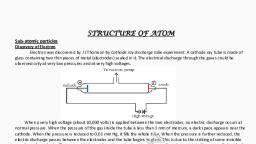
BEER Atomic Structure, INTRODUCTION, , pt that atoms are the, , , , , , , , , , , fandamental building blocks of matter dates back to very ancien, rding atoms of those times had no experimental evidence ang, these ideas had to lay dormant for a long period ungj, the basis of certain observations and experime; ntl, it regarded an atom as the ultimate particle g, , The conce|, times. However, the ideas rega, speculation. Therefore,, , s atomic theory on, Je of his theory was that i, , remained as mere, John Dalton proposed hi, results, The basic princip, , matter., s been successful in giving a convincing explanation for the various law., , as the law of conservation of mass, the law of definite proportions, and the law of multiple proportions. However, Dalton’s idea that the atom is an indivisible Partick, at matter has been disproved by later discovery of radioactivity. Several series of experiments g, d out later proved the presence of various subatomic particles j, an atom, Atoms are found to be mainly composed of three types of fundamental particles, nameh, , positively charged protons, neutral particles known as neutrons and negatively charged electrons, damental particles paved the way for further research on the int, , Dalton’s atomic theory ha:, of chemical combination such, , , , , , , , , , , , , , , Placing a small obje, , radioactivity which were carrie, , The discovery of these fun, , structure of an atom which obviously explains the enormous diversity of chemistry involved in Cathad, , wide range of chemical reactions. =, High-volt, , Placing a light pz, , (, , DISCOVERY OF FUNDAMENTAL PARTICLES, , The electron was the first fundamental particle that was discovered. The credit for the discovery, , the electron goes to J.J. Thomson based on his experiments carried out in a discharge tube., , Sir William Crookes was the first scientist who designed the discharge tube which was called th, Crooke’s discharge tube or cathode ray tube. It is a long glass tube having two metal plates connected, to the oppositely charged poles of a battery. The pressure inside the discharge tube can be adjusted, , , , by means of an exhaust pump., , This discharge tube was later slightly modified by J.J. Thomson. When high voltage was applied High, between the cathode and the anode with a small hole at the centre of a partially evacuated tube ata Passing throu,, pressure of 0.01 mm of Hg, a bright spot of light was formed on the zinc sulphide screen kept at the Cal, opposite end of the discharge tube. This was caused by the rays which originated from the cathode, called cathode rays., , Passing thro, path of the, Cathode, , , , , , L—=4]i]1[1, High-voltage source, , ll, , The abov, gases in t, , , , Figure 2.1 Cathode Ray Tube, , J.J. Thomson conducted some experiments with a discharge tube for studying the properties 0, cathode rays,, , , , Scanned with CamScanner
Page 2 :
Gas at low, Cathode Anode pressure, , q, High voltage source, , Experiments, , , , , , , , , ‘Shadow of, , Metal object object, , Cathode, , , , , , ae, 41 F-—, High-voltage source, , , , , , lacing a light paddle wheel between cathode and anode, Light paddle wheel, , , , , , , , , , I, High-voltage source, , , , Figure 2.2 J.J. Thomson's Cathode ray tube, , ____ Atomic Structure (ZEW, , , , Bright spot, , Fluorescent, material, , , , , , Properties based on observation, , Formation of a shadow of the object on the, opposite side of the cathode, , Cathode rays travel in straight lines, , Rotation of light paddle wheel. Small, particles having mass and kinetic energy, , , , , , , sing through electric field, Cathode Anode |, , , , Fluorescent, material, , (2ns), Bright spot, , , , , ‘Schematic diagram, , , , Bending of rays towards the positive plate, , , , , , , Negatively charged particles, , , , , , ssing through magnetic field applied perpendicular to the, th of the cathode rays, , , , , , , , Cathode Anode, , , , , , , , , , , , , , , , , , , , , , on,, lf oS) Fluorescent, d na material, ee (ZnS), os I if: Schematic diagram Bright spot, HY., , , , Deflection perpendicular to the applied, magnetic field, , , , , , , he above experiments were carried out with different, ses in the discharge tube., , , , , No change in properties, , The properties do not depend on the nature, of gas taken in the discharge tube., , Specific charge (e/m value) remains, , , , , , , 2h Se Se, , he discovery of negatively charged electron was later followed by the experiment conducted, obert Millikan in 1909 to determine the quantity of charge on an electron., , the same., , , , , , Scanned with CamScanner
Page 3 :
\ y ,, , ? ee Siok itll athlete ol yt, hide Aa eee La, , , , , , , , , , , , , , , , , , , , , , , , bid htc til, , Ee Atomic Structure ee, , Millikan’s Oil Drop Experiment, Some fine oil droplets were allowed to be sprayed into the chamber by an atomizer. The air jy, , chamber was subjected to ionization by X-rays. The electrons produced by the ionization o¢, attach themselves to the oil drops. When sufficient amount of electric field is applied which,, , ational force acting on an oil drop, the drop remains suspended in th, a, , (iil) The proper, (iv) The mass o, , The discovery, , just balance the gravit:, of atomic model, , From this experiment, Millikan observed that the smallest charge found on them, approximately 1.59 X 10⁷! coulombs and the charge on each drop was always an integral multig, of that value., , Various atomi, Bohr and Somn, , On the basis of this observation, he concluded that 1.59 x 10-!? coulombs is the smallest possip, charge and considered that value as the charge of the electron., , Thomson's ,, JJ. Thomson py, , , , , , , , , , , , Oil spray _ ___ Atomizer to produce (i) Anatom., (+) v © Siaropiets a thinly s, i (ii) Since th, X rays produce ~\_J [ D—ag— Microscope total pos, charges on ;, tha ol diops | Electrically charged, plates, , ©), , Figure 2.3 A schematic representation of the apparatus used by Millikan to determine, the charge of an electron, , DISCOVERY OF PROTONS, , The presence of positively charged particles in an atom has been predicted by Goldstein based 6, the electrical neutrality of an atom. The discovery of proton by Goldstein was done on the basis, the cathode ray experiment conducted by using a perforated cathode., , Just like the cathode rays, some rays were found to emanate from an anode. These are called ant, , , , , Thomson, , rays or canal rays. y watermelon, , Anode rays were found as a stream of positively charged particles in contrast to the cathode rays. Whe Validity of, hydrogen gas is taken in a discharge tube, these positively charged particles were found to be protons. | iY, , Positive rays Cathode rays positive pehomson’s, , from anode __ from cathode rays Red glow to explain |, , without ge, , Perforated cathode, , °, Write d, SOLUT, High-voltage source The iso, Figure 2.4 Discovery of Protons 20%, ,, , The iso, ycl® ;, The isc, 6c,, , Properties of Anode Rays, , (i) Anode rays travel in straight lines,, , Scanned with CamScanner
Page 4 :
7 ____ Atomic Structure SE, , the gas taken in the discharge tube,, , as the atomi, ‘omic mass of the gas inside the discharge tube., , , , (iii) The ene, Properties of anode rays depe Upon the nature o, , (iv) The mass of the particles was sain, s Was same, , , , , , , The discovery of electro, ns and proton:, - = Is as subatomi: i:, of atomic models which depi atomic particles insi, h depict the srameonea ene Patil inside the atom lead vo the conception, Various atomic models have ins aes ATTA, , ; be af, 1 multipl Bohr and Sommerfeld, n proposed by different scientists like J.J. Thomson, Rutherford,, , , , , , , , , , , , , , , , , , Thomson’s Atomic Model, , Thomson proposed his atomic model soon, J., J my 1 soon after his discovery of electrons as listed hereunder., , (i) An atom contains negativel, ly charged parti., 2 thinly spread positively charge a peace called electrons embedded uniformly throughout, , (ii) Since the atom is electrically, ally neut i i yy, : fae ral, the total negative charge of electrons is balanced by the, , Electrons, nine, , Positively, charged, , ased., basis, Figure 2.5 Thomson's atomic model, , | anor Thomson’s model of an atom is popularly known as plum pudding model or apple pie model or, , watermelon model., Validity of Thomson’s model, , Thomson’s model could successfully explai, to explain how the positively charged partic, without getting neutralized., , tons., n the electrical neutrality of atom. However, it failed, , Jes are shielded from the negatively charged electrons, , Write different isotopes of oxygen, carbon and chlorine., , SOLUTION, , The isotopes of oxygen are., 40", ,0”, 208., The isotopes of chlorine are, GOP gl”, The isotopes of carbon are, , 4, sor ch , sc 7, , 76, , , , Scanned with CamScanner
Page 5 :
GEXGR Atomic Structure, , Eo, , What was the basis for the proposal of Dalton’s atomic theory?, , SOLUTION, , Laws of chemical combination such as the law of conservation of mass, the law of definite Propo, ° . . . * ‘ rth, and the law of multiple proportions were the basis for the proposal of Dalton’s atomic theo;, , aa, , (a) What are A, B, C, D, E in the given figure?, , (b) What is the purpose of ‘C’?, , (c) Explain the role of ‘D’ in the phenomenon taking place in the, discharge tube., , SOLUTION, , (a) ‘A’ is cathode, ‘B’ is perforated anode, ‘C’ is suction pump, ‘D’ is zinc sulphide screen and, ‘E’ is cathode ray., , (b) -‘C’is suction pump which can help in reducing the pressure in the discharge tube., (c) ‘D’ is zinc sulphide screen. Zinc sulphide is a fluorescent material. When cathode, strike the zinc sulphide screen, bright spots are formed on the screen., , , , , , An atom of an element is represented as 2X, After the emission of a B- particle another elemer, Y is formed. Represent Y with atomic number and mass number., , SOLUTION, 1X4 1¥4 + A particle., , Calculate the specific charges (e/m) of the following particles and then arrange the particles ind, ascending order of their specific charges, , , , (a) Electron (b) Proton (c) particle, SOLUTION, -19, Specific charge of an electron = ee coulomb/kg, x, = 0.176 x 10!2 = 17.6 x 10!° coulomb/kg, Specific charge of a proton = 16x10 coulomb/kg = 0.96 x 10⁸ coulomb/kg, roton = ———— cou =0., P 1.67x10™” ., =19 8, 2x1.6x10 _ 1.610" = 0.472 x 10⁸ coulal /, , Specific charge of @ - particle = ——————_—, P 8 2x 1071.67 + 1.72) 3.39, , Hence ascending order of specific charges of electron, proton and @-particles is, , @-particle < proton < electron., , , , Scanned with CamScanner, , , , , , , , , , , , Most, foil v, Very, Q-pa, , , , , , Ruth, , The a, conce, its dia, Ruth, the mt