Page 1 :
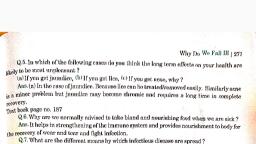
Why Do We fall ill, 1. Why are we normally advised to take bland and nourishing food when we are sick?, Ans. We are normally advised to take bland and nourishing food when we are sick because we, are weak during illness and need complete nourishment for faster recovery., 2. What are the different means by which infectious diseases are spread?, Ans. Infectious diseases can spread by following means:, a) through contaminated food and water, b) through air, c) through vectors or carriers (housefly, mosquito etc), d) through direct skin contact or sexual contact, e) through cuts and wounds, 3. What precautions can you take in your school to reduce the incidence of infectious, diseases?, Ans. To reduce the incidence of infectious diseases in my school the precautions will include:, (i) Isolating diseased students and clean surroundings, (ii) clean food and purified drinking water, (iii) not eating junk food and open/uncovered food materials, 4. What is immunisation?, Ans. Immunisation is a method of preparing memory cells in immune system. In this method weak, or dead microbes of disease are injected in the body such that develop memory, lymphocytes(WBCs) but do not cause disease. eg vaccination against polio, tetanus etc., 5. What are the immunisation programmes available at the nearest health centre in your, locality? Which of these diseases are the major health problems in your area?, Ans. DPT vaccine: it is for diphtheria, pertussis and tetanus in infants., Pulse polio vaccine: it is to prevent polio., BCG vaccine: bacillus calmette Guerin vaccine for tuberculosis., Hepatitis vaccine, TAB vaccine for typhoid., tuberculosis and diarrhea are the major health problems in our area., 6.List any three reasons why you would think that you are sick and ought to see a doctor. If, only one of these symptoms were present, would you still go to the doctor? Why or why, not?, Ans. If we have fever, headache, stomachache, loose motions, cough and sneeze etc we feel, weak. Then we would that we are sick and ought to see a doctor. If only one of these symptoms, were present we should still go to see the doctor. Any of these symptoms may be initial signs of a, severe disease., 7. In which of the following case do you think the long-term effects on your health are likely, to be most unpleasant?, • if you get jaundice,, • if you get lice,, • if you get acne., Why?, Ans. The long-term effects on our health are likely to be mistune pleasant if we get jaundice, because the symptoms severely affect our internal organs and persist for long time., 8. Conduct a survey in your neighbourhood to find out what the three most common, diseases are. Suggest three steps that could be taken by your local authorities to bring, down the incidence of these diseases.
Page 2 :
Ans. Three most common diseases in my locality are diarrhoea, malaria and tuberculosis and, following steps I would suggest to be taken by our local authorities to bring down the incidence of, these diseases:, i. Supply of safe drinking water and preventing incidences of open drains., ii. Improved and hygienic environment free of garbage and wastes thrown in the open., iii. Eradication of mosquitoes, iv. Immunisation/vaccination camps, 9. Why are antibiotics not effective for viral disease., Ans. Antibiotics block the bacterial pathways without affecting the pathways of humans. In the, case of viruses, they have very few biochemical pathways of their own. They use the metabolic, machinery of host and grow and reproduce., 10.What is inflammation? What are the changes occur during inflammation?, Ans. It is the recruitment process by immune system in which immune system recruits many cells, to the affected tissue to kill the disease causing germs., During this process, certain local effects such as swelling and pain and general effects such as, fever may develop., 11.Why do some children fall ill more frequently than others living in the same locality?, Ans. A system which protects our body from diseases and infections is known as immune system., This system is developed in adults due to long term exposure to environment. Children fall ill more, frequently because they do not have well developed immune system., 12.How can the disease be prevented?, Ans. Diseases can be prevented by –, (a) By presenting exposure to disease causing microbes – For this, exposure to overcrowded, areas can be avoided, source of drinking water must be checked, and we must provide clean, environments., (b) By consuming proper and sufficient food / balanced diet., (c)By immunization., 13. Give two examples for each of the following:, (a) Chronic diseases, (b) Infectious diseases, (c) Non-infection diseases., Ans. (a) Chronic diseases – Tuberculosis, arthritis, (b) Infectious diseases – Common cold, Mumps, (c) Non-infectious diseases – Haemophilia, obesity, 14. Give difference between vaccines and antibiotics., Ans.
Page 3 :
15. The body of a patient has lost its power of fighting against infections. Which disease, may the patient be suffering from? Name the pathogen and describe any two modes of its, transmission from the patient to other person., Ans. Patient is suffering from AIDS., It is caused by HIV (Human Immuno deficiency Virus) Modes of transmission are, (1) By sexual contact with infected person., (2) By the use infected syringe., 16. What are the means of spread of diseases?, Ans. Diseases spread through –, (1) Air – When an infected person sneezes or coughs or spits, a healthy person standing nearby, can inhale these droplets, causing infection in that person., (2) By water – Some diseases can spread from one person to another when a sick person’s stools, gets into water. The people drinking the infected water thus get the disease., (3) By physical contact – Some of the diseases like AIDS, syphilis and gonorrhea spread by, sexual contact. These diseases are not transmitted by casual physical contact like handshakes,, hug’s, sports like wrestling and other ways in which we touch other socially., 16. What are the conditions favoring for air-bone diseases?, Ans. Conditions favoring for air-borne infections a) Close proximity to the infected person., b) Over – crowding, c) Poor – Ventilation, 17. What are the various dimensions of health?, Ans. Various dimensions of health are–, a) Physical dimensions Physical health implies ‘perfect functioning of all the organs and systems, of the body., b) Mental dimension – Mental health implies a state of balance and harmony between the, individual and surrounding world., c) Social dimension – A person is socially healthy if he has a good job, a good house, a happy, family, good neighbors and understanding friends., 18. What are the causes of diseases?, Ans. Causes of diseases are –, a) Infection by micro – organisms – Bacteria, virus, fungi, protozoa and worms cause, communicable diseases., b) Malfunctioning of body organs., c) Deficiency of one or more nutrients., d) Genetic factors, e) Polluted environment., 19. Give the schedule of immunization for infants and children up to six years., Ans. Schedule of Immunization
Page 4 :
20. Explain giving reasons –, (a) Balanced diet is necessary for maintaining health body., (b) Health of an organism depends upon the surrounding environmental conditions., Ans. a) Balanced diet contain all the nutrient required for maintaining proper health as well as, needed for growth and repair. Lack of single nutrient causes deficiency diseases., b) surrounding environmental conditions plays an important role in the maintenance of health. For, ex we feel depressed if –, (i) surrounding are dirty or polluted, (ii) garbage is not collected or disposed off, (iii) drains are not cleaned and water collects in the streets or open spaces. Unclean surrounding, causes the entry of germs via air, water, food or vectors and makes the person unhealthy., 21. What is immunization, immune system, immunity?, Ans. Immunization is a specific method of preventing diseases by inoculating vaccines in the, human body., Immune system – It is a system which protect are body against infection, Immunity – The body’s power to resist and overcome infection is called immunity., 22. Name the agents and the diseases caused by them?, Ans., , 23. What are the different aspects of maintaining good health?, Ans. Different aspects for maintaining good healtha) Community health – It involves all the factors relating to personal health along with the services, necessary for providing good health for the community., b) Personal health (hygiene) It is the science of preserving and promoting health mainly through, the active efforts of an individual. It is practiced through active, sanitary habits and healthy way of, life., c) Exercise, relaxation and sleep. Regular exercise is very necessary to keep the body fit. Proper, sleep of about 6-8 hours is essential, Relaxation is very essential for good health., d) Nutrition – Optimum nutrition is essential for maintenance of good health. One should take, sufficient and balanced food for maintaining good health.