Page 1 :
9, Simplified Class Notes, By Rasheed Odakkal, , 1., 2., 3., 4., , Protectors of Biosphere, Food Through Digestive Tract, Simple Nutrients into Cells, Breathing for Energy, , www.shenischool.in, , 2019, , Copy left
Page 2 :
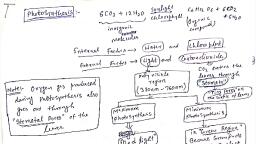
1. Protectors of Biosphere, 1. What are the important services offered by plants ?, • Provide food, • Provide oxygen, • Purify atmospheric air by absorbing CO2 and releasing O2., • Reduce global warming by absorbing CO2 ., • Cool the atmosphere...., 2. The process by which plants regulate the level of oxygen and carbon dioxide in the atmosphere ?, Photosynthesis., 3. Through the process ---------, the plants absorb and convert solar energy and fix it as chemical energy in the, food that can be consumed by animals ., Photosynthesis., 4. Define photosynthesis., The process of making food by green plants from water and carbon dioxide,, with the help of sunlight., 6 CO2 + 12 H2O, , Chlorophyll, , C6H12O6 (Glucose) +6 O2 + 6 H2O, , O2, CO2, , Water, , Food, , 5. The organ of photosynthesis ? The kitchen of the biosphere ?, Leaf., 6. Why is the lower part of a leaf less green in colour ?, More number of chloroplasts, containing chlorophyll, are seenon the upper part of leaf than on the lower part., 7. Factors needed for photosynthesis ?, • Sunlight - (for breaking water molecules in to hydrogen and oxygen), • Pigments like chlorophyll – (to absorb sunlight), • Water and Carbon dioxide, (used as the raw material for synthesising food)., • Minerals and salts8. What are the pigments present in the chloroplast ?, Mainly Chlorophyll a., Chlorophyll b , Carotene andXanthophyll are accessory pigments., 9. Why is certain pigments known as 'accessory pigments' ?, They absorb sunlight and transfer it to the chlorophyll a., 10. Structure of chloroplast ?, A chloroplast is a double membranous cell organelle with the fluid called stroma and many pack of, membranous sacs called grana, embedded in it. More pigments are seen in grana., Double membrane, Grana, , Stroma, Rasheed Odakkal, GVHSS Kondotty 9846626323, 11. Phases or stages of photosynthesis ?, a) – Light Reaction (The phase which requires light), Water splits in to hydrogen and oxygen. Light energy is converted in to chemical energy (stored as, ATP molecules)., Light reaction occur inside the grana of chloroplast. During this phase, O2 is released.
Page 3 :
b) – Dark Reaction (The phase which does not require light) or Calvin cycle., Using the energy of ATP, Hydrogen combines with CO2 to form glucose (carbohydrate)., This phase takes place in the stroma of chloroplast., Phases, , Process involved, , Site of process, , Light phase, , Water splits in to hydrogen and oxygen, , Grana, , Dark phase, , Glucose is formed from hydrogen and CO2, , Stroma, , 12. The dark reaction of photosynthesis known as 'Calvin cycle'. Why ?, The scientist, Melvin Calvin discovered the cyclic chemical reactions in the dark phase and, hence, the phase is also known as 'Calvin cycle'. He was awarded the Nobel Prize in 1961 for, this discovery., 13. Glucose, the product of photosynthesis, is converted in to starch. Why ?, Since glucose is readily soluble in water, it can not be stored. Hence it is converted in to insoluble starch., 14. The converted starch (sucrose) is transported through ----------- to various parts to store in different forms., Phloem., 15. In what ways the synthesized glucose is stored in different parts of plants, after metabolic activities ?, Glucose, , Starch, (in tubers), , Proteins, (in legumes), , Starch, , Sucrose, , Fat, (in oil seeds), , Fructose, (in fruits), , Sucrose, (in sugarcane), , 16. Give examples for plant products having economical importance., Coffee, Cocoa, Pepper, Rubber latex, Cardamom ..., 17. The process of making energy from chemical compounds by certain organisms with out the help of solar, energy is known as -----------Chemosynthesis. ( eg: Sulphur bacteria can produce energy by oxidising inorganic compound), 18. About 70-80% of oxygen in the atmosphere is contributed by ------------ present in ocean ecosystem., Algae and phytoplanktons., 19. Who are the chief producers of the ocean ecosystem ?, Algae and phytoplanktons., 20.Suggest an experiment to prove the release of oxygen molecules during photosynthesis., Take a piece of aquatic plant like hydrilla in a glass tumbler, filled with water. Cover the, plant using a transparent funnel. Cover the tail portion of the funnel by a test tube filled with, water. Take care to leave a little portion of the tube devoid of water (see the figure)., Keep this device under sunlight for one hour. Observe the air bubbles going upward., The gas is oxygen (released from water molecules during the light phase)., , (O2), , 21. Why plants are called as 'the lungs of the earth' ?, Plants offer great service to the biological world by absorbing CO2 from the atmosphere and releasing, oxygen and thus purify the air., 22. Give a few examples for how plants serve in the mitigation of natural disasters, To some extend, mangrove forests control Tsunami. Plants like bamboo, reed(ദരഭ), vetiver(രാമചം) and, lemongrass protect the river banks. Trees and bushes prevent soil erosion and landslide., 23. Make apt slogans for the awareness of reducing global warming., • Trees – A Solution for Global warming., • Protect the Green world for a Carbon free world., , Rasheed Odakkal, GVHSS Kondotty 9846626323, , www.shenischool.in
Page 4 :
2., •, •, , Why food ?, For obtaining energy, for growth and functioning of body., Nutrients and its functions ?, NUTRIENTS, , FUNCTION, , Carbohydrates, , •, , CONTAINING FOOD, , Mainly for energy and growth Rice & other grains, Tubers, Fruits etc, , Proteins, , Mainly for growth, , Pulses, Wheat, Meat, Fish, Milk etc., , Lipids, , Mainly for energy, , Oil, Ghee, Butter etc., , Vitamins, , For physiological activities, , Leafy vegetables, Fruits, Liver etc., , Minerals, , For physiological activities, , Milk,Egg, Meat,Sea food, vegetables etc, , Essential for all activities, , -----, , Water (70% of body wt), •, , Food Through Digestive Tract, , Digestion ?, The process of conversion of complex food materials to simple absorbable forms., Digestive system ?, [ Alimentary canal + Digestive glands ], , Salivary Glands, , Liver, Gall bladder, Pancreas, , Mouth, Pharynx, Oesophagus, , Stomach, Duodenum, Small Intestine, Large Intestine, , •, , •, , •, , Digestive glands ?, Rectum, - Salivary glands (3 pairs), - Liver [ secretes bile ], - Pancreas. [ secretes pancreatic juice ], [Also include Gastric glands (secretes gastric juice) as well as Intestinal glands (secretes intestinal juice)], Sites of digestion of food ?, Rasheed Odakkal, 9846626323, GVHSS Kondotty, Mouth, Stomach and Small intestine., 4 Types of Teeth., , Incisor (8) – To bite and cut the food, Canine (4) – For tearing the food, Premolar (8) –For chewing the food, Molar (12) – For chewing the food
Page 5 :
•, •, , The connective tissue that holds the tooth in the socket of the gum ?, Cementum., Enamel, Structure of a tooth., Dentine, - Enamel (The white, outer hardest dead tissue), - Dentine (Living tissue which forms the tooth), Pulp, - Pulp ( Soft connective tissue with blood vessels, lymph ducts and nerve), , [ Crown is the part of tooth seen out side the gum, Root is the part held, Cementum, inside the gum and Neck of a tooth is the narrow part seen in between, the crown and root], • The enzymes present in the saliva ?, - Salivary amylase (partially converts starch to maltose),, - Lysozyme (helps to destroy the germs, if present)., • Why we feel sweet taste while chewing rice for a certain time ?, The rice (starch) is converted to a sugar, maltose, by the action of salivary amylase., • When swallowing food, uvula prevents food from entering to the nasal cavity and epiglottis prevents, food from going to the trachea., • Peristalsis ?, Wave like movement of oesophagus, stomach and intestine, when food passes., • The special------- present in the posterior part of the stomach retain food for a specific period., Circular muscles., • ------ protects the wall of stomach from the actions of digestive juices., Mucus in the gastric juice., • The process of digestion., , Rasheed Odakkal, 9846626323, GVHSS Kondotty, , SMALL INTESTINE, , STOMACH MOUTH, , MECHANICAL, DIGESTION, , •, , •, •, , CHEMICAL DIGESTION, Digestive Fluid, , Factors in it, , Action on food, , ABSORPTION, , Cutting & Chewing, food by teeth and, Saliva, tongue, , -Mucus, -For smooth conduction of food., -Salivary amylase -Starch, Maltose, ----Lysozyme, -Destroy germs., , Churning food due, to peristalsis, , -Mucus, -HCl, -Pepsin, -Gastric lipase, , Gastric Juice, , Bile (of liver), ----, , -----, , - Protect stomach wall, -Destroy germs and regulate the pH level, -Protein, Peptone (partially) ---- Partial digestion of fat., , -Break down fats and make the food alkaline, , Pancreatic Juice -Pancr. Amylase -Starch, Maltose, -Tripsin, -Protein, Peptide, -PancreaticLipase -Fat, Fatty acid and, Glycerol, -Peptide, Amino acid, Intestinal Juice, (different, -Maltose, Glucose, enzymes), -Lactose, Galactose, -Sucrose, Fructose, , VILLUS, , Duodenum ?, Liver, The initial part of the small intestine, where the bile and the pancreatic juice mixes, with the food., Liver ?, Pancreas, The largest gland, which secretes bile.[Bile is stored in the Gall bladder], Duodenum, The digestive juice with out enzymes in it ?, Bile., www.shenischool.in
Page 6 :
•, , The bile secretion of liver and the pancreatic juice reach the food at ------- of small intestine., Duodenum (the initial part of small intestine)., , •, , Small Intestine ?, The longest tube of smooth muscles(5-6m). Digestion complete here. Many foldings and numerous villi, increase the area of absorption. Absorption of nutrients and 90% of water occur here., Villi ?, villus, The small finger like projections, seen in the wall of small intestine,, capillaries, with blood capillaries and lymph lacteals for absorption., , •, , lacteal, , •, , Amino acids, glucose, fructose and galactose are absorbed in to the, blood through the capillaries of villi. Fatty acid and glycerol are, absorbed in to the lymph through the lacteals., , •, , Large Intestine ?, Re-absorption of remaining water, salts and vitamin K produced by certain bacteria take place with in the, large intestine., , •, , Processes of absorption ?, -Osmosis :- Movement of water from a region of higher concentration to a region of lower concentration, across a semi-permeable membrane., (Absorption of water from the intestines occur through osmosis)., -Simple Diffusion :- Movement of molecules from a region of higher concentration to a region of lower, concentration, with or with out a semi-permeable membrane., (Absorption of fatty acids and glycerol to the lymph lacteal occur by diffusion)., -Facilitated diffusion :- Diffusion of certain molecules with the help of protein molecules in the cell, membrane., (Absorption of glucose/galactose/fructose and amino acids occur by facilitated diffusion)., Examples for the process of absorption of molecules with out using energy ?, Osmosis, Simple diffusion and Facilitated diffusion., The process of absorption of molecules against the molecule concentration gradient, utilizing energy ?, Active transport., (Active transport occur with the help of carrier proteins)., Eg:- Absorption of certain salts and glucose when its concentration decreases in the small intestine)., , •, •, , •, , Suggest a few healthy food habits., - Include roughage (fibre like indigestable items) like leafy vegetables and cereals in our daily food, to ease absorption and defecation., - Reduce the habit of taking junk food and fast to avoid health issues., - Avoid food that containing chemical additives for colour, taste or smell., Rasheed Odakkal, 9846626323, GVHSS Kondotty
Page 7 :
3., •, , Simple Nutrients into Cells, , The body system which carry out the transport of materials ?, Circulatory system (blood & lymph)., , * Human Blood, 55% Plasma (fluid), [90-92% water,, 7-8% proteins (Albumin, Globulin, Fibrinogen),, Other substances like fat, sugar, salts, hormones, urea etc.], 45% Blood cells, [Red blood corpuscles(RBC), white blood corpuscles (WBC), platelets], •, , Functions of plasma proteins ?, Albumins :- regulate BP, Globulin :- synthesize antibodies for immunity., Fibrinogens :- participate in the coagulation (clotting) of blood., , •, , Example for an anticoagulant (substance which prevent clotting of blood) ?, EDTA (Ethylene Diamine Tetra Acetic acid)., , •, , Major substances transported through the blood plasma ?, , Glucose, amino acids, fatty acids, glycerol etc., * Human Heart, Position - placed in the thoracic cavity, behind sternum, in between the lungs., Size, - approximately about one's fist., Weight - about 300 gm., Envelope – pericardium, a double membrane with pericardial fluid filled inside., Chambers – 4 (upper left & right atria and lower left & right ventricles), Arteries - pulmonary artery (deoxygenated blood), aorta (oxygenated blood)., Veins, - pulmonary vein (oxygenated), inferior-superior venacavas (deoxgtd.), Valves between chambers - Tricuspid valve (right) and Bicuspid valve (left)., Valves at the beginning of arteries - Aortic valve and pulmonary valve., Aorta, , Superior venacava, , Leftt Pulmonary artery, , Right Pulmonary artery, Right, Pulmonary veins, Right atrium, , LA, , Left atrium, , RA, LV, , tricuspid valve, Right ventricle, , Left, Pulmonary veins, , bicuspid valve, Left ventricle, , RV, , Inferior venacava, Pulmonary valve, , Aortic valve
Page 8 :
*, , Blood vessels, - Artery [carries blood from heart, 3 layered thick wall, no valves are seen ], - Vein [Carries blood to the heart, 3 layered thin wall, valves are seen ], - Capillaries [connect artery and vein, single layered wall with pores], , Artery, , Capillary, , Vein, , Rasheed Odakkal, 9846626323, GVHSS Kondotty, , •, , Circulation of blood: includes,, * Pulmonary circulation (blood circulation between heart and lungs) RV, * Systemic circulation (circulation between heart and various parts) LV, Right, Atrium, , Left, Atrium, , Pul. artery, , RA, RV, , ry, rte, l. a, , Left, Ventricle, , aorta, , Pu, , Right, Ventricle, , LA, RA, , Pul. veins, , s, ein, , Lu, ng, s, , l. v, Pu, , venacava, , *, , Pace maker ? :, Special muscles of Sino Atrial Node (SA node), seen at the anterior part of atrium is, known as pacemaker because of the initiation and regulation of heartbeat are, carried out by this part., , venacava, , LA, LV, aorta, , [Remember, Those vessels that carry to atria are, veins and those vessels that carry blood from the, ventricles are arteries], Rasheed Odakkal, 9846626323, GVHSS Kondotty, , •, , •, , •, , Why do the blood flow to the arteries and not flow back to the atria, when the, ventricles contract ?, The pulmonary valve and aortic valve prevent the back flow of blood to atria., Why is our blood circulation called as a 'double circulation' ?, When blood flows from the heart to different parts of the body and vice versa, it, passes twice through the chambers of the heart. Hence it is called as a double, circulation., Aorta and Pulmonary veins : Carry oxygenated blood,, ------------- and --------------- : Carry deoxygenated blood., Venacava and Pulmonary artery., , * Portal circulation ?, Circulation of blood from one organ to another organ, before reaching heart,, through the portal veins., [eg:- Hepatic portal system] ie, From Intestine, Liver, Heart.
Page 9 :
Why do nutrients reach the liver ?, To store glucose as glycogen, to release energy from fatty acids, to produce, cholesterol and to destroy pathogens if present., * Heart beat ?, One heart beat consists one contraction(systole) and relaxation(diastole) of heart, chambers. Normal heart beat is 72 per minute.., [0.8 seconds in between two consecutive beats], • During systole, blood flows from the atria to the ventricles and from the ventricles to, outside. During diastole, atria of the heart get filled with blood through veins., • About --- ml of blood is pumped into the arteries every time the heart contracts ., 70ml., • Pulse ?, The wave like movements felt through out the wall of arteries, due to the contraction, and relaxation of heart chambers., • Normal Blood Pressure ?, 120/80 mm.Hg,, This means the high pressure or systolic pressure is 120 mm.Hg, and the low pressure or diastolic pressure is 80, mm.Hg., • The instrument used to measure blood pressure ?, Sphygmomanometer and Digital BP apparatus., •, , •, , Hypertension and Hypotension ?, The condition in which the blood pressure increases above the normal rate (120/80, mm.Hg) is called hypertension., Reasons :- Excess use of salt and fat, smoking, lack of exercise etc., The condition in which the BP increases above the normal rate is called hypotension., Both the hypertension and hypotension may lead to stroke or heart attack., , •, , World Heart Day ?, September 29., The factors that affect the health of our heart ?, Change in food habits (excess fatty and salty food), lack of exercise, consumption, of alcohol, smoking etc., How the consumption of excess fatty food adversely affect the health of heart ?, , •, , •, , Atherosclerosis, (fat deposition in the arterial wall), Inner diameter of artery reduces, wall, becomes rigid losing its elasticity, Rupture of smaller arteries causing internal bleeding /, Formation of thrombus(blood clot) due to clumping of RBCs, Thrombus in the coronary artery may leads to heart attack, * Lymph ?, The colourless fluid seen inside the lymph, vessels. Liquid part of blood oozes out in to, the intracellular spaces to form tissue fluid, and when tissue fluid enters the lymph, capillaries, the fluid is said to be lymph., Lymph does not contain RBCs, platelets and, large protein molecules., • The lymphatic system :, Consists of lymph capillaries, lymph ducts,, lymph nodes and an organ, the spleen., , capillaries, , Lymph duct, cells, , Tissue fluid
Page 10 :
•, , •, , Functions of lymphatic system ?, Transports nutrients, provides immunity, helps to bring the tissue fluid back to, blood and transports fatty acids and glycerol to heart from the intestine., The flow chart showing how fatty acids and glycerol reach to heart from the, intestine., Fatty Acids and glycerol, Lacteals in the villi, , Small lymph ducts, , Large lymph ducts, , Blood in the venacava, , Heart, , * Vascular tissues in plants ?, Xylem and phloem., , Xylem : Conduction of water and salts from roots, Phloem : Transport of food from leaves, , Vascular bundles, , Rasheed Odakkal, 9846626323, GVHSS Kondotty, , Xylem, * Vessels which carry water and, minerals. From roots to various, parts of plant., * Include mainly the Tracheids and, long pipe like Vessels., (both are dead cells), , Phloem, * Vessels which carry food in the form, of sucrose from leaves to various, parts of plant., * Include mainly the Sieve tube (having, pores to connect cytoplasms) and, Companion cells ., , Tracheid, Xylem vessel, , •, , Sieve tube, Companion cell, , What are the forces that help the upward movement of water through the xylem ?, - Root pressure (a pressure exerted in roots due to osmosis), - Cohesion (capacity of water molecules to stick to themselves), - Adhesion (capacity of water molecules to stick with the walls of the vessels), - Transpiration pull in the leaves (a tendency to move water towards the cells, where water is lost by transpiration), •, , Transpiration ?, The expel of water from leaves, through, the stomata, by evaporation., , Only plants with leaves show transpiration, www.shenischool.in
Page 11 :
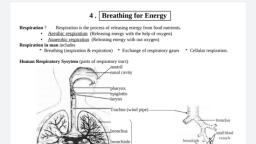
4 . Breathing for Energy, Respiration ?, Respiration is the process of releasing energy from food nutrients., • Aerobic respiration (Releasing energy with the help of oxygen), • Anaerobic respiration (Releasing energy with out oxygen), Respiration in man includes, * Breathing (inspiration & expiration) * Exchange of respiratory gases * Cellular respiration., Human Respiratory Sysytem (parts of respiratory tract), nostril, nasal cavity, pharynx, epiglottis, larynx, Trachea (wind pipe), , bronchus, bronchiole, lung, pleura, , diaphragm, , •, •, , Each bronchiole enters a set of alveoli (air sacs), which are surrounded by a number of, blood capillaries. The alveoli increase the respiratory surface area of the lungs and thus increase the, efficiency of the exchange of gases., Pleura ?, Double layered outer membrane of lungs with pleural fluid, which prevents friction., The pathway of air through the respiratory tract (from nostrils to the alveoli) :, Atmospheric air, , Bronchiole, , Trachea, , Nasal cavity, , Nostrils, , Alveoli, , Bronchus, , Blood in the capillaries, , * A. Breathing (Process of Inspiration and Expiration), Occur by the combined working of the diaphragm (a flat muscular structure between the thoracic and, abdominal cavities) and intercostal muscles (muscles seen in between the ribs)., During inspiration, , During expiration, , contracts and straightens, , relaxes, , raise, , lower, , Volume of thorax, Pressure in thorax, , increases, , decreases, , lower, , higher, , Air, , enters in, , expels out, , Diaphragm, Ribs, , Oxygen is more in inhaled air. CO2 and water vapour are more in exhaled air., www.shenischool.in
Page 12 :
* B. Exchange of gases, From the alveoli of lungs, oxygen diffuses to the red blood corpuscles of the surrounding blood, capillaries. Iron of haemoglobin, seen in the RBCs, absorb oxygen to form a less stable compound, 'oxyhaemoglobin' and is transported. Oxygen diffuses in to the tissue fluid and then in to the cells., Oxygen + Hb, , Oxyhaemoglobin (HbO2), , CO2 diffuses from blood to the alveoli, where its concentration is low., •, , How far is the structure of red blood cell suitable for carrying oxygen ?, Red blood corpuscles can carry more oxygen in its haemoglobin molecules, because of their disc shape, and absence of nucleus or other cell organelles with in them. Oxygen has affinity to combine with, haemoglobin, due to the iron in it. Our blood contain 45 to 60 lakh RBCs per each ml., , •, , How many oxygen molecules can be carried by one haemoglobin molecule ?, Four., Why is it advisable to include iron contained food items like leafy vegetables in our diet ? (What is the, importance of taking iron tablets ?), Iron in the haemoglobin of RBCs carries oxygen molecules through our blood. Iron contained food helps, to prevent anaemia., Define anaemia., Anaemia is a condition in which the amount of haemoglobin in the blood decreases., (The average, amount of haemoglobin in a healthy man is 15gm/100ml and that of woman is 13gm/100ml of blood), , •, , •, , •, , The pathway of oxygen from alveoli to the cells :, Oxygen in, Oxyhaemoglobin, Blood, the alveoli, , Oxygen, , Tissue fluid, , Cell, , * C. Cellular Respiration ?, The process of energy production in cells. It has two stages., • Glycolysis - In the cytoplasm, glucose is converted to pyruvic acid. No oxygen is required for this., 2 ATP energy is gained during glycolysis., n, • Kreb's Cycle - With in the mitochondria, pyruvic acid under go a series of, drio, n, o, enzymatic reaction to produce energy. Oxygen is required for this. CO2 and, och, Mit, water form as by-products. 28 ATP energy is gained., Pyruvic Acid + O2, •, , CO2 + H2 O + 30 ATP, , How is CO2 eliminated ?, 70% CO2 is eliminated as bicarbonate by dissolving in the water of plasma and the RBCs,, 23% as carbaminohaemoglobin and 7% as dissolved in blood plasma water., , * Comparison between Photosynthesis and Aerobic respiration, Photosynthesis, , Aerobic Respiration, , - Anabolic activity (synthesis)takes place in, plants., - Light energy is assimilated as chemical, energy with in the food molecules., - CO2 & water are used., - O2 is expelled., - Light phase occur in the grana and the, dark phase in the stroma of chloroplasts., , - Catabolic activity (dissociation) takes place, in both plants and animals., - The process of releasing energy from food., - CO2 & water are expelled., - O2 is used., - Glycolysis occur in the cytoplasm and the, Kreb's cycle in the mitochondria., , Rasheed Odakkal, GVHSS Kondotty 9846626323
Page 13 :
•, •, , How does the respiratory system help to maintain the homeostasis (internal equilibrium of the body) ?, Through eliminating excess CO2 and a trace of water vapour., How excess CO2 is harmful to our body ?, CO2 may combines with water to form carbonic acid, which in turn increases acidity in blood and tissue, fluid. To avoid this lungs eliminate excess CO2.., , * Anaerobic Respiration (Fermentation), Certain bacteria and yeast produce energy through anaerobic respiration (also known as fermentation), Illustration of lactic acid fermentation and alcohol fermentation is given below :, Glucose, , Aerobic respiration, •, •, •, •, , Lactic acid (in bacterial action), eg:- curding milk., Alcohol + CO2 (in action of yeast), eg:- fermenting batter to soften it., , Pyruvic acid (2 ATP is released), , Oxygen is required., Glycolysis and Kreb's cycle occur., 28 ATP molecules of energy is released, from one glucose molecule., CO2 and water formed as by-products., , Anaerobic respiration (fermentation), •, •, •, •, , Oxygen is not required, Only glycolysis occur., 2 ATP molecules of energy is released from, one glucose molecule., Lactic acid (in bacterial), alcohol and CO2, (in yeast ) as by-products., , Rasheed Odakkal, GVHSS Kondotty 9846626323, , •, , Reason for muscle fatigue after strenuous work or exercise ?, During strenuous work or exercise oxygen may cease and anaerobic respiration occur for energy, production resulting the formation of lactic acid in the muscle cells., , •, , The things that can cause damage to our respiratory system ?, In take of smoke, dust, fog, germs and chemicals, habit of smoking etc., , * Respiratory disorders caused by smoking, • Lung cancer due to the carcinogens contained in tobacco., • Emphysema (rupture of alveoli when elasticity is lost) due to the toxic substances of tobacco., • Bronchitis (mucus deposition and swelling of lungs) due to the proliferation of germs by the tar or, carbon monoxide in tobacco., • What do you mean by the terms, tidal volume and vital capacity ?, The volume of air breath in and out during a normal breathing is the tidal volume. (it is about 500 ml)., The maximum volume of air that we can breath in and out is called the vital capacity of our lungs. (it is, about 3 litres in females and 4.5 litres in males), • Experimental set up for measuring, the vital capacity of lungs., The volume of water, That falls in to this jar, Will be proportional to, his/her vital capacity., •, , The organ or mode and the process of respiration in Amoeba, Cockroach and Fish., Amoeba - The cell membrane, through which oxygen diffuses from water., Cockroach - Trachea,(network of tubules), through which oxygen diffuses to cells from atmosphere., Fish, - Gill is the organ through which oxygen diffuse to blood, from water., , * Mechanisms of gas exchange in plants, • through the stomata seen on leaves and green tender stems., • through lenticels (small pores on the surface of stem and roots), www.shenischool.in, , Lenticel