Page 1 :
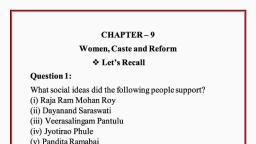
History Chapter 8- Women, Catse and Reforms, , 1. What social ideas did the following people support., Ans- a. Rammohun Roy — Ban of Sati, , b. Dayanand Saraswati - Widow Remarriage, , c. Veerasalingam Pantulu — Widow Remarriage, , d. Jyotirao Phule — Equality amongst castes, , e. Pandita Ramabai - Women’s education, , f. Periyar — Equality to untouchables, , g. Mumtaz Ali - Women’s education, , h. Ishwar Chandra Vidyasagar — Widow remarriage, , 2. State whether true or false:, Answer., (a) True, (b) False, (c) False, , (d) False, , 3. How did the knowledge of ancient texts help the reformers promote, new laws?, , Ans- Ram Mohan Roy tried to show through his writings that the practice, of widow burning had no sanction in ancient texts. The strategy adopted, by him was used by later reformers as well. Whenever they wished to, challenge a practice that seemed harmful, they tried to find a verse or
Page 2 :
sentence in the ancient sacred texts that supported their point of view., They then suggested that the practice, as it existed at present, was, against early tradition., , 4. What were the different reasons people had for not sending girls to, school?, , Ans- There were the following reasons for people to not send their girls, to school:, , a. They feared that schools would take girls away from home., b. Schools will prevent them from doing their domestic duties., c. Girls had to travel through public places in order to reach school., d. Travelling to schools would have a corrupting influence on them., , e. They felt that girls should stay away from public spaces., , Q.5: Why were Christian missionaries attacked by many people in the, country? Would some people have supported them too? If so, for what, reasons?, , Ans : People suspected that Christian missionaries were involved in, forced conversion of the poor and tribal people from Hinduism to, Christianity. lf some people have supported them, it must be due to the, reason that the poor and the tribal people, converted to Christianity,, would get a golden opportunity of going to school. The school would, equip them with some resources to make their way into a changing world., , 6. In the British period, what new opportunities opened up for people who, came from castes that were regarded as “low”?, , Ans- The poor from the villages and small towns, many of them from low, castes, began moving to the cities where there was a new demand for
Page 3 :
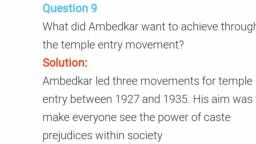
labour. Some also went to work in plantations in Assam, Mauritius,, Trinidad and Indonesia. The poor and the people from low castes saw, this as an opportunity to get away from the oppressive hold that uppercaste landowners exercised over their lives and the daily humiliation they, suffered., , 7. How did Jyotirao, the reformer justify his criticism of caste inequality n, society?, , Ans- Jyotirao Phule, who stood against caste inequality, believed that the, upper castes being ‘Aryans’, are not the original inhabitants of their lands., He put forward his opinions by telling people that the land has always, belonged to the lower-caste people and that the Aryans were outsiders., He looked forward to the golden age when lower-caste people would live, peacefully without the intrusion of upper castes., , 8. Why did Phule dedicate his book Gulamgiri to the American movement, to free slaves?, , Ans- Jyotirao Phule dedicated his book Gulamgiri which means Slavery, to all those Americans who had fought to free slaves, to establish a link, between the conditions of the “lower” castes in India and the black, slaves in America., , 9. What did Ambedkar want to achieve through the temple entry, movement?, , Ans- The dalits were not allowed entry into the temples. It was like, denying them one of the basic rights, i.e. equal access to a public place., By organizing the temple entry movement, Ambedkar wanted to regain, self respect for the dalits.
Page 4 :
10. Why were Jyoti rao Phule and Ramaswamy Naicker critical of the, national movement? Did their criticism help the national struggle in any, way?, , Ans- They were critical of the national movement because the, nationalists often made seating arrangements following caste, distinctions at feasts. The lower castes were made to sit at a distance, from the upper castes. Their criticism helped the national struggle to a, great extent. Ramaswamy Naicker inspired the untouchables to fight for, their dignity by initiating the Self Respect Movement