Page 1 :
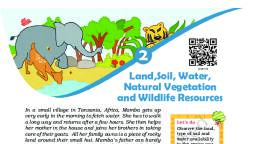
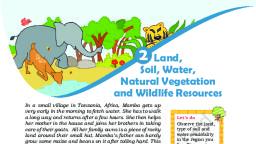
Land,Soil, Water,, Natural Vegetation, and Wildlife Resources, In a small village in Tanzania, Africa, Mamba gets up, very early in the morning to fetch water. She has to walk, a long way and returns after a few hours. She then helps, her mother in the house and joins her brothers in taking, care of their goats. All her family owns is a piece of rocky, land around their small hut. Mamba’s father can barely, grow some maize and beans on it after toiling hard. This, is not enough to feed their family for the whole year., Peter lives in the heart of the sheep rearing region in, New Zealand where his family runs a wool processing, factory. Everyday when he returns from school, Peter, watches his uncle taking care of their sheep. Their sheep, yard is situated on a wide grassy plain with hills in the, far distance. It is managed in a scientific way using the, latest technology. Peter’s family also grows vegetables, through organic farming., Mamba and Peter stay in two different parts of the, world and lead very different lives. This difference is, because of the differences in the quality of land, soil,, water, natural vegetation, animals and the usage of, technology. The availability of such resources is the, main reason places differ from each other., , Land, Land is among the most important natural resources., It covers only about thirty per cent of the total area of, the earth’s surface and all parts of this small percentage, are not habitable., The uneven distribution of population in different, parts of the world is mainly due to varied characteristics, of land and climate. The rugged topography, steep slopes, of the mountains, low-lying areas susceptible to water, , 2021–22, , Let’s do, Observe the land,, type of soil and, water availability, in the region you, live. Discuss in, your class, how it, has influenced the, lifestyle of people, there., , Do you know?, Ninety per cent, of the world, population, occupies only, thirty per cent of, land area. The, remaining seventy, per cent of the, land is either, sparsely populated, or uninhabited.
Page 2 :
logging, desert areas, thick, forested areas are normally, sparsely, populated, or, uninhabited. Plains and river, valleys offer suitable land for, agriculture. Hence, these are, the densely populated areas, of the world., , Land Use, Land is used for different, purposes such as agriculture,, Fig. 2.1: Salzburg in Austria, mining, building, Notice in how many ways the land has been used in the forestry,, above picture., houses, roads and setting up, of industries. This is commonly termed as Land use., Can you list out the different ways in which Mamba’s, and Peter’s family use their land?, The use of land is determined by physical factors, such as topography, soil, climate, minerals and, availability of water. Human factors such as population, and technology are also important determinants of land, use pattern., Land can also be classified on the basis of ownership, Let’s do, as – private land and community land. Private land, Talk to some, is owned by individuals whereas, community land, elderly person, is owned by the community for common uses like, in your family or, collection of fodder, fruits, nuts or medicinal herbs., neighbourhood and, These community lands are also called common, collect information, about changes, property resources., in the land use, People and their demands are ever growing but the, over the years, in, availability of land is limited. The quality of land also, the place where, differs from place to place. People started encroaching, you live. Display, the common lands to build up commercial areas,, your findings on a, bulletin board in, housing complexes in the urban areas and to expand, your classroom., the agricultural land in the rural areas. Today the, vast changes in the land use pattern also reflect the, cultural changes in our society. Land degradation,, landslides, soil erosion, desertification are the major, threats to the environment because of the expansion, of agriculture and construction activities., , 8, , Resources, , and, , Development, , 2021–22
Page 3 :
2., , 1., , 3., , 4., , Fig. 2.2: Change in land use over time, , Conservation, , of, , Land Resource, , Growing population and their ever growing demand has, led to a large scale destruction of forest cover and arable, land and has created a fear of losing this natural resource., Therefore, the present rate of degradation of land must, be checked. Afforestation, land reclamation, regulated, use of chemical pesticide and fertilisers and checks on, overgrazing are some of the common methods used to, conserve land resources., , Glossary, Weathering, The breaking, up and decay of, exposed rocks,, by temperature, changes, frost, action, plants,, animals and, human activity., , Soil, The thin layer of grainy substance covering the surface, of the earth is called soil. It is closely linked to land., Landforms determine the type of soil. Soil is made, up of organic matter, minerals and weathered rocks, found on the earth. This happens through the process, of weathering. The right mix of minerals and organic, matter make the soil fertile., , Land, Soil, Water, Natural Vegetation, , 2021–22, , and, , Wildlife Resources, , 9
Page 4 :
Landslides, , Landslides are simply defined as the mass movement, of rock, debris or earth down a slope. They often take, place in conjunction with earthquakes, floods and, volcanoes. A prolonged spell of rainfall can cause, heavy landslide that can block the flow of river for, quite some time. The formation of river blocks can, cause havoc to the settlements downstream on its, bursting. In the hilly terrain landslides have been a, major and widely spread natural disaster that often, strike life and property and occupy a position of major, concern., , A Landslide, , A Case Study, A massive landslide hit Pangi village near Reckong Peo in Kinnaur district of, Himachal Pradesh and damaged a 200-meter stretch of old Hindustan-Tibet, road, National Highway - 22. This landslide was triggered by intense blasting, at Pangi village. Due to the blasting this weak zone of slope collapsed and, caused intense damage to the road and nearby villages. The Pangi village was, completely vacated to avoid any possible loss of life., Mitigation Mechanism, Advancement in scientific techniques has empowered us to understand what, factors cause landslides and how to manage them. Some broad mitigation, techniques of landslide are as follows:, • Hazard mapping to locate areas prone to, landslides. Hence, such areas can be avoided, for building settlements., • Construction of retention wall to stop land from, slipping., • Increase in the vegetation cover to arrest, landslide., • The surface drainage control works to control, Retention Wall, the movement of landslide along with rain water, and spring flows., , 10, , Resources, , and, , Development, , 2021–22
Page 5 :
Top soil with humus and, vegetation, Do you know?, It takes hundreds, of years to make, just one centimetre, of soil., , Sub soil with sand, silt and, clay, Weathered rock material, Parent rock, , Fig. 2.3: Soil Profile, , Factors, , of, , Soil Formation, , The major factors of soil formation are the nature of, the parent rock and climatic factors. Other factors are, the topography, role of organic material and time taken, for the composition of soil formation. All these differ, from place to place., Parent Rock, Determines colour,, texture, chemical, properties, mineral, content,, permeability, , Relief, Altitude and, slope, determine, accumulation, of soil, , Soil, , Climate, Temperature,, Rainfall influence, rate of weathering, and humus, formation, , Flora, Fauna and, Micro-organism, Affect the rate of humus, formation, , Time, Determines thickness, of soil profile, , Fig. 2.4: Factors affecting soil formation, , Land, Soil, Water, Natural Vegetation, , 2021–22, , and, , Wildlife Resources, , 11
Page 6 :
Activity, In India soils, could be alluvial,, black, red, laterite,, desertic and, mountain soil., Collect a handful, of different, types of soil and, observe. How are, they different?, , Degradation, Measures, , 12, , Resources, , and, , Soil, , and, , Conservation, , Soil erosion and depletion are the major threats to soil, as a resource. Both human and natural factors can, lead to degradation of soils. Factors which lead to soil, degradation are deforestation, overgrazing, overuse of, chemical feritilisers or pesticides, rain wash, landslides, and floods., Some methods of soil conservation are listed below:, Mulching: The bare ground between plants is covered, with a layer of organic matter like straw. It helps to, retain soil moisture., Contour barriers: Stones, grass, soil are used to build, barriers along contours. Trenches are made in front of, the barriers to collect water., Rock dam: Rocks are piled up to slow down the flow of, water. This prevents gullies and further soil loss., , Fig 2.5: Terrace Farming, , Fig 2.7: Shelter Belts, , of, , Fig 2.6: Contour Ploughing, , Terrace farming: Broad flat steps or terraces are, made on the steep slopes so that flat surfaces are, available to grow crops. They reduce surface runoff and soil erosion (Fig. 2.5)., Intercropping: Different crops are grown in alternate, rows and are sown at different times to protect the, soil from rain wash., Contour ploughing: Ploughing parallel to the, contours of a hill slope to form a natural barrier, for water to flow down the slope (Fig. 2.6)., Shelter belts: In the coastal and dry regions, rows, of trees are planted to check the wind movement to, protect soil cover (Fig. 2.7)., , Development, , 2021–22
Page 7 :
Activity, Take two trays A and B of same, size. Make six holes at one end, of these trays and then fill them, with the same amount of soil., Leave the soil in tray A bare while, sow wheat or rice grains in tray, B. When the grain in tray B has, grown a few centimetres high,, place both the trays in such a, way that they are on a slope., Pour one mug of water from, the same height into each tray., Collect the muddy water that, trickles down the holes of both, trays in two separate containers, and compare how much soil, is washed out of each tray?, , A, , B, , Water, Water is a vital renewable natural resource. Threefourth’s of the earth’s surface is covered with water., It is therefore appropriately called the ‘water planet’., It was in the primitive oceans that life began almost, 3.5 billion years back. Even today, the oceans cover, two-thirds of the earth’s surface and support a rich, variety of plant and animal life. The ocean water is, however saline and not fit for human consumption., Fresh water accounts for only about 2.7 per cent. Nearly, 70 per cent of this occurs as ice sheets and glaciers in, Antarctica, Greenland and mountain regions. Due to, their location they are inaccessible. Only 1 per cent of, freshwater is available and fit for human use. It is found, as ground water, as surface water in rivers and lakes, and as water vapour in the atmosphere., Fresh water is therefore, the most precious substance, on earth. Water can neither be added nor subtracted, from the earth. Its total volume remains constant., Its abundance only seems to vary because it is in, constant motion, cycling through the oceans, the, air, the land and back again, through the processes, of evaporation, precipitation and run-off. This as, you already know is referred to as the ‘water cycle’., Land, Soil, Water, Natural Vegetation, , 2021–22, , Do you know?, In 1975, the, consumption of, water for human, use was 3850cu, km/year. It soared, to more than 6000, cu km/year in the, year 2000., , Do you know?, A dripping tap, wastes1200, litres of water in, a year., , and, , Wildlife Resources, , 13
Page 8 :
Humans use huge amounts of water not only for, drinking and washing but also in the process of, production., Water, for, agriculture,, industries,, generating electricity, through reservoirs of, Activity, dams are the other, An average urban Indian uses about 150 litres, usages., Increasing, of water every day., population,, rising, Use, Litres per person per day, demands for food and, Drinking, 3, cash crops, increasing, Cooking, 4, urbanisation and rising, Bathing, 20, standards of living, Flushing, 40, Washing clothes, 40, are the major factors, Washing utensils, 20, leading to shortages in, Gardening, 23, supply of fresh water, Total, 150, either due to drying, Can you suggest some ways to bring down this amount?, up of water sources or, water pollution., Do you know?, Have you ever, heard about a water, market? Amreli, city in Saurastra, region with a, population of 1.25, lakhs is completely, dependent on, purchasing water, from the nearby, talukas., , Problems, , of, , Water Availability, , There is scarcity of water in many regions of the world., Most of Africa, West Asia, South Asia, parts of western, USA, north-west Mexico, parts of South America and, entire Australia are facing shortages in fresh water supply., Countries located in climatic zones most susceptible to, droughts face great problems of water scarcity. Thus,, water shortage may be a consequence of variation in, seasonal or annual precipitation or the scarcity is caused, by over-exploitation and contamination of water sources., , Conservation, Resources, , Fig 2.8: River Yamuna is getting polluted due, to sewage, industrial effluents and garbage, 14, , Resources, , and, , of, , Water, , Access to clean and adequate water, sources is a major problem facing the, world today. Steps have to be taken to, conserve this dwindling resource. Even, though water is a renewable resource, its, overuse and pollution make it unfit for, use. Discharge of untreated or partially, treated sewage, agricultural chemicals, and industrial effluents in water bodies, are major contaminants. They pollute, water with nitrates, metals and pesticides., , Development, , 2021–22
Page 9 :
Most of these chemicals are non-biodegradable and, reach human bodies through water. Water pollution can, be controlled by treating these effluents suitably before, releasing them in water bodies., Forest and other vegetation cover slow the, surface runoff and replenish underground, water. Water harvesting is another method, to save surface runoff. The canals used, for irrigating field should be properly, lined to minimise losses by water seepage., Sprinklers effectively irrigate the area by, checking water losses through seepage and, evaporation. In dry regions with high rates, of evaporation, drip or trickle irrigation is, Fig 2.9: A Water Sprinkler, very useful. The valuable water resource, can therefore be conserved by adopting, these means of irrigation., Do you know?, , Natural Vegetation, , and, , Rain water, harvesting is, the process of, collecting rain, water from roof, tops and directing, it to an appropriate, location where, it is stored for, future use. On an, average, one spell, of rain for two, hours is enough to, save 8,000 litres of, water., , Wildlife, , Some school children were visiting an exhibition on, handicrafts. The articles in the exhibition were collected, from different parts of the country. Mona picked up a bag, and exclaimed, “This is a beautiful handbag!” “Yes, it, is made from Jute,” the teacher said. “Do you see those, baskets, lamp shades and chairs? Those are made of, canes and bamboos. In the eastern and north eastern, humid regions of India, bamboo grows in plenty.” Jassy, was excited to see a silk scarf. “See this beautiful, scarf”. The teacher explained that silk is obtained from, silk worms that are bred on Mulberry trees. The children, understood that plants provide us with many different, products that we use in our day-to-day life., Natural vegetation and wildlife exist only, in the narrow zone of contact between the, lithosphere, hydrosphere and atmosphere, that we call biosphere. In the biosphere living, beings are inter-related and interdependent, on each other for survival. This life supporting, system is known as the ecosystem. Vegetation, and wildlife are valuable resources. Plants, provide us with timber, give shelter to animals,, produce oxygen we breathe, protects soils so, , Fig 2.10: Silk Worms, , Land, Soil, Water, Natural Vegetation, , 2021–22, , and, , Wildlife Resources, , 15
Page 10 :
Do you know?, Vultures in, the Indian, subcontinent were, dying of kidney, failure shortly, after scavenging, livestock treated, with diclofenac, a, painkiller that is, similar to aspirin, or ibuprofen., Efforts are on to, ban the drug for, livestock use and, breed vultures in, captivity., , essential for growing crops,, act as shelter belts, help, in storage of underground, water, give us fruits, nuts,, latex, turpentine oil, gum,, medicinal plants and also, the paper that is so essential, for your studies. There are, innumerable uses of plants, and you can add some more., Wildlife includes animals,, birds, insects as well as the, aquatic life forms. They provide, us milk, meat, hides and wool., Fig 2.11: Brahma Kamal, Insects like bees provide us, a Medicinal Herb, honey, help in pollination of, flowers and have an important, role to play as decomposers, in the ecosystem. The birds, feed on insects and act as, decomposers as well. Vulture, due to its ability to feed on dead, livestock is a scavenger and, considered a vital cleanser of, the environment. So animals, big or small, all are integral Fig 2.12: A Blue Kingfisher, to maintaining balance in, the ecosystem., , Distribution, , of, , Natural Vegetation, , The growth of vegetation depends primarily on, temperature and moisture. The major vegetation, types of the world are grouped as forests,, grasslands, scrubs and tundra., In areas of heavy rainfall, huge trees, may thrive. The forests are thus associated, with areas having abundant water supply., As the amount of moisture decreases the, size of trees and their density reduces., Short stunted trees and grasses grow in, the regions of moderate rainfall forming the, grasslands of the world. Thorny shrubs and, Fig. 2.13: Grassland and Forest, 16, , Resources, , and, , Development, , 2021–22
Page 11 :
scrubs grow in dry areas of low rainfall., In such areas plants have deep roots and, leaves with thorny and waxy surface, reduce loss of moisture through, transpiration. Tundra vegetation of, cold Polar Regions comprise of mosses, and lichens., Today there are many more people in, the world than there were two centuries, back. To feed the growing numbers,, large areas of forests have been cleared, to grow crops. Forest cover all over the, world is vanishing rapidly. There, is an urgent need to conserve, this valuable resource., , Fig. 2.14: A Python in a forest, , Conservation of Natural, Vegetation and Wildlife, Forests are our wealth. Plants, give shelter to the animals and, together they maintain the, ecosystem. Changes of climate, and human interferences can, cause the loss of natural habitats, for the plants and animals. Many, species have become vulnerable Fig. 2.15: A collage of a forest made by school students, or endangered and some are, on the verge of extinction. Deforestation,, soil erosion, constructional activities, forest, fires, tsunami and landslides are some of the, human and natural factors which accelerate, the process of extinction of these resources., One of the major concerns is the poaching, which result in a sharp decline in the number, of particular species. The animals are poached, for collection and illegal trade of hides, skins,, nails, teeth, horns as well as feathers. Some, of these animals are tiger, lion, elephant,, deer, black buck, crocodile, rhinoceros, snow, Fig. 2.16: Loss of rainforest in, Great Nicobar after Tsunami, , Land, Soil, Water, Natural Vegetation, , 2021–22, , and, , Wildlife Resources, , 17
Page 12 :
Fig. 2.17: Black buck also needs protection, , leopard, ostrich and peacock. These can be, conserved by increasing awareness., National parks, wildlife sanctuaries,, biosphere reserves are made to protect our, natural vegetation and wildlife. Conservation, of creeks, lakes, and wetlands is necessary to, save the precious resource from depletion, There is a balance in the environment, if the relative number of species is not, disturbed. Human activities in several parts, of the world have disturbed the natural, Forest Fire, , Activity, Read the news item and find out how fire started in California ? Could it be avoided?, Know More, Forest fire is a threat to the entire region of fauna and flora. It occurs mainly due to, three reasons :, 1. Natural fire due to lightening etc., 2. Fire due to heat generated in the litter due to carelessness of people., 3. Fire purposely caused by local inhabitants, mischief makers, miscreants etc., Some Control Measures, 1. Prevention of fires through education., 2. Prompt detection of fires through well co-ordinated network of observation points,, efficient ground patroling and communication network. , 18, , Resources, , and, , Development, , 2021–22
Page 13 :
habitats of many species. Due to indiscriminate killings,, several birds and animals have either become extinct or, are on the verge of extinction., Awareness programmes like social forestry and, Vanamohatasava should be encouraged at the regional, and community level. School children should be, encouraged to bird watch and visit nature camps so, that they appreciate the habitat of varied species., Many countries have passed laws against the trade, as well as killing of birds and animals. In India, killing, lions, tigers, deers, great Indian bustards and peacocks, is illegal., An international convention CITES has, been established that lists several species, of animals and birds in which trade is, prohibited. Conservation of plants and, animals is an ethical duty of every citizen., , Glossary, National Park, A natural area, designated to, protect the, ecological integrity, of one or more, ecosystems for the, present and the, future generations, , Fig. 2:18: A Herd of Cheetals, Glossary, Biosphere reserves, Series of protected, areas linked, through a global, network, intended, to demonstrate, the relationship, between, conservation and, development., , Fig. 2:19: A herd of Elephants in Kaziranga, National Park, , Do you know?, CITES (the Convention on International Trade in Endangered Species, of Wild Fauna and Flora) is an international agreement between, governments. It aims to ensure that international trade in specimens of, wild animals and plants does not threaten their survival. Roughly 5,000, species of animals and 28,000 species of plants are protected. Bears,, dolphins, cacti, corals, orchids and aloes are some examples., , Land, Soil, Water, Natural Vegetation, , 2021–22, , and, , Wildlife Resources, , 19
Page 14 :
Exercises, 1. Answer the following questions., (i) Which are the two main climatic factors responsible for soil formation?, (ii) Write any two reasons for land degradation today., (iii) Why is land considered an important resource?, (iv) Name any two steps that government has taken to conserve plants, and animals., , (v) Suggest three ways to conserve water., 2. Tick the correct answer., (i) Which one of the following is NOT a factor of soil formation?, (a) time, , (b) soil texture, , (c) organic matter, , (ii) Which one of the following methods is most appropriate to check, soil erosion on steep slopes?, (a) shelter belts, , (b) mulching, , (c) terrace cultivation, , (iii) Which one of the following is NOT in favour of the conservation, of nature?, (a) switch off the bulb when not in use, (b) close the tap immediately after using, (c) dispose polypacks after shopping, 3. Match the followings :, (i) Land use, (ii) Humus, (iii) Rock dams, (iv) Biosphere, , , (a) prevent soil erosion, (b) narrow zone of contact between the lithosphere,, hydrosphere and atmosphere, (c) productive use of land, (d) organic matter deposited on top soil, (e) contour ploughing, , 4. State whether the given statement is true or false., If true, write the reasons., (i) Ganga–Brahmaputra plain of India is an overpopulated region., (ii) Water availability per person in India is declining., (iii) Rows of trees planted in the coastal areas to check the wind , movement is called intercropping., (iv) Human interference and changes of climate can maintain the, ecosystem., 5. Activity, Discuss some more reasons which are responsible for changes of land use pattern., Has your place undergone any change in the land use pattern in recent years?, , 20, , Resources, , and, , Development, , 2021–22
Page 15 :
Find out from your parents and elderly people. You can conduct an interview by, asking the following questions., Place, , When your, When your, grand, parents were, parent’s were in their 30’s, in their 30’s, , Why do you, think this is, happening?, , Are common, areas and, open spaces, disappearing?, , Rural, Number of, cattle and, poultry owned, Number of, trees and, ponds in the, village, Main, occupation of, the head of, the family, Urban, Number of, cars owned, Number of, rooms in the, house, Number of, metalled, roads, Number of, flyovers in the, city, Number of, parks and, playgrounds, Based on the table you have just completed, draw a picture of land use patterns, that you foresee in your neighbourhood after 20 years. Why do you think that land, use patterns change over the years?, , Land, Soil, Water, Natural Vegetation, , 2021–22, , and, , Wildlife Resources, , 21