Page 1 :
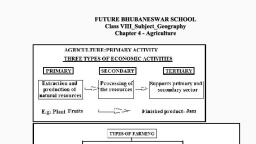
Agriculture, , Gurpreet, Madho and Tina were walking through, the village where they saw a farmer tilling land. The, farmer told them that he was growing wheat and had, just added manure to the soil to make it more fertile., He told the children that the wheat would fetch a, good price in the mandi from where it would be taken, to factories to make bread and biscuits from flour., This transformation from a plant to a finished, product involves three types of economic activities., These are primary, secondary and tertiary activities., , Word Origin, The word, agriculture is, derived from Latin, words ager or agri, meaning soil and, culture meaning,, cultivation., , Primary activities include all those connected, with extraction and production of natural resources., Agriculture, fishing and gathering are good examples., Secondary activities are concerned with the processing, of these resources. Manufacturing of steel, baking of, bread and weaving of cloth are examples of this activity., Tertiary activities provide support to the primary and, secondary sectors through services. Transport, trade,, banking, insurance and advertising are examples of, tertiary activities., Agriculture is a primary activity. It includes growing, crops, fruits, vegetables, flowers and rearing of livestock., In the world, 50 per cent of persons are engaged in, agricultural activity. Two-thirds of India’s population is, still dependent on agriculture., Favourable topography of soil and climate are vital, for agricultural activity. The land on which the crops, are grown is known as arable land (Fig. 4.1). In the map, you can see that agricultural activity is concentrated in, those regions of the world where suitable factors for the, growing of crops exist., , 2021–22
Page 2 :
Fig. 4.1: World Distribution of Arable Land, , Do you know?, Agriculture, The science and art of cultivation on the soil, raising, crops and rearing livestock. It is also called farming., , Agri, Seri, + Culture, , Pisci, Viti, Horti, , Sericulture, Commercial rearing of silk worms. It may supplement the, income of the farmer., Pisciculture, Breeding of fish in specially constructed tanks and ponds., Viticulture, Cultivation of grapes., Horticulture, Growing vegetables, flowers and fruits for commercial use., , Farm System, Agriculture or farming can be looked at as a system. The, important inputs are seeds, fertilisers, machinery and, Agriculture, , 2021–22, , 39
Page 3 :
Inputs, , Processes, , Physical Inputs, , Outputs, , Rainfall, , Sunshine, , Human, Inputs, , Machinery, , Temperature, , Soil, , Slope, , Storage, Crops, , Seeds, , Labour, Machinery, , Ploughing, Sowing, Spraying, , Chemicals, , Chemicals, , Fig 4.2: The farm system of an arable farm, , Fig 4.3: Physical and human farm inputs, , labour. Some of the operations involved are ploughing,, sowing, irrigation, weeding and harvesting. The outputs, from the system include crops, wool, dairy and poultry, products., , Types Of Farming, Interesting Fact, Organic Farming, In this type of, farming, organic, manure and, natural pesticides, are used instead, of chemicals., No genetic, modification is, done to increase, the yield of the, crop., , Farming is practised in various ways across the world., Depending upon the geographical conditions, demand, of produce, labour and level of technology, farming can, be classified into two main types. These are subsistence, farming and commercial farming., , Subsistence Farming, This type of farming is practised to meet the needs of the, farmer’s family. Traditionally, low levels of technology, and household labour are used to produce on small, output. Subsistence farming can be further classified, as intensive subsistence and primitive subsistence, farming., In intensive subsistence agriculture the farmer, cultivates a small plot of land using simple tools and, more labour. Climate with large number of days with, sunshine and fertile soils permit growing of more than, one crop annually on the same plot. Rice is the main, crop. Other crops include wheat, maize, pulses and, oilseeds. Intensive subsistence agriculture is prevalent, in the thickly populated areas of the monsoon regions, of south, southeast and east Asia., , 40, , Resources, , and, , Development, , 2021–22
Page 4 :
Primitive subsistence agriculture includes shifting, cultivation and nomadic herding., Shifting cultivation is practised in the thickly, forested areas of Amazon basin, tropical Africa, parts of, southeast Asia and Northeast India. These are the areas, of heavy rainfall and quick regeneration of vegetation., A plot of land is cleared by felling the trees and burning, them. The ashes are then mixed with the soil and crops, like maize, yam, potatoes and cassava are grown. After, the soil loses its fertility, the land is abandoned and the, cultivator moves to a new plot. Shifting cultivation is, also known as ‘slash and burn’ agriculture., , Do you know?, Shifting cultivation, is known by, different names in, different parts of, the world, Jhumming North-East India, Milpa -Mexico, Roca - Brazil., Ladang - Malaysia, , Nomadic herding is practised in the semi-arid, and arid regions of Sahara, Central Asia and some, parts of India, like Rajasthan and Jammu and, Kashmir. In this type of farming, herdsmen, move from place to place with their animals for, fodder and water, along defined routes. This, type of movement arises in response to climatic, constraints and terrain. Sheep, camel, yak and, goats are most commonly reared. They provide, milk, meat, wool, hides and other products to, the herders and their families., Fig 4.4: Nomadic Herders with, their camels, , Commercial Farming, In commercial farming crops are grown and, animals are reared for sale in market. The area, cultivated and the amount of capital used is, large. Most of the work is done by machines., Commercial farming includes commercial, grain farming, mixed farming and plantation, agriculture (Fig 4.5)., In commercial grain farming crops are grown, for commercial purpose. Wheat and maize are, common commercially grown grains. Major, areas where commercial grain farming is, pracised are temperate grasslands of North America,, Europe and Asia. These areas are sparsely populated, with large farms spreading over hundreds of hectares., Severe winters restrict the growing season and only a, single crop can be grown., , Fig 4.5: A Sugarcane, plantation, , In mixed farming the land is used for growing, food and fodder crops and rearing livestock., Agriculture, , 2021–22, , 41
Page 5 :
It is practised in Europe, eastern USA, Argentina,, southeast Australia, New Zealand and South Africa., Plantations are a type of commercial farming, where single crop of tea, coffee, sugarcane, cashew,, rubber, banana or cotton are grown. Large amount, of labour and capital are required. The produce may, be processed on the farm itself or in nearby factories., The development of a transport network is thus, essential for such farming., Major plantations are found in the tropical, regions of the world. Rubber in Malaysia, coffee, in Brazil, tea in India and Sri Lanka are some, examples., Fig 4.6 : A Banana Plantation, , Major Crops, A large variety of crops are grown to meet the, requirement of the growing population. Crops also, supply raw materials for agro based industries., Major food crops are wheat, rice, maize and, millets. Jute and cotton are fibre crops. Important, beverage crops are tea and coffee., , Rice: Rice is the major food crop of the world. It, , Fig 4.7: Rice Cultivation, , Fig 4.8: Wheat Harvesting, , is the staple diet of the tropical and sub-tropical, regions. Rice needs high temperature, high, humidity and rainfall. It grows best in alluvial, clayey soil, which can retain water. China leads in, the production of rice followed by India, Japan, Sri, Lanka and Egypt. In favourable climatic conditions, as in West Bengal and Bangladesh two to three, crops are grown in a year., , Wheat: Wheat requires moderate temperature and, rainfall during growing season and bright sunshine, at the time of harvest. It thrives best in well drained, loamy soil. Wheat is grown extensively in USA,, Canada, Argentina, Russia, Ukraine, Australia, and India. In India it is grown in winter., Millets: They are also known as coarse grains and, , Fig 4.9: Bajra Cultivation, 42, , Resources, , and, , can be grown on less fertile and sandy soils. It is, a hardy crop that needs low rainfall and high to, , Development, , 2021–22
Page 6 :
moderate temperature and adequate rainfall. Jowar,, bajra and ragi are grown in India. Other countries are, Nigeria, China and Niger., Maize requires, moderate temperature,, rainfall and lots of, sunshine., It, needs, well-drained fertile soils., Maize is grown in North, America, Brazil, China,, Russia, Canada, India,, and Mexico., , Maize:, , Fig 4.10: Maize Cultivation, , Do you know?, Maize is also know, as corn. Various, colourful varieties, of maize are found, across the world., , Cotton: Cotton requires, , high temperature, light, rainfall, two hundred, and ten frost-free days, and bright sunshine for, its growth. It grows best, on black and alluvial, Fig 4.11: Cotton Cultivation, soils. China, USA, India,, Pakistan, Brazil and Egypt are the leading producers of, cotton. It is one of the main raw materials for the cotton, textile industry., , Jute: Jute was also known as the ‘Golden Fibre’. It grows, , well on alluvial soil and requires high temperature,, heavy rainfall and humid climate. This crop is grown in, the tropical areas. India and, Bangladesh are the leading, producers of jute., , Coffee: Coffee requires warm, , and wet climate and welldrained loamy soil. Hill slopes, are more suitable for growth, of this crop. Brazil is the, leading producer followed by, Fig 4.12: Coffee Plantation Columbia and India., , Interesting Fact, Who discovered, the Coffee Plant?, There are different, versions about, the discovery of, coffee. In about, AD 850, Kaldi, an, Arab goat-herder,, who was puzzled, by the queer antics, of his flock, tasted, the berries of the, evergreen bush on, which the goats, were feeding., On experiencing, a sense of, exhilaration, he, proclaimed his, discovery to the, world., , Tea: Tea is a beverage crop grown on plantations. This, , requires cool climate and well distributed high rainfall, throughout the year for the growth of its tender leaves., Agriculture, , 2021–22, , 43
Page 7 :
It needs well-drained loamy soils and gentle, slopes. Labour in large number is required to, pick the leaves. Kenya, India, China, Sri Lanka, produce the best quality tea in the world., , Agricultural Development, , Fig 4.13: Tea Plantation, , Do you know?, Food security, exists when all, people, at all, times, have access, to sufficient, safe, and nutritious, food to meet their, dietary needs and, food preferences, for an active and, healthy life., , Agricultural Development refers to efforts, made to increase farm production in order, to meet the growing demand of increasing, population. This can be achieved in many ways such as, increasing the cropped area, the number of crops grown,, improving irrigation facilities, use of fertilisers and high, yielding variety of seeds. Mechanisation of agriculture, is also another aspect of agricultural development. The, ultimate aim of agricultural development is to increase, food security., Agriculture has developed at different places in different, parts of the world. Developing countries with large, populations usually practise intensive agriculture where, crops are grown on small holdings mostly for subsistence., Larger holdings are more suitable for commercial agriculture, as in USA, Canada and Australia. With the help of two case, studies of farms — one from India and the other from the, USA, let us understand about agriculture in the developing, and a developed country., , A Farm in India, , There is a small village Adilabad in Ghazipur district of, Uttar Pradesh. Munna Lal is a small farmer in this village, who has farmland of about 1.5 hectares. His house is in, the main village. He purchases high yielding varieties of, seeds from the market every alternate year. The, land is fertile and he grows atleast two crops, in a year which are normally wheat or rice and, pulses. The farmer takes advice of his friends, and elders as well as government agricultural, officers regarding farming practices. He takes, a tractor on rent for ploughing his field, though, some of his friends still use traditional method, of using bullocks for ploughing. There is a, tubewell in the nearby field which he takes on, Fig 4.14: Farmers ploughing, rent to irrigate his field., a field, , 44, , Resources, , and, , Development, , 2021–22
Page 8 :
Munna Lal also has two buffaloes and few hens. He, sells milk in the cooperative store located in the nearby, town. He is a member of the co-operative society which, also advises him on the type of fodder for his animals,, safety measures to protect the health of the livestock, and artificial insemination., All the members of the family help him, in various farm activities. Sometimes, he, takes credit from a bank or the agricultural, co-operative society to buy HYV seeds and, implements., He sells his produce in the mandi located, in the nearby town. Since majority of the, farmers do not have lack storage facilities,, they are forced to sell the produce even, when the market is not favourable to them. Fig 4.15: An Agricultural Field in India, In recent years, the government has taken, some steps to develop storage facilites., , A Farm in the USA, The average size of a farm in the USA is much, larger than that of an Indian farm. A typical, farm size in the USA is about 250 hectares., The farmer generally resides in the farm., Some of the major crops grown are corn,, soyabean, wheat, cotton and sugarbeet., Joe Horan, a farmer in the Midwest USA, in, Iowa State owns about 300 hectares of land., He grows corn on his field after making sure, Fig 4.16: A Farm in the USA, that soil and water resources meet the needs, of this crop. Adequate measures are taken to control, pests that can damage the crop. From time to time, he sends the soil samples to a soil testing laboratory, to check whether, the, nutrients are sufficient or, not. The results help Joe, Horan to plan a scientific, fertiliser programme. His, computer is linked to the, satellite which gives him, a precise picture of his, field. This helps him to, Fig 4.17: Spray of Pesticides, use chemical fertilisers, Agriculture, , 2021–22, , 45
Page 9 :
Fig 4.18: Mechanised Harvesting in the USA, , and pesticides wherever they are required., He uses tractors, seed drills, leveller,, combined harvester and thresher to perform, various agricultural operations. A grains are, stored in the automated grain storage or, despatched to market agencies. The farmer, in USA works like a businessman and not, like a peasant farmer., , Exercises, 1. Answer the following questions., (i) What is agriculture?, (ii) Name the factors influencing agriculture?, (iii) What is shifting cultivation? What are its disadvantages?, (iv) What is plantation agriculture?, (v) Name the fibre crops and name the climatic conditions required for their, growth., 2. Tick the correct answer., (i) Horticulture means, (a) growing of fruits and vegetables, (c) growing of wheat, (ii) Golden fibre refers to, (a) tea, (b) cotton, (iii) Leading producers of coffee, (a) Brazil, (b) India, , (b) primitive farming, , (c) jute, (c) Russia, , 3. Give reasons., (i) In India agriculture is a primary activity., (ii) Different crops are grown in different regions., 4. Distinguish between the followings., (i) Primary activites and tertiary activities, (ii) Subsistence farming and intenstive farming., 5. Activity, (i) Collect seeds of wheat, rice, jowar, bajra, ragi, maize, oilseeds and pulses, available in the market. Bring them to the class and find out in which type, of soil they grow., (ii) Find out the difference between the life style of farmers in the USA and, India on the basis of pictures collected from magazines, books, newspapers, and the internet., , 46, , Resources, , and, , Development, , 2021–22
Page 10 :
6. For Fun, , 1, , Solve the crossword puzzle with, the help of given clues., 2, , 3, 4, , 6, , 5, , 8, , 7, 9, 10, , 11, 13, , 12, , 14, , Across, , Down, , 1. Crop that needs well drained fertile, soils, moderate temperatures and, lots of sunshine (5), , 1. Coarse grains are also called (7), , 2. Increasing production through use, of HYV seeds, chemical fertilisers, and pesticides (5,10), , 5. Growing of crops,, vegetables (11), , 3. Cultivation involving slash and, burn (8), and, , 6. Tea, coffee, sugarcane and rubber, are grown in (11), , 4. USA, Canada, Russia, Australia are, major producers of this crop (5), , 7. Requires 210 frost-free days for, growth (6), , 10. Type of farming to meet family, needs (11), , 8. Growing of flowers (12), , 13. Rearing of animals for sale (9), 14. Growing grapes for wines (11), , fruits, , 9. Also called ‘Golden Fibre’ (4), 11. Also known as paddy (4), 12. Activity concerned with extraction, of natural resources (7), Agriculture, , 2021–22, , 47