Page 1 :
GURU SHREE SHANTIVIJAY JAIN VIDYALAYA, SOCIAL SCIENCE NOTES, Class: VIII, , Agriculture, , Answer the following questions, 1.Commercial rearing of silk worms is known as, Answer: sericulture, 2.What per cent of persons are engaged in agricultural activity in the world?, Answer:50%, 3.Shifting cultivation is also known as Milpa in which part of the world., Answer: Mexico, 4.In which type of farming is the land used for growing food and fodder crops and rearing livestock?, Answer: Mixed farming, 5.…………… is a type of commercial farming where single crop of tea, coffee, sugarcane etc are grown?, Answer: Plantation, 6.Which one of the following is known as paddy crop?, Answer: Rice, 7.What is another name of shifting agriculture in Mexico?, Answer: Milpa, 8.Which agriculture is referred as Slash and Burn agriculture?, Answer: Shifting agriculture, 9.Who is the Leading producer of coffee?, Answer: Brazil, 10. What do you mean by Horticulture?, Answer: Growing fruits, flowers and vegetables., 11.Where does the word ‘agriculture’ originated from?, Answer: The word agriculture originated from the Latin term ‘agri’ meaning soil and ‘culture’, meaning cultivation. Thus, the term means cultivation of soil., 12.What are tertiary activities?, Answer: Provide support to primary and secondary activities, 13.What is the science of commercial rearing of silk worms called?, Answer: Sericulture, 14.What is horticulture?, Answer: Growing vegetables, flowers and fruits for commercial use is known as horticulture., 15.Why is different crops grown in different regions of our country?, Answer: Our country has different climatic conditions, terrain and different of soil types in different, areas and therefore different crops are grown in various regions of India.
Page 2 :
Match the following:, 1., Column-I, Column-II, 1. Commercial grain farming (a) No genetic modification is done., 2. Organic farming, (b) Brazil, (c) Growing vegetables, flowers and fruits for commercial use., 3. Horticulture, 4. Viticulture, 5. Roca, , (d) Crops are grown for commercial purpose., (e) Cultivation of grapes., , Answer:, Column-I, Column-II, 1. Commercial grain farming (d) Crops are grown for commercial purpose., 2. Organic farming, (a) No genetic modification is done., (c) Growing vegetables, flowers and fruits for commercial use., 3. Horticulture, 4. Viticulture, (e) Cultivation of grapes., 5. Roca, (b) Brazil, Fill in the blanks, 1………………. of fish in specially constructed tanks and ponds is termed as Pisciculture., Answer: Breeding, 2.Cultivation of grapes is termed as ………………………., Answer: viticulture, 3.In………………. farming crops are grown and animals are reared for sale in market., Answer: commercial, 4.Tea is a …………………crop grown on plantations., Answer: beverage, 5.Maize is also known as ………………………., Answer: corn, Picture Based Questions, 1., , (i), , What is shown in the above figure?, , (ii) Which, , method is used in the picture for the purpose of ploughing?
Page 3 :
Answer:, (i) Farmers ploughing a field is shown., (ii) Traditional method is used., 2., , (i), , What type of plantation is shown in the above picture?, (ii) ii) Who had discovered these?, Answer:, (i) Coffee plantation., (ii) Kaldi, an Arab goat – herder, had discovered the coffee plant., Map Skills, 1.On an outline Map of World mark, the following countries where Maize is grown:, (i) North America (ii) Brazil (iii) China (iv) Russia (v) Canada (vi) India (vii) Mexico, Answer:
Page 4 :
2., , Mark the countries where cotton is grown suitably on the outline Map of World., (i) China (ii) USA (iii) India (iv) Pakistan (v) Brazil (vi) Egypt, Answer:, , 3., , Mark the countries on an outline Map of World showing major plantations found in the tropical, regions of the world., (i) Rubber in Malaysia (ii) Coffee in Brazil (iii) Tea in India, Answer:
Page 5 :
Book Exercise Questions, 1. Answer the following questions., (i) What is agriculture?, Answer: Agriculture is a primary activity, as it is connected with the extraction and production of natural, resources., (ii) Name the factors influencing agriculture., Answer: The factors that influence agriculture include soil, climate, topography, population etc., (iii) What is shifting cultivation? What are its disadvantages?, Answer: Shifting cultivation is also known as Slash-and-burn cultivation. It is a type of farming activity which, involves clearing of a land plot by cutting down trees and burning them. The ashes are then mixed with the soil, and crops are grown. After the land has lost its fertility, it is abandoned. The farmers then move to a new place., Disadvantages of shifting cultivation:, , , Leads to deforestation, , , , Loss of fertility of a particular land, , , , Leads to Soil erosion, , , , Burning of trees causes air pollution, , , , Insufficient cultivation of crops for a large population., , (iv) What is plantation agriculture?, Answer: Plantations are a type of commercial farming where single crops of tea, coffee, sugarcane, cashew,, rubber, banana or cotton are grown. Major plantations are found in the tropical regions of the world. Rubber in, Malaysia, coffee in Brazil, tea in India and Sri Lanka are some examples., (v) Name the fibre crops and name the climatic conditions required for their growth., Answer: Jute and Cotton are fibre crops., The climatic conditions necessary for the growth of Jute are:, , , High temperature, , , , Heavy rainfall and high humidity., Similarly, for the growth of cotton climatic conditions are:, , , , High temperature, , , , Light rainfall, , , , Bright sunshine is required., , 2. Tick the correct answer., (i) Horticulture means, (a) growing of fruits and vegetables, (b) primitive farming, (c) growing of wheat, Answer: (a) Growing of fruits and vegetables, (ii) Golden fiber refers to, (a) tea, (b) cotton, (c) jute
Page 6 :
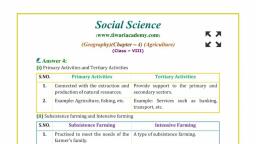
Answer: (c) Jute, (iii) Leading producers of coffee, (a) Brazil, (b) India, (c) Russia, Answer: (a) Brazil, 3. Give reasons., (i) In India agriculture is a primary activity., Answer: Agriculture is a primary activity because many regions in India have fertile land that is favourable for, agriculture. Two-thirds of the Indian population still depend on agriculture. This is mainly because of the lack of, literacy among the people. Hence, India being a densely populated country requires large scale production of, food to fulfil the people needs., (ii) Different crops are grown in different regions., Answer Different crops are grown in different regions because growing the crops depends on factors such as, favourable topography of soil, demand of produce, type of climate, amount of rainfall, technology and labour., 4. Distinguish between the following., (i) Primary activities and tertiary activities, , Primary Activities, 1.It involves the extraction and production of, natural resources., , Tertiary Activities, , 1. No production of goods is involved., , 2. It provides raw materials., , 2. It provides services and supports primary, and secondary sectors., , 3. Examples: Agriculture, mining, fishing, and animal husbandry etc., , 3. Examples: Banking and transport services, , (iii)Subsistence Farming and Intensive Farming., , Subsistence Farming, 1. It involves farming on a small scale., 2. The farmers grow food for their own families, and use a small amount of land and household, labour and low levels of technology., , Subsistence Farming, 1. This kind of farming is done at a, larger scale to gain some profit., , 2. It utilizes large land and a high level, of technology.