Page 1 :
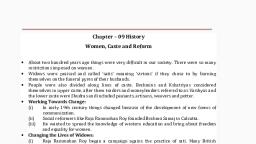
KAMARAJ INTERNATIONAL ACADEMY(CBSE), GRADE:8 SUB: SOCIAL -HISTORY, , Chapter ov Women, Caste And Reform, , , , Topic-wise Questions, Working Towards Change, 1. (a) All men and women can vote and contest elections, (b) Widows can remarry, (c) Girls and boys can go to school, (d) They can take up any job of their choice., 2. (a) Most children were married off at an early age., (b) Widows were praised if they chose death by burning themselves on the funeral pyre of their husbands., (c) Women’s rights to property were restricted., (d) Women had no access to education as it was believed that an educated woman will become a widow., 3. caste 4. Brahmans, Kshatriyas 5. traders, moneylenders 6. shudras, , 7. The upper castes treated many of these groups at the bottom as “untouchables”. They were not allowed to enter, temples, draw water from the wells used by the upper castes, or bathe in ponds where upper castes bathed. They, were seen as inferior human beings., , 8. The development of anew form of communication like books, newspapers, magazines, leaflets and pamphlets led, to debates and discussions about social customs and practices., , 9. The new forms of communication were far cheaper and easily accessible. People could express their ideas in their, own languages. All kinds of issues — social, political, economic and religious could now be debated and discussed., , 10. Brahmo Samaj, , 11. Reformers were those who felt that unjust practices needed to be done away with and changes were necessary in, society. They thought that the best way to ensure such changes was by persuading people to give up old practices, and adopt a new way of life., , 12. He was keen to spread the knowledge of Western education in the country and bring about greater freedom and, equality for women., , Changing the lives of widows, 1, He was deeply moved by the problems faced by the widows in their lives., Sanskrit. Persian, Indian, European, Ishwarchandra Vidyasagar, boycotted, Madras, , wee yy, , Swami Dayanand Saraswati, , Girls begin going to school, 1. (a) They feared that schools would take girls away from home, prevent them from doing their domestic duties., , (b) Girls would have to travel through public places in order to reach school. They felt that girls should stay away, from public spaces., , (c) Many felt that this would have a corrupting influence on them., 2. Aamar Jiban, 3. Koran
Page 2 :
‘Women write about women, , 1, 3., 5., , Bhopal 2. Rokeya Sakhawat Hossain, , Stripurushtuina 4. Pandita Ramabai, , They wrote books, edited magazines, founded schools and training centres, and set up women’s associations. From, the early twentieth century, they formed political pressure groups to push through laws for female suffrage, better, , health care and education for women. Some of them joined various kinds of nationalist and socialist movements, from the 1920s., , Caste and Social Reform, , 1, , 4., 5., , Buddhist, , To work for the abolition of caste., , (a) There were various jobs coming up in the cities in the factories and municipalities., , (b) The cities were expanded., , (c) Drains had to be dug, roads laid, buildings constructed and cities cleaned. This required coolies, diggers, carriers,, bricklayers, sewage cleaners, sweepers, palanquin bearers, rickshaw pullers, etc., , Assam, Mauritius, Trinidad, Indonesia, , In spite of hard working conditions in the plantations, people, especially the poor from the low caste, worked there, because they saw it an opportunity to get away from the oppressive hold that upper caste landholders exercised, over their lives and the daily humiliation they suffered., , Demands for equality and justice, , 1. caste, social equlaity, justice 2. Ghasidas, , 3. Chandala 4. Ezhava, , 5. They tried to change those habits and practices which provoked the contempt of dominant castes and sought to, create a sense of self-esteem among the subordinate castes., , Gulamgiri, , 1. Phule argued that the Brahmans or the Aryans came from outside the subcontinent, and defeated and subjugated the, true children of the country who had lived here from before the coming of the Aryans. He attacked the Brahmans, claim that they were superior to others., , 2. He proposed that Shudras (labouring castes) and Ati Shudras (untouchables) should unite to challenge caste, discrimination., , 3. Jyotirao Phule, , 4. Phule dedicated his book Giulamgiri to all those Americans who had fought to free slaves, thus establishing a link, between the conditions of the “lower” castes in India and the black slaves in America., , §. Jyotirao Phule devel oped his own ideas about the injustices of caste-based society. He did not accept the Brahmans?, claim that they were superior to others, since they were Aryans (foreigners) who came from outside the subcontinent,, and defeated and subjugated the native Indians. As the Aryans established their supremacy, they began looking at, the Indians as inferior and low caste people. According to Phule, the “upper” castes had no right to their land and, power: in reality, the land belonged to indigenous people, the so-called low castes., , 6. Dr B.R. Ambedkar, E.V. Ramaswamy Naicker
Page 3 :
Who could enter temples?, , 1. Mahar, , 2s, , As a child he experienced what caste prejudice meant in everyday life. In school he was forced to sit outside the, classroom on the ground, and was not allowed to drink water from taps that the upper-caste children used., , Dr. B. R. Ambedkar started a temple entry movement in 1927 which was supported by his Mahar caste followers., Brahman priests were outraged when the lower castes used water from the temple tank. Dr. Ambedkar led three, such movements for temple entry between 1927 and 1935. His aim was to make everyone see the power of caste, prejudices within the society., , The Non-Brahman movement, , 1, , It was a non-Brahman caste that had acquired access to education, wealth and influence. They argued that Brahmans, were heirs of Aryan invaders from the north who had conquered southern lands from the original inhabitants of the, region — the indigenous Dravidian races. They also challenged Brahmanical claims to power., , Periyar, , 3. Because he found that at a feast organised by nationalists, seating arrangements followed caste distinctions, that is,, , the lower castes were made to sit at a distance from the upper castes., Tamil, Dravidian, , (a) Code of Manu, the ancient lawgiver (b) The Bhagavad Gita, (c) The Ramayana (d) the Brahmans, The orthodox Hindu society reacted by founding Sanatan Dharma Sabhas and the Bharat Dharma Mahamandal, , in the north and associations like the Brahman Sabha in Bengal., , Let’s Revise, , 1. Multiple Choice Questions., (a) (iv) ) Gv) © @ (@ Gi), © @ © @ (@) Gv) (h) @), , 2. Read the following passage carefully and fill in the blanks, (a) widows, British, 1856, remarriage (b) Madras, remarriage, (c) Swami Dayanand Saraswati, , 3. Fill in the blanks., (a) Traders, moneylenders (b) Arya Samaj (c) Koran, (d) Sanskrit (e) Shri Narayan Guru, , 4. I. State whether True or False., (a) True (b) False (c) False (d) False, IL. State whether True or False., (a) True (b) True (c) Tre (d) True, , 5. Match the columns, (@) Gv) (b) ii) oO®@ (@ Gi), © wi) ® (iii) ) &) (h) (vii), , @ (ii) @ és) &®) &) @ @)
Page 4 :
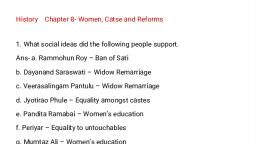
6. Very Short Answer Questions., , (a) Social reformers are described so because they feel that changes are necessary in society, and unjust practices, need to be done away with., , (b) They persuade people to give up old practices and adopt a new way of life that has logical approach., , (c) In this popular festival, devotees underwent a peculiar form of suffering as part of ritual worship. With hooks, pierced through their skin they swung themselves on a wheel., , (d) Leatherworkers have been traditionally heldin contempt since they work with dead animals which are seen as, dirty and polluting., , 7. Short Answer Questions., , (a) (i) Women were married at an early age., , (ii) Women were forced to practice sati by burning themselves on the funeral pyre of their husbands., Gii) Women’s right to property were also restricted., , (iv) Women had virtually no access to education., , (v) It was believed that if a woman was educated, she would become a widow., , (b) Whenever the reformers wished to challenge a practice that seemed harmful, they tried to find a verse or sentence, in the ancient sacred texts that supported their point of view. They then suggested that the practice as it existed, at present was against early tradition. Thus, the knowledge of ancient texts helped the reformers promote new, laws., , (c) He tried to show through his writings that the practice of widow buming had no sanction in ancient texts., , (d) The British period saw the rise of the cities. Many of the poor living in the Indian villages and small towns at, the time began leaving their villages and towns to look for jobs that were opening up in the cities. As the cities, were growing, there was a great demand for labour—tabour for digging drains, laying roads, constructing, buildings, working in factories and municipalities, etc. This demand for labour was met by the population, migrating from the villages and towns. There was also the demand for labour at the various plantations, both, within the country and abroad. The army too offered opportunities for employment. Many of these migrating, people belonged to the low castes. For them, the cities and the plantations represented the opportunity to get, away from the oppressive hold that upper-caste landowners exercised over their lives and the daily humiliation, , they suffered., (e) (i) Banning the practice of ‘Sati? (ii) Widow remarriage, Gii) Widow remarriage (iv) Castes equality, (v) Women’s Education (vi) Equality for untouchables., (vii) Women’s Education (viii) Widow remarriage, , 8. Long Answer Questions., (a) (i) Brahmans and Kshatriyas considered themselves as “upper castes”., (ii) Others, such as traders and moneylenders often referred to as Vaishyas, were placed after them., Gii) Then came peasants and artisans such as weavers and potters who were referred to as Shudras., , (iv) At the lowest rung were those who laboured to keep cities and villages clean or worked at jobs that upper, castes considered “polluting”, that is it could lead to the loss of caste status., , (v) The upper castes also treated many of these groups at the bottom as “untouchables”.
Page 5 :
(b), , ©, , @), , (2), , G@) Muslim women like the Begums of Bhopal played a notable role in promoting education among women., , They founded a primary school for girls at Aligarh., , Gi) Women like Begum Rokeya Sakhawat Hossain started schools for Muslim girls in Patna and Calcutta., , She was a fearless critic of conservative ideas, arguing that religious leaders of every faith accorded an, inferior place to women., , Gii) By the 1880s, Indian women began to enter universities. Some of them trainedto be doctors, some became, , teachers. Many women began to write and publish their critical views about women’s place in society., , (iv) Tarabai Shinde got educated at home at Poona, publisheda book, Stripiurishtulna, a comparison between, , women and men, criticizing the social differences between men and women., , (v) Pandita Ramabai, a great scholar of Sanskrit, felt that Hinduism was oppressive towards women, and, , wrote a book about the miserable lives of upper caste Hindu women. She founded a widows’ home at, Poona to provide shelter to widows who had been treated badly by their husband’s relatives. Here, women, were trained so that they could support themselves economically., , @ Brahmo Samaj: The Brahmo Samaj formed in 1830, prohibited all forms of idolatry and sacrifice. It, , believed in the Upanishads, and forbade its members from criticizing other religious practices. It critically, drew upon the ideals of religion especially of Hinduism and looking upon its negative and positive, dimensions., , Gi) Prarthana Samaj: Established in 1867 at Bombay, the Prarthana Samaj sought to remove caste restrictions,, , abolish child marriage, encourage the education of women and end the ban on widow remarriage. Its, religious meetings drew upon Hindus, Bhuddhist and Christian texts., , Gii) Paramhans Mandali: Founded in 1840 at Bombay, the Paramhans Mandali worked for the abolition of, , caste. Many of these reformers and members of reform associations were people from upper castes., , G) The Satnami movement in Central India, founded by Ghasidas a “low” caste, worked among the leather, , workers to improve their social status., , (ii) In eastern Bengal, Haridas Thakur’s Matua set among ‘low’ caste Chandala cultivators questioned, , Brahmanical texts that supported the caste system., , Gii) In 1972, Ambedkar started a temple entry movement, in which his Mahar caste followers participated., , Brahman priests were outraged when the Dalits used water from the temple tank., , (iv) Convinced that the untouchables had to fight for their dignity, Periyar founded the Self-Respect Movement., , He argued that the untouchables were the true upholders of an original Tamil and Dravidian culture, which had been subjugated by the Brahmans. He felt that all religious authorities saw social divisions, and inequality as God given., , Indian society had been plagued by evil practices for long as well as discrimination based on gender and caste., Men and women were treated differently with women subjected to many restrictions. They were not allowedto, study, choose husbands, etc. Child marriage was common. Both the Hindu and the Muslim men were allowedto, have more than one wife. Hindu women were subjected to sati. Women’s right to property was either restricted., , People from different sections of society did not enjoy equal status. Brahmans and Kshatriyas claimed to be, upper castes and enjoy ed all privileges. Other sections were subjected to exploitation andnot allowed to perform, certain activities. Some people were not allowed to enter temples and draw water from the well used by the so, , called upper castes., , Such an attitude in the society had restricted its progress. Therefore, changes within the society were thought, , to be necessary., , (f) The Christian missionaries were suspected to have been involved in forced conversion, especially of the poor, and tribal population, besides interference in the religious and social customs of India. They gave financial, support to new converts. These converts were also given the opportunity to study which was not liked by the, people who looked down on the lower caste and did not like them progress., , Social reformers supported the missionaries as they worked to eradicate social evils.