Page 1 :
Priya had painstakingly grown a beautiful garden in her home balcony. She had to urgently, leave the city for a duration of one month to attend a training programme. Her friend,, Rashida volunteered to look after the garden for a month. Unfortunately, Rashida fell, severely ill during this period and was unable to tend to the garden. On her return, Priya, noticed that all her plants had died due to lack of proper care. She was extremely upset and, decided to regrow the plants immediately. What are the different methods by which she, can regrow her plants?, , 4, , , , Reproduction, , Several processes such as digestion, respiration and circulation take place in the animal body., These processes are necessary for the survival of the organism. Reproduction is a biological, process in which a new offspring of a plant or animal species is produced. Reproduction is not, just essential for the survival of the organism but without reproduction the animal or plant, species would cease to exist., , Modes of reproduction, , There are two modes of reproduction in animals:, + Asexual reproduction, , * Sexual reproduction, , Asexual reproduction, , The type of reproduction in which offsprings are produced from a single parent, without the, fusion of sex cells is known as asexual reproduction. In asexual reproduction, one parent can, produce a new individual of its own kind. The offsprings are identical to each other, both, physically as well as genetically. The characteristics of asexual reproduction are:, , i
Page 2 :
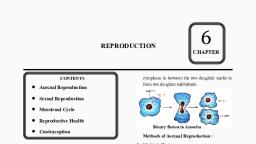
+ It involves a single parent., , * There is no gamete formation or fertilisation., , * The whole process takes place in a small period of time., * Rapid multiplication and growth happens., , * There is limited variation (genetically similar offsprings)., , Animals such as hydra, starfish and microorganisms such as amoeba, paramecium, yeasts, reproduce using the asexual mode. Organisms choose to reproduce asexually by different, means. Some of the asexual methods are binary fission (e.g. amoeba, bacteria), budding (e.g., hydra), and fragmentation (e.g. planaria)., , Binary fission, , Binary fission involves the division of the parent organism into two halves. At first, the nucleus, elongates and divides to form two daughter nuclei. Then the cytoplasm of the mother, cell divides to form two daughter cells. Each daughter cell has a nucleus and its own cell, organelles. The daughter cells are genetically identical to each other. The daughter cells grow, independently into adults that can undergo binary fission. This type of reproduction is seen, mostly in unicellular organisms like amoeba, paramoecium and euglena., , Lee parent cell, , (m2 nucleus elongates, nucleus divides then, the cytoplasm divides, ayy two daughter two daughter, cells cells, , Fig. 9.1 Binary fission in amoeba Fig. 9.2 Binary fission in paramecium, Budding, , Some organisms develop buds on their body. Buds are small bulges or outgrowths which, , develop on the parent body due to repeated cell division. When the buds are fully mature, they, separate from the parent body to begin life as new independent individuals. This is known as, , mature paramoecium, , nucleus elongates, , , , nucleus divides then, , cytoplasm divides, , 604
Page 3 :
budding. An example is hydra. From fully mature bud, , ff . the bud daughter, the parent hydra, a bud arises which develops hydra, eventually matures into a new hydra., Once it matures, it detaches from the, parent body. The newly developed bud parent, hydra, , offspring or individual is exactly the, same as the parent as it has developed Fig 9.3 al ia, from only one parent. Flatworms and yeast also reproduce by budding., , Fragmentation, , Fragmentation is another mode Planaria Hydra, , of asexual reproduction. In_ this => ie sk, , type of asexual reproduction a 4 5 5, new organism develops from parts > L si, or fragments of the parent body. a Cc, , Multicellular organisms like hydra,, , at ¢% ae, planaria, starfish, etc. reproduce by => => bo oy ste ok, , fragmentation. The parent body Fig. 9.4 Fragmentation, , Starfish, , divides into two or more fragments., , Later, each fragment develops into a new individual. Regeneration and development of a, new individual depend on the size of the fragment. If the fragment is large enough it will, regenerate and develop into a new individual., , : Aim: To observe, * binary fission in amoeba, * budding in hydra and yeast, , * fragmentation in spirogyra, , : Materials: permanent slide showing binary fission in amoeba, permanent slides showing , : budding in hydra and yeast, permanent slides showing fragmentation in spirogyra., , - Procedure: :, : Observe the permanent slides under a microscope. Draw neat labelled diagrams of, : what you observe on the slides. :
Page 4 :
Fill in the blanks:, i involves the division of the parent organism into two halves., , 2. From the parent hydra, a arises which eventually matures into a new hydra., , 2 and development of a new individual depend on the size of, the fragment., , , , Sexual reproduction, , Sexual reproduction is the combination of reproductive cells from two individuals to form a, genetically unique offspring. Sexual reproduction requires both male and female members, of the animal species. The male and female members of each animal species produce special, cells called sex cells or male and female gametes, respectively. The female reproductive system, of a sexually mature female produces the female gametes or ovum. The male reproductive, system of a sexually mature male produces the male gametes or sperms. The male and the, female gametes fuse to form a zygote. The process of fusion of a male gamete with a female, gamete to produce a single celled zygote is called fertilisation. The zygote undergoes cell, division to develop into an embryo. The embryo eventually develops into a new individual of, that species. Animals such as humans, cats, bears, dogs reproduce by sexual reproduction., , The characteristics of sexual reproduction are:, , * It involves two parents., , * There is gamete formation and fertilisation., , * The whole process does not take place in a small period of time., * Growth is not rapid., , * Variation is observed in the offsprings., , Reproduction in Humans, , Humans reproduce by the sexual method of reproduction. The production of male and female, gametes begins in humans after the male or female reaches the age of sexual maturity or, puberty. The organs that enable a human being to reproduce form the reproductive system, of the body. Fertilisation as well as the development of the baby takes place in the mother's, body., , Male Reproductive System:, The main parts of the male reproductive system are as follows:
Page 5 :
prostate gland, , Cowper's gland, , urethra, scrotum, , , , Fig. 9.5 Male reproductive system, Testes, , The male reproductive system includes a pair of testes which produces the, , sperms, The testes are located within a sac like structure called scrotum, head, present just outside the abdominal cavity. The scrotum maintains the, temperature of the testes slightly lower than the body temperature (2-3 midpiece, , degrees lower). The lowered temperature is necessary for the production, , of millions of sperms. Human sperms are very small in size, Each sperm is a, , single cell with all the usual cell components. Each sperm has three parts- a, , head, a middle piece and a tail. The tail enables the sperm to move quickly tail, towards the female gamete or egg., , Epididymis, , The epididymis is a long, tightly coiled tube that rests on the backside of, , each testicle. It transports and stores sperm cells that are produced in the Fig. 9.6 Structure, testes. The sperms produced in the testes move first into the epididymis. of a sperm, , It also is the job of the epididymis to bring the sperm to maturity, since the sperms that, emerge from the testes are immature and incapable of fertilisation, The sperms mature in the, epididymis and then move to the sperm ducts or vas deferens., , Sperm ducts, , Sperm ducts or vas deferens is a narrow duct which helps to transport sperms from the testes, to the urethra present in the penis. Several fluids secreted inside this duct by several glands, mix with the sperms to form a fluid called semen in order to increase the motility of the, sperms., , Urethra, , In males, the urethra is a part of both the urinary tract and the reproductive system. The