Notes of Class 8, Science light.pdf - Study Material
Page 1 :
Chapter 16 — Light, , 1. Suppose you are in a dark room. Can you see objects in the room?, Can you see objects outside the room? Explain., , Ans: In a dark room one cannot see things in a room, but things outside the, room will be visible., , The reason for this is that the object is only visible when light from the object, reaches the eye. In a dark room, we cannot see objects because the rays of, light do not reach our eyes whereas in a lighted room, the rays of light, reflected from the objects reach our eyes making them visible for us., , 2. Differentiate between regular and diffused reflection. Does diffused, reflection mean the failure of the laws of reflection?, Ans: Difference between reget and ciftveed refection i os folions:, , , , , , , , (Regular Reflection, Regular Reflection takes place ee, from a smooth and shiny on a rough or irregular surface., All rays are parallel after The reflected rays are not, reflection. parallel to each other., , , , , , , , Diffused reflection is not due to the failure of the laws of reflection. It is, caused by the irregularities in the reflecting surface., , 3. Mention against each of the following whether regular or diffused, reflection will take place when a beam of light strikes. Justify your, answer in each case., , a) Polished wooden table, Ans: A polished surface means the surface is very smooth, thus, regular reflection takes place., , b) Chalk powder, Ans: A diffused reflection takes place on a chalk powder because its, surface is uneven., , c) Cardboard surface
Page 2 :
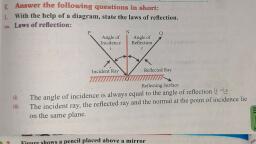
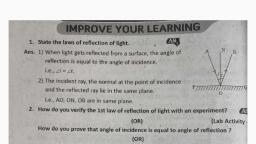
Ans: The surface of cardboard which reflects light is not smooth, thus, diffused reflection will take place from a cardboard surface., , d) Marble floor with water spread over it, , Ans: The water spread over marble makes the surface very, , Smooth which makes it act like a plane surface. Hence, regular reflection, takes place., , e) Mirror, Ans: The surface of the mirror is very smooth and shiny. Therefore, regular, Teflection takes place., , f) Piece of paper, Ans: A piece of paper may look smooth, but it has many irregularities on, its surface. Thus, diffused reflection takes place., , 4. State the laws of reflection., Ans: Laws of reflection can be stated as follows:, i, The angle of reflection and angle of incidence are always equal to each, other., ii. The incident ray, the normal at the point of incidence and the reflected, ray all lie in the same plane., , 5. Describe an activity to show that the incident ray, the reflected ray, , and the normal at the point of incidence lie in the same plane., Ans:To perform this experiment take a plane mirror and place it on a plane, sheet of paper in a standing position with a block. Then draw an incidence, line AB on this paper. Mark the points on the paper by carefully looking on, the mirror. The line that goes after it appears on the screen. Draw a, perpendicular on the mirror line and then remove the mirror. Join the points to, make the reflected ray on the paper. You will observe that incident ray,, reflected ray and normal will be in the same plane, i.e. on the sheet of paper., This verifies the law of reflection.
Page 3 :
6. Fill in the blanks in the following., a) A person 1 m in front of a plane mirror seems to be ___ m away, from his image., Ans: A person 1 m in front of a plane mirror seems to be 2 m away from, his image., , b)If you touch your __ ear with your right hand in front of a, plane mirror, it will be seen in the mirror that your right ear is, touched with your, , Ans: If you touch your left ear with your right hand in front of a plane, mirror, it will be seen in the mirror that your right ear is touched with your, left hand., , ¢) The size of the pupil becomes when you see in dim light., Ans: The size of the pupil becomes large when you see in dim light., , d) Night birds have cones than rods in their eyes., Ans: Night birds have lesser cones than rods in their eyes., , 7. Angle of incidence is equal to the angle of reflection., , a) Always, , b) Sometimes, , ¢) Under special conditions, d) Never, , Ans: (a) Always, Since, the first law of reflection states that the angle of incidence and, angle of reflection are always equal to each other., , 8. Image formed by a plane mirror is, , 4) virtual, behind the mirror and enlarged., , b) virtual, behind the mirror and of the same size as the object., , c) real at the surface of the mirror and, , d) real, behind the mirror and of the same size as the object., Ans: (b) Virtual, behind the mirror and of the same size as the object., The image created by the plane mirror is built behind the mirror. This image, Cannot be created on screen, so it produces a virtual image of the size as that, of the object., , 9. Describe the construction of a kaleidoscope., Ans: The Kaleidoscope is made up of three rectangular squares each about
Page 4 :
15 cm long and 4 cm wide which are joined together to build a prism. They, are arranged in a circular cardboard tube. Note that the tube is slightly longer, than the screen straps. One end of the tube is closed with a cardboard disc, with a hole in the middle. To make the disk last longer, a piece of transparent, plastic paper is attached to the bottom of the cardboard disk. At the other end,, a round plate of the glass plane is fixed touching the mirrors., , >, , , , *, , | }, ~~ Oo “3, , , , Ans:, Cary muscies, A, Ceysaliee ens a Lo, Aqueost L /, henent Re, Se aw -———— fein, * —— shh sed Optic, Comes + “Fao, , 11. Gurmit wanted to perform Activity 168 using a laser torch. Her, teacher advised her not to do so. Can you explain the basis of the, teacher's advice?, , Ans: The intensity of the laser light is very high which is harmful for eye and, , can cause a permanent defect in the eye. She can lose her eyesight also due to, , severe damage to the retina. Therefore, it is advisable not to look at a laser, , beam directly., 12. Explain how you can take care of your eyes.
Page 5 :
Ans: To protect our eyes, the following precautions should be taken:, i, Do not read in too little or too much light., ji. Wash your eyes frequently with cold water., tii, Do not read by bringing your book too close to your eyes or keeping it, too far., , iv. Never rub your eyes., v. If particles of dust go into our eyes, wash our eyes with clean water. If, there is no improvement go to a doctor., , 13, What is the angle of incidence of a ray if the reflected ray is at an, angle of 90 to the incident ray?, , Ans: We know that, angle of incidence is equal to the angle of reflection., , Therefore, twice of incidence angle is equal to 90° ., , Thus, Angle of incidence i = 92, , sind, , 14. How many images of a candle will be formed if it is placed between, two parallel plane mirrors separated by 40 cm?, , Ans; Since the mirrors are kept parallel to each other, Infinite no of images, , will be formed due to multiple reflection between them., , 15, Two mirrors meet at right angles. A ray of light is incident on one at, , an angle of 30’ as shown in Fig. 16.19 . Draw the reflected ray from, the seoond mirror,, , , , Fig 16.19, Ans. From the first law of reflection, The angle of reflection and angle of, incidence are always equal to each other., , ‘The diagram of the reflected ray from the second mirror is as follows:



 Learn better on this topic