Page 1 :
1, , Food:, Where Does it Come From?, , W, , hat did you eat at home, today? Find out what your, friend ate today. Did you eat, the same kind of food yesterday and, today? We all eat different kinds of food, at different times, isn’t it?, , 1.1 FOOD VARIETY, Activity 1, Ask your friends in the school about the, items they would be eating during a day., See if you can also get this information, from friends staying in different states, of India. List all the items in your, notebook as given in Table 1.1, for as, many friends as possible., Table 1.1 What do we eat?, Name of the, student/friend, , Food items, eaten in a day, , There seems to be so much variety, in the food that we eat (Fig 1.1). What, are these food items made of?, Think about rice, cooked at home. We take, raw rice and boil it in, water. Just two materials, or ingredients are, needed to prepare a dish of boiled rice., On the other hand, some food items, are made with many ingredients. To, prepare vegetable curry, we need, different kinds of vegetables, salt, spices,, oil and so on., , Activity 2, Choose some of the items you listed in, Table 1.1 and try to find out what, ingredients are used to prepare these,, by discussing with your friends and, elders at home. List them in Table 1.2., Some examples are given here. Add, some more items to this list., Table 1.2 Food items and their, ingredients, Food Item, , Ingredients, , Roti/chapati, , Atta, water, , Dal, , Pulses, water, salt, oil/, ghee, spices, , Fig. 1.1 Different food items, , 2021–22
Page 2 :
What do we find? Do we find some ingredients common, for different food items? Discuss in class., So, where do these ingredients come from?, , 1.2 FOOD MATERIALS, , AND, , SOURCES, , It may be easy for us to guess the sources of some of the, ingredients that we listed in Table 1.2. Fruits and, vegetables, for instance (Fig. 1.2a). Where do they come, from? Plants, of course! What are the sources of rice or, wheat? You may have seen paddy or wheat fields with rows, and rows of plants, which give us these grains (Fig. 1.3)., And then, there are food items like milk, eggs and meat,, which come from animals (Fig. 1.2b)., , Activity 3, , (a) Plant sources, , Fig. 1.2 Sources of, food ingredients, , Let us take the food items listed earlier, and try to find out where they come from, — the ingredients and their sources., Some examples are shown in Table 1.3., Fill in the blanks in Table 1.3 and add, more examples to this list., , (b) Animal sources, , Table 1.3 Ingredients used to, prepare food items and, their sources, Food Item Ingredients, Idli, , Rice, , Sources, Plant, , Urad dal, Salt, Water, Chicken, curry, (a), , Chicken, , Animal, , Spices, Oil/ghee, , Plants/, Animals, , Water, Kheer, (b), Fig. 1.3 Source of food grains, (a) Paddy field (b) Wheat grains transported, , Milk, , Animal, , Rice, , Plant, , Sugar, , 2, , SCIENCE, , 2021–22
Page 3 :
What do we conclude from Activity, 3? Plants are the sources of food, ingredients like grains, cereals,, vegetables and fruits. Animals provide, us with milk, meat products and eggs., Cows, goats and buffaloes are some, common animals which give us milk., Milk and milk products like butter,, cream, cheese and curd are used all over, the world. Can you name some other, animals which give us milk?, , Flower, , Fruit, Stem, Leaf, , Node, Internode, , {, , Bud, , 1.3 PLANT PARTS AND ANIMAL, PRODUCTS AS FOOD, Plants are one source of our food. Which, parts of a plant?, We eat many leafy vegetables. We eat, fruits of some plants. Sometimes roots,, sometimes stems and even flowers, (Fig 1.4). Have you ever eaten pumpkin, , Paheli wants to know if any of our, food comes from sources other, than plants and animals., , Shoot, system, , Primary, root, Root, Secondary system, root, , Fig. 1.4 Different edible parts of plants, , flowers dipped in rice paste and fried?, Try it!, Some plants have two or more edible, (eatable) parts. Seeds of mustard plants, give us oil and the leaves are, used as a vegetable. Can you think of, the different parts of a banana plant that, are used as food? Think of more, examples where two or more parts of a, single plant are used as food., , Table 1.4 Plant parts as food, Food item with plant, as the major source, 1. Brinjal curry, , Ingredients/source, , Plant part which gives, us the ingredient, , Brinjal, , Fruit, , Chilli as spice (any other), , Fruit, , Oil from groundnut, mustard,, soybean, any other plant, , Seed, , 2., 3., FOOD: WHERE DOES IT COME FROM?, , 3, , 2021–22
Page 4 :
Do not try to taste unknown plants, around you to see if they are edible!, Some plants could be poisonous., , Activity 4, From all the food items you have listed, in Table 1.3, choose those items whose, ingredients are obtained from plants., Which part of a plant? Identify these, and list the food items and plant parts, as shown in Table 1.4., , Fig. 1.6 Chana (gram) and its sprouts, , covered with a wet cloth. The next day,, see if the seeds have sprouted., After washing these sprouted seeds,, you can eat them. They can also be, boiled. Add some spices and get a tasty, snack to eat., Do you know where honey comes, from, or how it is produced? Have you, seen a beehive where so many bees keep, buzzing about? Bees collect nectar, (sweet juices) from flowers, convert it, , Activity 5, Take some dry seeds of moong or chana., Put a small quantity of seeds in a, container filled with water and leave this, aside for a day. Next day, drain the water, completely and leave the seeds in the, vessel. Wrap them with a piece of wet, cloth and set aside. The following day,, do you observe any changes in the seeds?, Fig. 1.7 Beehive, , Fig. 1.5 Whole moong and its sprouts, , A small white structure may have grown, out of the seeds. If so, the seeds have, sprouted (Fig. 1.5 and 1.6). If not, wash, the seeds in water, drain the water and, leave them aside for another day,, , into honey and store it in their hive, (Fig. 1.7). Flowers and their nectar may, be available only for a part of the year., So, bees store this nectar for their use, all through the year. When we find such, a beehive, we collect the food stored by, the bees as honey., , 1.5 WHAT, , DO, , ANIMALS EAT?, , Do you have cattle or a pet that you take, care of? A dog, cat, buffalo or a goat?, , 4, , SCIENCE, , 2021–22
Page 5 :
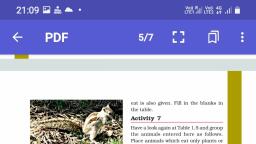
eat is also given. Fill in the blanks in, the table., , Activity 7, , Fig. 1.8 Squirrel eating nuts, , You will then surely be aware of the food,, the animal eats. What about other, animals? Have you ever observed what, a squirrel (Fig 1.8), pigeon, lizard or a, small insect may be eating as their food?, , Activity 6, Several animals are listed in Table 1.5., For some of them, the type of food they, Table 1.5 Animals and their Food, Name of the, animal, , Have a look again at Table 1.5 and group, the animals entered here as follows., Place animals which eat only plants or, plant products in Group 1. These are, called herbivores. There are some, animals which eat other animals., Place these in Group 2. These animals, are called carnivores. Do you find, some animals which eat both plants, and animals? Place them in Group 3., These are called omnivores. Prepare, a table as in Table 1.6 and enter, these separately in the three columns,, as shown., Table 1.6, Herbivores Carnivores Omnivores, , Food the, animal eats, , Buf falo, , Grass, oilcake,, hay, grains, , Cat, , Small animals,, birds, milk, , Cow, , Lion, , D og, , Rat, Lion, T iger, Spider, , Paheli wants to know where you, would place human beings,, while filling Table 1.6., , House lizard, Cow, Human beings, Butter fly, Crow, Others, , We know that there are many, amongst us, who do not get sufficient, , FOOD: WHERE DOES IT COME FROM?, , 5, , 2021–22
Page 6 :
food. We need to find ways by which, more food can be produced in the, country. That will not be enough; we, , will need to find ways to ensure that, this food is made easily available to each, one of us., , Ingredients, Edible, Nectar, Sprouted seeds, Herbivore, Car nivore, Omnivore, , n, , There is a lot of variation in the food eaten in different regions of India., , n, , The main sources of our food are plants and animals., , n, , Animals which eat only plants are called herbivores., , n, , Animals which eat only animals are called carnivores., , n, , Animals which eat both plants as well as other animals are called, omnivores., , 1., , Do you find that all living beings need the same kind of food?, , 2., , Name five plants and their parts that we eat., , 3., , Match the items given in Column A with that in Column B, Column A, , Column B, , Milk, curd, paneer, ghee,, , eat other animals, , Spinach, cauliflower, carrot, , eat plants and plant products, , Lions and tigers, , are vegetables, , Herbivor es, , are all animal products, , 6, , SCIENCE, , 2021–22
Page 7 :
4., , Fill up the blanks with the words given:, herbivore, plant, milk, sugarcane, carnivore, (a) Tiger is a ____________________ because it eats only meat., (b) Deer eats only plant products and so, is called ______________., (c) Parrot eats only _________________ products., (d) The ________________ that we drink, which comes from cows, buffaloes and, goats is an animal product., (e) We get sugar from ___________________., , SUGGESTED PROJECTS AND ACTIVITIES, 1., , You must have seen a garden lizard around your home. Next time whenever you see it, observe carefully and find out what it takes for food. Is the, food different from that of a house lizard?, , 2., , Make a list (with pictures, when possible) of food items generally taken by, people of different regions of India. Place these on a large outline map of, India to display in your classroom., , 3., , Find out the names of plants that grow in water and which are eaten, as food., , 4., , In Chapter 10, you will find out ways of measuring length of curved lines., In your mathematics classes you will learn to prepare bar graphs. After, you learn these, try the following interesting project. Prepare some sprouts, of moong as discussed in the chapter. Wash them in water everyday and, drain all the water. Let them grow for a week until the whole of the seeds, grow into young plants. Measure the lengths of the sprouts everyday using, a string. Take care that they do not break. Prepare a bar graph of the, number of sprouts having lengths in different ranges., , THINGS TO THINK ABOUT, 1., , Does everyone around you get enough food to eat? If not, why?, , 2., , What are the ways we can think of to avoid wastage of food?, , FOOD: WHERE DOES IT COME FROM?, , 7, , 2021–22