Page 1 :
MATERIALS : METALS AND NON-METALS, , Y, , ou are familiar with a number of, materials like iron, aluminium,, copper, etc. Some materials have, been given in Table 4.1., Table 4.1 : Appearance and, Hardness of Materials, Object/, Material, , a similar change if we try to beat a, piece of coal ?, Let us find out., , Activity 4.1, , Appearance, Hardness, (Shiny/Dull) (Very hard/, Not very, hard), , Take a small iron nail, a coal piece,, a piece of thick aluminium wire and, a pencil lead. Beat the iron nail with, a hammer (Fig. 4.1). (But take care, that you don’t hurt yourself in the, process.) Try to hit hard. Hit hard, , Iron, Coal, Sulphur, Aluminium, Copper, -----, , Fig. 4.1 : Beating an iron nail with hammer, , Can you name the materials which, are metals? The rest of the materials in, Table 4.1 are non-metals. Metals can be, distinguished from non-metals on the, basis of their physical and chemical, properties. Recall that lustre and, hardness are physical properties., , 4.1 Physical Properties of, Metals and Non-metals, , the aluminium wire also. Then, repeat the same kind of treatment, on the coal piece and pencil, lead. Record your observations in, Table 4.2., Table 4.2 : Malleability of Materials, Object/, Material, Iron nail, , Have you ever seen a blacksmith beating, an iron piece or an article made up of, iron, like a spade, a shovel, an axe ? Do, you find a change in the shape of these, articles on beating ? Would you expect, , 2020-21, , Coal piece, Aluminium wire, Pencil lead, , Change in Shape, (Flattens/Breaks, into pieces)
Page 2 :
You saw that the shape of the iron nail, and the aluminium wire changed on, beating. If they were beaten harder these, could be changed into sheets. You might, be familiar with silver foil used for, decorating sweets. You must also be, familiar with the aluminium foil used for, wrapping food. The property of metals by, which they can be beaten into thin sheets, is called malleability. This is a, characteristic property of metals. As you, must have noticed, materials like coal and, pencil lead do not show this property. Can, we call these metals?, Can you hold a hot metallic pan which, is without a plastic or a wooden handle, and not get hurt? Perhaps not! Why? Try, to list some other experiences in which a, wooden or plastic handle protects you, from being hurt while handling hot, things. On the basis of these experiences, what can you say about the conduction, of heat by wood and plastic?, You must have seen an electrician, using his screw driver. What kind of, handle does it have? Why?, Let us find out., , the activity with various objects in, Class VI. Now, repeat the activity, with the materials mentioned in, Table 4.3. Observe and group these, materials into good conductors and, poor conductors., Table 4.3 : Electrical Conductivity, of Materials, S.No. Materials, , Fig. 4.2 : Electric tester, , Iron rod/nail, , 2., , Sulphur, , 3., , Coal piece, , 4., , Copper wire, , You observe that iron rod, nail and, copper wire are good conductors while, rolled sulphur piece and coal piece are, poor conductors., , Oh! The meaning of recalling, our experiences and then of, this activity was to show that, metals are good conductors of, heat and electricity. We learnt, this in Class VI., , Activity 4.2, Recall how to make an electric, circuit to test whether electricity can, pass through an object or not, (Fig. 4.2). You might have performed, , 1., , Good Conductor /, Poor Conductor, , Where do you find the use of, aluminium and copper wires? Have you, seen wires of coal? Definitely not!, The property of metal by which it can, be drawn into wires is called ductility., Have you ever noticed the difference, in sound on dropping an iron sheet/, plate, a metal coin, and a piece of coal, on the floor? If not, you can try it now., Do you note any difference in the sound, produced?, 45, , MATERIALS : METALS AND NON-METALS, , 2020-21
Page 3 :
Have you seen wooden bells in, temples? Can you give a reason?, The things made of metals produce, a ringing sound when struck hard., Suppose you have two boxes similar in, appearance, one made of wood and the, other of metal. Can you tell which box, is made of metal by striking both the, boxes?, Since metals produce ringing, sounds, they are said to be sonorous., The materials other than metals are not, sonorous., After performing the above activities,, we can say that some materials are hard,, lustrous, malleable, ductile, sonorous, and good conductors of heat and, electricity. The materials which, generally possess these properties are, called metals. The examples of metals, are iron, copper, aluminium, calcium,, magnesium, etc. In contrast, materials, like coal and sulphur are soft and dull, in appearance. They break down into a, powdery mass on tapping with a, hammer. They are not sonorous and are, poor conductors of heat and electricity., These materials are called non-metals., The examples of non-metals are sulphur,, carbon, oxygen, phosphorus, etc., , which rust is formed. You had also, performed in Class VII an activity of, burning a magnesium ribbon in air. You, had learnt that in both the processes, oxide formation takes place. Complete, the following reactions of iron and, magnesium with oxygen., Iron (Fe) + Oxygen (O2) + Water (H2O) → ?, Magnesium (Mg) + Oxygen (O2) → ?, , Activity 4.3, Let us check the nature of rust, formed as a result of the reaction, between iron, oxygen and water., Collect a spoonful of rust and, dissolve it in a very little amount of, water. You will find that the rust, remains suspended in water. Shake, the suspension well. Test the, solution with red and blue litmus, papers (Fig. 4.3). What do you, observe? Is the solution acidic or, basic?, , Rust, suspension, , Red litmus, paper, , Metals like sodium and potassium are, soft and can be cut with a knife., Mercury is the only metal which is, found in liquid state at room, temperature. These are exceptions., , 4.2 Chemical Properties of, Metals and Non-metals, , Rust, , Reaction with Oxygen, You are familiar with the phenomenon, of rusting of iron. Recall the reaction by, 46, , Fig. 4.3 : Testing the nature of rust, SCIENCE, , 2020-21
Page 4 :
As soon as sulphur starts burning,, introduce the spoon into a gas jar/, glass tumbler [Fig. 4.4 (a)]. Cover the, tumbler with a lid to ensure that, the gas produced does not escape., Remove the spoon after some time., Add a small quantity of water into, the tumbler and quickly replace the, lid. Shake the tumbler well. Check, the solution with red and blue, litmus papers [Fig. 4.4 (b)]., , Does copper also get, rusted? I have seen, a greenish deposit, on the surface of, copper vessels., When a copper vessel is exposed to, moist air for long, it acquires a dull, green coating. The green material is, a mixture of copper hydroxide, (Cu(OH) 2 ) and copper carbonate, (CuCO3). The following is the reaction, 2Cu+H2O+CO2+O2→Cu (OH)2 + CuCO3, moist air, , Improvised, deflagrating, spoon, , Now recall the activity of burning, magnesium ribbon. The ash obtained, on burning magnesium ribbon is, dissolved in water and tested for its, acidic/basic nature., Is the solution acidic or basic? How, do you ascertain this?, You must have observed that the red, litmus turns blue. So, oxide of magnesium, is also basic in nature. In general, metallic, oxides are basic in nature., Let us now observe the reaction of, non-metals with oxygen., , Fig. 4.4 (a) : Burning of sulphur powder, , Activity 4.4, (To be demonstrated by the teacher, in the class), Take a small amount of powdered, sulphur in a deflagrating spoon and, heat it. If deflagrating spoon is not, available, you may take a metallic cap, of any bottle and wrap a metallic wire, around it and give it the shape, shown in Fig. 4.4 (a)., , Fig. 4.4 (b) : Testing of solution with litmus, papers, 47, , MATERIALS : METALS AND NON-METALS, , 2020-21
Page 5 :
Table 4.4 : Metals and Non-metals in Acids and Bases, S.No., , Name of the Base, , Metal, , Name of the Acid, , Non-metal, , 1., , Calcium hydroxide, , Calcium, , Sulphuric acid, , Sulphur, , 2., 3., 4., 5., , The name of the product formed in, the reaction of sulphur and oxygen is, sulphur dioxide gas. When sulphur, dioxide is dissolved in water sulphurous, acid is formed. The reaction can be given, as follows:, , Activity 4.5, , Sulphur dioxide (SO2) + Water (H2O) →, Sulphurous acid (H2SO3), The sulphurous acid turns blue, litmus paper red. Generally, oxides of, non-metals are acidic in nature., Recall the name of some of the, laboratory acids and bases you have read, in Class VII. Note down their names in, Table 4.4. Identify the metal or nonmetal present in them which forms, oxides with oxygen., Reaction with Water, , (To be demonstrated by the teacher., During demonstration special care, should be taken that the size of the, sodium metal piece is roughly the size, of a wheat grain. It should be held, with a pair of tongs.), Take a 250 mL beaker/glass tumbler., Fill half of it with water. Now, carefully cut a small piece of sodium, metal. Dry it using filter paper and, wrap it in a small piece of cotton., Put the sodium piece wrapped in, cotton into the beaker. Observe, carefully. (During observation keep, away from the beaker). When, reaction stops touch the beaker., What do you feel? Has the beaker, become hot? Test the solution with, red and blue litmus papers. Is the, solution acidic or basic?, , Let us see how metals and non-metals, react with water., Sodium metal is very reactive. It, reacts vigorously with oxygen and, water. A lot of heat is generated in, the reaction. It is, therefore, stored, in kerosene., , Fig. 4.5 : Reaction of sodium with water, , 48, , SCIENCE, , 2020-21
Page 6 :
You observed that sodium reacts, vigorously with water. Some other metals, do not do so. For example, iron reacts, with water slowly., Generally, non-metals do not react, with water though they may be very, reactive in air. Such non-metals are, stored in water. For example,, , phosphorus is a very reactive non-metal., It catches fire if exposed to air. To prevent, the contact of phosphorus with, atmospheric oxygen, it is stored in water., Reactions with Acids, Let us see how metals and non-metals, behave with acids., , Activity 4.6, (Warning : Keep the mouth of the test tube away from your face. Use test tube, holder to hold the test tube.), Take samples of metals and non-metals listed in Table 4.5 in separate test, tubes and label them as A, B, C, D, E, and F. With the help of a dropper add 5, mL of dilute hydrochloric acid to each test tube one by one. Observe the, reactions carefully. If no reaction occurs in the cold solution, warm the test, tube gently. Bring a burning matchstick near the mouth of each test tube., Repeat the same activity using dilute sulphuric acid instead of the dilute, hydrochloric acid. Record your observations in Table 4.5., Table 4.5 : Reaction of Metals and Non-metals with Acids, Test, tube, Label, , Metal/, Non-metal, , A, , Magnesium, (ribbon), , B, , Aluminium (foil), , C, , Iron (filings), , D, , Copper (peeled, , Reaction with Dilute, Hydrochloric Acid, Room, Warm, Temperature, , Reaction with Dilute, Sulphuric Acid, Room, Warm, Temperature, , flexible wire), E, , Charcoal (powder), , F, , Sulphur (powder), 49, , MATERIALS : METALS AND NON-METALS, , 2020-21
Page 7 :
Is there a difference in the way metals, and non-metals react with acids? What, could the ‘pop’ sound in some cases be, due to when a burning match stick is, brought near the mouth of the test tubes?, You must have found that nonmetals generally do not react with acids, but metals react with acids and produce, hydrogen gas that burns with a ‘pop’, sound. You must have noticed that, copper does not react with dilute, hydrochloric acid even on heating but, it reacts with sulphuric acid., , performed in Class VII. Let us observe, some more reactions of that kind., , Activity 4.8, Take five 100 mL beakers and label, them A, B, C, D and E. Take about, 50 mL of water in each beaker., Dissolve in each beaker a, teaspoonful of each substance as, indicated in Fig. 4.6 (a)., Ü Keep the beakers undisturbed for, some time., Ü Record your observations in your, note book., , Reactions with Bases, , Activity 4.7, (To be demonstrated by the teacher., During the preparation of sodium, hydroxide solution, care should be, taken that pellets of sodium hydroxide, are handled with a plastic spatula)., Prepare a fresh solution of sodium, hydroxide in a test tube by, dissolving 3-4 pellets of it in 5 mL, of water. Drop a piece of aluminium, foil into it. Bring a burning match, stick near the mouth of the test, tube. Observe carefully., , A, , C, , B, , D, , E, , (a), ZnSO4, , A, , What does the ‘pop’ sound indicate?, As before, the ‘pop’ sound indicates the, presence of hydrogen gas., Metals react with sodium hydroxide, to produce hydrogen gas., Reactions of non-metals with bases, are complex., , Cu, , FeSO4, , B, , C, , D, , E, , Cu, No Change, (b), , Beaker A : Copper sulphate (CuSO4) + Zinc granule (Zn), Beaker B : Copper sulphate (CuSO4) + Iron nail (Fe), Beaker C : Zinc sulphate (ZnSO4) + Copper turnings (Cu), Beaker D : Iron sulphate (FeSO4) + Copper turnings (Cu), , Displacement Reactions, Recall the activity of the reaction between, copper sulphate and iron that you, , Beaker E : Zinc sulphate (ZnSO4) + Iron nail (Fe), , 50, , Fig. 4.6 (a) and (b) : Displacement reactions, SCIENCE, , 2020-21
Page 8 :
What changes do you observe in the, various beakers? You have read that one, metal displaces another metal from its, compound in aqueous solution. In, beaker ‘A’ zinc (Zn) replaces copper (Cu), from copper sulphate (CuSO4). That is, why the blue colour of copper sulphate, disappears and a powdery red mass of, copper is deposited at the bottom of the, beaker. The reaction can be represented, as follows:, Copper Sulphate (CuSO4) + Zinc (Zn), (Blue), → Zinc Sulphate (ZnSO4) + Copper (Cu), (Colourless), (Red), You can write down the reaction, taking place in beaker ‘B’ in a similar, manner., , I have understood the reactions, taking place in beakers ‘A’ and, ‘B’. But I am still confused why, there is no change in beakers, ‘C’, ‘D’ and ‘E’?, , There could have been displacement, of zinc by copper in beaker ‘C’ and by, iron in beaker ‘E’. Similarly iron could, be displaced by copper in beaker ‘D’., Since we do not see any change in, beaker C, we can infer that copper is, not able to replace zinc from zinc, sulphate. But why? When zinc can, replace copper in beaker ‘A’ why, cannot copper replace zinc in beaker, ‘C’? Remember that science is not, , arbitrary. It follows definite rules, based on facts. And the rule here is, that zinc is more reactive than copper, and iron. A more reactive metal can, replace a less reactive metal, but a less, reactive one cannot replace a more, reactive metal. Now you can, understand why there are no, displacement reactions in beakers D, and E also. Can you guess the, sequence of metals from more reactive, to less reactive among zinc, iron and, copper?, , 4.3 Uses of Metals and, Non-metals, You should be able to guess why metals, are used in making machinery,, automobiles, aeroplanes, trains,, satellites, industrial gadgets, cooking, utensils, water boilers, etc. You are also, familiar with the uses of some nonmetals. Here are some interesting ones., We are sure that you will guess them, right:, l, , Non-metal is essential for our life, which all living beings inhale during, breathing,, , l, , Non-metals used in fertilisers to, enhance the growth of plants,, , l, , Non-metal used in water purification, process,, , l, , Non-metal used in the purple, coloured solution which is applied, on wounds as an antiseptic,, , l, , Non-metals used in crackers., , You may add some more uses of, metals and non-metals from your, experiences., 51, , MATERIALS : METALS AND NON-METALS, , 2020-21
Page 9 :
The doctor reported iron, deficiency in my body., Where is iron in my body?, , I heard that magnesium is, found in plants. In what, form is it found in them?, , In Class VII, you have learnt that in a chemical reaction, new substances are, formed. These substances are different from those which underwent the reaction., Now, if a substance cannot be broken down further by chemical reactions, by, cooling, heating, or by electrolysis, it is called ‘element’. Sulphur is an element., So is iron. Carbon, too, is an element. The smallest unit of an element is atom. A, sample of an element contains only one kind of atom. The atom of an element, remains unaffected by physical changes in the element. For example, an atom of, liquid sulphur would be exactly the same as the atom of solid or vapour sulphur., Although we have an infinite variety of substances in the universe, the number, of elements forming these substances is limited. There are no more than 94, naturally occurring elements. An important classification of elements is in terms, of metals and non-metals. Most of the elements are metals. The remaining are, either non-metals or metalloids. Metalloids possess character of both metals and, non-metals., , 52, , SCIENCE, , 2020-21
Page 10 :
KEYWORDS, , T Y, VE LEARNT, YOU, WHAT, HAVE, WHA, OU HA, , ATOM, , Ü, , Metals are lustrous whereas non-metals have, no lustre., , CONDUCTOR, Ü, DISPLACEMENT, , Generally, metals are malleable and ductile., Non-metals do not have these properties., , REACTION, , Ü, , Generally, metals are good conductors of heat, and electricity but non-metals are poor, , DUCTILITY, , conductors., ELEMENTS, , Ü, , On burning, metals react with oxygen to, produce metal oxides which are basic in, , HARDNESS, , nature. Non-metals react with oxygen to, produce non- metallic oxides which are acidic, , MALLEABILITY, , in nature., , METALS, , Ü, , Some metals react with water to produce metal, hydroxides and hydrogen gas. Generally, non-, , METALLOIDS, , metals do not react with water., NON-METALS, , Ü, , Metals react with acids and produce metal, salts and hydrogen gas. Generally, non-metals, , SONOROUS, , do not react with acids., Ü, , Some metals react with bases to produce, hydrogen gas., , Ü, , More reactive metals displace less reactive, metals from their compounds in aqueous, solutions., , Ü, , Metals and non-metals are used widely in, every day life., , Exercises, 1., , Which of the following can be beaten into thin sheets?, (a) Zinc, , 2., , (b) Phosphorus, , (c) Sulphur, , (d) Oxygen, , Which of the following statements is correct?, (a), , All metals are ductile., , (b), , All non-metals are ductile., , (c), , Generally, metals are ductile., , (d), , Some non-metals are ductile., 53, , MATERIALS : METALS AND NON-METALS, , 2020-21
Page 11 :
EXERCISES, , 3., , 4., , 5., , Fill in the blanks., non-metal., , (a), , Phosphorus is a very, , (b), , Metals are, , (c), , Iron is, , (d), , Metals react with acids to produce, , conductors of heat and, reactive than copper., gas., , Mark ‘T’ if the statement is true and ‘F’ if it is false., (a), , Generally, non-metals react with acids., , ( ), , (b), , Sodium is a very reactive metal., , ( ), , (c), , Copper displaces zinc from zinc sulphate solution., , ( ), , (d), , Coal can be drawn into wires., , ( ), , Some properties are listed in the following Table. Distinguish between, metals and non-metals on the basis of these properties., Properties, , 6., , ., , Metals, , 1., , Appearance, , 2., , Hardness, , 3., , Malleability, , 4., , Ductility, , 5., , Heat Conduction, , 6., , Conduction of Electricity, , Non-metals, , Give reasons for the following., (a), (b), (c), (d), , Aluminium foils are used to wrap food items., Immersion rods for heating liquids are made up of metallic substances., Copper cannot displace zinc from its salt solution., Sodium and potassium are stored in kerosene., , 7., , Can you store lemon pickle in an aluminium utensil? Explain., , 8., , Match the substances given in Column A with their uses given in, Column B., A, , B, , (i) Gold, , (a) Thermometers, , (ii) Iron, , (b) Electric wire, , (iii) Aluminium, , (c) Wrapping food, , (iv) Carbon, , (d) Jewellery, , (v) Copper, , (e) Machinery, , (vi) Mercury, , (f) Fuel, , 54, , SCIENCE, , 2020-21
Page 12 :
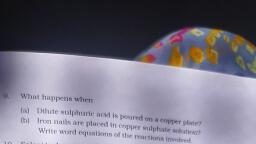
EXERCISES, , 9., , What happens when, (a) Dilute sulphuric acid is poured on a copper plate?, (b) Iron nails are placed in copper sulphate solution?, Write word equations of the reactions involved., , 10. Saloni took a piece of burning charcoal and collected the gas evolved in a, test tube., (a), (b), , How will she find the nature of the gas ?, Write down word equations of all the reactions taking place in this, process., , 11. One day Reeta went to a jeweller’s shop with her mother. Her mother gave, an old gold jewellery to the goldsmith to polish. Next day when they brought, the jewellery back, they found that there was a slight loss in its weight., Can you suggest a reason for the loss in weight?, , Extended Learning — Activities and Projects, 1., , Prepare Index Cards for any four metals and four non-metals. The, card should have information like name of metal/non-metal; its, physical properties, chemical properties and its uses., , 2., , Visit a blacksmith and observe how metals are moulded., , 3., , Suggest an experiment to compare the conductivity of electricity by, iron, copper, aluminium and zinc. Perform the experiment and, prepare a short report on the results., , 4., , Find out the locations of the deposits of iron, aluminium and zinc, in India. Mark these in an outline map of India. In which form are, the deposits found? Discuss in the class., , 5., , Discuss with your parents/neighbours/goldsmiths why gold is, preferred for making jewellery., , 6., , Visit the following websites and enjoy the quiz on metals and, non-metals:, l, chemistry.about.com/od/testsquizzes/Chemistry_Tests_, Quizzes.htm, l, www.gcsescience.com/q/qusemet.html, l, www.corrosionsource.com/handbook/periodic/metals.htm, , 55, , MATERIALS : METALS AND NON-METALS, , 2020-21