Page 1 :
CROP PRODUCTION AND MANAGEMENT, , P, , aheli and Boojho went to their, uncle’s house during the summer, vacation. Their uncle is a farmer., One day they saw some tools like khurpi,, sickle, shovel, plough, etc., in the field., , Food has to be, produced on a large, scale., , h, s, , T, i, l, R, b, E, u, C, p, N re, © e, b, o, t, t, , I want to know, where and how we, use these tools., , You have lear nt that all living, organisms require food. Plants can make, their food themselves. Can you recall, how green plants synthesise their own, food? Animals including humans can, not make their own food. So, where do, animals get their food from?, But, first of all why do we have to eat, food?, You already know that the energy, from food is utilised by organisms for, carrying out their various body, functions, such as digestion, respiration, and excretion. We get our food from, plants, or animals, or both., , o, n, , Since we all need food,, how can we provide, food to a large number, of people in our, country?, , d, e, , In order to provide food for a large, population— regular production, proper, management and distribution of food is, necessary., , 1.1 Agricultural Practices, Till 10,000 B.C. people were nomadic., They were wandering in groups from, place to place in search of food and, shelter. They ate raw fruits and, vegetables and started hunting for, animals for food. Later, they could, cultivate land and produce rice, wheat, and other food crops. Thus, was born, ‘Agriculture’., , When plants of the same kind are grown, and cultivated at one place on a large, scale, it is called a crop. For example,, crop of wheat means that all the plants, grown in a field are that of wheat., You already know that crops are of, different types like cereals, vegetables, and fruits. These can be classified on the, basis of the season in which they grow., India is a vast country. The climatic, conditions like temperature, humidity, and rainfall vary from one region to, another. Accordingly, there is a rich
Page 2 :
variety of crops grown in different parts, of the country. Despite this diversity,, two broad cropping patterns can be, identified. These are:, (i) Kharif Crops : The crops which are, sown in the rainy season are called, kharif crops. The rainy season in India, is generally from June to September., Paddy, maize, soyabean, groundnut,, cotton, etc., are kharif crops., (ii) Rabi Crops : The crops grown in the, winter season are called rabi crops., Their time period is generally from, October to March. Examples of rabi, crops are wheat, gram, pea, mustard, and linseed., Besides these, pulses and vegetables, are grown during summer at many, places., , to as agricultural practices. These, activities are listed below., (i), (ii), (iii), (iv), (v), (vi), (vii), , Preparation of soil, Sowing, Adding manure and fertilisers, Irrigation, Protecting from weeds, Harvesting, Storage, , 1.3 Preparation of Soil, , h, s, , T, i, l, R, b, E, u, C, p, N re, © e, b, o, t, t, , 1.2 Basic Practices of Crop, Production, , Why can paddy not be, grown in the winter season?, , Paddy requires a lot of, water. Therefore, it is grown, only in the rainy season., , o, n, , Cultivation of crops involves several, activities undertaken by farmers over a, period of time. You may find that these, activities are similar to those carried out, by a gardener or even by you when you, grow ornamental plants in your house., These activities or tasks are referred, 2, , d, e, , The preparation of soil is the first step, before growing a crop. One of the most, important tasks in agriculture is to turn, the soil and loosen it. This allows the, roots to penetrate deep into the soil. The, loose soil allows the roots to breathe, easily even when they go deep into the, soil. Why does the loosening of soil allow, the roots to breathe easily?, The loosened soil helps in the growth, of earthworms and microbes present in, the soil. These organisms are friends of, the farmer since they further turn and, loosen the soil and add humus to it., But why does the soil need to be turned, and loosened?, You have learnt in the previous, classes that soil contains minerals,, water, air and some living organisms., In addition, dead plants and animals, get decomposed by soil organisms. In, this way, various nutrients held in the, dead organisms are released back into, the soil. These nutrients are again, absorbed by plants., Since only a few centimetres of the, top layer of soil supports plant growth,, turning and loosening of soil brings the, nutrient-rich soil to the top so that, plants can use these nutrients. Thus,, SCIENCE
Page 3 :
turning and loosening of soil is very, important for cultivation of crops., The process of loosening and turning, of the soil is called tilling or ploughing., This is done by using a plough. Ploughs, are made of wood or iron. If the soil is, very dry, it may need watering before, ploughing. The ploughed field may have, big pieces of soil called crumbs. It is, necessary to break these crumbs with a, plank. The field is levelled for sowing as, well as for irrigation purposes. The, levelling of soil is done with the help of, a leveller., Sometimes, manure is added to the, soil before tilling. This helps in proper, mixing of manure with soil. The soil is, watered before sowing., , Plough : This is being used since, ancient times for tilling the soil, adding, fertilisers to the crop, removing the, weeds, scraping of soil, etc. This, implement is made of wood and is drawn, by a pair of bulls or other animals, (horses, camels, etc.). It contains a, strong triangular iron strip called, ploughshare. The main part of the, plough is a long log of wood which is, called a ploughshaft. There is a handle, at one end of the shaft. The other end is, attached to a beam which is placed on, the bulls’ necks. One pair of bulls and a, man can easily operate the plough, [Fig. 1.1 (a)]., The indigenous wooden plough is, increasingly being replaced by iron, ploughs nowadays., Hoe : It is a simple tool which is used, for removing weeds and for loosening, the soil. It has a long rod of wood or, iron. A strong, broad and bent plate of, iron is fixed to one of its ends and, , h, s, , T, i, l, R, b, E, u, C, p, N re, © e, b, o, t, t, , Agricultural Implements, Before sowing the seeds, it is necessary to, break soil to the size of grains to get better, yield. This is done with the help of, various tools. The main tools used for this, purpose are the plough, hoe and cultivator., , d, e, , beam, , o, n, , ploughshaft, ploughshare, , Fig. 1.1 (a) : The plough, CROP PRODUCTION AND MANAGEMENT, , 3
Page 4 :
works like a blade. It is pulled by, animals [Fig. 1.1 (b)]., grip, handle, , beam, , bent plate, rod, Fig. 1.1 (b) : A hoe, , Cultivator : Nowadays ploughing is, done by tractor driven cultivator. The, use of cultivator saves labour and time., [Fig. 1.1 (c)]., , Activity 1.1, Take a beaker and fill half of it, with water. Put a handful of wheat, seeds and stir well. Wait for some, time., Are there seeds which float on, water? Would those be lighter or, heavier than those which sink? Why, would they be lighter? Damaged seeds, become hollow and are thus lighter., Therefore, they float on water., This is a good method for, separating good, healthy seeds from, the damaged ones., Before sowing, one of the important, tasks is to know about the tools used, for sowing seeds [Fig. 1.2 (a), (b)]., , h, s, , T, i, l, R, b, E, u, C, p, N re, © e, b, o, t, t, , Fig. 1.1 (c) : Cultivator driven by a tractor, , 1.4 Sowing, , Sowing is the most important part of, crop production. Before sowing, good, quality seeds are selected. Good quality, seeds are clean and healthy seeds of a, good variety. Farmers prefer to use seeds, which give a high yield., , d, e, , Traditional tool : The tool used, traditionally for sowing seeds is, shaped like a funnel [Fig. 1.2 (a)]. The, seeds are filled into the funnel,, passed down through two or three, pipes having sharp ends. These, ends pierce into the soil and place, seeds there., , Selection of Seeds, , o, n, , One day I saw my mother put, some gram seeds in a vessel, and pour some water on, them. After a few minutes, some seeds started to float, on top. I wonder why some, seeds float on water!, , 4, , Fig. 1.2 (a) : Traditional method of sowing, SCIENCE
Page 5 :
sufficient sunlight, nutrients and water, from the soil. Sometimes a few plants, have to be removed to prevent, overcrowding., , 1.5 Adding Manure and, Fertilisers, The substances which are added to the, soil in the form of nutrients for the, healthy growth of plants are called, manure and fertilisers., Fig. 1.2 (b) : A seed drill, , Seed drill : Nowadays the seed drill [Fig., 1.2 (b)] is used for sowing with the help, of tractors. This tool sows the seeds, uniformly at proper distances and, depths. It ensures that seeds get covered, by the soil after sowing. This prevents, damage caused by birds. Sowing by, using a seed drill saves time and labour., , T, i, l, R, b, E, u, C, p, N re, © e, b, o, t, t, , There is a nursery near my, school. I found that little, plants were kept in small, bags. Why are they, kept like this?, , Seeds of a few plants, such as paddy are first, grown in a nursery. When, they grow into plantlets,, they are transplanted in, the field manually. Some, forest plants and flowering, plants are also grown in, the nursery., , o, n, , An appropriate distance between the, seeds is important to avoid overcrowding, of plants. This allows plants to get, CROP PRODUCTION AND MANAGEMENT, , d, e, , h, s, , I saw a healthy crop growing, in a farm. In the neighbouring, farm, the plants were weak., Why do some plants grow, better than others?, , Soil supplies mineral nutrients to the, crop. These nutrients are essential for, the growth of plants. In certain areas,, farmers grow crop after crop in the same, field. The field is never left uncultivated, or fallow. Imagine what happens to the, nutrients?, Continuous growing of crops makes, the soil poorer in certain nutrients., Therefore, farmers have to add manure, to the fields to replenish the soil with, nutrients. This process is called, manuring. Improper or insufficient, manuring results in weak plants., Manure is an organic substance, obtained from the decomposition of, plant or animal wastes. Farmers dump, plant and animal waste in pits at open, places and allow it to decompose. The, decomposition is caused by some, microorganisms. The decomposed, matter is used as organic manure., You have alr eady lear nt about, vermicomposting in Class VI., 5
Page 6 :
Activity 1.2, Take moong or gram seeds and, germinate them. Select three equal, sized seedlings out of these. Now, take three empty glasses or similar, vessels. Mark them A, B and C. To, glass A add little amount of soil, mixed with a little cow dung manure., In glass B put the same amount of, soil mixed with a little urea. Take, the same amount of soil in glass C, without adding anything [Fig., 1.3(a)]. Now pour the same amount, of water in each glass and plant the, seedlings in them. Keep them in a, safe place and water them daily. After, 7 to 10 days observe their growth, [Fig. 1.3(b)]., , showed better growth of plants? In, which glass was the growth fastest?, Fertilisers are chemical substances, which are rich in a particular, nutrient. How are these different from, manure? Fertilisers are produced in, factories. Some examples of fertilisers, are— urea, ammonium sulphate,, super phosphate, potash, NPK, (Nitrogen, Phosphorus, Potassium)., The use of fertilisers has helped, farmers to get better yield of crops, such as wheat, paddy and maize. But, excessive use of fertilisers has made, the soil less fertile. Fertilisers have also, become a source of water pollution., Therefore, in order to maintain the, fertility of the soil, we have to, substitute fertilisers by organic, manure or leave the field uncultivated, (fallow) in between two crops., The use of manure improves soil, texture as well as its water retaining, capacity. It replenishes the soil with, all the nutrients., Another method of replenishing, the soil with nutrients is through crop, rotation. This can be done by growing, different crops alternately. Earlier,, farmers in northern India used to, grow legumes as fodder in one season, and wheat in the next season. This, helped in the replenishment of the soil, with nitrogen. Farmers are being, encouraged to adopt this practice., In the previous classes, you have, learnt about Rhizobium bacteria., These are present in the nodules of, the roots of leguminous plants. They, fix atmospheric nitrogen., , h, s, , T, i, l, R, b, E, u, C, p, N re, © e, b, o, t, t, , Fig. 1.3 (a) : Preparation of the experiment, , o, n, , Fig. 1.3 (b) : Growing seedlings with manure, and fertiliser, , Did all the plants in all the glasses, grow at the same pace? Which glass, 6, , d, e, , SCIENCE
Page 7 :
Table 1.1 : Differences between Fertiliser and Manure, S. No., , Fertiliser, , 1., , A fertiliser is an inorganic, salt., , Manure is a natural substance obtained, by the decomposition of cattle dung,, human waste and plant residues., , 2., , A fertiliser is prepared in, factories., , Manure can be prepared in the fields., , 3., , A fertiliser does not provide, any humus to the soil., , Manure provides a lot of humus to the soil., , 4., , Fertilisers are very rich in, plant nutrients like nitrogen,, phosphorus and potassium., , Advantages of Manure : The organic, manure is considered better than, fertilisers. This is because, , z, z, z, , it enhances the water holding, capacity of the soil., it makes the soil porous due to which, exchange of gases becomes easy., it increases the number of friendly, microbes., it improves the texture of the soil., , 1.6 Irrigation, , o, n, , All living beings need water to live., Water is important for proper growth, and development of flowers, fruits and, seeds of plants. Water is absorbed by, the plant roots. Along with water,, minerals and fertilisers are also, absorbed. Plants contain nearly 90%, water. Water is essential because, germination of seeds does not take place, under dry conditions. Nutrients, dissolved in water get transported to, CROP PRODUCTION AND MANAGEMENT, , d, e, , h, s, , T, i, l, R, b, E, u, C, p, N re, © e, b, o, t, t, , Table 1.1 gives the differences, between a fertiliser and manure., , z, , Manure, , Manure is relatively less rich in plant, nutrients., , each part of the plant. Water also, protects the crop from both frost and, hot air currents. To maintain the, moisture of the soil for healthy crop, growth, fields have to be watered, regularly., The supply of water to crops at, different intervals is called irrigation., The time and frequency of irrigation, varies from crop to crop, soil to soil and, season to season. In summer, the, frequency of watering is higher. Why is, it so? Could it be due to the increased, rate of evaporation of water from the soil, and the leaves?, I am very careful this, year about watering, the plants. Last, summer my plants, dried up and died., , Sources of irrigation : The sources of, irrigation are— wells, tubewells, ponds,, lakes, rivers, dams and canals., 7
Page 8 :
Traditional Methods of, Irrigation, The water available in wells,, lakes and canals is lifted up, by different methods in, different regions, for taking it, to the fields., Cattle or human labour is, used in these methods. So, these methods are cheaper,, but less efficient. The various, traditional ways are:, , d, e, , h, s, , (i) moat (pulley -system), (ii) chain pump, , T, i, l, R, b, E, u, C, p, N re, © e, b, o, t, t, Fig. 1.4 (a) : Moat, , Fig. 1.4 (b) : Chain pump, , Fig. 1.4 (c) : Dhekli, , (iii) dhekli, and, (iv) rahat (Lever system), [Figs. 1.4 (a)- (d)]., , o, n, , Pumps are commonly, used for lifting water. Diesel,, biogas, electricity and, solar energy is used to run, these pumps., , Fig. 1.4 (d) : Rahat, 8, , SCIENCE
Page 9 :
Modern Methods of, Irrigation, Modern methods of irrigation, help us to use water, economically. The main, methods used are as follows:, (i) Sprinkler System: This, system is more useful on the, uneven land where sufficient, water is not available. The, perpendicular pipes, having, rotating nozzles on top, are, joined to the main pipeline, at regular intervals. When, water is allowed to flow, through the main pipe under, pressure with the help of a pump, it, escapes from the rotating nozzles. It gets, sprinkled on the crop as if it is raining., Sprinkler is very useful for sandy soil, [Fig. 1.5 (a)]., , h, s, , T, i, l, R, b, E, u, C, p, N re, © e, b, o, t, t, , (ii) Drip system : In this system, the, water falls drop by drop just at the, , Fig. 1.5 (a) : Sprinkler system, , d, e, , position of the roots. So it is called drip, system. It is the best technique for, watering fruit plants, gardens and trees., The system provides water to plants drop, by drop [Fig. 1.5(b)]. Water is not wasted, at all. It is a boon in regions where, availability of water is poor., , o, n, , Fig. 1.5 (b) : Drip System, CROP PRODUCTION AND MANAGEMENT, , 9
Page 10 :
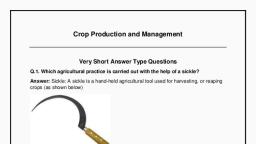
1.7 Protection from Weeds, Boojho and Paheli went to a nearby, wheat field and saw that there were some, other plants in the field., Have these other, plants been planted, purposely?, , In a field many other undesirable, plants may grow naturally along with, the crop. These undesirable plants are, called weeds., The removal of weeds is called, weeding. Weeding is necessary since, weeds compete with the crop plants for, water, nutrients, space and light. Thus,, they affect the growth of the crop. Some, weeds interfere even in harvesting and, may be poisonous for animals and, human beings., Farmers adopt many ways to remove, weeds and control their growth. Tilling, before sowing of crops helps in, uprooting and killing of weeds, which, may then dry up and get mixed with, the soil. The best time for the removal, of weeds is before they produce flowers, and seeds. The manual removal includes, physical removal of weeds by uprooting, or cutting them close to the ground,, from time to time. This is done with the, help of a khurpi. A seed drill [Fig. 1.2(b)], is also used to uproot weeds., Weeds are also controlled by using, certain chemicals, called weedicides,, like 2,4-D. These are sprayed in the, fields to kill the weeds. They do not, damage the crops. The weedicides are, diluted with water to the extent required, and sprayed in the fields with a sprayer., (Fig. 1.6)., , Fig. 1.6 : Spraying weedicide, , h, s, , T, i, l, R, b, E, u, C, p, N re, © e, b, o, t, t, , o, n, , 10, , d, e, , Do weedicides have any, effect on the person handling, the weedicide sprayer?, , As already mentioned, the weedicides, are sprayed during the vegetative growth, of weeds before flowering and seed, formation. Spraying of weedicides may, affect the health of farmers. So they, should use these chemicals very carefully., They should cover their nose and mouth, with a piece of cloth during spraying of, these chemicals., , 1.8 Harvesting, , Harvesting of a crop is an important, task. The cutting of crop after it is, mature is called harvesting. In, harvesting, crops are pulled out or cut, close to the ground. It usually takes 3, to 4 months for a cereal crop to mature., Harvesting in our, country is either done, manually, by, sickle, (Fig. 1.7) or by a machine, called harvester. In the, harvested crop, the grain Fig. 1.7 :, seeds need to be separated, Sickle, SCIENCE
Page 11 :
from the chaff. This process is called, threshing. This is carried out with the, help of a machine called ‘combine’ which, is in fact a combined harvester and, thresher (Fig. 1.8)., , Harvest Festivals, After three or four months of hard, work there comes the day of the, harvest. The sight of golden fields, of standing crop, laden with grain,, fills the hearts of farmers with joy, a n d a s e n s e o f w e l l -b e i n g . T h e, efforts of the past season have, borne fruit and it is time to relax, and enjoy a little. The period of, harvest is, thus, of great joy and, happiness in all parts of India., Men and women celebrate it with, great, enthusiasm., Special, festivals associated with the, h a r v e s t s e a s o n are P o n g a l ,, Baisakhi, Holi, Diwali, Nabanya, and Bihu., , h, s, , T, i, l, R, b, E, u, C, p, N re, © e, b, o, t, t, , Fig. 1.8 : Combine, , d, e, , 1.9 Storage, , After harvesting, sometimes, stubs are left in the field, which, are burnt by farmers. Paheli is, worried. She knows that it, causes pollution. It may also, catch fire and damage the crops, lying in the fields., , Farmers with small holdings of land, do the separation of grain and chaff by, winnowing (Fig. 1.9). You have already, studied this in Class VI., , o, n, , Fig. 1.9 : Winnowing machine, CROP PRODUCTION AND MANAGEMENT, , Storage of produce is an important task., If the crop grains are to be kept for, longer time, they should be safe from, moisture,, insects,, rats, and, microorganisms. The fresh crop has, more moisture. If freshly harvested, grains (seeds) are stored without drying,, they may get spoilt or attacked by, organisms, losing their germination, capacity. Hence, before storing them,, the grains are properly dried in the sun, to reduce the moisture in them. This, prevents the attack by insect pests,, bacteria and fungi. Farmers store, , I saw my mother putting, some dried neem leaves, in an iron drum, containing wheat., I wonder why?, 11
Page 12 :
Fig. 1.10 (a) : Silos for storage of grains, , 1.10 Food from Animals, Activity 1.3, , d, e, , T, i, l, R, b, E, u, C, p, N re, © e, b, o, t, t, , h, s, , Make the following Table in your, note book and complete it., , S.No., 1., , Food, , Milk, , Sources, , Cow, Buffalo, Shegoat, She-camel . . ., , 2., 3., 4., , Fig. 1.10 (b) : Storage of grains in granaries, , grains in jute bags or metallic bins., However, large scale storage of grains, is done in silos and granaries to protect, them from pests like rats and insects, [Fig. 1.10 (a) and (b)]., Dried neem leaves are used for, storing food grains at home. For storing, large quantities of grains in big, godowns, specific chemical treatments, are required to protect them from pests, and microorganisms., , o, n, , 12, , After completing this Table, you, must have seen that, like plants,, animals also provide us with different, kinds of food. Many people living in the, coastal areas consume fish as a major, part of their diet. In the previous classes, you have learnt about the food that we, obtain from plants. We have just seen, that the process of crop production, involves a number of steps like selection, of seeds, sowing, etc. Similarly, animals, reared at home or in farms, have to be, provided with proper food, shelter and, care. When this is done on a large scale,, it is called animal husbandry., Fish is good for health., We get cod liver oil from fish, which is rich in vitamin D., SCIENCE
Page 13 :
KEYWORDS, , WHAT YOU HAVE LEARNT, , AGRICULTURAL, , Â, , In order to provide food to our growing, population, we need to adopt certain, agricultural practices., , Â, , Same kind of plants grown and cultivated at, a place constitute a crop., In India, crops can be broadly categorised into, two types based on seasons - rabi and kharif, crops., It is necessary to prepare soil by tilling and, levelling. Ploughs and levellers are used for, this purpose., Sowing of seeds at appropriate depths and, distances gives good yield. Good variety of, seeds are sown after selection of healthy seeds., Sowing is done by seed drills., Soil needs replenishment and enrichment, through the use of organic manure and, fertilisers. Use of chemical fertilisers has, increased tremendously with the introduction, of new crop varieties., Supply of water to crops at appropriate, intervals is called irrigation., Weeding involves removal of unwanted and, uncultivated plants called weeds., Harvesting is the cutting of the mature crop, manually or by machines., Separation of the grains from the chaff is called, threshing., Proper storage of grains is necessary to protect, them from pests and microorganisms., Food is also obtained from animals for which, animals are reared. This is called animal, husbandry., , PRACTICES, ANIMAL HUSBANDRY, CROP, Â, , FERTILISER, GRANARIES, , Â, , HARVESTING, IRRIGATION, , Â, , MANURE, , Â, , PLOUGH, RABI, SEEDS, , Â, , SILO, , Â, , SOWING, STORAGE, THRESHING, WEEDS, , Â, Â, Â, , WEEDICIDE, , o, n, , WINNOWING, , h, s, , T, i, l, R, b, E, u, C, p, N re, © e, b, o, t, t, , KHARIF, , Â, , d, e, , Exercises, , 1. Select the correct word from the following list and fill in the blanks., float, water, crop, nutrients, preparation, (a) The same kind of plants grown and cultivated on a large scale at a, place is called _____________., (b) The first step before growing crops is _____________ of the soil., , CROP PRODUCTION AND MANAGEMENT, , 13
Page 14 :
EXERCISES, , (c), (d), , Damaged seeds would _____________ on top of water., For growing a crop, sufficient sunlight and _____________ and, _____________ from the soil are essential., , 2. Match items in column A with those in column B., A, (i), , B, , Kharif crops, , (a), , Food for cattle, , Rabi crops, , (b), , Urea and super phosphate, , (iii) Chemical fertilisers, , (c), , Animal excreta, cow dung, urine and plant waste, , (iv) Organic manure, , (d), , Wheat, gram, pea, , (e), , Paddy and maize, , (ii), , h, s, , T, i, l, R, b, E, u, C, p, N re, © e, b, o, t, t, , 3. Give two examples of each., (a) Kharif crop, (b) Rabi crop, , 4. Write a paragraph in your own words on each of the following., (a), , Preparation of soil, , (b), , Sowing, , (c), , Weeding, , (d), , Threshing, , d, e, , 5. Explain how fertilisers are different from manure., , 6. What is irrigation? Describe two methods of irrigation which conserve water., 7. If wheat is sown in the kharif season, what would happen? Discuss., 8. Explain how soil gets affected by the continuous plantation of crops in, a field., 9. What are weeds? How can we control them?, , 10. Arrange the following boxes in proper order to make a flow chart of, sugarcane crop production., , o, n, , Sending crop to, sugar factory, 1, , Preparation of, soil, 5, 14, , Irrigation, , Harvesting, , Sowing, , 2, , 3, , 4, , Ploughing the, field, , Manuring, , 6, , 7, SCIENCE
Page 15 :
EXERCISES, , 11. Complete the following word puzzle with the help of clues given below., Down, 1., Providing water to the crops., 2., Keeping crop grains for a long time under proper conditions., 5., Certain plants of the same kind grown on a large scale., Across, 3., A machine used for cutting the matured crop., 4., A rabi crop that is also one of the pulses., 6., A process of separating the grain from chaff., , d, e, , h, s, , T, i, l, R, b, E, u, C, p, N re, © e, b, o, t, t, , Extended Learning — Activities and Projects, 1., , o, n, 2., , Sow some seeds in the soil and arrange to water them by drip, irrigation. Observe daily., (i) Do you think it can save water?, (ii) Note the changes in the seed., Collect different types of seeds and put them in small bags. Attach, these bags in a herbarium file and label them., , 3., , Collect new agricultural machine pictures and paste in a file with, their names and uses., , 4., , Project Work, Visit a farm, nursery or a garden nearby. Gather information about, (i) importance of seed selection., (ii) method of irrigation., , CROP PRODUCTION AND MANAGEMENT, , 15
Page 16 :
(iii) effect of extreme cold and extreme hot weather on the plants., (iv) effect of continuous rain on the plants., (v) fertilisers/manure used., For more information, visit :, z www.krishiworld.com/html/balanced fertiliser. htm., z www.ikis.com/links/ap.cultivation.html, , An Example for Field Trip Work, , d, e, , h, s, , Himanshu and his friends were very anxious and curious to go to Thikri village., They went to Shri Jiwan Patel’s farmhouse. They had taken bags to collect some, seeds and other things., , T, i, l, R, b, E, u, C, p, N re, © e, b, o, t, t, , Himanshu : Sir namaskar, I am Himanshu. Here are my friends Mohan, David, and Sabiha. We want some information about crops. Please guide, us., Shri Patel :, , Namaskar and welcome all of you. What are your queries?, , Sabiha : When did you start this work and what are the main crops that, you grow?, Shri Patel :, , About 75 years ago, my grandfather started this work. The main, crops that we grow are wheat, gram, soyabean and moong., , David : Sir, can you tell us the difference between traditional and modern, agricultural practices?, Shri Patel :, , o, n, , Earlier we used traditional tools like sickle, bullock plough, trowel,, etc., and depended on rain water for irrigation. But now we use, modern methods of irrigation. We use implements like tractors,, cultivators, seed drill and harvester. We get good quality seeds., We carry out soil testing and use manure and fertilisers. New, information about agriculture is obtained through radio, T.V. and, other sources. As a result we are able to get good crops on a large, scale. This year we got 9 to 11 quintals of gram crop/acre and 20, to 25 quintals of wheat/acre. In my opinion awareness of new, technology is important for better crop yield., , Mohan :, , Sabiha, come here and see some earthworms. Are they helpful to, the farmers?, , Sabiha :, , Oh Mohan! we learnt about it in Class VI., , Shri Patel :, , Earthworms turn the soil and loosen it for proper aeration, so, they help the farmer., , David : Can we have some seeds of the crops you grow here?, [They put some seeds, fertilisers and soil sample in the bags.], , Himanshu :, , 16, , Sir, we are thankful to you for making this visit pleasant and for, providing useful information., SCIENCE