Page 2 :
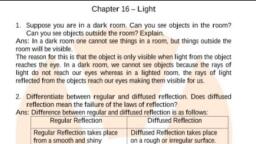
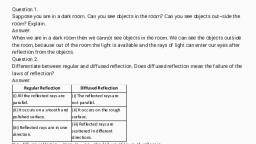
What makes Things Visible ?, Have you ever thought how we see, various objects?, You may say that eyes see the objects., But, can you see an object in the dark?, It means that eyes alone cannot see, any object., It is only when light from an object, enters our eyes that we see the object., The light may have been emitted by the, object, or may have been reflected by, it.
Page 3 :
Laws of Reflection, • The light ray, which strikes any surface, is, called the Incident ray., • The ray that comes back from the surface after, reflection is known as the Reflected ray., • The line perpendicular to surface is called, Normal., • Angle of incidence is always equal to the angle, of reflection. This is known as the law of, reflection., • The incident ray, the normal at the point of, incidence and the reflected ray all lie in the, same plane. This is another law of reflection., • The angle between the normal and incident ray, is called the angle of incidence (∠i). The angle, between the normal and the reflected ray is, known as the angle of reflection (∠r).
Page 4 :
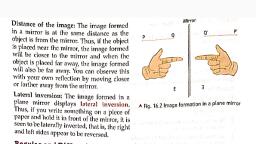
Image formation in a plane, mirror, , Activity 16.3, , • A source of light O is placed in front of a plane mirror PQ., Two rays OA and OC are incident on it. Can you find out the, direction of the reflected rays? Draw normal to the surface, of the mirror PQ, at the points A and C. Then draw the, reflected rays at the points A and C. How would you draw, these rays? Call the reflected rays AB and CD, respectively., Extend them further. Do they meet? Extend them, backwards. Do they meet now? If they meet, mark this point, as I. For a viewer’s eye at E ,do the reflected rays appear to, come from the point I. Since the reflected rays do not, actually meet at I, but only appear to do so, we say that a, virtual image of the point O is formed at I. As you have, learnt already in Class VII, such an image cannot be, obtained on a screen., • You may recall that in an image formed by a mirror the left, of the object appears on the right and the right appears on, the left. This is known as lateral inversion.
Page 5 :
Regular and Diffused Reflection, • When all the parallel rays reflected from a, plane surface are not parallel, the reflection, is known as diffused or irregular reflection., (Fig.A) Remember that the diffused, reflection is not due to the failure of the laws, of reflection. It is caused by the irregularities, in the reflecting surface, like that of a, cardboard., • On the other hand, reflection from a smooth, surface like that of a mirror is called regular, reflection (Fig.B). Images are formed by, regular reflection.
Page 6 :
Do We See all Objects due to Reflected, Light?, Nearly everything you see around is seen due to reflected light. Moon, for example, receives, light from the sun and reflects it. That’s how we see the moon. The objects which shine in the, light of other objects are called illuminated objects. Can you name some other such objects?, There are other objects, which give their own light, such as the sun, fire, flame of a candle and, an electric lamp. Their light falls on our eyes. That is how we see them. The objects which emit, their own light are known as luminous objects.
Page 7 :
Reflected Light can be Reflected Again, • When two mirrors are placed opposite to, each other, the first mirror reflects light that, falls on its surface. When this reflected light, falls on the second mirror that is placed, the, second mirror also reflects this light., • The periscope makes use of this concept by, using two plane mirrors., • Periscopes are used in submarines, tanks, and also by soldiers in bunkers to see things, outside., , Mirror at the hair dresser shop
Page 8 :
periscope
Page 9 :
Activity, Take two plane mirrors. Set them at right, angles to each other with their edges touching, (Fig. 16.10). To hinge them you can use, adhesive tape. Place a coin in between the, mirrors. How many images of the coin do you, see (Fig. 16.10)? Now hinge the mirrors using, the adhesive tape at different angles, say 45º,, 60º, 120º, 180º, etc. Place some object (say a, candle) in between them. Note down the, number of images of the object in each case., Finally, set the two mirrors parallel to each, other. Find out how many images of a candle, placed between them are formed (Fig., , Images in plane mirror at right angle to each other, , 16.11)., , Image in plane mirror parallel to each other
Page 10 :
Kaleidoscope, To make a kaleidoscope, get three rectangular, mirror strips each about 15 cm long and 4 cm, wide. Join them together to form a prism as, shown in Fig. 16.12(a). Fix them in a circular, cardboard tube or tube of a thick chart paper., Make sure that the tube is slightly longer than the, mirror strips. Close one end of the tube by a, cardboard disc having a hole in the centre,, through which you can see [Fig. 16.12(b)]. To, make the disc durable, paste a piece of, transparent plastic sheet under the cardboard, disc. At the other end, touching the mirrors, fix a, circular plane glass plate [Fig. 16.12(c)]. Place, on this glass plate several small pieces of, coloured glass (broken pieces of coloured, bangles). Close this end of the tube by a ground, glass plate. Allow enough space for the colour, pieces to move around.
Page 11 :
Sunlight White or Coloured, ❖Get a plan mirror of a suitable size., ❖Place it in bowl., , ❖Fill the bowl with water., ❖Direct sunlight falls on the mirror., ❖Reflected light will be seen to have many, colours., , ❖The mirror and water form prism., ❖Splitting of light in to colours is called, dispersion of light., ❖Rainbow .
Page 12 :
What is inside Our Eyes?, ❖ Eye is one of our most important sense, organs., ❖ The eye has a roughly spherical shape., ❖ The outer coat of the eye is white., ❖ Tough so that it can protect the interior of the, eye from accidents., ❖ transparent front part is called cornea., ❖ Behind the cornea, we find a dark muscular, structure called iris., ❖ In the iris, there is a small opening called the, pupil., ❖ Size of the pupil is controlled by the iris., ❖ iris is that part of eye which gives it its, distinctive colour., ❖ The iris controls the amount of light entering, into the eye.
Page 13 :
activity, • Behind the pupil of the eye is a lens which, is thicker in the centre., • The lens focuses light on the back of the, eye, on a layer called retina., • Sensations felt by the nerve cells are then, transmitted to the brain through the optic, nerve., • There are two kinds of cells, ➢cones, which are sensitive to bright, light and, ➢rods, which are sensitive to dim light., • Cones sense colour., • At the junction of the optic nerve and the, retina, there are no sensory cells, so no, vision is possible at that spot. This is called, the blind spot.
Page 14 :
activity, • Get a square piece of cardboard of size, 6-8 cm., , • Make two holes as shown in Fig., • Thread a string through the two holes., • Draw/ paste a cage on one side of the, cardboard and a bird on the other side., , • Twist the string and make the card twirl, rapidly.
Page 15 :
activity, ❖Impression of an image persists for about 1/16th of a, second., ❖Movies that we see are actually a number of separate, pictures in proper sequence., ❖24 pictures per second, ❖Eyelids to prevent any object from entering the eye., ❖Eyelids also shut out light when not required., ❖Most comfortable distance at which one can read with, a normal eye is about 25 cm., ❖In old age, eyesight becomes foggy., ❖Eye lens becoming cloudy., ❖When it happens, persons are said to have cataract., ❖The opaque lens is removed and a new artificial lens is, inserted.
Page 17 :
Care of the Eyes, • If advised, use suitable spectacles., • Too little or too much light is bad for eyes. Insufficient light causes, eyestrain and headaches. Too much light, like that of the sun, a, power full lamp or a laser torch can injure the retina., • Never rub your eyes. If particles of dust go into your eyes, wash, your eyes with clean water. If there is no improvement go to a, doctor., • Wash your eyes frequently with clean water., • Always read at the normal distance for vision. Do not read by, bringing the book too close to your eyes or keeping it too far., • Lack of vitamin A in foodstuff is responsible for many eye troubles., • Most common amongst them is night blindness., • Raw carrots, broccoli and green vegetables (such as spinach), and cod liver oil are rich in vitamin A. Eggs, milk, curd, cheese,, butter and fruits such as papaya and mango are also rich in, vitamin A.
Page 18 :
Visually Challenged Persons Can, Read and Write ?, • Some persons, including children, can be, visually handicapped., • They have very limited vision to see things., Some persons cannot see at all since birth., Some persons may lose their eyesight, because of a disease., • Such persons try to identify things by, touching and listening to voices more, carefully., • They develop their other senses more, sharply., • However, additional resources can enable, them to develop their capabilities further.
Page 19 :
What is the Braille System ?, • The most popular resource for visually challenged persons is, Braille., • Louis Braille, himself a visually challenged person, developed a, system for visually challenged persons and published it in 1821., • Braille system has 63 dot patterns or characters., • Each character represents a letter, a combination of letters, a, common word or a grammatical sign., • Dots are arranged in cells of two vertical rows of three dots each., • Patterns of dots to represent some English letters and some, common words are shown below. These patterns when, embossed on, , • Braille sheets help visually challenged persons to recognise, words by touching. To make them easier to touch, the dots are, raised slightly., • Braille texts can be produced by hand or by machine.