Page 1 :
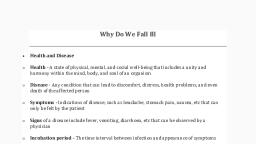
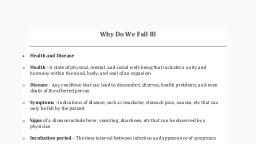
2. Health and Diseases, , ¢ Health and Disease, , o Health - A state of physical, mental, and social well-being that includes a unity and harmony within, the mind, body, and soul of an organism, , o Disease - Any condition that can lead to discomfort, distress, health problems, and even death of the, affected person, , o Symptoms - Indications of disease, such as headache, stomach pain, nausea, etc that can only be, felt by the patient, , o Signs of a disease include fever, vomiting, diarrhoea, etc that can be observed by a physician, , o Incubation period - The time interval between infection and appearance of symptoms, , Causes of diseases, , 1. Contributory causes, o Unhealthy condition, o Improper public service, © Poverty, , 2. Immediate causes:, , ¢ These are external causes like micro-organisms., ¢ Organisms like virus, bacteria, and other micro-organisms can cause diseases in a person., , On the basis of its duration , diseases are of two types- Acute and Chronic, , = Acute - Lasts for a short period of time, eg. Cold, cough, influenza, etc., = Chronic - Lasts for long periods of time, eg. Diabetes, kidney stones, etc., , The disease-causing microorganisms that transmit communicable diseases belong to different categories such as:, ¢ Viruses - These are tiny organisms that grow, multiply, or reproduce only inside the host cells., Diseases caused by viruses - Influenza, cold (Rhinovirus), dengue, AIDS, etc., ¢ Bacteria - These are unicellular organisms; larger than viruses, Diseases caused by bacteria - Whooping cough, typhoid, cholera, anthrax, etc., e Fungi - These are plant-like organisms; heterotrophic, Diseases caused by Fungi - Athlete’s foot, candidiasis, ringworms, etc., ¢ Protozoa - These are simple, primitive unicellular organisms which are often found in water., Diseases caused by Protozoa - Amoebiasis, kala azar, malaria, African sleeping sickness, etc., , ¢ Multicellular animals like worms - These are parasites that infect the intestines of human beings and, other animals.
Page 2 :
Diseases caused by worms- Diarrhoea, anaemia, liver rot, etc., , Disease is characterised by various signs and symptoms., , Infectious diseases. For example: Common cold, , Noninfectious For example: Cancer, , Infectious diseases., , It spreads through infectious agents that include bacteria, viruses, protozoans and fungi., , 1, , Bacterial diseases, , . Typhoid fever: Salmonella typhi; Widal test is used for confirmation of typhoid, . Pneumonia: Streptococcus pneumoniae and Haemophilus influenzae; it infects the alveoli of lungs, , . Other examples include dysentery, plague, diphtheria, , Viral diseases, 1. Common cold: Spreads through Rhino viruses, , Protozoan diseases, , . Malaria: Pathogen is Plasmodium; malarial parasite requires two hosts: humans and female, , anopheles mosquito; malarial parasite reproduces asexually in the human host while in the, mosquito host it reproduces sexually, , . Amoebiasis (amoebic dysentery): Entamoeba histolytica, , Helminthes diseases, 1. Ascariasis: Pathogen is Ascaris, 2. Elephantiasis or filariasis: Pathogen is Wuchereria bancrofti, 3. Taeniasis : pathogen is Taenia solium or Taenia saginata, Fungi, , 1, Ringworms: Caused by fungi which belong to genera Microsporum, Trichophyton and, Epidermophyton, , On the basis of causative agents - Infectious and Non-infectious
Page 3 :
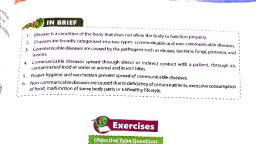
¢ Infectious - Diseases such as influenza, cold, etc., which are caused due to infectious agents . An, infectious disease is classified as communicable because it can be transferred from an infected person to a, healthy person., , ¢ Non-infectious - Diseases such as high blood pressure, cancer, etc., which are caused by some internal, causes such as excessive weight, genetic defects, etc. These are non communicable because it cannot be, transmitted from a diseased person to a healthy person., , 1. Communicable Diseases - Diseases which spread from one person to another, such as influenza, cold,, etc. They are caused by the disease-causing microorganisms., , 2. Non-communicable Diseases - Diseases which cannot spread from one person to another such as high, blood pressure, cancer, etc. These diseases are caused by some internal causes such as excessive weight,, genetic defects, etc., , Communicable diseases, The disease-causing microorganisms that transmit communicable diseases belong to different categories such as:, ¢ Viruses - These are tiny organisms that grow, multiply, or reproduce only inside the host cells., Diseases caused by viruses - Influenza, cold (Rhinovirus), dengue, AIDS, etc., ¢ Bacteria - These are unicellular organisms; larger than viruses, Diseases caused by bacteria - Whooping cough, typhoid, cholera, anthrax, etc., ¢ Fungi - These are plant-like organisms; heterotrophic, Diseases caused by Fungi - Athlete’s foot, candidiasis, ringworms, etc., ¢ Protozoa - These are simple, primitive unicellular organisms which are often found in water., , Diseases caused by Protozoa - Amoebiasis, kala azar, malaria, African sleeping sickness, etc., , ¢ Multicellular animals like worms - These are parasites that infect the intestines of human beings and, other animals., , Diseases caused by worms- Diarrhoea, anaemia, liver rot, etc., ¢ Means of spread of communicable diseases, Based on the mode of transmission, communicable diseases are of following types, , ¢ Air-borne diseases - Transmitted when disease-causing microorganisms are expelled into the air by, coughing, sneezing, talking, etc., , Eg. Common cold, chicken pox, small pox, pneumonia, influenza, tuberculosis, etc., , e Water-borne diseases - Spread when the excretions, from an infected person, containing causal, microorganisms get mixed with drinking water and this contaminated water is consumed, , Eg. Cholera, typhoid, hepatitis A, etc., ¢ Food borne diseases — Caused by consuming food infected by disease causing microbes., , Eg. Botulism, stomach infections, etc.
Page 4 :
¢ Contact — spreads through coming in contact with the diseased person or using the articles used by him, Eg. swine flu, ringworm, conjunctivitis, , e Animals — Animals which transfer disease-causing microorganisms from an infected person to others are, called vectors, , Eg. female mosquitoes can transfer the malaria-causing Plasmodium, Non-Communicable diseases, , A non-communicable disease can be caused by nutrient deficiency, malfunctioning of body organs (degenerative, diseases), and bad habits like drug abuse., , ¢ Nutrition deficiency — These diseases are caused by deficiency of certain nutrients like carbohydrates,, proteins, minerals, vitamins, etc. The person suffering from such diseases is called malnourished, , 1. Carbohydrate and protein deficiency — Leads to marasmus. In this the body becomes lean and thin, ribs, become prominent and child suffers from mental retardation., , 2. Protein deficiency — Leads to Kwashiorkor. In this, the belly protrudes out, eyes bulge and the legs, become stick thin., , 3. Vitamin deficiency — deficiency of different vitamins lead to different diseases., , Deficiency of Leads to, Vitamin A Night blindness, Vitamin B Beri-beri, Vitamin C Scurvy, Vitamin D Rickets, Vitamin K haemorrhage, , 4. Mineral deficiency — deficiency of different minerals lead to different diseases., , Deficiency of Leads to, Iron Anaemia, Calcium Rickets, Sodium Muscle cramps, Phosphorus Bad teeth and bones, , iodine Goitre
Page 5 :
¢ Health: A complete state of well being, which not just includes a fit, disease-free body, but also includes a, person's abiltiy to realize his or her full potentials., , ¢ Disease refers to any disorder of structure or structural function in an organism., , ¢ Acute diseases are those that last only for a short period of time. Examples include cold and cough., , ¢ Chronic diseases are those that last for a long period. Examples include diabetes, blood pressure, etc., , ¢ On the basis of communicability, diseases can be communicable or infectious and non-communicable, or, non-infectious., , * Communicable or infectious diseases are caused by some germs or pathogens. They can get transferred, from one person to the other, a process called infection. Common examples are cholera, malaria, small, pox, etc., , ¢ Non-communicable or non-infectitous diseases are not caused by any germ and cannot spread from one, patient to the other. They can occur due to some nutritional deficiency (like scurvy), or due to some, metabolic disorder (diabetes), or due to any allergy or genetic disorder (haemophilia), etc., , ¢ Viruses, © Viruses are extremely small infectious agents, made up of nucleic acids and proteins., They cannot live freely in nature and require a host cell to live., They can be cultured on living tissue in the laboratory. They can also be crystallised and stored., Most of the viruses are highly specific for their hosts., , oo °0, , ¢ Viral diseases, 1, Common cold: Spreads through Rhino viruses, , 2. Poliomyelitis (polio): Spreads through polio virus, 3. Measles: Spreads through Paramyxo virus, , . Other disease include: AIDS, Mumps, Rabies etc., , ¢ Protozoan diseases, , . Malaria: Pathogen is Plasmodium; malarial parasite requires two hosts: humans and female anopheles, mosquito; malarial parasite reproduces asexually in the human host while in the mosquito host it, reproduces sexually, , 2. Amoebiasis (amoebic dysentery): Entamoeba histolytica, , ¢ Helminthes diseases, , 1, Ascariasis: Pathogen is Ascaris, , 2. Elephantiasis or filariasis: Pathogen is Wuchereria bancrofti, , 3. Taeniasis : pathogen is Taenia solium or Taenia saginata, , Degenerative Diseases