Page 1 :
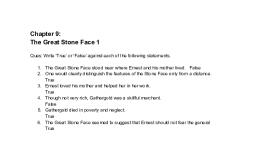
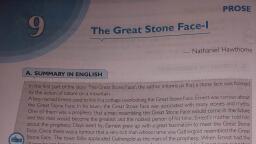
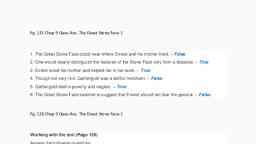
Chapter 9:, The Great Stone Face 1, Ques: Write ‘True’ or ‘False’ against each of the following statements., 1. The Great Stone Face stood near where Ernest and his mother lived. False, 2. One would clearly distinguish the features of the Stone Face only from a distance., True, 3. Ernest loved his mother and helped her in her work., True, 4. Though not very rich, Gathergold was a skillful merchant., False, 5. Gathergold died in poverty and neglect., True, 6. The Great Stone Face seemed to suggest that Ernest should not fear the general, True, , Q 1: What was the Great Stone Face?, A (i) The Great Stone Face was a work of nature. It was formed on the perpendicular side of a, mountain by some immense rocks that had been thrown together so that when viewed at a, proper distance, they resembled the features of a human face., Q 2: What did young Ernest wish when he gazed at it?, A (ii) Gazing at the Great Stone Face, young Ernest wished that it could speak because it, looked so very kindly that he thought its voice must be pleasant. He also said that if he ever saw, a man with such a face, he would love him very much., Q 3 : What was the story attributed to the Stone Face?, A 3: The story that was attributed to the Stone Face was that at some future day, a child would, be born near there, and he would be destined to become the greatest and noblest person of his, time. His face, in manhood, would bear an exact resemblance to the Great Stone Face., , Q 4: What gave the people of the valley the idea that the prophecy was about to come true for, the first time?, A 4: The people got the idea that the prophecy was about to come true from a rumour that went, throughout the valley. The rumour was that the great man, who was to bear a resemblance to, the Great Stone Face, had appeared at last. Many years before, a young man named, Gathergold had left the valley and settled at a distant seaport. He had set up as a shopkeeper, and being sharp in business matters, had become so rich that it would have taken him a
Page 2 :
hundred years only to count his wealth. In time, he thought of his native valley, and decided to, go back there and end his days where he had been born. The people believed that this was the, prophesied man., Q 5: Did Ernest see in Gathergold the likeness of the Stone Face?, A 5: No, Ernest did not see any likeness of the Stone Face in Gathergold., Q 6: Who did he confide in and how was he proved right?, A6 : He confided in the Great Stone Face. After Gathergold’s death as his wealth and gold had, already disappeared, it was generally agreed that Gathergold had no resemblance to the Great, Stone Face., Q 7: What made people believe General Blood- and-Thunder was their man?, A 7: Gen. Blood-and-thunder had risen from a soldier to a high position. His childhood friends, said when he returned to the valley that the General had always looked like the Stone Face., , Q 8 :Ernest compared the man’s face with the Stone Face. What did he conclude?, A 8: Ernest could not find any likeness between the General and the Stone Face., This is not to be written in CW. Complete it in the book, Question 1:, Write the noun forms of the following words by adding -ness or -ity to them appropriately. Check, the spelling of the new words., , ANSWER:, (i) lofty. loftiness. (vi) enormous enormity, (ii) able ability. (vii) pleasant pleasantness, (iii) happy happiness (viii) dense density, (iv)near nearness. (ix) great greatness, (v) noble nobility. (x) stable stability, Page No 130:, Question 2:, Add -ly to each of the following adjectives, then use them to fill in the blanks., ANSWER:, (i) Why didn’t you turn up at the meeting? We all were eagerly waiting for you.
Page 3 :
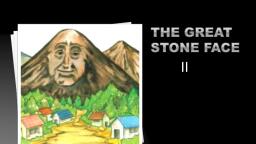
(ii) Kindly write your name and address in capital letters., (iii) I was pleasantly surprised to see him at the railway station. I thought he was not coming., (iv) It is perfectly believable that I am not responsible for this mess., (v) He fell over the step and nearly broke his arm., , Page No 131:, Question 3:, Complete each sentence below using the appropriate forms of the verbs in brackets., , ANSWER:, (i) I will phone you when I will get home from school., (ii) Hurry up! Madam will be annoyed if we are late., (iii) If it rains today, we will not go to the play., (iv) When you see Mandal again, you will not recognize him. He is growing a beard., (v) We are off today. We will write to you after we are back., , THE GREAT STONE FACE - II, Question 1:, Write ‘True’ or ‘False’ against each of the following statements., 1. Ernest’s words reminded people of the wise old sayings. TRUE, 2. Total strangers from far away, who visited Ernest in the valley, found his face familiar. TRUE, 3. The Great Stone Face confirmed Ernest’s view that the poet could be worthy of its likeness., FALSE, 4. When Ernest and the poet met, they respected and admired each other equally. TRUE, 5. The poet along with Ernest addressed the inhabitants of the valley. FALSE, 6. The poet realised that Ernest’s thoughts were far nobler than his own verses. TRUR
Page 4 :
Page No 137:, Q1: How was Ernest different from others in the valley?, A 1 The wise thoughts of Ernest made him different from others in the valley. Ernest was, well-known in his valley and had become famous even beyond the valley. College professors, and even the active men of cities came from far to see and converse with him. He received, them with gentle sincerity and spoke freely with them of whatever came uppermost or lay, deepest in his heart or their own., , Q 2: Why did Ernest think the poet was like the Stone Face?, A 2: When Ernest read his poems, he hoped that the poet was like the Stone Face. The poet, had celebrated the Great Stone Face in his poems. Ernest believed that the poet’s thoughts, were worthy of him bearing resemblance to the Stone Face., Q 3: What did the poet himself say about his thoughts and poems?, A 3: The poet said that Ernest could hear the distant voice of a heavenly song in his thoughts, and poems. However, the poet felt that his own life had not corresponded with his thoughts. He, had grand dreams, but they had been only dreams. Sometimes he even lacked faith in his own, thoughts., Q 4: What made the poet proclaim Ernest was the Stone Face?, A 4: When Ernest was addressing the inhabitants of the valley, the poet realised that the life and, character of Ernest were nobler than his works of poetry. At a distance high up in the golden, light of the setting sun, the Great Stone Face appeared with white mists around it, similar to the, white hairs around the brow of Ernest. At that moment, Ernest’s face took on an expression so, grand that the poet proclaimed that Ernest was the Stone Face., Q 5: Write ‘Ernest’ or ‘Poet’, against each statement below., (i) There was a gap between his life and his words. Poet, (ii) His words had the power of truth as they agreed with his thoughts. Ernest, (iii) His words were as soothing as a heavenly song but only as useful as a vague dream. Poet, (iv) His thoughts were worthy. Ernest, (v) Whatever he said was the truth itself. Ernest, (vi) His poems were noble. Poet, (vii) His life was nobler than all the poems. Ernest
Page 5 :
(viii) He lacked faith in his own thoughts. Poet, (ix) His thoughts had power as they agreed with the life he lived. Ernest, (x) Greatness lies in truth. Truth is best expressed in one’s actions. He was truthful, therefore he, was great. Ernest, , Q 6:, (i) Who, by common consent, turned out to be like the Great Stone Face?, (ii) Did Ernest believe that the old prophecy had come true?, A (i) By common consent, Ernest turned out to be like the Great Stone Face., (ii) No, Ernest did not believe that the old prophecy had come true. Even though everybody had, agreed that he was the likeness of the Great Stone Face, he himself hoped that some wiser and, better man than himself would appear, bearing a resemblance to the Great Stone Face., This is not to be written in CW. Complete it in the book, Question 1:, Mark the meaning that best fits the word or a phrase in the story., ANSWER:, (i) (sun) going down − setting, (ii) brightening − lending (it) a special glow, (iii) spacious − big and wide, (iv) prophecy − prediction, (v) marvellous − wonderful, (vi) proclaim − declare, (vii) cease − stop, (viii) (a night’s) shelter − stay, (ix) gazed − stared at
Page 6 :
(x) took on (an expression) − assumed, , Q 2:, (ii) Which form of the verb is more natural in these sentences?, , ANSWERS, (a) I’m not free this evening. I am working on a project., (b) Have you decided where you will go for your higher secondary?, Yes, I have. I will go to the Kendriya Vidyalaya., (c) Don’t worry about the dog. It won’t hurt you., (d) The weatherman has predicted that it will snow in Ranikhet tonight., (e) Swapna can’t go out this evening. Her father is coming to see her., , Page No 139:, Question 3:, (i) Complete these pieces of conversation using will or going to with the verbs given., , ANSWER:, (a) Rani : Why are you turning on the radio?, Ravi : I am going to listen to the news., (b) Rani : Oh, I can’t buy this book. I have no money., Ravi : Don’t worry. I will lend you some., (c) Rani : Look at those dark clouds., Ravi : I think it is going to rain., (d) Rani : What shall we have for dinner?
Page 7 :
Ravi : I can’t decide., Rani : Make up your mind., Ravi : All right, then. We will have fried rice and dry beans., (e) Rani : Why are you filling the kettle with water?, Ravi : I am going to make coffee., (f) Rani : We need some bread and butter for breakfast., Ravi : All right. I will go to the bakery and get some., (Before he goes out, Ravi talks to their father.), Ravi : I am going to get some bread and butter. Do you want anything from the bakery?, Father : Yes, I want some salt biscuits., Ravi : Fine, I will get you a packet.