Notes of 8th, English Narration.pdf - Study Material
Page 1 :
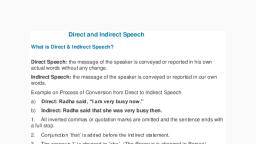
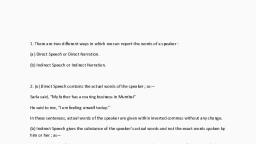
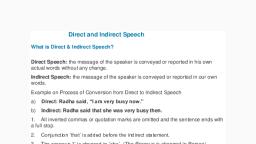
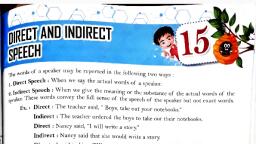
DA] DIRECT AND INDIRECT SPEECH, , , , Whatever a speaker speaks, his words cz, S, his words can be reported j u, ) , xe reported in two ways. Suppose teach, ee ee man RE tie: | s. Suppose, your teacher told, you to WO k hard and you want to say it to your friend or anyone. How would you say these words ?, , These words can be said in two wavs, Oc FU Na Ss. ) ‘ > : = Vale kok m {+1 z, aoe cpick ba cae Ga ce ys. We A ive no concern with the teacher (speaker) but only, his ee ges; iS e actual words said by the teacher (speaker) are used, it will be a Direct, Speech and il his words are reported in your words, that will be an Indirect Speech, Now read the following sentence and judge about it, The teacher said to me, “Work hard.”, 5 Nt37o> <p rs ae ry Tate é . — : : 3, In the —) Sé ppee the words given within the inverted commas (“...”) are the actual words, said by the teac rer. t we say the same words as said by the teacher, it will be Direct Speech. We can, cay these words in our own words, as ;, The teacher advised me to work hard, Love stated words are, Above anes wol ds are not the actual words said by the teacher, but these are the words said in, -own words. It will be indirect speech., , WS, So, we may report the words and not the actual words said by the teacher, but these are words, sid in our own words. It will be Indirect speech., , ne, WMATA ~, , So. we may report the words of a speaker in two ways : Direct Speech and Indirect Speech., , i. Direct Speech, Every direct speech has two parts—One is outside the inverted commas (“...”) and the other is, within the inverted commas., , Oul, , , , we are only concerned, and the part within the inverted commas 1s called the reported, , fa ee ee ee ee, , What do you mean by a reporting verb., It means the reporter who reports. Reporting verb play, from active to passive, e.g.,, He says to him, “You are a noble man.”, In the above sentence, ‘He says to him is th, says is to be taken to change the verb or tense ©, inverted commas., , 2. Indirect Speech, , When speaker’s actual words are replac, then it becomes an indirect speech, e.g.,, He says to me, “I am your friend.” —, This is direct speech, as the speaker's, becomes :, He tells me that he is my friend. ee, It is an indirect speech as the actual words have been changed and own words have been used., But, in changing the narration, pronouns and verbs are also changed and that is added after, , removing the inverted comma, , s a dominating role in changing the voice, , e reporting verb. While changing the voice, the verb, f the reported speech which is enclosed within the, , ed by us in our words and inverted commas are removed,, , actual words are there. But, by changing tts narration, it
Page 2 :
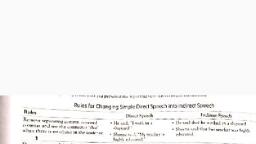
RULES FOR ao DIRECT SPEECH INTO INDIRECT, , tt ro, — > —, , |. ya pe 2S), = ss, , = = 4 f, SIT" r , TE :, ty fil Fi i, , a > if,, UW a a rs, he eS Te, , , , Ai as ZA. 7 ho, , Direct : She says to me, “I will come to see you.”, Indirect : She tells me that she will come to see me., Direct : Harish will say, “Nobody was in the room.”, Indirect : Harish will say that nobody was in the room., Direct : The Principal says, “Mary will not pass.”, , Indirect : The Principal says that Mary will not pass., , , , , , Direct - =: She said Slanrunwelle =, , Indirect : She said that she was unwell., , Direct : Sudha said, “Brijesh loves sweets.”, , Indirect : Sudha said that Sales) eed sweets., , Direct 2h Be ak “My one is ante a letter.”, , Indirect : He said that his brother was writing letters., , Direct: The teacher said, “The boys are playing in the field.”, Indirect: The Bee! said eral oe boys were playing in the field., , , , , y a . 3k, erfect. e, wy Ww hg . °9, , , , Direct : She a “| ae Saeed the examination. ”, , Indirect : She said that she had passed the examination., , Direct : He said, “Reshma has done her work.”, , Indirect - EG ae that Resama had oN ney work., , Direct eae boys a to ae feecher “We have been doing our practical for five, hours.”, , Indirect : The boys told the teacher that they had been doing their practical for five, , , , hours., Direct = dle said “The ae died j in the night.”, Indirect : He said that the lion had died in the night., Direct : He said, “Pawan bought a book.”, , , , , , Indirect : He said that Pawan ped a a Books, Direct =a Mig renee a fas me, ‘I was seeing the Red Boa :, Indirect : My brother told me that he had been seeing the Red Fort., , , , , \ ~, SO, . 293 ©
Page 4 :
hose. ST ae, 4 comes that day. becomes the next day., _ Yesterday becomes the previous day. Tonight becomes that night.”, , , , , , Last night becomes the previous night. veek becomes that previous week., © BaGIBecomes before.” TBief>ccmoes, , , , Direct : Ajit said, “I am glad to be here this evening.”, Indirect : Ajit said that he was glad to be there that evening., Direct : He said, “Manish may come tomorrow. ”, Indirect : He said that Manish might come the next day., Direct : Amit said, “I am busy now.”, Indirect : Amit said that he was busy then., F Direct : She said to me, “I finished the work long ago.”, Indirect : She told me that she had finished the work long before., Direct : Sunita said, “This happened yesterday.”, Indirect : Sunita said that that had happened the previous day., Direct : Peter said, “Today is a hot day.”, Indirect : Peter said that that day was a hot day., Direct : She said, “These apples are sweet.”, Indirect : She said that those apples were sweet., , 2. INTERROGATIVE SENTENCE ee, (QUESTIONS) 7., , a shang:, = «il 4 =, <i ee:, , ate Nola ie, n changing an InienogativeSenfenceint the Indrect Speech,, | reporting verb ‘said’ or ‘said to’ will be changed into ‘asked’, “enquired” or some other, , word aving a eae maar, , , , , , id) No conjunction is ad dies = reported speech begins with the question word (what,, where, when, who, how, whys which, ee, , can, , Indirect. ced me if I w, are ; ae aoe a : Re rae, Direct ee seg oe, Indirect he waste ee, Direct : He said, “Will gon pee, Indirect eee 8 SS . a, Direct, , Indirect, Direct, , Indirect, Direct, , , , , , , , , , , , , , , >, , sho 1542
Page 5 :
Indirect : She asked me how I was, Direct ; he said to me. “What are, Indirect : She asked me wh:, , Direct : I said to her, “Why have you not come?”, , Indirect : Tasked her why she had not come., , Direct : They said to Sachin, “Why have you not been doing this job since yesterday;?”, Indirect : They asked Sachin w, , Direct =: He said to me, “Why have you beaten him?” %, Indirect : He asked me why I had beaten him., , Direct | said to him, “What was he doing at that time?”, , Indirect : Iasked him what he had been doing at that time., , Remember : Question mark (, , ?) of reported speech will not be used in indirect speech. The full, stop (.) is used in indirect speech., , 3. IMPERATIVE SENTENCES, , In the imperative sentence, the subject is mostl, , verb. In these sentences, while changing the spee, the inverted commas are removed., , Undermentioned points may be kept in mind, , y omitted. So, the reported speech begins with a, ch, ‘to’ is used in spite of any conjunction when, , (a) The reporting verb ‘said to’ is changed according to the mood or sense of the sentence, given in the reported speech. If the reported speech shows the order, the reporting verb said to must, be changed into ordered. When it shows the request, requested’ will be used in place ‘of said to’., , When it shows some ‘advice, advised’, the same is used in place of said or said to. If ‘do not’ is given, , in reported speech, ‘forbade’ will be used in place of ‘said’ or ‘said to’. Here, we should remember, that while using ‘forbade’, not given in the reported speech is omitted., , (b) The Imperative Mood is changed into Infinitive Mood by placing ‘to’ before the verb., , Direct : The student said to the teacher, “Please allow him to come in.”, Indirect : The student requested the teacher to allow him to come in., Direct : The teacher said, “Get out from the class, Rama.”, , Indirect : The teacher ordered Rama to get out from the class., , Direct - The mother said to her son, “Work hard.”, , Indirect : The mother advised her son to work hard., , Direct : The teacher said, “Do not make a noise, students.”, , Indirect : The teacher forbade the students to make a noise., , Direct : We said, “Be quiet and listen to my words.”, , Indirect : He urged them to be quiet and listen to his words., , Direct : The beggar said to Kapil, “Please give me something to eat.”, Indirect : The beggar begged Kapil to give him something to eat., , 4. EXCLAMATORY SENTENCES, , (a) When a sentence depicts joy, sorrow, surprise or praise, it is an exclamatory sentence., , While changing the speech of these sentences, these sentences should be changed into positive, , Sentences, so mark of exclamation (!) is being taken off and a full stop (.) is used. The reporting verb, , exclaimed with is used in place of said or said to and the sense of sentence showing that’ is used, _ WIthie word 5... |, , , , PO



 Learn better on this topic