Page 1 :
Write ‘True’ or ‘False’ against each of the, following statements., , 1. Ernest's words reminded people of the wise, old sayings. _---, 2. Total strangers from far away, who visited, Ernest in the valley, found his face familiar., , 3. The Great Stone Face confirmed Ernest's, view that the poet could be worthy of its, likeness,, , 4, When Ernest and the poet met, they, respected and admired each other equally., , 5. The poet along with Ernest addressed the, inhabitants of the valley., , 6. The poet realised that Ernest’s thoughts, , were far nobler than his own verses.

Page 2 :
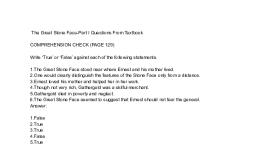
Answers:, , 1. True, 2. True, 3. False, 4. True, 5. False, 6. True
Page 3 :
Answer the following questions., , Question 1:, , How was Ernest different from others in the, valley?, , Answer:, , Ernest was unlike other commoners in the valley., He was a good, simple hearted, noble and, thoughtful person. He had been under, observation. He did not go with the crowd. He, welcomed total strangers as the prophets., , Question 2:, , Why did Ernest think the poet was like the Stone, Face?, , Answer:, , The poet wrote wonderful songs. He had, celebrated the Great stone Face in one of his, poems. When Ernest read this poem he became, convinced that the poet was like the stone face.
Page 4 :
Question 3:, , What did the poet himself say about his thoughts, and poems?, , Answer:, , The poet confessed that he was not worthy to be, compared with the Stone Face. His actions did, not match with his thoughts., , Question 4:, , What made the poet proclaim Ernest was the, Stone Face?, , Answer:, , Ernest and the poet together went to a meeting, place. Ernest addressed the gathering. His words, had power and his thoughts had depth. They were, the words of life, a life of good deeds and selfless, love. The poet was convinced that Ernest - was, much nobler than him. Ernest's face had such a, grand expression that he declared that Ernest, bore the likeness of the Great Stone Face.
Page 5 :
Question 5:, Write ‘Ernest’ or ‘Poet’, against each statement, below., , (i) There was a gap between his life and his, words., , (ii) His words had the power of truth as they, agreed with his thoughts., , (iii) His words were as soothing as a heavenly, song but only as useful as a vague dream., (iv) His thoughts were worthy., , (v) Whatever he said was truth itself., , (vi) His poems were noble., , (vii) His life was nobler than all the poems., (viii) He lacked faith in his own thoughts., (ix) His thoughts had power as they agreed, with the life he lived., , (x) Greatness lies in truth. Truth is best, expressed in one's actions. He was truthful,, therefore he was great.