Page 1 :
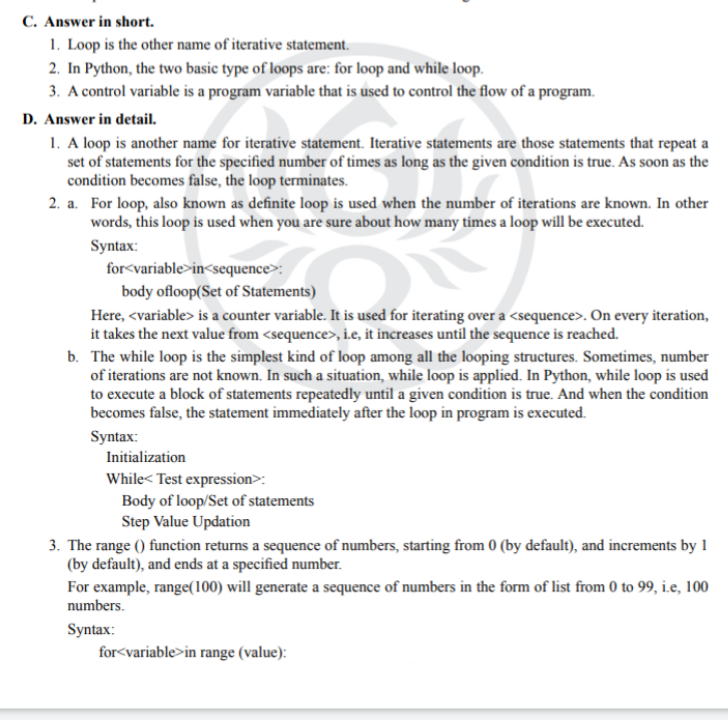
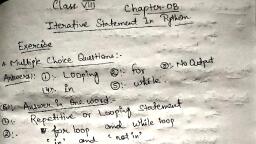
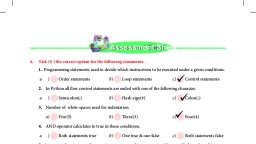
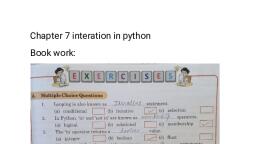
C. Answer in short., , 1. Loop is the other name of iterative statement,, , 2. In Python, the two basic type of loops are: for loop and while loop., , 3. A control variable is a program variable that is used to control the flow of a program., , D. Answer in detail., , 1. A loop is another name for iterative statement. Iterative statements are those statements that repeat a, set of statements for the specified number of times as long as the given condition is true. As soon as the, condition becomes false, the loop terminates., , 2. a. For loop, also known as definite loop is used when the number of iterations are known. In other, , words, this loop is used when you are sure about how many times a loop will be executed., ‘Syntax:, for<variable>in<sequence>:, body ofloop(Set of Statements), Here, <variable> is a counter variable. It is used for iterating over a <sequence>. On every iteration,, it takes the next value from <sequence>, ie, it increases until the sequence is reached., , b. The while loop is the simplest kind of loop among alll the looping structures. Sometimes, number, of iterations are not known. In such a situation, while loop is applied. In Python, while loop is used, to execute a block of statements repeatedly until a given condition is true. And when the condition, becomes false, the statement immediately after the loop in program is executed., , ‘Syntax:, Initialization, While< Test expression>:, Body of loop’Set of statements, Step Value Updation, , 3. The range () function returns a sequence of numbers, starting from 0 (by default), and increments by 1, (by default), and ends at a specified number., , For example, range(100) will generate a sequence of numbers in the form of list from 0 to 99, i.e, 100, , numbers., , Syntax:, for<variable>in range (value):