Page 1 :
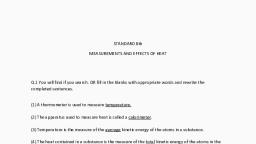
Std- 8th, Subject – science, Chapter 14 - Measurement And Effects Of Heat, Q 1. A. Whom should I Pair with?, Group A Group B, a. Temperature of a, healthy human body 296 K, b. Boiling point of, water 98.6 F, c. Room temperature 0, d. Freezing point of water 212 F, : A., Group A Group B, a. Temperature of a, healthy human body 98.6 F, b. Boiling point of water 212 F, c. Room temperature 296 K, d. Freezing point of water 0 ̊C, B. Who is telling the truth?, a. The temperature of a substance is measured in joules., b.Heat flows from an object at higher temperature to an object at lower temperature., c. Joule is the unit of heat., d. Objects contract on heating., e. Atoms of a solid are free., f. The average kinetic energy of atoms in a hot objects is less than the average kinetic energy of atoms in a cold objects., Ans :, B., a. False- The temperature of a substance is measured in C or F or k, b. true, c. true, d. false- objects expand on heating., E false- atoms of a solid are bound to each other due to of force attraction, between them., f. Sentence f is lying as the average kinetic energy of atoms in a hot objects is greater than the average kinetic energy of atoms in a cold objects., C. You will find if you search., a. A thermometer is used to measure............... ., b. The apparatus used to measure heat is called a..................... ., c. Temperature is the measures of the............................ Kinetic energy of the atoms in a substance., d. The heat contained in a substance is the measures of the....................... kinetic energy of atoms in the substance., C., a. A thermometer is used to measure temperature., b. The apparatus used to measure heat is called a calorimeter., c. Temperature is the measures of the average kinetic energy of the atoms in a substance., d. The heat contained in a substance is the measures of the total kinetic energy of atoms in the substance., Q 2. Nishigandha kept a vessel containing all the ingredients for making tea in a solar cooker. Shivanikept a similar vessel on a stove. Whose tea will be ready first and why?, Ans : Shivani's tea will be prepared first., Reason- in a given time, the amount of heat received by the vessel on a stove is far greater than that received by the vessel kept in a solar cooker, Q 3. Write brief answers., a. Describe a clinical thermometer. How does it differ from the thermometer used in laboratory?, b. What is the difference between heat and temperature? What are their units., c. Explain the construction of a calorimeter. Draw the necessary figure., d. Explain why rails have gaps at specific distances., e. Explain with the help of formulae the expansion coefficients of liquid and gas., Ans :a. Clinical thermometer is used in homes. It has a glass tube with a bulb at one end and theother end closed. This bulb and some part of the tube is filled with thermometric liquid, such as mercury or alcohol. The rest of the volume of the tube has vacuum in it. There is a kink near the, end of the glass tube which prevents the falling back of the thermometric liquid once it is removed from the hot body under observation., It is basically used to measure the temperature of humans. A clinical thermometer has a temperature range of only 35 ºC to 42 °C., b., c.Calorimeter, A device used for heat measurement is called a calorimeter., Construction of a Calorimeter, It consists of a metallic vessel and stirrers. They are made of copper or aluminium., The vessel is then kept inside a wooden jacket which contains heat-insulating materials., The outer wooden jacket acts as a heat shield, and reduces the heat loss from the innervessel., The outer jacket has an opening through which a mercury thermometer is inserted into thecalorimeter., d. All solids expand on heating. As rails are made up of steel, these also expand in summers and contract in winters. These expansion and contraction can cause sagging and bending of rails which could derail the trains running on them. Thus, the rails have been provided with gaps at specific distance so as to prevent this bending of rails. These spaces get closer in summers and wider in winters., e. The formula for liquid expansion or gas is, From the above formula, we can say that, the volumetric expansion coefficient of a liquid (β) is defined as the fractional change inthe volume of the liquid per degree Celsius (or kelvin) change in temperature., the volumetric expansion coefficient of a liquid (β) is defined as the fractional change inthe volume of the gas per degree Celcius (or kelvin) change in temperature at constantpressure. So, β is the constant pressure volumetric expansion coefficient in case of gas., Q 4. Solve the following examples., a.What must be the temperature in Fahrenheit so that it will be twice its value in Celsius?, b. A bridge is made from 20 m long iron rods. At temperature 18 ̊C, the distance between two rods in 0.4 cm. Up to what temperature will the bridge be in good shape?, c. At 15 ̊C the height of Eifel tower is 324 m. If it is made of iron, what will be the increase in length in cm, at 30 ̊C?, d. Two substances A and B have specific heats c and 2 c respectively. If A and B are given Q and 4Q amounts of heat respectively, the change in their temperatures is the same. If the mass of A is m, what is the mass of B?, e. When a substance having mass 3 kg receives 600 cal of heat, its temperature increases by 10 ̊C. What is the specific heat of the substance?, Ans :, a. a. Let the temperature in Celsius be T., So, the temperature in Fahrenheit = 2T, Now,, F = 32 + C ⇒2T = 32 + TT = 160, oC⇒Temperature in Fahrenheit = 2T = 320 oF, b. Length of the iron rod = 20 m = 2000 cm at 18 C, Distance between the length of two rods, = 0. 4 cm, Temperature coefficient of linear expansion of iron = 11. 5 ×, The bridge will be in good shape till both the rods expand by 0.2 cm as the temperature is, increased. Let at temperature T, both the rods expand by 0.2 cm i.e. the total expansion is 0.4 cm., Using formula for linear expansion of solids, we have, c. Height of Eifel tower = 324 m = 32400 cm at 15 C, Temperature coefficient of linear expansion of iron = 11. 5 ×, Change in temperature = 30 ̊C - 15 ̊C = 15 ̊C, Change in length = Δ l, Using formula for linear expansion of solids, we have, ⇒ 11. 5 × × 15 Δ l = 32400 × 11. 5 × × 15 = 5. 6 cm, d. Let the mass of B M., Let the change in temperature be T for both the bodies, A and B., The amount of heat in a body is given as, Q = m × c × Δ T, For body A,, Q = m × c × T ⇒T =…….( i ), For body B,, e. Let the specific heat capacity of the substance be c., Given: Mass of the substance, m = 3 kg = 3000 g, Heat given to the substance, Q = 600 cal, Increase in temperature of the substance = 10 C, Now, the amount of heat in a body is given as, Q = m × c × Δ T ⇒c = = 0. 02 cal