Page 1 :
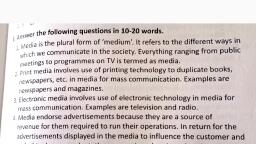
Class 7 Civics Chapter 4, Question 1., What do you understand by the word ‘media’?, Answer:, Media is the plural from of the word ‘medium’ and it describes the various ways through which we communicate in society., Question 2., Name various forms of media., Answer:, Phone, TV, radio, newspapers, magazine, periodicals, internet etc., are forms of media. Some of them may reach millions of people beyond the boundaries., Question 3., What does the word ‘mass media’ mean?, Answer:, When any idea is spread upto the millions of people it is called mass media., Question 4., What is the use of technology in the media?, Answer:, Technology is playing an important role in the media. Technology makes it possible to access everything within short span of time and at large scale., Question 5., What do you mean by a balanced report?, Answer:, In the balance report the media discusses all points of view and then leaves it to the readers to make up their minds., Question 6., How is an independent media useful for the people?, Answer:, Only an independent media can write or present a balanced report., Question 7., How is the changing technology useful for media?, Answer:, Changing technology or machines makes technology more modern, helps media to reach more people. It also improves the quality of sound and the images that are seen., Question 8., How does media manage its cost?, Answer:, The technology used by the mass media, costs a lot of money. They earn money by advertising various products of companies, programmes, schemes, tenders etc., Question 1., Write a short note on media activities., Answer:, In a democracy, the media plays a very important role in providing news and discussing events. Government’s programmes, policies, new laws, implementation status etc., and various issues are discussed daily on TV and Radio. Various other activities such as sports, social protest, and parliamentary discussion are also included in the daily shows of TV. Thus, media is also a means to provide information., Question 2., Which are issues focussed by media?, Answer:, Media focusses on the stories which are liked by the masses. Thus, such stories are presented to make this as an interesting form. Various TV serials are example of such type of presentation. Media focusses on business-related activities. Thus, many times social matters are given look importance., Question 3., What are two main reasons where the media does not look independent?, Answer:, The reasons are:, The first is the control that the government has on the media. During the Emergency, between 1975-1977, the government censored the media., The second is due to the relationship of media and big businessmen who provide them large amount in the form of advertisements., Question 4., Why is it important for the media to be independent?, Answer:, An independent media is very important because on the basis of the information received from the various sources of media, people make an opinion. Hence, it is essential that this information should be reliable and bias-free. Otherwise, a wrong image will be made in the mind of people and this may be very harmful for the people as well as for the country., Question 1., What is mean by independent media? Is the media independent?, Answer:, An independent media means that no one should control and influence its coverage of news. No one should tell the media what can be included and what should not be included in a news story., The reality is that media is far from independent. This is mainly because of two reasons. The first is the control that the government has on the media. During the Emergency between 1975-1977, the government censored the media., Despite the absence of censorship by the government, most newspapers and TV nowadays still fail to provide a balanced story. This is due to the relationship of media and big businessmen who provide them large amount in the form of advertisements., Question 2., How do you think TV influences us?, Answer:, TV has different types of programmes such as news, sports, cartoons, animal planet, regional channels and its programmes, entertainment programmes viz., movies, songs, bhajans, religion related programmes, Kaun Banega Crorepati, reality TV shows like Big Boss etc. About half time is given to the advertisement in between, before and after the programme., We can choose TV channels as per our choice. Hot discussions on political and social issues are presented which also shape our attitude and help in expanding our knowledge. Thus, TV shapes our views of the world, our beliefs, attitudes and values., Highlights, A. Tick the correct option., B. Fill in the blanks., C. True or False., D. Answer the following questions in brief., E. Answer the following questions., A. Tick the correct option., 1. Paper was invented by the-, Answer: Chinese, 2. The Right to Information has promoted-, Answer: accountability, 3. Information provided by media should not be-, Answer: biased, 4. Who among the following is NOT involved in the process of telecasting the news?, Answer: technician, 5. Which country did Johannes Gutenberg belong to?, Answer: Germany, B. Fill in the blanks., 1. Media has brought ___________ to a level where technology is media., 2. Chinese influenced the development of ___________ by inventing paper., 3. Television affects public perception and ___________., 4. Media should not ___________ a class/person or an organisation., 5. The Right to Information has promoted ___________ and accountability., Answer: (1) technology (2) printing (3) opinion (4) favour (5) transparency, C. State True or False for the following statements., 1. Media influences our beliefs and attitudes., 2. RTI was passed due to the demands of various organisations and movements., 3. Media is like a watchdog in a democracy., 4. Freedom of Speech and Expression has no limitation., 5. A very big share of Indian media is owned by political parties., Answer: (1) True (2) True (3) True (4) False (5) False, D. Answer the following questions in brief., 1. Define Media., Answer: Media refers to a various means of communication that help in communicating to a large number of people at a same time. For ex- radio, television, newspaper, etc., 2. Why is media called a watchdog of democracy?, Answer: Media is like a watchdog in democracy that keeps the government active and the people involved., 3. In what ways does the cinema affect our views?, Answer: Cinema played an important role creating awareness about social evils, economic exploitation and the fast-changing Indian society and its value system., 4. What are the different means of print and electronic media?, Answer: The different means of print media are books, newspaper, magazines and electronic media are television, radio, mobile phone etc., 5. What other basic rights are linked with the Right to Information?, Answer: The other basic rights linked with the Right to Information are freedom of speech and expression and right to education., E. Answer the following questions., 1. How are media and technology dependent on each other?, Answer: The latest technologies help media to reach out to the masses. Technology has improved the efficiency of media and on the other, media updates us on the advances in technology. For example, media uses digital technology to provide improved quality of sound and picture as well as influences our thinking. It also helps us to think on global level, beyond the narrow boundaries of our country., 2. How does media influence our daily life?, Answer: The media helps in building public opinion by providing information to the public. Reports, editorials and letters published in the newspapers and magazines influence the public opinion. In the present time, it is the prime source for the public to know about the current affairs, sports and games, progress of wars, political situation in a country, etc. Thus, it has a great impact on the public perception and opinion., 3 Describe the role of media in a democracy., Answer: In a democratic country, media plays an important role in the creating aware and enlightened citizens. Media has been successful in creating public opinion about the bride burning issues, exposing scandals and building the confidence of the people. It also ensures that the political power, and other powerful groups do not step beyond their limits. It is the main source of information. Interviews, speeches and panel discussions make viewers aware of the opinions of different political parties., 4. In what ways does the media bring the problems of the common man to the forefront?, Answer: The selection and the extent of media coverage by a television channel or a newspaper bring the problems of the common man to the forefront. It must constantly draw the attention of the public and the government towards issues like scarcity of clean drinking water, lack of health facilities in rural areas or over crowded cities, crime and violence, illiteracy etc., 5. Do you think Indian media is free? Justify your answer., Answer: Yes, Indian media is free because our constitution safeguarded the ‘freedom of press’ as a fundamental Rights under freedom of speech and expression with some certain limitations in the interests of the public. But sometimes, the government can ban the media from broadcasting or publishing certain items to protect the interest of our country., Extra extra extra, Class 7 Civics Chapter 4 Extra Questions Question 1., What is media?, Answer:, All means of communication are collectively referred to as media, Class 7 Extra Questions Question 2., Why are newspapers called print media?, Answer:, The newspapers are called print media, because these newspapers use print technology in reporting their news, etc., Question 3., What is censorship?, Answer:, When the government prevents media from making a news or programme or their parts public, it is called censorship., Question 4., What do you mean by mass media?, Answer:, Those forms of media that reaches millions of people or the masses, across the country and the world, are called mass media. For example, Television, radio and newspapers., Question 5., How does the technology help media?, Answer:, The technology helps media to reach more people. It also improves the quality of print, sound and the images that reaches to the public., Question 6., What role does media play in democracy?, Answer:, In democracy, the media plays a significant role in providing news arid discussing events that generally takes place in the country and the world., Through these news the citizen come to know about the work of the government and decide their action., Question 7., What is the role of TV in our live?, Answer:, At present we can not imagine oiribes without TV. It has made us the members of the world community., It allows us to view news and entertainment ctannels across the world through satellites and cables., We can see live telecasts of any event, natural calamities, etc., happening in one, corner while sitting in other corners of the world. Thus, the TV has changed the world into a small village., Multiple Choice Questions (MCQs), 1. Which one of the following terms is used to refer to the radio, TV, newspapers, internet and several forms of communications?, (a) LCD, (b) Mass Media, (c) Print Media, (d) Electronic Media., Answer:, (b) Mass Media, 2. Which one of the following is an example of Print Media?, (a) Newspapers, (b) TV, (c) Radio, (d) Internet., Answer:, (a) Newspapers., 3. Which one of the following is different from the other three, \Vith reference to the electronic media?, (a) TV, (b) Radio, (c) Stereo, (d) Magazines., Answer:, (d) Magazines., 4. Which one of the following is false about the changing technology?, (а) It improves the quality of sound., (b) It can’t be used anytime and anyplace., (c) It improves the images., (d) It helps media to reach more and more people., Answer:, (b) It can’t be used anytime and anyplace., 5. Television images travel huge distances through;, (а) electricity, (b) satellites and cables, (c) new technology, (d) improved machines., Answer:, (b) satellites and cables., 6. Which one of the following is mainly associated with Japan and United States?, (a) Serials, (b) Movies, (c) News, (d) Cartoon., Answer:, (d) Cartoon., 7. Which, one of the following statements is true about the independent media?, (a) It should be controlled by high-class people., (b) It should be controlled by university students., (c) It should not be controlled and influenced by any organisation., (d) It should be controlled by the government., Answer:, (c) It should not be controlled and influenced by any organisation., 8. Which one of the following is important in a democracy? ,, (a) Independent media, (b) TVs, (c) Radios, (d) Newspapers., Answer:, (a) Independent media., 9. Why is the media far from independence?, (а) Government’s control on the media, (b) Because it shows news only, (c) Because of the lack of entertainment, (d) Because they need money from big organisations., Answer:, (а) Government’s control on the media., 10. In which one of the following periods, the media was censored by the government?, (a) 1990-1991, (b) 1975-1977, (c) 1976-1980, (d) 1980-1985., Answer:, (b) 1975-1977., 11. The media influence our;, (a) food habits, (b) clothing, (c) lifestyle, (d) thoughts, feelings and actions., Answer:, (d) thoughts, feelings and actions., 12. Which one of the following newspapers is run by eight Dalit women in Uttar Pradesh?, (a) Janata, (b) Khabar Lahriya, (c) Maro Gaun, (d) Meri Baat, Answer:, (b) Khabar Lahriya., Important Terms:, Publish: Publish means to produce or print news reports, articles, interviews, stories, etc., in newspapers, magazines, journals and books for a wide audience to read., Censorship: Censorship is the power that authorises the government to examine material or certain stories that is to be published and ban anything considered offensive or a threat to security either in part or whole of a media, i.e., book, film, newspapers, etc., Broadcast: Broadcast is the process of transmission of different types of informative popular programmes by radio or television to aware and entertains the people., Public protest: Public protest is a powerful way by which a large number of people come together and openly state their opposition to some issues or draw attention to injustices. It is generally done by organising public rallies and demonstrations, starting a signature campaign, blocking roads, etc.