Page 2 :
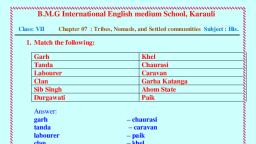
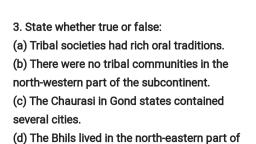
(c) The Akbar Nama mentions that Garha Katanga had 70,000 villages., (d) As tribal states became bigger and stronger, they gave land grants to poets and scholars., , 3. State whether true or false:, , (a) Tribal societies had rich oral traditions., , (b) There were no tribal communities in the north-western part of the subcontinent., (c) The chaurasi in Gond states contained several cities., , (d) The Bhils lived in the north-eastern part of the subcontinent., , Answer, , (a) True, (b) False, (c) False, (d) False, , 4. What kinds of exchanges took place between nomadic pastoralists and settled agriculturist;, Answer, , Nomadic pastoralists exchanged wool and ghee with settled agriculturists in return for grain,, cloth, utensils and other products., , Let’s understand, 5. How was the administration of the Ahom state organised?, Answer, , Administration of the Ahom state:, , (i) The administration was centralised during first half of the 17th century., , (ii) The Ahom state depended upon forced labour to work for the state and were called paiks., (iii) Almost all adult males served in the army during war and in other times, they were engag, in building, , dams, irrigation systems and other public works.., , (iv) Ahom society was divided into clans or khels who often controlled several villages., , (v) The peasant was given land by his village community and even king could not take it awa, withouth the permission of the community., , 6. What changes took place in varna-based society?, , Answer