Page 1 :
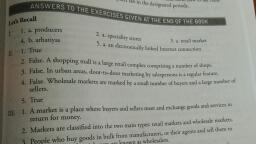
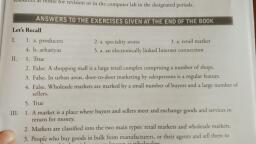
Let’s Recall, , 1., , 2, A., LL, z, 3., , a. producers 2. a. speciality stores 3. a, retail market, b. arhatiyas 5. a. an electronically linked Internet connection, ‘True, , . False. A shopping mall is a large retail complex comprising a number of shops., , False. In urban areas, door-to-door marketing by salespersons is a regular feature., , 4, False, Wholesale markets are marked by a small number of buyers and a large number of, , ow, , en, , sellers., , . True, , . A market isa place where buyers and sellers mect and exchange goods and services in, , return for moncy., , . Markets are classified into the two main types: retail markets and wholesale markets., . People who buy goods in bulk from manufacturers, or their agents and sell them to, , retailers and industrial users are known as wholesalers., , . Both price and quality are cqually important factors which influence a customer's, , preference for a particular market., , . E-choupal is basically aimed at empowering small and marginal farmers by installing, , computers with Internet access in rural areas., , . In India, markets are classified into the two main types: retail markets and wholesale, market, , ts., , * Retail trade is defined as selling of products to consumers for their personal and daily, use. The retailer buys products from the manufacturer in large quantities and sells, them to the consumer,, , * In the wholesale market, wholesalers buy goods in bulk from manufacturers, or their, agents and sell them to retailers and industrial users., , . Various kinds of retailers, both big and small, sell different kinds of products through, , diverse outlets., , * Mobile traders or vendors carry their business by moving from one place to another, according to the sale prospects and their convenience., , + Fixed shop retailers operate through fixed shops or stores located in markets or in, residential areas., , + A departmental store consists of several shops, cach of which specialises in the sale of a, particular product., , + A shopping mall is a large retail complex comprising a number of shops that sell, different types of products, which cater to the needs of people., , |. Difference between a mobile trader and a fixed shop retailer:, , , , Public Healthcare Services Private Healthcare Services, “These retailers do not sell their goods, from a fixed place and carry their business | Such retailers operate through fixed, by moving from one place to another _| shops or stores located in markets or in, according to the sale prospects and their _| residential areas., convenience., , , , , , , , , , , , . A departmental store consists of several shops, each of which specialises in the sale of a, , particular product. Although these different shops are centrally linked, they also form, a complete sales unit within themselves. Yes, such a store can be opened in a shopping, mall., , . In franchise outlets:, , + The franchisee is the person who opens the outlet, , + The franchisor refers to the company which leases out the product to be sold., , * The franchisee pays the franchisor a certain amount of money in return for, permission to sell the product., , + The quality of the product cannot be compromised and it has to be sold at the same, price as fixed by the franchisor., , . Following are the functions of a retailer:, , + Presenting their products in an innovative and attractive manner so that consumers, are attracted by product presentation., , + Using print and electronic advertisements, pamphlets and providing discounts to, promote their products, , + Using methods such as window displays to draw people to their shop
Page 2 :
mall., 5. In franchise outlets:, * The franchisee is the person who opens the outlet, * The franchisor refers to the company which leases out the product to be sold., , * The franchisce pays the franchisor a certain amount of money in return for, permission to sell the product., , * The quality of the product cannot be compromised and it has to be sold at the same, price as fixed by the franchisor., , . Following are the functions of a retailer:, , + Presenting their products in an innovative and attractive manner so that consumers, are attracted by product presentation., , + Using print and clectronic advertisements, pamphlets and providing discounts to, promote their products, , + Using methods such as window displays to draw people to their shop, , + The interior décor and layout of the store is a significant factor in a retail market as it, helps to provide a pleasant shopping experience to the customers., , * Goods are displayed in a manner which provides easy access to the customer., , * Care is taken to create the right ambience with the appropriate lights colour scheme, and music so as to make the customer co!, , + Ensuring casy accessibility of their stores so ee customers do not go to another shop, or store that has higher visibility and is easily accessible., * Providing certain services such as free home delivery; credit facility and after sales, , service., , 2. Difference between the functions of a retailer and wholesaler:, Retailer, , Retailers act as a channel between the, , producer/wholesaler on one hand and the, customer on the other hand., , , , Wholesaler, , , , Wholesalers act as a two-way channel, between producers and retailers., , , , Wholesalers do not need to advertise, to the end customers, however, they, do advertise to the retailers about the, wholesale products they may have., , Retailers use print and electronic, advertisements, pamphlets and providing, discounts to promote their products., , , , ‘The interior décor and layout of the store is a, significant factor in a retail marker as it helps, to provide a pleasant shopping experience to, , Décor does not have a role to play in the, wholesalers business as many a times they, operate from godowns/warchouses rather, , . The agriculturalists are in favour of selling their produce in a mandi,, , . Intermediaries in marketing and selling of farmer's produ, , , , the customers., , than shops., , , , , , , , i.e, a large market, , in a nearby town or city, where they can carn a higher profit on their produce., , * A mandi ensures that the prices are regulated so that the farmers can earn reasonable, profits and are not cheat:, , + Relying on intermediaries such as dalals is not encouraged since they have to be paid, in case they help in selling the crops., , , , , , * Most of the Indian farmers practise subsistence farming, i.e., they produce the, amount which is sufficient for thcir own consumption. If they grow more than the, required amount, it is sold ro the moncylender in the village who in turn sells it to, the people who work at the mandis in the cities., , + Intermediaries often help the farmers by selling their produce to wholesalers known, as arhatiyas who sell the same to the retailers oF to processing uni, , , , , , . The word ‘choupal’ means a ‘village meeting place’ where the elders of the village meet, , to discuss matters of importance. ‘E’ stands for electronic communication through an, , Internet connection. Thus, e-choupal allows interaction among people living in remote, , parts of the country., , * Icis aimed at empowering small and marginal farmers by installing computers with, Internet access in rural areas., , + Iealso provides farmers with up-to-date marketing, weather-related, and agricultural, information,, , + The system also serves to unite farmers and protects them from being cheated at the, time of sale of their produce, besides providing vital information on farming practices., , + The farmers can sell their crops to ITC centres or to the local centres after checking, the prices on the Internet., , 249