Page 1 :
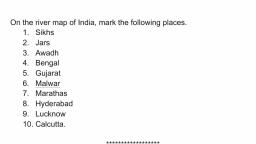
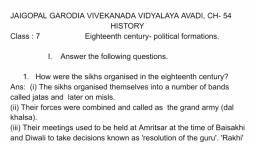
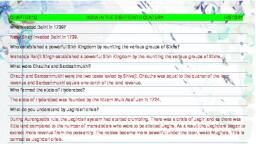
JAIGOPAL GARODIA VIVEKANADA VIDYALAYA AVADI, CH- 54, HISTORY, Class :7 Eighteenth century- political formations., , |. Answer the following questions., , 1. How were the sikhs organised in the eighteenth century?, Ans: (i) The sikhs organised themselves into a number of bands, called jatas and later on misls., , (ii) Their forces were combined and called as the grand army (dal, khalsa)., , (iii) Their meetings used to be held at Amritsar at the time of Baisakhi, and Diwali to take decisions known as ‘resolution of the guru’. ‘Rakhi’, a system was introduced, offering protection to cultivation on the, payment of tax of 20%of produce., , 2. Write a short note on Ahmad shah Abdali:, Ans: (i)Ahmed shah Abdali was the independent ruler of Afghanistan., He plundered Delhi and Mathura., (ii) At this time Marthas too were emerging , powerful in North India., (iii) They challenged the Afghan viceroy in Lahore and drove him, away., (iv)Thus, the Marthas and not the Mughals, were locked in battles, against foreign invaders, the Afghans ., (v) The second battle was fought at the famous battleground at, Panipat in 1761. The Marathas were defeated and completely routed., , 3. Describe the land revenue system of Marathas., Ans: (i) The task of collection of revenue including those under the, zamindari system was supervised by the state., (ii) only the subjugated territories had to pay two kinds of taxes,, Chauth and Sardeshmuki ., (iii) It was paid by the rulers., (iv) chauth was fixed at 25% of the land revenue claimed by, zamindars under Marathas in Deccan and Sardeshmuki was fixed at, 9-10 percent of the land revenue paid to the head revenue collector, in the Deccan., (v) Both of these taxes were levied in return for protection given by, Marathas against attacks by other forces.