Page 1 :
Transportation in plant and animals
Page 4 :
Why plants and animals need a, transportation system?, We know that all living organisms like plants, and animals need food, oxygen and water, so that they can survive., These elements need to be delivered to their, body parts so that they can function, properly.
Page 5 :
, , Hence, all living organisms need a transport, system in their bodies.
Page 6 :
Human Circulatory System, , , , The circulatory system is a transport system, of the human body which consists of a, network that supplies food, water, oxygen, and other substances throughout the body.
Page 7 :
, , The main parts of the circulatory system are:, Blood, Blood Vessels, Heart
Page 8 :
Blood, Blood is a red colour fluid that flows in our, body through the blood vessels., Functions of blood:, 1. The blood acts as the medium of, transportation of essential, substances throughout our bodies, such as oxygen and nutrients.
Page 9 :
2. Blood carries oxygen from the lungs, and transports it to different cells of, the body., 3. The blood also carries waste, material to the kidneys which then, filters the blood. The small intestine, digests the food and absorbs its, nutrients. These nutrients are
Page 10 :
provided to all the parts of the body, through blood., 4. The blood also protects the body, from losing blood by forming a blood, clot at the place of injury., 5. The blood contains a special, substance that helps in regulating, the temperature of the body.
Page 11 :
Components of blood - Blood can perform, several functions because of different, substances present in it.
Page 12 :
Blood plasma – the liquid substance present, in the blood is called blood plasma. Almost, 55% of the blood is blood plasma. The plasma, facilitates the transportation of different, substances throughout the body. The blood, plasma is made up of water, salt, fats,, proteins and sugar.
Page 13 :
Red blood cells (Erythrocytes) – They are, present in ample amount in the blood (40% to, 45%). They are red in colour because they, contain a special pigment called haemoglobin., The oxygen we take in binds itself with the, haemoglobin and hence reaches every cell of, the body through the blood.
Page 14 :
White blood cells (Leukocytes) – They are, present in fewer amounts (almost 1%) but, perform a vital function in the body. These, cells fight against the germs present in the, body.
Page 15 :
Blood platelets – These are the cells that, help in the formation of a blood clot and, prevent the blood from flowing out of the body, due to an injury.
Page 16 :
Components of blood
Page 17 :
Blood Vessels, Our body contains tube-like structures called, the blood vessels that help in the, transportation of blood throughout our body., Our body contains two types of blood vessels, based on the function that they perform:
Page 18 :
Arteries, , Veins, , These blood vessels, These blood vessels carry, carry blood that is rich, blood from the heart that, in Carbon dioxide from, contains oxygen into, the body organs to the, different parts of the body., heart., Veins do not have thick, Arteries have thick walls as, walls as the blood, the blood pressure is quite, pressure is quite low in, high in these blood vessels., them.
Page 19 :
They are narrow so that the, They are slightly wider, blood can flow quickly, than the arteries., through them., They do not contain valves, They contain valves that, as the blood in arteries, prevent blood from, always flows in the right, flowing in opposite, direction due to the, direction., pumping of the heart.
Page 21 :
Pulse, We know that the heart pumps the blood in, the arteries. This continuous pumping of blood, in the arteries results in their rhythmic, throbbing which is called Pulse.
Page 22 :
Pulse rate, Pulse rate is defined as the number of pulse, beats per minute. The normal pulse rate of, human beings is 70 to 80 beats per minute.
Page 24 :
Checking the Pulse Rate, Pulmonary Artery, The pulmonary artery is a special blood, vessel that connects the heart to the lungs. It, takes blood that contains less oxygen, (deoxygenated blood) from the heart to the, lungs. Hence, it is unlike all other arteries that, carry oxygen-rich blood.
Page 25 :
Pulmonary Vein, The Pulmonary vein is a special blood vessel, that connects the lungs and the heart. It, carries oxygen-rich blood from the lungs to, the heart. Hence, it is unlike all other veins, that carry oxygen-less blood.
Page 26 :
Capillaries, Small blood vessels are called capillaries. The, arteries divide themselves into capillaries, which then deliver oxygenated blood to the, tissues in the body. Then these capillaries, take up the deoxygenated blood from the, tissues to the veins.
Page 28 :
How Blood Circulates, , The Heart, The heart is an organ present in our body, that pumps the blood in the blood vessels., It is located in the chest cavity., Its lower part is a little tilted towards the left.
Page 29 :
, , , , , , , , The heart is divided into four chambers with, prevents the oxygen-rich blood from mixing, with carbon dioxide-rich blood., The Atria or upper chambers contain the, blood with no oxygen., The Ventricles or the lower chamber of the, heart contains oxygen-rich blood., The Atria and Ventricles both are individually, divided within themselves into two chambers, with the help up of valves.
Page 30 :
, , , , From the left ventricle, the biggest artery of, our body called aorta begins., The right Atrium of the body receives, deoxygenated blood from the body through, a vein called Vena cava. Vena cava is the, largest vein of our body.
Page 31 :
Heart
Page 33 :
Flow of Blood in Human Body, Heartbeat, The muscles of the heart relax and contract, continuously as it pumps the blood in the, arteries. This rhythmic contraction and, relaxation of the heart is called a heartbeat., The stethoscope is an instrument that is, used to listen to the Heartbeat of a person.
Page 34 :
, , , , It amplifies the Heartbeat so that the, doctors can monitor it and find out about the, patient's condition., It contains two earpieces, a tube that, connects them to a chest piece comprising, of a sensitive diaphragm.
Page 35 :
Stethoscope
Page 36 :
Do all animals possess a circulatory, system?, No, animals like Hydra and Sponges do not, possess a circulatory system., These animals live in water and hence get, food and oxygen from the water as it enters, their bodies., As the water comes out of their bodies, it, takes away the carbon dioxide and waste, materials out of it.
Page 37 :
Excretion in Animals, The cells in animals release some waste, products as they perform different functions., These waste products are toxic and hence, they must be removed from the bodies of the, living organisms., The process of removal of waste products, produced in the cells of the living organisms, is called Excretion.
Page 38 :
The Excretory System in Human Beings
Page 40 :
The Excretory System, The excretory system is a system of organs in, living organisms that undergo excretion. The, excretory system consists of different organs:, 1., Kidneys – there are two organs called, Kidneys present in our body. These Kidneys, contain blood capillaries that filter out the, unwanted substances from the blood in the, form of urine.
Page 41 :
2., Urinary bladder – The urine produced by, the Kidneys is stored in a bladder called, urinary bladder., 3., Ureters – There are two tube-like, structures which connect the Kidneys and the, urinary bladder together. They allow passage, of urine from the kidney to the bladder., 4., Urethra – There is a muscular tube, through which the urine moves out of the, body.
Page 42 :
Different organisms excrete different, wastes:, The major excretory product in humans is, urea. The urine consists of toxic wastes, (2.5%), urea (2.5%) and water (95%)., The way in which waste chemicals are, removed from the body of the animal, depends on the availability of water. Fishes, and aquatic animals excrete ammonia in the, water.
Page 43 :
Birds, Snakes and lizards excrete semi-solid,, white coloured uric acid., Dialysis – Sometimes people use artificial, Kidneys, that is, they get the blood purified, artificially periodically. It is called dialysis., They have to do so in a case of Kidney failure, in which the Kidneys of a person are unable to, perform their function due to an infection or an, injury., ,
Page 44 :
How is sweat useful to us?, Sweat contains water and some salts and, hence help in getting rid of toxic wastes from, the body., Also, as the sweat evaporates from our skin, it, takes up our body heat and this makes us feel, cool, especially during the summer days.
Page 45 :
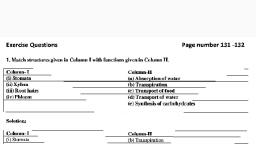
Transportation in Plants, Transportation of Water and Minerals, The roots of the plants absorb the essential, minerals and water from the soil., The roots have hair like structures present, on them.
Page 46 :
, , These hairs increase the surface area of, the roots and hence allow more amount of, absorption.
Page 48 :
, , Absorption by Roots, From the roots, the water and minerals are, transported to other parts of the plant, through special kind of tissues called, vascular tissues. There are two vascular, tissues present in the plants:, Xylem – It is a vascular tissue that is, responsible for transporting nutrients and, water in the plants. The root cells absorb, water and minerals and transport it to
Page 49 :
, , xylem. Xylem carries it to other parts, unidirectionally without usage of energy., Phloem – It is a vascular tissue that, transports the food produced by the, leaves (source) to all parts of the plant, (sink) . This flow is bidirectional and, utilizes energy. This is known as, translocation.
Page 51 :
Transportation by Xylem and Phloem, , Transpiration, Sometimes not all the water that plants, absorb is used by them., Hence they need to get rid of the excess, water in them.
Page 52 :
, , , , , , This loss of water in plants takes place, through the process of transpiration in which, the water evaporates in the atmosphere, through the stomata present on the leaves., Stomata are tiny pores present on the, leaves that allow the movement of gases, and water through them., Transpiration results in absorption of, water: As the water from the leaves, evaporates, it generates a suction pull in the
Page 53 :
, , plants that bring the water from the roots, upwards., Transpiration helps in cooling down the, plants: As the water evaporates, it utilizes, the heat of the pant and results in cooling of, the internal temperature of the plant.
Page 55 :
Transpiration