Page 1 :
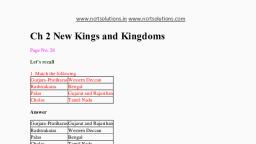
Solutions for Class 7 Social Science History Chapter 2 New Kings and Kingdoms, TEXTBOOK EXERCISES, LET’S RECALL, Question 1., Match the following:, Gurjara-Pratiharas Western Deccan, Rashtrakutas Bengal, Palas Gujarat and Rajasthan, Cholas Tamil Nadu, Answer., Guijara-Pratiharas Gujarat and Rajasthan, Rashtrakutas Western Deccan, Palas Bengal, Cholas Tamil Nadu, Question 2., Who were the parties involved in the “tripartite struggle”?, Answer., Parties involved in the “tripartite struggle”, Guijara-Pratiharas, Rashtrakutas, Palas., Question 3., What were the qualifications necessary to become a member of a committee of the sabha in the Chola Empire?, Answer., According to the Uttaramerur inscription, the following qualifications were necessary to become a member of a committee of the sabha in the Chola Empire:, A person should own land from which revenue was collected., He should have been their own home., He needed between 35 and 70 years of age., He should have been knowledgeable of Vedas., He required to be well-versed in administrative matters and honest., If anyone had been a member of any committee in the last three years, he could not have become a member of another committee., Anyone who had not submitted his accounts, and those of his relatives, could not have contested the elections., Question 4., What were the two major cities under the control of the Chahamanas?, Answer., The two cities under the control of the Chahamanas:, Delhi., Ajmer., LET’S UNDERSTAND, Question 5., How did the Rashtrakutas become powerful?, Answer., It was during the seventh century that the kings acknowledged the big landlords as their subordinates or samantas. The samantas were expected to bring gifts and provide military support to their kings. In due course they gained power and wealth. They declared themselves to be maha-samantas, maha- mandaleshvar (the great lord of a circle or region) and so on., Rashtrakutas were one of them who were initially the subordinates of the Chalukyas in Deccan. In the mid-eighth century, Dantidurga, a Rashtrakuta chief, performed a ritual hiranya-garbha and overthrew the Chalukya overlord. After the ritual was over he was reborn as Kshatriya, even if he was not by birth., Question 6., What did the new dynasties do to gain acceptance?, Answer., The new dynasties performed holy rituals with the help of Brahmanas in order to gain acceptance. For example, hiranya-garbha ritual performed by low caste Dantidurga, the Rashtrakuta chief., Question 7., What kind of irrigation works were developed in the Tamil region?, Answer., During the fifth or sixth century the area of Tamil Nadu was opened up for large-scale cultivation. For irrigation, a variety of new methods were discovered. In many areas, wells were dug. Hugh tanks were constructed for rainwater storage., Question 8., What were the activities associated with Chola temples?, Answer., The following activities were associated with the Chola temples :, Temples were nuclei of settlements which grew around them., The temples were centres of craft production., The produce of the land owned by the temple (granted to the temple by kings) went into maintaining—priests, garland makers, cooks, sweepers, musicians, dancers, etc., Temples were the places of social, economic, cultural, and religious activities., Bronze images were also made in Chola temples., LET’S DISCUSS, Question 9., Look at Map 1 once more and find out whether there were any kingdoms in the state in which you live., Answer., Yes., Different answers for students living in different states. Some examples:, West Bengal → Palas, Orissa → Utkalas, Gangas, Kalinga, Tamil Nadu → Cholas, Pandyas, Kerala → Cheras, Maharashtra & Karnataka → Rashtrakutas, Gujarat → Andhra, Rajasthan → Chahamanas, Question 10., Contrast the ‘elections’ in Uttaramerur with present-day panchayat elections., Answer., The present-day panchayat elections do not use the lottery system to elect the members of panchayat as was done in the Chola Empire., LET’S DO, Question 11., Compare the temple shown in this chapter (of your textbook) with any present-day temple in your neighbourhood, highlighting any similarities and differences that you notice., Answer., Comparison between temples shown the chapter and present-day temples in our in neighbourhood., Question 12., Find out more about taxes that are collected at present. Are these in cash, kind, or labour services?, Answer., Some of the important present-day taxes are income tax, service tax, house tax, etc. All the present-day taxes are collected in cash.