Page 1 :
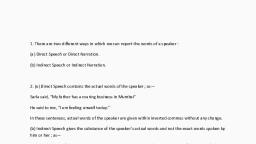
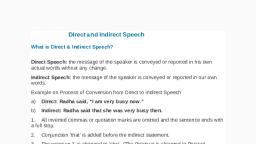
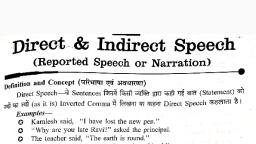
2% "i, , cf c\., DIRECT/AND INDIRECT, SPEECH, , , , There are two ways of narrating/reporting what a person has said. To quote her actual €, , wordewith quotation marks is called Direct Speech. To report what she said Without fi mi, ‘ gn eC > Ding, , her actual (exact) words is called Indirect Speech. In indirect speech, we use a saying 8, telling verb followed by that and a noun clause. *, Ex. : (i) Monica said, “ 1 draw a picture.” (Direct Speech), This sentence is made of two clauses :, Monica said (Reporting Speec h), , I draw a picture (Reported Speech), , (ii) Monica said that she drew a picture. (Indirect Speech), , This sentence is made of two clauses :, Monica said (. porting Speech), , She drew a picture (Reported Speech), , The verb ‘said’ of the indirect speech which introduces the Reported Speech is called the, Reporting Verb., , Rules for Changing from Direct Speech to Indirect Speech :, , (, , 1. If the Reporting Verb is in the Present Tense or Future Tense, then the tense of the, , verb in the Reported Speech is not changed., , Direct Speech) (Present Tense), , Ex. : Eliza says, “I am ready.” ( (, Eliza says that she is ready. (Indirect Speech) (Present Tense), ( (, , Direct Speech) (Present Tense), , He will say, “I am ready.”, He will say that he is ready. (Indirect Speech) (Present Tense), , 2. If the Reporting Verb is in the Past Tense, the tense of the verb in the Reporte, Speech is changed into one of the forms of the Past Tense as follows :, , Simple Present —» Simple Past, , Present Continuous —» Past Continuous, , Present Perfect —» Past Perfect, , Present Perfect Continuous —» Past Perfect Continuous, , Past Simple —» Past Perfect, ih. Past Continuous —» Past Perfect Continuous, 80
Page 2 :
Past Perfect (no change), , Past Perfect Continuous (no change), , will —» would shall —» should, , can —» could may —* might, , Note: If the Reported Speech cont, Present in the Reported, , Ex.: Direct Speech : The, , ains some universal or habitual fact, then the Simple, Speech is not changed., , teacher said, “Honesty is the best policy.”, , Indirect Speech : The teacher said that honesty is the best policy., , Direct Speech : He said, “I am an early riser.”, , , , , , , , , , , , , Indirect Speech : He said that he is an early riser., , Changes in Pronouns, , 1. Pronouns of the first person in the Reported Speech are changed to the same person as, the subject of the Reporting Verb. ,, , Ex. : Direct Speech : David said, “I will not go there.”, Indirect Speech : David said that he would not go there., , - Pronouns of the second person in the Reported Speech are changed to the same person, as the object of the Reporting Verb., , Ex. : Direct Speech : Jenny, said to me, “The teacher will reward you.”, Indirect Speech : Jenny told me that the teacher would reward me., , ther Ci ros, , , , The words in the reported speech expressing nearness of time or place are changed into, words showing distance., , now —+» then this —-+ that, today —+ that day these —+ those, tonight —+ that night here —~+ there, last night —» the previous night thus —+ so, yesterday —» the day before/the previous day, , tomorrow —» the next day, , ago —~» before, , Ex.: Direct Speech : She said, “I am reading now.”, , Indirect Speech : She said that she was reading then., , Direct Speech : He said, “I am glad to be here this evening.”, Indirect Speech : He said that he was glad to be there that evening. i}, 8. ei, , sO eee
Page 3 :
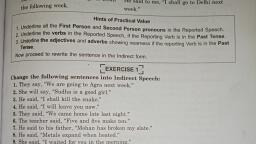
EES ee OO aFOs 00:, , / S ‘, , OOS a8) OOD: ., , Formation of Indirect Speech ’, Assertive Sentences, , ‘said to’ is changed generally into ‘told’ :, , Ex.: Direct Speech : The teacher said to me, “Yo, old me that I was late thal day., , u are late today.”, , Indirect Speech : The teacher t, , CIO A. Change the following sentences into indirect eat i ot +0 ia kell, He said, “I want to be a aut He sore that, , : 4 saidjte him, 7 ave 1 een an you, Tor for a ee rea, , : Pare anti wong te ati i ke find ., , 2, 3., 4, 5. “This ‘is fl hguse.I like,“, 6, 7, 8, 9, , ay, , * the {ady said, said, juiay!e got be Shegrapee to An s Sy pois oveai, , a hink pres wo; or ha, ° 4 ide him. T Pte tnat yout, , said,“ sh * shalt rae gash auicly Scan,” a Lee tats, ct, , pate pe 30 wise nba creak oh ad, | 10. He ait to me, oT ey Pt sly t eat youtin £ nt ie patch th any tatty, , 11. Pauecy will say, “They haveddone their best. al, , 12, She said, “I did my work.” Sha gad thol the, and, 13. He said, “The old man died last night.’ “pia sasd trek foe ald an ene, , 14. David said to you, “You will send the book.” ‘Navid 4 asked ys that you ts wi Vad |, 45. Neen said, We shall i here. speck \, , Imperative gehts”, , The Reporting Verb in a command or request sentence is changed to order, command, forbid,, advise, suggest, request, beg etc., , | The verb in the Reported Speech is put in the infinitive., , | Ex. : Direct Speech : “Call the accused,” said the judge., Indirect Speech : The judge ordered them to call the accused., Direct Speech : The teacher said to the pupils, “Do not stand here.”, Indirect Speech : The teacher forbade the students to stand there., Direct Speech : She said, “Will you please help me to lift this box 2”, Indirect Speech : She requested us to help her to lift that box., Direct Speech : My mother said, “Do not waste your time, study hard now.”, , Indirect Speech : My mother advised me not to waste my time but to study hard, , A then., 82