Page 1 :
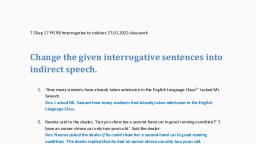
7 Chap 16 Notes on Interrogative into Indirect, , Chap 16 Transformation of Interrogative, Sentences into Indirect Speech and Vice, Versa, Rules for changing Direct Interrogative Sentences/Speech into Indirect, Speech or reporting statements and Vice Versa:, , Change of Tense, Note the following rules for converting the tenses in an Interrogative sentence to make it, Indirect speech or reported speech., Rule 1, The reporting verb said is changed to asked, enquired or demanded according to the, sense conveyed in the question., Example:, Direct Interrogative Sentence:, Sam said, ‘Where are the car keys?’, Indirect Interrogative Sentence:, Sam asked where the car keys were., , Rule 2:, While introducing indirect speech, never use the word ‘that’ after removing the, apostrophe., Example:, Direct Interrogative Sentence: The teacher said, “Did you do your homework?”, Indirect Interrogative Sentence: The teacher asked that if they had done their, homework., [INCORRECT], Indirect Interrogative Sentence: The teacher asked if they had done their homework., [CORRECT], Rule 3:, When reporting wh-questions, the question word follows immediately after the reporting, verb or its object, Example:
Page 2 :
Direct Interrogative Sentence: He said, ‘Where are you going?’, Indirect Interrogative Sentence: He asked where I was going., Example:, Direct Interrogative Sentence: The teacher said to Sam, ‘What class do you have, now?’, Indirect Interrogative Sentence: The teacher asked Sam what class he had then., Rule 4:, For questions that begin with, Helping verbs (auxiliary verbs), such as is, am, are, was, were, has have, etc., And, Modals, such as will, shall, do , does, did, may, might, can , could, should ,etc., You should use Conjunctions, ‘if’ or ‘whether’ immediately after the reporting verb or its object., if, - is used when the answer is uncertain; and, whether – is used when, even though the answer is certain, it depends on the person, who is being asked the question to answer it., Example:, Direct Interrogative Sentence: The stranger said, ‘Can you tell me your name?’, Indirect Interrogative Sentence: The stranger asked me whether I could tell him my, name., [The person who needs to answer the question may not want to share the information, with the stranger.], Example:, Direct Interrogative Sentence: Sam said to Tom, ‘Do you have a pen?’, Indirect Interrogative Sentence: Sam asked Tom if he had a pen., [Sam does not know if Tom has a pen], , Rule 5:, When converting to indirect speech for interrogative sentences, remove Question Mark, (?)., Direct Interrogative Sentence: He said, ‘Where is your younger brother?’, Indirect Interrogative Sentence: He asked me where my younger brother was., , Rule 6:, The table below shows the change in pronouns in the indirect speech. It indicates the, relationship between the speaker of the direct utterance and the person who reports it.
Page 3 :
For Direct Interrogative, Sentence, I / Name, We, , For Indirect Interrogative, Sentence, He / She, They, , You, My, Me, Our, Your, Us, Myself, Ourselves, , He/She/They/Him/Her, His/Her, Him/her, Their, His/Her/Their, Them, Himself/Herself, Themselves, , EXAMPLE:, , Rule 7:, The table below shows the change in time and place in the indirect speech. Words that, show nearness in time or place change ot words expressing distance. Study the, changes to frame indirect sentences correctly., For Direct Interrogative, Sentence, This, These/There, , For Indirect Interrogative, Sentence, That, Those, , Now, Today, , Then, That day
Page 4 :
Tonight, Yesterday/Last Night, Tomorrow, Can, May, Will, Ago, Just, Come, Did + verb, , That night, The previous day/night, The following day/night, The next day, Could, Might, Would, Before, Then, Go, Had +verb of past participle