Page 1 :
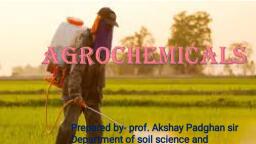
Prepared by- prof. Akshay Padghan sir, Department of soil science and, agricultural chemistry
Page 2 :
Agrochemicals: Introduction and role, 1.They are generic name given to the chemicals i.e. fertilizers, pesticides and insecticide, used in agriculture to facilitate Plant growth and protection., 2.Although initially used to crop growth to improve crop production But overuse use of, chemical has now started affecting the environment., 3.Apart from the obvious effect on crops and the food chain agrochemicals have wide, area of application. Due to the many uses , they keep into the surrounding land and water, bodies, therefore having widespread effect., 4.Regarding their widespread impact on crops, excessive use of such chemicals, generates a significant amount of residues., 5.These residues causes, Nutrient Imbalance, quality reduction of agril. Produce, That lead to long term ill effects on the health of organism that consume them., Ex. pesticide residues in food have been linked to being one of the causes of Astma in, humans
Page 3 :
1. Effects on soil:, 1. May kill beneficial bacteria, 2. Increase nitrate level in soils, 3. Alter the pH of the soil, 4. Residual effect, 5. Kill soil organisms, 6. Toxicity and reduction in soil quality, 2. Effects on water:, 1. Water becomes unfit for consumption, 2. Can promote the growth of algae, 3. Leads to eutrophication due to excessive, chemicals, 4. Affect aquatic animals due to water pollution
Page 4 :
3. Effects on air:, 1. Residues and particles of these chemicals can lead to air, pollution., 2. Pesticides drift happens when air carries agrochemicals, particles from one place to other., 3. More amount of spray evaporation may happen due to low, relative humidity and higher temperatures., 4. Effect surrounding organisms’ health due to inhalation of, polluted air., 4. Effects on human health:, 1. It causes variety of health effects, from simple skin and, eyes irritation., 2. It also effects the nervous system, causes cancer and also, reproductive problems., 3. Can cause nerve damage, infertility, hormones disorders, and neurotoxicity.
Page 5 :
Pesticides, , Soil conditioners, , Fertilizers, , Liming & acidifying, agent
Page 6 :
Insecticides kills insects, , Fungicides kills disease causal organisms, ( Fungi), , Herbicides kills weeds, , Nematicides kills nematodes
Page 8 :
Fertilisers: This are chemical compounds used for promoting, plant growth. They are used to mitigate nutrient deficiency in the soil., Typically, it is applied to soils or to plant tissues., Fertilisers can be categorized into two categories:, 1. organic: Organic fertilisers are naturally existing substances, prepared through natural processes., 2. inorganic fertilisers. Inorganic fertilisers, also referred to as, synthetic fertilizers are manufactured artificially using chemical, processes by utilizing natural deposits, which are altered chemically., Soil conditioners: To keep all soils in good condition, the best, thing to do is to add things that keep it in good condition. These good, things are called soil conditioners that includes manure, compost, peat,, livestock manures and leaves. All these things are laid on top of the, soil and then mixed. Soil conditioners enhance aeration and water, holding capacity of the soil.
Page 9 :
Liming and acidifying agents: Soils, sometimes can be too acidic or too alkaline for, proper growth of crops. In these cases, liming, and acidifying products are added to soil to, adjust its pH. When the soil is too acidic, calcite, on the form of powdered limestone is added, primarily, whereas for more alkaline soil sulfur, compounds are added to neutralize.
Page 10 :
Besides there are other classes viz.,, Antibiotics, Carcinogen,, Dessicants,, Defoliants,, Ovicide,, Pheromone and Plant growth regulators, , Predominant classes of pesticides used in, India are insecticides- 57 % of total pesticide, consumption, followed by fungicides (29%) and herbicides,, which constituted about (14 %).
Page 12 :
Fertilizer is any material of natural or, synthetic origin added to the soil to supply one, or more plant nutrients.
Page 13 :
A. On the basis of nutrient content, 1. Straight fertilizers: Straight fertilizers are those which supply only one, primary plant nutrient, namely nitrogen or phosphorus or potassium., eg. Urea, ammonium sulphate, potassium chloride and potassium, sulphate., , 2. Complex fertilizers:, , Complex fertilizers contain two or three primary, plant nutrients of which two primary nutrients are in chemical combination., These fertilisers are usually produced in granular form., eg. Diammonium phosphate, nitrophosphates and ammonium phosphate., , 3. Mixed fertilizers: are physical mixtures of straight fertilisers. They, , contain two or three primary plant nutrients. Mixed fertilisers are made by, thoroughly mixing the ingredients either mechanically or manually.
Page 14 :
Fertilizer
Page 15 :
)., , 1.Powder (single superphosphate),, 2.Crystals (ammonium sulphate),, 3.Prills (urea, DAP, superphosphate),, 4.Granules (Holland granules),, 5.Super granules (urea super granules), 6.Briquettes (urea briquettes, , Urea prills, , Granulated urea, , Ammonium sulphate, , Liquid fertilizers:, 1. Liquid form fertilizers are applied with irrigation water or for direct, application., 2. Ease of handling, less labour requirement and possibility of mixing, with herbicides have made the liquid fertilizers more acceptable to, farmers.
Page 16 :
C. Based on nutrients, , Fertiliers, , Nitrogenous fertilizer, Ammonical, , Nitrate, , 1. Ammonium, Sulphate, , 1. Sodium, Nitrate, , 2. Ammonium, chloride, , 2. Calcium, Nitrate, , 3. Anhydrous, ammonia, , 3. Potassium, Nitrate, , Ammoniacal and, Amide fertilizer, Nitrate, 1. Ammonium, 1. Urea, Nitrate, 2. Calcium, 2. Calcium, Cynamide, Ammonium, Nitrate, 3. Ammonium, Sulphate Nitrate
Page 17 :
1. Ammoniacal fertilizers, It contain nitrogen in the form of ammonium, or ammonia., They are readily soluble in water and therefore, readily available to crops., Except rice, all crops absorb nitrogen in nitrate, form., These fertilizers are resistant to leaching loss,, as the ammonium ions get readily absorbed on, the colloidal complex of the soil.
Page 18 :
Characteristics of Ammonical fertilizes, Ammonium sulphate [(NH4)2 S04], 1.white salt completely soluble in water, 2.Contains 20.6 % nitrogen and 24.0, %sulphur., 3.It is used in rice and jute cultivation., 4.It is easy to handle, 5.it stores well under dry conditions., 6. during rainy season forms lumps., 7.applied before sowing, at the time of, sowing, top-dressing to the crop., , Ammonium chloride (NH4Cl), , 1.26.0 % N, 2.It is usually not recommended for, tomato, tobacco and such other crops as, may be injured by chlorine., , Anhydrous ammonia (NH4), 1.colorless and pungent gas, 2.Contains 82.0 % N, 3.It is the cheapest, 4.Can be applied directly to soil by, injection using blade type applicator, having tubes., 5.It becomes liquid (anhydrous, ammonia) under suitable conditions of, temperature and pressure.
Page 19 :
2. Nitrate Fertilizers, It contain N in the form of NO3, These ions are easily lost by leaching, because of the greater mobility of nitrate ions in, the soil., Continuous use of these fertilizers may, reduce the soil acidity as these nitrogenous, fertilizers are basic in their residual effect on soils.
Page 20 :
a) Sodium nitrate (NaNO3), Sodium nitrate is a white salt containing15.6 % N, It is completely soluble in water, readily available for the use of plants, It is easily lost by leaching and denitrification., Its excessive use year after year, the nitrate ions are absorbed by crops and, sodium ions accumulate and affect the structure of the soil., Sodium nitrate is also known as chile salt peter or chilean nitrate., Sodium nitrate is particularly useful for acidic soils, , b) Calcium nitrate [Ca (NO3)2], It is a white crystalline hygroscopic solid, soluble in water containing 15.5 %N and 19.5 % calcium., The calcium is useful for maintaining a desirable soil pH., , c) Potassium nitrate (KN03), The purified salt contains 13.0 per cent nitrogen and 36.4 per cent potassium., The nitrogen of the potassium nitrate has the same properties and value as, that of the sodium nitrate.
Page 21 :
3. Ammoniacal and nitrate fertilizers, both ammonium and nitrate forms., The nitrates are useful for rapid utilization by, crops and the ammonical is gradually available., a) Ammonium nitrate (NH4N03), It is white, water soluble and hygroscopic crystalline salt., 35 % N half as nitrate nitrogen and half in the ammonium form., In the ammonium form, it cannot be easily leached from the soil., This fertilizer is quick-acting, but highly hygroscopic and not fit for storage., It has an acidulating effect on the soil., It is dangerous in pure form because of explosion hazard.
Page 22 :
b) Calcium ammonium nitrate (CAN), Calcium ammonium nitrate is a fine free-flowing, light brown or grey granular, fertilizer, containing 26 per cent of nitrogen., It is almost neutral and can be safely applied even to acid soils., Half of its total nitrogen is in the ammoniacal form and half is in nitrate form., It is made harmless by adding lime., , c) Ammonium sulphate nitrate [(NH4)2S04 NH4NO3], It contains 26 % N ammoniacal form and the rest (6.5%) as nitrate N., In addition to nitrogen it contains 12.1 % sulphur., It is a mixture of ammonium nitrate and ammonium sulphate., It is available in a white crystalline form or as dirty-white granules., It is readily soluble in water and is very quick-acting., Its keeping quality is good and it is useful for all crops., Its acid effect on the soils is only one-half of that of ammonium sulphate., It can be applied before sowing, at sowing time or as a top-dressing.
Page 23 :
4. Amide fertilizers, readily soluble in water and easily decomposable in the soil., The amide form of nitrogen is easily changed to ammoniacal and then to nitrate, form in the soil., a) Urea [CO (NH2)2] ( 46 % N), It is the white crystalline substance readily soluble in water., It absorbs moisture from the atmosphere and has to be kept in moisture proof, containers. It is readily converted to NH4l and NO3 forms in the soil., The nitrogen in urea is readily fixed in the soil in NH4 form and is not lost in, drainage., Urea sprays are readily absorbed by plants., It may be applied at sowing or as, a top-dressing., It is suitable for most crops and can be applied to all soils., b) Calcium cyanamide (CaCN2), Calcium cyanamide or nitrolime contains 20.6 per cent of nitrogen., It is a greyish white powdery material that decomposed in moist soil giving rise to, ammonia.
Page 25 :
Slow-release fertilizers are excellent, alternatives to soluble fertilizers., Advantages:, 1., 2., , 3., , 4., , 5., , 6., , nutrients are released at a slower rate throughout the season, plants are able to take up most of the nutrients without waste, by leaching., A slow-release fertilizer is more convenient, since less, frequent application is required., Fertilizer burn is not a problem with slow-release fertilizers, even at high rates of application., however, it is still important to follow application, recommendations., may be more expensive than soluble types, but their benefits, outweigh their disadvantages.
Page 26 :
1. Pelletized:, One type of slow-release fertilizer consists of relatively, insoluble nutrients in pelletized form., As the pellet size is increased, the time it takes for the, fertilizer to breakdown by microbial action is also increased., E.g. MagAmp (7-40-0), 2. Chemically Altered:, A fertilizer may be chemically altered to render a portion of it, water insoluble. E.g. urea is chemically modified to make Ureaform, (ureaformaldehyde) (38 % N, 70 % of which is water-insoluble.),, IBDU (isobutylidene diurea) 32 % N 90 % insoluble), 3. Coated:, Water-soluble fertilizers may be coated or encapsulated in, membranes to slow the release of nutrients. For example,, Osmocot- water-soluble nitrogen, sulfur coated urea (SCU)- sulfur, Nutricote- resin
Page 27 :
It should be non-toxic plants, soil microorganisms, animals, fish and, mammals, It should block the conversion of NH3 to NO3 by inhibiting Nitrosomonas, activity, It should not interfere with the transformation of NO2 (nitrite) by, Nitrobacter, It should be able to move with the fertilizer so that it will be distributed, uniformly through the soil zone contacted by nitrogen fertilizer, It should be relatively in expensive, so that it can be used on a, commercial scale, There are various nitrification inhibitors, of which N-Serve or nitrapyrin, and AM are most important., N-Serve- 2-choloro-6(trichloromethyl) pyridine or nitrapyrin, AM- Chemically it is a substituted pyrimidine (2-amino-4-chloro-6- methyl, pyrimidine)
Page 28 :
Nitrogen cycle, , 9/25/2013, , 28
Page 30 :
Nitrogen cycle consists of the following, 1., stepsNitrogen Fixation 2. Nitrogen assimilation, 3. Ammonification, 5. Denitrification, , 4. Nitrification, 6. Sedimentation, , 1. Nitrogen fixation :, The conversion of free atmospheric nitrogen into the, biologically acceptable form or nitrogenous, compounds., There are following ways to convert N2 into more chemically, reactive forms:, , a) Biological Nitrogen fixation, b) Non- Biological /Physicochemical, nitrogen fixation/ Atm. N F, c) Industrial nitrogen fixation
Page 32 :
c) Industrial nitrogen fixation :, Under great pressure, at a temperature of, , 600 C, , and with, , the use of an iron catalyst, hydrogen and atmospheric, nitrogen can be combined to form ammonia (NH3) in the, Haber-Bosch process., N2 + H2, NH4, NH4+ CO2, Urea
Page 33 :
2. Nitrogen assimilation :, In this process, Inorganic nitrogen in the form of nitrates,, nitrites and ammonia is absorbed by the green plants via their, roots and then it is converted into nitrogenous organic, compounds., Nitrates ------->ammonia + organic acids ----->amino acids ., Aminoacids are used in the systhesis of proteins, enzymes,, chlorophylls, nucleic acids, etc., , 3. Ammonification :, It is the process of releasing ammonia by certain, microorganisms utilizing organic compounds derived from the, dead organic remains of plants and animals and excreata of, animals ., e.g. actinomycetes, and bacilli( Bacillus, , ramosus , B. vulgaris, B. mesenterilus )
Page 35 :
6. Sedimentation :, Sometimes , nitrates of soil are locked up in the, rocks while they are washed down to the sea or, leached deeply into the earth along with, percolating water.This phenomena is known as, sedimentation.
Page 37 :
Phosphatic fertilizers :, Manufacturing process and properties of, single super phosphate, enriched super, phosphate, ammonium phosphate, ammonium, polyphosphate, Classification of phosphatic fertilizers :, Phosphatic fertilizers are classified into three, groups, depending on the form in .which, orthophosphoric acid/phosphoric acid is, combined with calcium.
Page 41 :
C. Potassic fertilizers, There are a limited number of fertilizer materials, that can be used to supply K when needed., , Common fertilizer sources of K, Material, , Chemical Formula, , K2O Contend(%), , Potassium chloride, , KCl, , 60, , K2SO4-2MgSO4, , 20, , Potassium nitrate, , KNO3, , 44, , Potassium sulfate, , K2SO4, , 50, , Potassium-magnesium, sulfate
Page 42 :
a) Potassium chloride (KCI), •, •, •, •, , Potassium chloride or muriate of potash is a white or red, crystal, containing 60.0 per cent K2O., It is completely soluble in water and therefore readily available to the, crops., It is not lost from the soil, as it is absorbed on the colloidal surfaces., It can be applied at sowing or before or after sowing., , b) Potassium sulphate (K2S04), • Potassium sulphate or sulphate of potash is a white salt and contains, 48 per cent K2O., • It is soluble in water nd therefore readily available to the crop., • It does not produce any acidity or alkalinity in the soil., • It is preferred for fertilization of crops like tobacco, potato etc.,
Page 46 :
Management of potassic fertilizers :, 1. KCl is cheaper fertilizer and extensively, used by the cultivators for all crops except, where no chloride is desired in the fertilizer,, e.g. Tabacco., 2. K2SO4 is some what costlier on the basis, of per unit of K as compared to KCl and, used for the crops like potato, tobacco and, tomato.
Page 47 :
Complex fertilizers:, The commercial fertilizers containing at, least two or more of the primary essential, plant nutrients (N, P and K) are called, complex fertilizers., When the fertilizer contains only two of, the primary nutrients it is designated as, incomplete complex fertilizer, while one, containing all three primary major nutrients, (N, P and K) is designated as complete, complex fertilizer.
Page 48 :
Characteristics of complex, fertilizer:, 1. High analysis fertilizers, 2. Have Uniform grain size, 3. Cheaper on the basis of nutrient content, per Kg., 4. Transport and distribution cost is less, 5. Safe for storage, 6. Desirable as these contain balanced, nutrients for applications., 7. Non caking and non hygroscopic.
Page 49 :
Advantages of complex, fertilizers :, 1.Easy application, 2.Balanced crop nutrition., 3.High fertilizer efficiency, 4.Even distribution of nutrients, 5.Saving of Iabour and time, 6.Safe for storage.
Page 50 :
Definition:, Insecticide may be defined as a substance, or mixture of substances intended to kill,, repel or otherwise prevent the insects.
Page 51 :
Classification Of Insecticides, 1. Based on chemical composition, 2. Based on the mode of entry of, insecticides into the body of the insect, 3. Based on mode of action, 4. Based on toxicity, 5. Based on stage specificity
Page 53 :
2. Based on the mode of entry, 1. Contact poisons: These insecticides are capable of gaining entry into, the insect body either through spiracles and trachea or through the, cuticle itself. Hence, these poisons can kill the insects by coming in, contact with the body of the insects., Eg: DDT ., 2. Stomach poisons: The insecticides applied on the leaves and other parts, of plants when ingested act on the digestive system of the insect and, bring about the kill of the insect., Eg: Calcium arsenate, lead arsenate., 3. Fumigants: A fumigant is a chemical substance which is volatile at ordinary, temperatures and sufficiently toxic to the insects., Eg: Aluminium phosphide,Carbon disulphide., 4. Systemic insecticides: Chemicals that are capable of moving through the, vascular systems of plants irrespective of site of application and poisoning, insects that feed on the plants., Eg: Methyl demeton, Phosphamidon , Acephate.
Page 54 :
3. Based on mode of action, 1.Physical poisons: Bring about the kill of insects by exerting a physical, effect., Inert dusts effect lossof body moisture by their abrasiveness as in aluminium, oxide or absorb moisture from the body as in charcoal., Eg: Heavy oils, tar oils etc., 2. Protoplasmic poisons: A toxicant responsible for precipitation of protein, especially destruction of cellular protoplasm of midgut epithelium., Eg. Arsenical compounds., 3. Respiratory poisons: Chemicals which block cellular respiration as in, hydrogen cyanide (HCN), carbon monoxide etc., 4. Nerve poisons: Chemicals which block Acetyl cholinesterase(AChE) and, effect the nervous system. Eg. Organophosphorous, carbamates., 5. Chitin inhibitors: Chitin inhibitors interfere with process of synthesis of chitin, due to which normal moulting and development is disrupted., Ex Novaluron, Lufenuron,Buprofezin, 6. General Poisons: Compounds which include neurotoxic symptoms after, some period and do not belong to the above categories., Eg.Chlordane, Toxaphene
Page 76 :
What is a Bio-Pesticide?, Biopesticide is a formulation made from naturally occurring, substances that controls pests, Biopesticides may be derived from animals, plants or microorganisms and include living organisms (natural enemies), The active ingredient of a biopesticide is a ‘living organism’, Biological control refers introduction of any living organism, such as microorganisms including bacteria, fungi, nematodes, viruses,, protozoa, parasitoids and predators to control pests by biological nontoxic means
Page 77 :
Importance of Biopesticides, , , Biopesticides are usually less toxic than conventional pesticides, , , , Biopesticides generally affect only the target pest and closely related, organisms, in contrast to broad spectrum, conventional pesticides that may, affect organisms as different as birds, insects, and mammals, , , , Biopesticides often are effective in very small quantities and often, decompose quickly, thereby resulting in lower exposures and largely, avoiding the pollution problems caused by conventional pesticides, , , , When used as a component of Integrated Pest Management (IPM), programs, biopesticides can greatly decrease the use of conventional, pesticides, while crop yields remain high, , , , Cheap, renewable can be handled safely, , , , Difficult for insects to develop resistance to these pesticides
Page 78 :
Natural enemies of pests can damage the pests and, can maintain pest population below threshold level., There are different types of biological control agents, Predators, Parasitoids, Pathogens
Page 79 :
Examples of Predators , , , , , , , , , , , Soldier Bug, Praying Mantis, Yellow Jacket, Green Lacewing, Pirate Bug, Ladybug, Snake Fly, Ducks, Bats, Spiders
Page 82 :
Botanicals: These are derived from botanical sources; they have, varying levels of toxicity and degrade rapidly. Example: Neem oil, Horticultural oil: made from petroleum, vegetable or fish oil; smothers, insects and mites; used against soft-bodied insects, Pheromones: used for controlling population growth and for traps
Page 83 :
Thank You!
Page 86 :
When a pesticide is released into the environment Sometimes it is, beneficial. E.g. the leaching of some herbicides into the root zone can give you, better weed control., 1., Adsorption, , it is the binding of pesticides to soil particles., , The amount a pesticide is adsorbed to the soil varies with the type of, pesticide, soil, moisture, soil pH, and soil texture., , Pesticides are strongly adsorbed to soils having high clay or organic matter, contains than sandy soil., 2. Volatilization / vapour drift, , It is movement of pesticide from solid or liquid form into gas and move, away from initial application site is called as vapour drift., , Pesticides volatize most readily from sandy and wet soils. Hot, dry, or windy, weather and small spray drops increase volatilization., , Where recommended, incorporating the pesticide into the soil can help, reduce volatilization.
Page 87 :
3. Spray Drift, , It is the airborne movement of spray droplets away from a treatment site, during application., , Drift can damage nearby sensitive crops or can contaminate crops ready to, harvest., , Drift can contaminate water in ponds, streams, and ditches and harm fish or, other aquatic plants and animals., 4. Runoff, , is the movement of pesticides in water over a sloping surface. The pesticides, are either mixed in the water or bound to eroding soil., , Pesticide residues in surface water can harm plants and animals and, contaminate groundwater & livestock.
Page 88 :
5. Leaching, , is the downward, upward, or sideways movement of pesticides in water, through the soil., , The factors influencing whether pesticides will be leached into, groundwater include characteristics of the soil and pesticide, and their, interaction with water from a rain-event such as irrigation or rainfall., 6. Absorption, , is the uptake of pesticides and other chemicals into plants or, microorganisms., , Most pesticides break down once they are absorbed. Pesticide residues, may be broken down or remain inside the plant or animal and be released back, into the environment when the animal dies or as the plant decays., , Some pesticides stay in the soil long enough to be absorbed by plants, grown in a field years later. They may damage or leave residues in future crops., 7. Crop Removal through harvest or grazing may remove pesticide residues.
Page 94 :
Broad Spectrum:, Kills broad range of insects or fungi or bacteria, Contact Poison:, Kills by coming in contact with the pest, Stomach Poison:, Kills after ingestion by the pest, Disinfectant (Eradicant):, Effective against pathogen that has already infected, the crop, Germination Inhibitor:, Inhibits germination of weed seeds, fungal spores,, bacterial spores
Page 95 :
Non- selective:, Kills broad range of pests or crop plants, usually used with reference to, herbicides, Nerve Poison:, Interferes with nervous system functioning, Protectants:, Protects crop if applied before pathogens infect the crop, Repellents:, Repels pest from crop or interferes with pest’s ability to locate crop, Systemic:, Absorbed and translocated throughout the plant to provide protection
Page 97 :
Plant Diseases & Fungicides
Page 98 :
Disease - Definition, Disease – means ‘not well’, Disease is a disorder abnormality that is harmful to the plant or any, of its part or products that reduces the economic value, •The crop plants suffer from the pathogen attack which shows up as, symptoms on the foliage, flowers, fruits, seeds, stem, root and any, parts of the plant at any stage of the crop growth
Page 99 :
Types of Diseases, Plant Diseases, Non parasitic, •, •, •, , Temperature, Pollution, Deficiencies, , Parasitic, , Animal Parasites, •, •, •, •, , Insects, Nematodes, Birds, Rodents, , Viral, , Plant Parasites, • Bacteria, • Fungi, • Algae
Page 100 :
Thank You!