Page 1 :
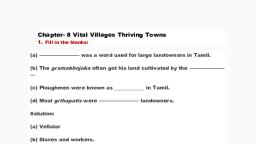
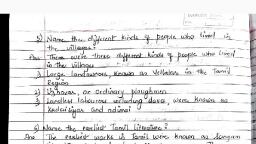
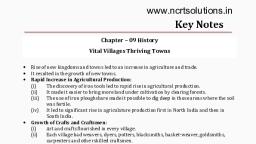
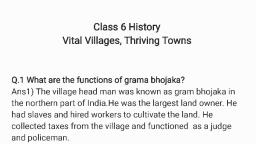
HISTORY, Chapter 8, Vital villages thriving towns, KEYWORDS, Iron: A strong and cheap metal, often used in making tools., Irrigation: The process of supplying water to farming lands., Village: A rural area, often not well-developed., Port: A harbour with access to navigable water., Ring well: Ceramic rings or rows of pots which are arranged on top of one another., City: a large town, often more developed., Shreni: Shrenis were associations or guilds of merchants and crafts persons that, were present in the cities. The shrenis organized trade, procured raw materials and, trained apprentices., Sangam: Sangam is the earliest collection of Tamil poetry. These poems are named, so because they were compiled and composed in assemblies called sangam, , Let's recall, 1.Fill in the blanks:, (a) Vellalar was a word used for large landowners in Tamil., (b) The gramabhojaka often got his land cultivated by the slaves and hired workers., (c) Ploughmen were known as uzhavar in Tamil., (d) Most griphapatis were small landowners., Q.2.Describe the functions of the gramabhojaka. Why do you think he was powerful?, Ans. In the Northern part of the country the village headman was known as the, grambhojaka ., He was powerful because, * The grambhojaka was often the largest Landowner., *He collected taxes from the village., * He also functioned as a judge and sometimes as a policeman., Q.3List the crafts persons who would have been present in both villages and cities., Ans. Goldsmith, Blacksmith, Carpenters, Statue maker, Weavers
Page 2 :
4.Choose the correct answer:, (a) Ring wells were used for:, 1. bathing, 2. washing clothes, 3. irrigation, 4. drainage.✓, (b) Punch marked coins were made of:, 1. Silver✓, 2. gold, 3. tin, 4. ivory., (c) Mathura was important:, 1. village, 2. port, 3. religious centre✓, 4. forested area., (d) ‘Shrines’ were associations of:, 1. rulers, 2. crafts persons✓, 3. farmers, 4. herders., Let's discuss, Q.5Which of the iron tools shown on page 79 would have been important for agriculture, what would the other tools have been used for?, Ans.•Sickle was used in agriculture., •Axe was used for chopping wood., •Tongs were used in kitchen or by ironsmith., Q.6. compare the drainage system in your locality with that of the cities mentioned in the, lesson .What similarities and differences do you notice?, Ans. The modern drainage system is made up of pipes were made up of plastic metal or, ceramic while the drainage system in this chapter was made up of rings and those things, work sticked together to make a tube like structure., Similarity -use of thalamic and tubes, Difference- use of rings in those cities, Let's do
Page 3 :
Q. 7 If you have seen craft person at work describe in a short paragraph what they do.(Hint:, how do this get the raw materials, what kind of equipment do they use, how do they work, what happens to the finished product)., Ans.a)The craft person buys raw material from different parts of the city or the village., b)He works in a part of the house, with the help of the family members., Q 8. List the function performed by men and women who live in your city or village., In what ways are these similar to those performed by people who lived in Mathura ? In what, ways are the different?, Ans. Similarities :The people in Mathura worked as goldsmiths, blacksmiths, weavers,, basket makers, garland makers, perfumers. In present times, people in cities are goldsmith, and others are present in the villages., Differences: In present times, we can find people who work in offices, banks, schools,, colleges etc., but they were not present in those days., , Internal Question, Q1. When did the use of iron begin in the subcontinent?, Ans. Use of iron in the subcontinent began about 3000 years ago., Q2.. Why were Varanasi and Madurai famous?, Ans. Both were famous centres for manufacturing of cloth., , Q3. Where were some of the largest collections of iron tools found?, Ans. These were found in the megalithic burials., Q4. What were Shrenis?, Ans. Many crafts persons and merchants formed associations known as shrenis., Q5. Who was called Grama Bhojaka?, Ans. In the northern part of the country, the village headman was known as the grama, bhojaka., Q6. What do you understand by Jatakas?, Ans. These were stories that were probably composed by ordinary people, and then written, down and preserved by Buddhist monks., Some Important, , Dates, >Beginning of the use of iron in the subcontinent (about 3,000 years ago), >Increase in the use of Iron, cities, punch marked coins (about 2,500 years ago), >Beginning of the composition of Sangam literature (about 2300 years ago), >Settlement in Arikamedu( between 2200 and 1900 years ago)