Page 1 :
9., Life in Towns and, Villages, 1/7
Page 2 :
EXERCISES., Objective Type Questions, A Multiple Choice Type Questions, Which metal led to the greater agricultural production?, (a) iron, 2 In which century did the Second Urbanisation begin in India?, (a) fifth century BC, seventh century BC, This was the first city in world to develop democracy, (@) Thebes, 4., (2) bronze, ()steel, )copper, (b) sixth century BC, )Eight century BC, 3., (b) Sparta, OAthens, (d) Corinth, The punch marked coins were made of, (a) copper, 5., (b) steel, bronze, (d) gold, What were the landless labourers known as?, (m) karmpati, (b) kar sevak, okarmakara, (d) sevak, B., Match the following:, Column A, Column B, 1 Arikamedu, 2 Mathura, 3. Bharuch, 4. Peddlers, S Ujaini, () Capital of Mahajanapada, (b) Traders, who travelled on foot, () Pondicherry, A Coastal town, (d) an important religous centre, (e) A thriving port town, C., Unscramble the letters given in help box and fill in the blanks., 1 twas the responsibility of, to build canals and tanks., 2 Small farmers were known as, Help Box, zuhavra, 3., and, were the major port, raikmaedu, towns of this period., iknsg, kvaeriapttinma, 4., was highly demanded spice., brauhe, epeepr, Very Short Answer Questions, 1 What is urbanization?, 2 Name the prosperous town which existed during this period in India, 3 Which type of irigation methods were used by the kings?, 4. How was village society divided in the second urbanisation of India?, 4Name the different port towns in the sixth century BC in India., 88, 2/7
Page 3 :
III, Short Answer Questions, 1., What was the method of transplantation used in the second urbanization of India?, 2. What were ring wells? What were they used for?, 3., Tamil literature mentions about the different categories of people who lived in villages. Name, them., 4., Who were gahapatis?, 5., Make a list of different types of artisans and craftsmen who lived in the cities., 6., The agricultural production added to the growth and prosperity of the towns. Explain, How?, (НOTS), IV, Long Answer Questions, 1., Explain how flourishing villages helped in the growth of towns., 2. Explain the role of gramabhojaka in the Northern India., 3., State the importance of the town of Arikamedu., 4., Write a note on the role of guilds in ancient India., State the importance of the town of Mathura., You may have heard of Jatakas. What were they? What is their importance today? (HOTS), 5., 6., How was the second urbanisation different from the first urbanisation of Harappan Civilization?, (НOTS), 7., VALUE ADDED QUESTIONS, 1. It is a proven fact that unplanned urbanisation results in the environmental degradation., Suggest what sort of development is suitable for a healthy environment?, 2. Urbanisation results in greater cuitural interaction and exchange of new ideas, Which is good, for a diverse society like India. Give your opinion on whether such interaction is beneficial for, the common masses., 3/7
Page 4 :
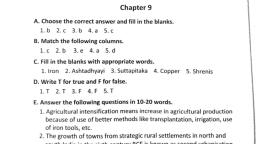
Summative Assessment, LA.L (a), 2. (b), 5. le), 3. (e), 4. (a), B. 1. (e), 2 (d), 3. (e), 4. (b), 5. (a), C. 1. kings, 2. uzhavar, 3. Kaveripattinam, Bharuch and Arikamedu, 4. Pepper, II. 1. The rise of city and urban life is known as, urbanization., 2. Kaushambi, Ayodhya, Rajagriha, Pataliputra,, Varanasi and Shravasti., (Any one), 3. Transplantation and improved methods of, irrigation by canals, wells and artificial lakes., 4. Village society was divided into different, categories on professional grounds., 5. Arikamedu in Puducherry, Kaveripattinam in, Tamil Nadu and Bharuch in Gujarat., 4/7
Page 5 :
VERS, III. 1. For the growth of production, the method of, transplantation was adopted. In this method.., saplings of paddy were raised to transplant, them in the field, instead of the usual practice, of scattering seeds on the ground. Later on,, most of the farmers began to adopt this method, of transplantation because it led to increased, production., 2. Ring wells were the wells that were made of, several hundreds of ceramic rings placed one, over another. Ring wells, most probably, were, used as toilets or drains and garbage damps., 3. According to Tamil literature, the names of, different categories of people in villages were :, Vellalar-large land owners, Uzhavar-small farmers, Adimai-landless labourers, In the contemporary age, people were identified, or recognized under the professional divisions, mentioned above., 4. Gahapatis or Grihapatis were the independent, farmers in northern India. These farmers, cultivated their own plots of land, and were not, depended on others in their work of farming., 5/7