Page 2 :
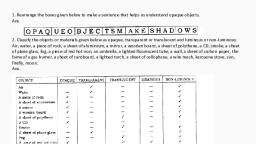
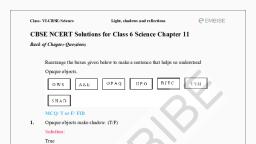
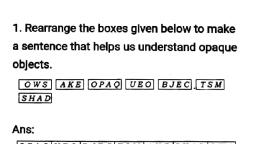
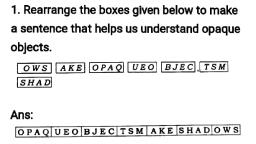
OO “, , Ans., , Fig. 11.5. Getting circular shadow with, , Q. 4., , Ans., , , , GOLDEN SCIENCE, SET), , +S M AKE SHAD, , , , , , , , OP AQ | UEO BIEC, , ee, Ows, , nasal}, , , , , , , , Classify the objects or materials given below as opaque, transpareny or, - Classify the objects, , US!, ransluce uminous or non-lumine A, translucent and lumi Juminium, a mirror, a wooden board, Sheet, Air, water, a piece of rock, a sheet of alum, , lass, fog, a piece of red hot iron, ap, Wf polythene smoke, a sheet of plane & . :, - ee pores aes tube, a wall, a sheet of carbon sal the flame of, a bur x a h et of cardboard, a lighted torch, a sheet of cellophane, q ire, a gas burner, a she :, , mesh, kerosene stove, sun, firefly, moon. ', , (a) Transparent objects: Air, water, a sheet of eee fase eat, , (b) Translucent objects: A sheet of polythene, smoke, fog, a sheet of ce ophane,, a wire mesh. . ,, , . luminium, a mirror, a woode, j : A piece of rock, a sheet of a , en, , “ eae a ac umbrella, a wall, a sheet of carbon paper, a sheet of, cardboard. . ., , (d) Luminous objects: A piece of red hot iron, a lighted fluorescent tube, the, flame of a gas burner, a lighted torch, kerosene stove, sun, firefly., , (e) Non-luminous objects: Include all (a) transparent objects, (6) translucent, objects and (c) opaque objects and moon. . ;, , Can you think of creating a shape that would give a circular shadow if, , held in one way and a rectangular shadow if held in another way?, , - Yes, there are many things which give a circular shadow if held in one way and, , a rectangular shadow if held in another way. For example, a cylinder, a circular, disc, etc., , , , -— Shadow Shadow, , , , , , Source, , of light, , —t— Screen ime, , , , , , Cylinder, , , , , , , , , , , , Fig. 11.6. Getting a rectangular shadow with, a cylinder, , if you hold up.a mirror in front of you, will, , a cylinder, In a completely dark room,, , you see a reflection of yourself in the mirror?, , No. In a completely dark room, no image will be formed because image seen in a, mirror is formed due to reflection, , no light in a completely dark roo:, , of light from the object and since there will be, m, no image will be formed.
Page 3 :
), , [176 GOLDEN SCIENCE wi, Q. 11, List four natural sources of light., , Ans. (/) Sun (i) Stars, , , , , , , , (ii) Fire (iv) Jugnu (Firefly),, sources of light., Qi) Oil lamp, , (iv) Torch,, , Q. 12. Write down four man-made, Ans. () Candle, , (iit) Electric bulb, Q. 18. Does the fire emit light?, Ans. Yes, fire emits light., Q. 14, On what factor does the, , proportion of light that enters an object depend?, Ans. Optical nature of the object, , 11.2, WHAT EXACTLY ARE SHADOWS?, , (Q. 1) What is an obstacle?, , Ans. An object which comes to the path of light is called an obstacle., , Q. 2. Give examples of two substances through which light does not pass?, Ans. Wood and bricks are substances through which light does not pass., , Q. 3. Whether a shadow is two-dimensional or three-dimensional?, , Ans. Shadow is not just the two-dimensional outline that you see on the ground. All the, space behind the opaque object up to some distance behind it, seems to be filled with the, shadow (See Fig. 11.2)., , Q. 4. What do we need in order to see a shadow?, Ans. We need (i) a source of light,, (ii) an opaque object in the way of light, and, (iit) a screen., , Q. 5. Does the direction of shadow change during the day? Does the length of, shadow also change from season to season?, , Ans. Yes, the direction of shadow changes as the sun changes its position during the, day. The length of the shadow also changes from season to season., , Q. 6. at is a shadow? How is it formed? How does the colour of an opaque, object-affect the colour of the shadow?, , Ans. A shadow is a dark outline or image cast by an opaque object that blocks lisht, coming from a source of light. It is formed when light hits the opaque object which does not, let the light pass through. Everywhere else around the opaque object, the light continues in, a straight path until it bounces off the ground or wall behind the object. The wall or ground, behind the opaque object is the screen. On this screen is a dark patch, or shadow, with the, same outline as the object surrounded by light. The colour of the opaque object does not afiet, the colour of the shadow that is formed.
Page 4 :
oat, all., , , , , , , , , [TIGHT SHADOWS AND REFLECTIONS, , See ee ena, 7. Wom is the difference Detween j, , , , , , , , , , Image Shadow, j 1. Image is formed due to reflection or | 1. Shadow ia formed when light falls on the, on of light, , , , , opaque body, , i), , is seen when light coming from the, yect after reflection ot refraction enters the, observer's eye, , 2. No light enters the eye from the shadow of, the object, , 3. Image gives more information such as colour,, , 3. Shadow does not provide any detail about, structure, ete, about the object, , the object, it gives an idea about the shape, of the object, , , , , , , , , , Q. 8. Define screen,, , Ans. Screen is a surface on which images are formed., Q. 9. What is umbra and penumbra?, , Ans. Umbra is the dark region behind object facing light which does not receive light, , Penumbra is the less dark part of shadow, It is the outer part of shadow., , , , | activity 4 (Page 109), , Place a chair in the school ground on a sunny day. What do you observe from, _ the shadow of the chair?, , ., Does the shadow give an accurate picture of the shape of the chair? If the, chair is turned around a little, how does the shape of the shadow change?, , — No, accurate shape of chair is not shown by the shadow. When turned around, a little, the shape of the shadow will change because now different portions of, the chair will obstruct light and make shadow., , Take a thin notebook and look at its shadow. Then, take a rectangular box and look, at its shadow. Do the two shadows seem to have a similar shape?, , — Yes, the two shadows seem to have a similar shape., , Take flowers or other objects of different colours and look at their shadows such as, a red rose and a yellow rose, for instance. Do the shadows look different in colour,, , when the colours of the objects are different?, — No, the shadows of the different coloured objects are not different., , Take a long box and look at its shadow on the ground. When you move the box, around, you may see that the size of the shadow changes. When is the shadow of the, , box the shortest, when the long side of the box is pointed towards the Sun or, when the short side is pointing towards the Sun?, , — Shadow of the box is the shortest when the short side is pointing towards the, Sun,
Page 5 :
~=, , [ave GOLDEN SciENGES>, , 11.3. ALPINHOLE CAMERA, . 1. Define pinhole camera., , ‘ins. It is a device which forms a photograph like image of a bright object on g Screg, , Q. 2. Can you think of a situation where we can see the path of the ligtae, , Ans. In a dark room, we can see with torch light which goes straight. Similarly, ;, particles become visible when light enters the room through fine hole., , All these examples indicate that light travels in straight line., , Q. 3. Why is the image formed in a pinhole camera inverted?, , Ans. In a pinhole camera, image formed is inverted because the object is between, radius of curvature and focus., , Q. 4. What is the path of light?, , Ans. Straight line., , 11.4. MIRRORS AND REFLECTIONS, , Q. 1. What is reflection?, , Ans. When a ray of light falls on a smooth and shiny surface, the whole of light is, sent back in the same medium. It is called reflection. Mirrors do not allow even a small, amount of light to pass through them. Mirrors show regular and complete reflection,, , Q. 2. Define ‘Mirror’., Ans. A smooth shining surface, which rebounds the light back in same or in differen, , direction-is called a mirror., (25 Sn is silvered glass used as a mirror?, AntS- The silvered glass has a smooth surface and the smoothness helps in forming clea, , image. Silvering makes it shiny and the shiny surface helps in reducing the absorption., , Q. 4. What happens when light falls on a mirror? :, , Ans. Mirror is silvered on one side; so it does not allow the light to pass through it. |, reflects almost whole of the light falling on it., , Q. 5. What change in the path of light takes place when light falls on a shin, surface? What is this called?, , : Ans. The light comes back in the same plane, when light falls on a shiny surface., This is known as reflection of light., Q. 6. Why do we need a shiny surface for reflection?, , Ans. The extent of reflection depends upon the shine and smoothness of the surfa', More is the shine and smoothness of the surface, more will be the reflection. That is wi, mirrors reflect most of the light falling on it. Hence, for reflection, shiny surfaces <, required., , Q. 7. How are moon and planets visible to us, though they are not luminot, , , , , , dust, , Ans. Because they reflect light from the sun., Q. 8. What do you mean by scattering of light?, , ‘Ans. When a beam of light falls on a rough surface, it is turned back in differ, directions, it is called scattering of light.