Notes of 6th, Science Chapter 14 Light Shadow and Reflection - Study Material
Page 1 :
Class-6th, Subject-Science, Chapter 14 Light Shadow and Reflection, D. Give reason for each of the following, 1.The smooth surface appears even, Ans- Smooth surface reflects all the light evenly, therefore it, appears even., 2. Transparent object do not form shadow, Ans- Transparent objects allow all the light to pass through and, hence do not form shadows., 3. Shadow does not form a in the dark, Ans- Shadow is formed only when light is blocked by an opaque, object. So, light is an essential requirement for the formation of, shadows. Hence, no shadow forms in the dark., 4. All surface do not reflect in the same manner, Ans- Reflection of light depends on the appearance of the surface., Smooth surfaces reflect the light rays evenly while rough surfaces, reflect the light rays unevenly., 5. Image formed in a pinhole camera is inverted, Ans- A ray from the top of the object travels in straight line and, meets the screen at the bottom while the ray from the bottom of the
Page 2 :
object meets the screen at the top. Due to this reason, an inverted, image is formed in a pinhole camera., E. Name the following, 1.Two natural sources of light, Ans- Sun, stars, 2. Two artificial sources of light, Ans- Bulb, tube light, 3. Two transparent objects, Ans- Clear glass, air, 4. Two natural phenomena that exist due to shadow formation, Ans- Solar eclipse, lunar eclipse, 5. A device in which light passes through hole and projects an, inverted image on the opposite side, Ans- Pinhole camera, F. Answer the following question in one word or a sentences., 1.Define luminous object, Ans- Objects that have their own light are called luminous objects., 2.What happens to size of shadow if the sources of light moves, towards it?, Ans- Size of shadow increases if the source of light moves towards, it., 3. when is regular reflection possible?
Page 3 :
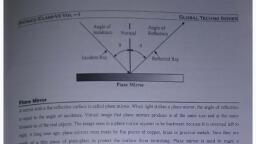
Ans- Regular reflection is possible in case of even surfaces., 4. What type of image is formed in a pinhole camera?, Ans- Inverted, 5. Give one use of pinhole camera., Ans- A pinhole camera is used to capture sun’s movement over a, long period of time., G. Answer the following question in brief., 1. What are the necessary condition for the formation of a shadow, Ans- Shadow is formed only in the presence of a source of light, an, opaque object and a screen., 2.What is reflection of light? How can it be used to distinguish, between smooth and rough surface?, Ans- The phenomenon by which the light rays falling on an object, bounce back fully or partially is called reflection of light., When we look at the objects we can estimate whether the object is, smooth or rough just by looking at it (without touching the object)., This is possible because of the reflection of light from the surface. A, smooth surface will reflect all the light rays evenly . such reflection, knoe as regular reflection A rough surface will reflect the light rays, unevenly in all directions which makes the surface look uneven., Such a reflection is called irregular reflection., 3.Draw and define a light ray and a light beam.
Page 4 :
Ans- A straight line along with the arrow head is called a light ray. A, group of light rays travelling either parallel to each other or going, outwards (if the light source is very small) is called a light beam., Draw diagram from textbook page no.180 fig no. 14.2, 4. What is image ? how is it formed?, Ans- When we stand in front of a mirror, what we see in the mirror, is called an image. An image is formed when light rays from an, object are reflected off a surface., 5. What is the effect of size of the hole on the quality of the image in, pinhole camera?, Ans- A small hole allows less number of light rays to enter the, pinhole camera that results in the formation of a sharper but dull, image. On the other hand, a bigger hole allows more number of light, rays to enter the pinhole camera forming a bright but blurred image, due to overlapping of the images., , H. Answer the following question in detail., 1.Describe an activity to show the rectilinear propagation of light, Ans- Rectilinear propagation of light can be shown with the help of, the following activity. Light a candle and place it on a candle stand;, take a straight straw and look at the candle flame through it; bend, the straw and look again at the candle flame through it. We can see, the candle flame through the straight straw but not through the bent, straw. This proves that light travels in the straight line.
Page 5 :
2.What are transparent, translucent and opaque object? Explain, with the help of example, Ans- Objects such as clear glass, air and water that allow light to, pass through them completely are transparent objects. Objects such, as butter paper and frosted glass that allow light to pass through, them partially are translucent objects., Opaque objects: Objects such as wood and brick that do not allow, any light to pass through them are opaque objects., 3. What are the characteristics of shados?, Ans- The shadow of an object has the following characteristics., i. Shadow is formed only in the presence of a source of light, an, opaque object and a screen., ii. Shadow always forms on the opposite side of the object., iii. Irrespective of the colour of the object, shadow is always black., iv. Size of the shadow depends on the distance between the source, of light and the object and the distance between the screen and the, object., 4.What is pinhole camera? Discuss the characteristic of image, formed I pinhole camera, Ans- A pinhole camera is a simple camera with a tiny hole on one, side of a light-proof box. Light from an object passes through the, hole and forms an inverted image on the opposite side of the box., The characteristics of the image formed in a pinhole camera are, given below:
Page 6 :
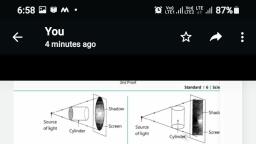
i. A pinhole camera always forms an inverted image, as a ray from, the top of the object travels in straight line and and meets the screen, at the bottom while the ray from the bottom of the object meets the, screen at the top., ii. Quality of the image formed depends on the size of its hole., iii The colour of the image formed is same as that of the object. The, image formed in a pinhole camera can be smaller than the object,, equal to the object or larger than the object depending upon the, distance of the object from the pinhole., Draw diagram from textbook page no. 183 fig no. 14.7 instead, of man you can draw tree, 5. Differentiate between in image and shadow, Ans- Shadowi) is always dark, ii) Gives inly the outline of the object, iii) Formed by blocking of light by the object, ImageI) has the same colour as that of the object, ii) Gives the details of the object, iii) formed by reflection of light from the object



 Learn better on this topic