Page 1 :
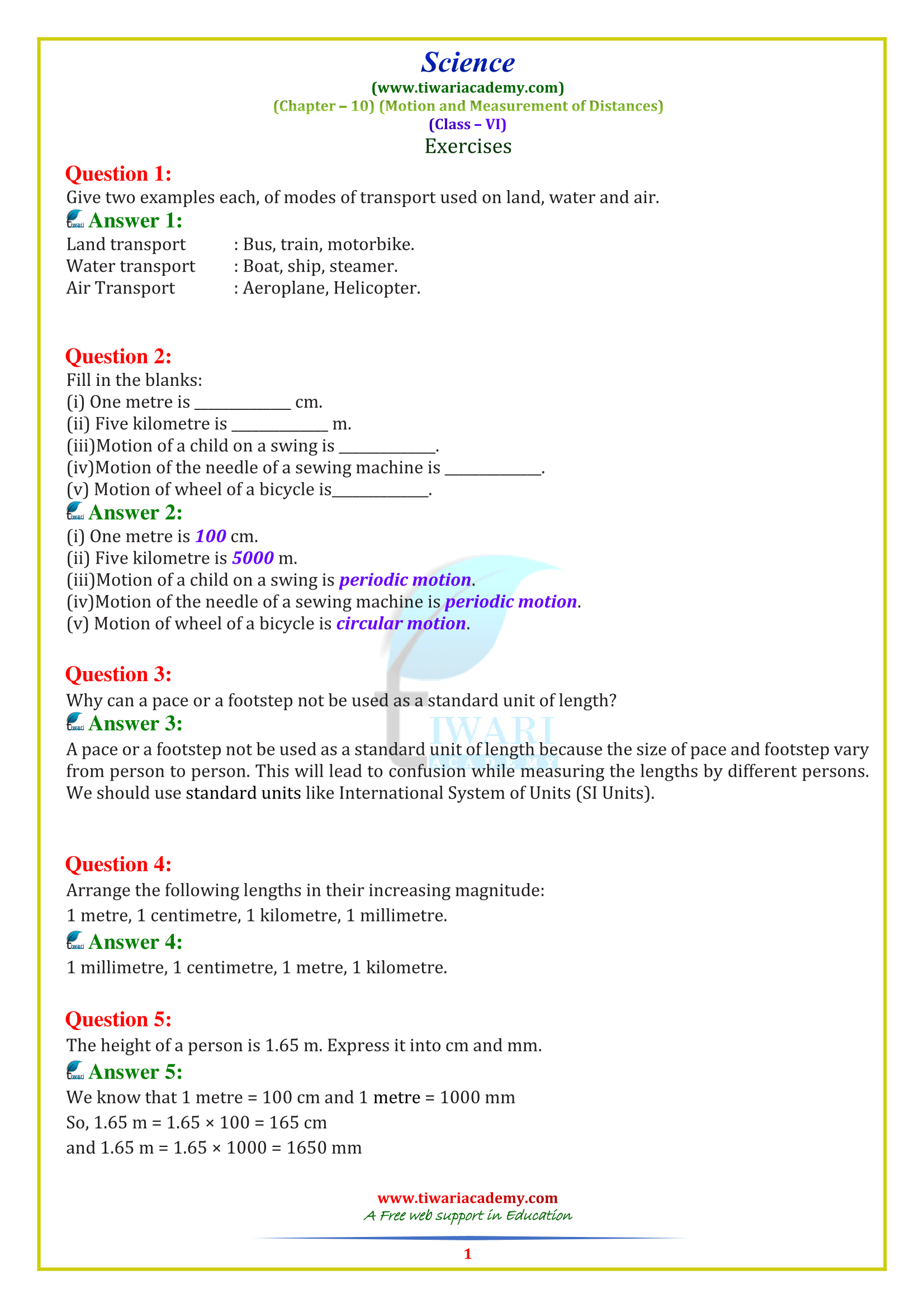
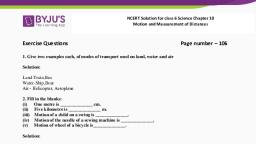
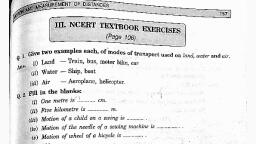
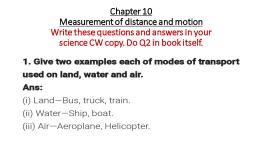
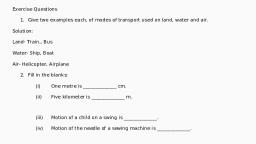
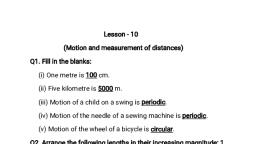
Science, , (www.tiwariacademy.com), (Chapter - 10) (Motion and Measurement of Distances), (Class - VI), , Exercises, Question 1:, Give two examples each, of modes of transport used on land, water and air., €. Answer 1:, Land transport : Bus, train, motorbike., Water transport : Boat, ship, steamer., Air Transport : Aeroplane, Helicopter., , Question 2:, , Fill in the blanks:, , (i) One metre is cm., , (ii) Five kilometre is m., , (iii) Motion of a child on a swing is, , (iv)Motion of the needle of a sewing machine is, , (v) Motion of wheel of a bicycle is, , €. Answer 2:, , (i) One metre is 100 cm., , (ii) Five kilometre is 5000 m., , (iii) Motion of a child on a swing is periodic motion., (iv)Motion of the needle of a sewing machine is periodic motion., (v) Motion of wheel of a bicycle is circular motion., , Question 3:, Why can a pace or a footstep not be used as a standard unit of length?, , €. Answer 3:, , A pace or a footstep not be used as a standard unit of length because the size of pace and footstep vary, from person to person. This will lead to confusion while measuring the lengths by different persons., We should use standard units like International System of Units (SI Units)., , Question 4:, , Arrange the following lengths in their increasing magnitude:, 1 metre, 1 centimetre, 1 kilometre, 1 millimetre., , €. Answer 4:, , 1 millimetre, 1 centimetre, 1 metre, 1 kilometre., , Question 5:, , The height of a person is 1.65 m. Express it into cm and mm., €. Answer 5:, , We know that 1 metre = 100 cm and 1 metre = 1000 mm, , So, 1.65 m = 1.65 x 100 = 165 cm, and 1.65 m = 1.65 x 1000 = 1650 mm, , www.tiwariacademy.com, A Free web support in EGaucation, , 1