Page 1 :
NAVODAYA VIDYALAYA SAMITI, PROSPECTUS FOR JAWAHAR NAVODAYA VIDYALAYA SELECTION TEST-2020, FOR ADMISSION TO CLASS-VI, , NAVODAYA VIDYALAYA SCHEME, INTRODUCTION, In accordance with the National Policy of Education (1986), Government of India, started Jawahar Navodaya Vidyalayas (JNVs). Presently the JNVs are spread in, 28 States and 07 Union Territories. These are co-educational residential schools, fully financed and administered by Government of India through an autonomous, organization, Navodaya Vidyalaya Samiti. Admissions in JNVs are made through, the JAWAHAR NAVODAYA VIDYALAYASELECTION TEST (JNVST)to Class VI. The, medium of instruction in JNVs is the mothertongue or regional language up to, Class VIII and thereafter English for Mathematics and Science and Hindi for Social, Science. Students of the JNVs appear for board examinations of the Central, Board of Secondary Education. While education in the schools is free including, board& lodging, uniform and textbooks, a sum of Rs. 600/- per month is collected, only from the students of Classes IX to XII towards Vidyalaya Vikas Nidhi. However,, students belonging to SC/ST categories, all Girl students and the students whose, family income is below poverty line (BPL) are exempted.In respect of wards of, Government employees other than exempted category (Students of classes VI to, VIII, all SC/ST & girl students and wards of BPL families) Vikas Nidhi will be charged, @Rs.1500/- per month or actual children education allowance received by the, parent per month whichever is less. However, VVN shall not be less than Rs.600/per student per month., , Objective of the Scheme, (i) To provide good quality modern education including a strong component, of culture, inculcation of values, awareness of the environment, adventure, activities and physical education to the talented children predominantly, from rural areas.
Page 2 :
(ii) To ensure that students attain a reasonable level of competency in three, languages., (iii) To promote national integration through migration of students from Hindi to, non-Hindi speaking State and vice-versa., (iv) To serve in each district as focal point for improvement in quality of school, education in general through sharing of experiences and facilities., , 1.1 State-wise Distribution of Jawahar Navodaya Vidyalayas, According to the Navodaya Vidyalaya Scheme, one Jawahar Navodaya, Vidyalaya is to be set up in each District in a phased manner. At present,, 661Vidyalayas are sanctioned in 28 States and 07 Union Territories, out of, which 636 are functioning. The State-wise distribution of JNVs sanctioned is, as under:, Andhra Pradesh, , 13+02**, , Assam, , 27+01**, , Arunachal Pradesh, , 18, , Himachal, Pradesh, Jammu, Kashmir, , 12, , Punjab, , 22+01**, , Pudducher, 04, ry, , Jharkhand, , 24+02**, , Rajasthan, , 33+02**, , Andaman & Nicobar, 03, Islands, , Karnataka, , 30+01**, , Sikkim, , 04, , Bihar, , 38+01**, , Kerala, , 14, , Tripura, , 08, , Chandigarh, , 01, , Lakshadweep, , 01, , Telangana 09, , Chattisgarh, , 27+01**, , Madhya, Pradesh, , Delhi, , 09, , Maharashtra, , Daman & Diu, , 02, , Manipur, , Dadra & Nagar Haveli, , 01, , Meghalaya, , 51+02**+ Uttar, 75+01**, 01*, Pradesh, Uttarakhan, 33+01**, 13, d, West, 09+02**, 19+01**, Bengal, Total, 638+22**+1*=, 11+01**, 661, , Goa, , 02, , Mizoram, , 08, , Gujarat, , 33+01**, , Nagaland, , 11, , Haryana, , 21, , Orissa, , 30+01**, , &, , 22+01**, , ** Additional JNVs sanctioned for the Districts having large concentration of SC/ST, population.* Special JNV, , A maximum of eighty students are admitted in Class VI in each Vidyalaya, through a Selection Test subject to availability of suitable candidates. The, Samiti reserves the right to reduce the seats to forty or to withhold result
Page 4 :
(iv) Online platform is in open source and free of cost. Application may be, submitted from any source like desktop, laptop, mobile, tablet etc., (v) In all JNVs a help desk will be available to assist the candidates/parents to, upload application free of cost. Parents may also approach the help desk in, JNV along with candidate and required documents such as certificate, signed by the Head Master, photograph and a mobile phone with valid, mobile number for receiving the registration number and password through, SMS for registration process., , 2.2, , Issue of Admit Cards, The admit card will be made available with effect from 1st December 2019, and 1st March 2020 in respect of phase 1 and phase 2 class VI JNVST 2020respectively on application portal which shall be downloaded free of, cost by the candidates/parents before the conduct of JNVST., , 2.3, , Result of the Selection Test, The result of JNV Selection Test 2020 is expected to be announced by March, 2020 and May 2020 for Phase 1 and phase 2 class VI JNVST-2020, respectively. Candidates can get the result from the admission portal.The, result will also be displayed in the offices of the concerned, i., , Jawahar Navodaya Vidyalaya, , ii., , District Education Officer, , iii., , District Magistrate, , iv., , Deputy Commissioner, Navodaya Vidyalaya Samiti of the Region., , v., , The website of the Navodaya Vidyalaya Samitiwww.navodaya.gov.in., The Principal, Jawahar Navodaya Vidyalaya concerned, will also inform the, selected candidates through SMS on the registered mobile number followed, by a speed post., , SELECTION AND ADMISSION, 3.1), , Selection in the test will not vest any right on the candidate to secure, admission into the JNV. At the time of seeking actual admission, each, selected candidate will have to produce all relevant certificates, as, prescribed by the Navodaya Vidyalaya Samiti. Until admission, the selection
Page 5 :
is provisional only. Candidates are advised to apply for TC from parent, school only after the verification of documents and confirmation of, admission by the respective JNV., 3.2), , In case of any dispute, the decision of Navodaya Vidyalaya Samiti shall be, final and binding on the candidates., , 3.3), , Marks obtained by candidates (both selected and not selected) in the test, are not communicated., , 3.4), , There is no provision for re-evaluation of the answer scripts or re-totaling of, marks, since the result is processed through computer and sufficient care is, taken to ensure accuracy through various checks while processing the, result., , 3.5), , It may also be noted by the candidates and their parents/guardians that, under the scheme of NVS, students of a JNV located in Hindi speaking State, may have to be migrated to another JNV in Non-Hindi Speaking State and, vice-versa for one academic year when the students are promoted to Class, IX. In case of refusal by the students/ parents selected for migration,, continuation of such students in JNV will not be allowed., , 3.6), , The candidates and their parents/guardians may note that the children, selected on the basis of the Test will be admitted only in the JNV located in, the district from where they are studying in class V and appearing for the, JNVST. Under no circumstances, the selected candidate will be given, admission to any other JNV. No request for shifting of students on account of, medium of instruction in the JNV concerned, shifting of parents/guardians to, other district(s) / State(s) etc. will be entertained., , 3.7), , Candidates belonging to the Scheduled Caste (SC) and Scheduled Tribe, (ST) will have to produce a certificate of scheduled Caste/Tribe at the time, of seeking admission, if selected. Such certificate should be obtained from, the competent authority before 30thMarch of the year of seeking admission, so that it may be submitted to the Principal of JNV concerned at the time of, verification of document.For example, candidates seeking admission during, 2020-21 should get the certificate on or before 30thMarch2020.
Page 6 :
3.8), , Candidates applying for admission under Rural Category will have to, produce a certificate to the effect that the school(s) where candidates, studied classes III,IV and V is located in Rural Area., , 3.9), , Candidates, , belonging, , to, , the, , Divyang, , category, , (Orthopedically, , Handicapped, Hearing Impaired and Visually Handicapped), if selected ,, will have to produce a medical certificate signed by Chief Medical Officer, of the District concerned at the time of admission in appropriate format., 3.10) Candidates belonging to transgender category will have to submit a, certificate from the competent authority prescribed by the concerned State, Govt. with regard to their gender. No reservation is made for this category., , WHO IS ELIGIBLE, FOR ALL CANDIDATES:, 4.1, , Only the candidates from the district concerned where the Jawahar, Navodaya Vidyalaya has been opened are eligible to apply for admission., However, if the district where JNV is opened is bifurcated at a later date, the, old boundaries of the district are considered for the purpose of eligibility for, admission into JNVST, in case a new Vidyalaya is not started in the newly, bifurcated district as yet., , 4.2, , A candidate seeking admission must not have been born before01-052007and after 30-04-2011 (Both dates are inclusive).This will apply to, candidates of all categories, including those who belong to theScheduled, Caste (SC) and Scheduled Tribe (ST). In case of doubtful cases of overage in, comparison to the age recorded in the certificate,they may be referred to, the Medical Board for confirmation of the age. The decision of the medical, board will be treated as final., , 4.3, , A candidate appearing for the selection test must be studying in Class-V for, the whole of the academic session 2019-20 in a Government/Government, aided or other recognized schools or ‘ B’ certificate competency course of, National Institute of Open Schooling in the same district where he/she is, seeking admission. A school will be deemed recognized if it is declared so by, the Government or by any other agency authorized on behalf of, Government. Schools where students have obtained ‘ B’ certificate under, National Institute of Open Schooling should have accreditation of NIOS. A
Page 7 :
candidate must successfully complete Class-V in the session 2019-20. Actual, admission in Class-VI for the session 2020-21 will be subject to the mentioned, condition., 4.4, , A Candidate claiming admission under rural quota must have studied and, passed classes III, IV and V from a Govt. / Govt. aided / recognized school, spending one full academic session each year in a school located in rural, area., , 4.5, , Candidates passing ‘ B’ certificate competency course of National Institute, of Open Schooling on or before30thSeptember 2019 arealso eligible to write, admission test provided they are in the prescribed age group. The rural status, of a child from National Institute of Open Schooling will be decided on the, basis of a certificate to be issued by Tehsildar/District Magistrate of the District, indicating that the child has been residing in rural areas for the last three, years. Students studying under the above scheme and residing in urban and, notified areas are not eligible for obtaining seat in rural quota., , 4.6A Candidate who has not been promoted and admitted to Class-V, , before, , 15thSeptember, 2019 is not eligible to apply., 4.7No candidate is eligible to appear in the selection test for the second time,, under any circumstances., , FOR RURAL CANDIDATES, A), , At least 75% of the seats in a district will be filled by candidates selected, from rural areas and remaining seats will be filled from the urban areas of, the district., , B), , A candidate seeking admission under the rural quota must have studied in, Classes-III, IV and V completing full academic session from the Government/, Government Aided/Government recognized school(s) located in rural, areas. However, the candidate should study full academic session in ClassV from the same district where admission is sought., , C), , Candidates studying under the schemes of National Institute of Open, Schooling should produce their rural status certificate issued by District, Magistrate / Tehsildar / Block Development Officer.
Page 8 :
FOR URBAN CANDIDATES, A candidate who has studied in a school located in an urban area even for, a single day of session in Class-III, IV and V will be considered as an urban, candidate. Urban areas are those which are so defined in 2011 census or through, a subsequent Government notification. All other areas will be considered as rural., FOR TRANSGENDER CANDIDATES, No separate reservation for transgender category candidates is provided, and they will be included in Boys category for reservation purpose, under various, sub-categories viz Rural, Urban, SC, ST and Divyang., , RESERVATION OF SEATS, a), , At least 75% of the seats in a district are filled by candidates selected from, rural areas and remaining seats are filled from urban areas of the district., , b), , Reservation of seats in favour of children belonging to Scheduled Castes, and Scheduled Tribes is provided in proportion to their population in the, district concerned provided that in no district, such reservation will be less, than the national average (15% for SC and 7.5% for ST) but subject to, maximum of 50% for both the categories (SC & ST) taken together. These, reservations are interchangeable and over and above the candidates, selected under open merit., , c), , Minimum One third of the total seats are filled by girls., , d), , There, , is, , a, , provision, , Orthopedically, , for, , reservation, , Handicapped,, , for, , Hearing, , **, , Divyang, , Impaired, , children, and, , (i.e., , Visually, , Handicapped) as per GOI norms., **, , “ Blindness” refers to a condition where a person suffers from any of the, followingconditions namely:-, , (i), , Total absence of sight; or, , (ii), , Visual acuity not exceeding 6/60 or 20/200 (snellen) in the better eye with, correcting lenses; or, , (iii), , Limitation of the field of vision subtending an angle of 20 degree or worse.
Page 9 :
**, , “ Hearing Impairment” means loss of sixty decibels or more in the better ear in, theconversational range of frequencies., , **, , “ Locomotor disability” means disability of the bones joints or muscles leading, tosubstantial restriction of the movement of the limbs or any form of cerebral, palsy., , **, , “ Person with disability” means a person suffering from not less than forty, percent of anydisability as certified by a medical authority., DOCUMENTS TO BE SUBMITTED AFTER SELECTION, The parents of the candidates who are provisionally selected for admission, , will have to submit the following documents at the time of admission for, verification: i), , Proof for date of birth., , ii), , Proofs for eligibility as per the conditions of NVS., , iii) For candidates seeking admission under rural quota, the parents will also, have to submit a certificate from the competent authority to the effect that, the child had studied in an Institution / School located in a rural area., iv), , Residence Certificate in prescribed proforma in case of NIOS study only, , v), , Any other documents required., , ABOUT THE SELECTION TEST, 1. Centre for Examination, Each candidate shall appear for the selection test at the examination center, allotted to him/her as indicated on the Admit Card. No candidate is, permitted to appear from any other center. No request for change of center, will be entertained. No candidate can appear in the selection test without, proper Admit Card. Admit card may be downloaded from the website of, NVS, HQ – www.navodaya.gov.in or from admission portal
Page 11 :
3. Composition of the Test, The selection test will be of two-hour duration from 11:30 am to 01:30 pm and, will have 3 sections with only objective type questions. There are 80 questions in, all for 100 marks., , Type of Test, , Number of Questions, , Marks, , Mental ability Test, Arithmetic Test, Language Test, Total, , 40, 20, 20, 80, , 50, 25, 25, 100, , Duration, 60 Minutes, 30 Minutes, 30 Minutes, 2 Hours, , A single test booklet comprising of all the three sections will be given to each, candidate. Additional time of 30 minutes will be allowed for “ Divyang students”, (differently-abled students), , 3. Method of Recording Answers, a), , A separate OMR (Optical Mark Recognition) answer sheet will be provided., Candidates are required to indicate their answers at an appropriate place, on the OMR sheet. A copy of specimen OMR Sheet will be uploaded in the, website of NVS., , b), , Only Blue/Black Ball Point Pen is to be used to write on the OMR, Sheet.Candidatesshould bring their own ballpoint pens. Use of pencil is, strictly prohibited., , c)For each question, there are four probable answers, out of which only one is, correct. Thecandidate is required to select the correct answer and darken, the corresponding circleof the chosen answer. For example if your answer, for Question no. 37 is C, darken the circle under C as given below., 37., d), , A, , B, , C, , D, , No change in the darkened circle is allowed. Striking, applying, white/correction fluid and erasing on the OMR sheet is also not allowed., Such answers will not be evaluated., , e), , 1.25 marks will be given for every correct answer., , f), , No negative marking will be done.
Page 12 :
4., , Instructions and Examples, , A., , The candidate must carefully read the instructions given on the cover page, of the test booklet as well as those for each section before attempting, thequestions. Candidates are advised to confirm that the test booklet, received by them is of the language opted for the test. In case test booklet, of correct language opted for is not provided, the candidate should get it, changed before the start of the examination. It is the responsibility of the, candidate to obtain the test booklet of his choice as opted in the, application form. No representation in this regard will be entertained after, the examination is over., , B., , The total time would be two hours without any break. Additional time of 30, minutes will be allowed for “ Divyang students” (differently-abled students)., , C., , Securing qualifying marks in each of the three sections is essential., Candidates are advised not to spend more time on each section of test, than suggested, although they are free to adjust the total time, as they like., , D., , There will be a bell after every 30 minutes., i., , No candidate will be allowed to appear in the selection test without, proper Admit Card., , ii., , Candidates have to be seated in the allotted rooms latest by 11:00, a.m. Late comers will not be permitted to appear for the test., , iii., , No candidate will be permitted to leave the examination hall/room till, the completion of full allotted time., , Nature of the test, Section-1Mental Ability Test (MAT), This is a non – verbal test. Questions are based on figures and diagrams, only. Questions are meant to assess general mental functioning of the, candidates. The section is divided into ten parts having 4 questions each., Given below are some examples:
Page 13 :
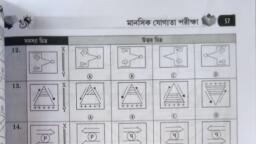
PART-I(ODD-MAN OUT), , Directions:, , In questions 1 to 4, four figures A,B,C and D have been given in each, question. Of these four figures, three figures are similar in some way and one, figure is different. Select the figure which is different., , Correct answer is (A), PART- II(FIGURE MATCHING), , Directions:, , In questions 5 to 8, a problem figure is given on the left side and four answer, figures marked A, B, C and D are given on the right side. Select the answer, figure which is exactly the same as the problem figure., , Correct answer is (C), , PART- III (PATTERN COMPLETION), , Directions:, , In questions 9 to 12 there is a problem figure on the left hand side, a part of, which is missing. Observe the answer figures A, B, C and D on the right hand, side and find out the answer figure which without changing the direction,
Page 14 :
fits in the missing part of the problem figure in order to complete the pattern, in the problem figure., , Correct answer is (A), , PART- IV (FIGURE SERIES COMPLETION), , Directions:, , In questions 13 to 16, there are three problem figures on the left hand side, and the space for the fourth figure is left blank. The problem figures are in a, series. Find out one figure among the answer figures given on the right hand, side, which occupies the blank space for the fourth figure on the left hand, side and completes the series., , 18, , Correct answer is (C), , C, , PART-V (ANALOGY), Directions:, , In questions 17 to 20, there are two sets of two problem figures each. The, second set has a mark of interrogation (?). There exists a relationship, between the first two problem figures. Similar relationship should exist
Page 15 :
between the third and fourth problem figure. Select one of the answer, figure which replaces the mark of interrogation., , Correct answer is (A), , PART - VI [Geometrical Figure Completion (Triangle, Square, Circle)], Directions:, , In questions 21 to 24 one part of a geometrical figure is on the left hand side, as question figure and the other one is among the four answer figures A, B,, C and D given on the right hand side. Find out the figure that completes the, geometrical figure., , Correct answer is (A), , (A), , (B), , (C), , (D), , PART – VII (MIRROR IMAGING), Directions:, , In questions 25 to 28 there is a problem figure on the left side and four, answer figures marked A, B, C and D are given on the right side. Select the, answer figure which is exactly the mirror image of the problem figure when, the mirror is held at X Y.
Page 16 :
Correct answer is (D), , PART - VIII (PUNCHED HOLD PATTERN - Folding/Unfolding), Directions:, , In question 29 to 32 a piece of paper is folded and punched as shown in, problem figures on the left side and four answer figures marked A, B, C and, D are given on right side. Select the answer figure which indicates how the, paper will appear when opened (unfolded)., , Correct answer is (A), , PART - IX (SPACE VISUALISATION), Directions:, , In questions 33 to 36 a problem figure is given on the left side and four, answer figures, marked A, B, C and D are given on the right side. Select the, answer figure which can be formed from the cut-off pieces given in the, problem figure.
Page 17 :
(A) (B), , (C), , (D), , Correct answer is (D), , PART – X (EMBEDDED FIGURE), Directions:, , In questions 37 to 40 a problem figure is given on the left side and four, answer figures, marked A, B, C and D are given on the right side. Select the, answer figure in which the problem figure is hidden/ embedded., , Correct answer is (B), [, , Section 2: Arithmetic Test, The main purpose of this test is to measure candidate's basic competencies in, Arithmetic. All the Twenty questions of this test will be based on the following 15 topics, 1., , Number and numeric system., , 2., , Four fundamental operations on whole number., , 3., , Fractional number and four fundamental operations on them., , 4., , Factors and multiples including their properties., , 5., , LCM and HCF of numbers., , 6., , Decimals and fundamental operations on them., , 7., , Conversion of fractions to decimals and vice-versa., , 8., , Measurement of length, mass, capacity, time, money etc., , 9., , Distance, time and speed., , 10., , Approximation of expressions.
Page 18 :
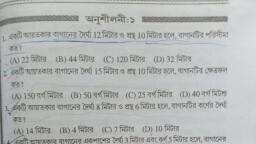
11., , Simplification of Numerical Expressions,, , 12., , Percentage and its applications., , 13., , Profit and loss., , 14., , Simple interest., , 15., , Perimeter, area and volume., , Note:- Emphasis will be more on testing of understanding and application of the, concepts and skills involved. In order to provide some guidance to the, candidates on the types of questions that are expected in Arithmetic Test, a, few examples are given belowExample - 1 (Test of Understanding):, What is the prime factorization of 1000?, A., B., , 10x10x10, 2x5x5x10, , C., , 2 x 2 x 2 x5 x 5, , D., , 2 x 2x 2 x 5 x5 x 5, , A factorization of a number is said to be a prime factorization if (i) the product of the, factors (taking a factor as many times as it occurs) is equal to the given number, and, (ii) each factor is a prime number. Here only option D satisfies both the requirements., As such, option D is the correct answer., Example 2 (Test of Understanding):, What is the average of first four odd numbers?, A., , 5, , B., , 4, , C., , 5, , D. 16, , The first four odd numbers are 1,3,5 and 7. Their average is (l+3+5+7)/4. As such, option, B is the correct answer., Example 3 (Test of Application):, A 1 km. long goods train is running at speed of 1 km per 3 minutes .The time taken by, this train to pass through 2 km. long tunnel is:, A. 1 minute, B. 3 minute, , C. 6 minute, D. 9 minute, , The tunnel is 2 km. long and the train is 1 km. in length. The train will have to cover a, total distance of 3 km. in order to pass through the tunnel running at a speed of 1 km, per 3 minutes, the train will take 9 minutes to pass through the tunnel and that is the, correct answer. As such, option D is the correct answer., Section 3: Language Test.
Page 19 :
The main purpose of this test is to assess reading comprehension of the candidates., The test consists of four passages. Each passage is followed by 5 questions., Candidates shall read each passage carefully and answer the questions that follow., Given below is a specimen passage and the questions follow the passage., PASSAGE, Forests are useful to us in many ways. They provide us with timber to build houses and, make furniture. Forests also provide us with wood for fuel and making paper. They, provide shelter for birds, wild animals and insects. Forests bring rainfall. Existence of, forests is very important for the preservation of the ecosystem. The fact that we have, to care for an ecosystem is indisputably established. Wise use of the environment and, its resources are essential for man's continued survival., 1. To preserve the ecosystem, existence of...............is essential., A., , forests, , B. human beings, , C., , animals, , D. resources, , Correct answer is A, 2., , Opposite of preservation' is..............., , a. conservation, C. construction, , B. Shelter, D. destruction, , Correct answer isD, 3., , Which one of the following is not a synonym of 'wise'?, a. Sensible, , B. Humorous, , c. Intelligent, , D.Judicious, , Correct answer is B, 4., , Carpenters depend on forests because they provide..............., A. wood for fuel, , C. timber to make furniture, , B. wood for making paper, , D. houses for animals, , Correct answer is C, 5., , Wild animals will become homeless if..............., A. paper mills are destroyed, , C., , forests are destroyed, , B. houses are built, , D., , ecosystem is taken, , Correct answer is C
Page 20 :
SOME IMPORTANT GUIDELINES FOR UPLOADING THE ONLINE APPLICATION, FORM, The online application form for admission to Class VI in Jawahar Navodaya Vidyalaya is, self-explanatory. However, following guidelines may be specifically kept in view by the, students and their parents/guardians., 1., , Please read the Prospectus carefully. Fill in complete information after ensuring that, the candidate fulfills all the prescribed requirements such as date of birth within, specified range (01.05.2007 to 30.04.2011), schooling in classes III, IV & V in, recognized institution(s). (Govt. / Govt. Aided / Recognized / NIOS)., , 2., , Carefully fill the certificate to be uploaded along with the application form with, regard to category i.e. General, SC, ST, OBC &Divyang. If it is found at the time of, admission that a candidate has opted SC/ST though he/she does not actually, belong to SC/ST community, his/her selection is liable to be cancelled. Same is, applicable for cases like rural category candidates, etc.,, , 3. (a) Mention the date of birth in figures as well as in words. Write correct Date of Birth as, per school records. In case, if it is observed at a later stage that the Date of Birth of, the candidate does not match with the school records his/her candidature is liable, to be rejected., (b), , Permanent identification marks which can be identified clearly shall be mentioned, in the Application Form by the candidate., , 4., , Signature of both, the candidate and the parent / guardian should be uploaded, while applying for the Jawahar Navodaya Vidyalaya Selection Test., , 5., , The last date to submit online applicationfor test is 15th September 2019., , CAUTION:Application form is liable for rejection, if columns are left blank or the entries, areincomplete. Applicants should ensure that they fulfill all the prescribed requirements of, education, age, categories (SC/ST/Divyang) and, , area (Urban/Rural) wherever, , applicable. If any information given in the original application form is found to be false /, incorrect on subsequent verification, even after the selection of the candidate, the, admission is liable to be cancelled and the decision of Navodaya Vidyalaya Samiti will be, final and binding. No correspondence shall be entertained in this regard. Such admissions,, if any, obtained by any candidate on the basis of false certificate / declaration /, information shall not only be cancelled but Samiti also reserves the right to recover the, expenditure incurred on a student during his/her entire stay in a Vidyalaya.
Page 21 :
RESIDENCE CERTIFICATE, Applicable for the candidates who seek admission through the studies in NIOS, and to be furnished at the time of admission to JNVs, As per Jawahar Navodaya Vidyalaya _____________________________________________, District, , _______________, , State, , _______________________________Dated, , ________________, _____________, , my, , Letter, ward, , no., Mast./Kum., , __________________________________________ has qualified through the entrance exam for, admission to Class VI at JNV ____________________ District ______________________ State / UT, ______________ during the session _____________________., I am residing in the following address since _____________________., * The area where the residence falls under the Rural/Urban area of the District, Village _____________________________, Town _______________________________, District ______________________________, State _______________________________, Pin Code ___________________________, Certified that the information furnished by me is true and no fact has been concealed., Signature of Parents, Full Name, Address, Place __________________, Date ___________________, CERTIFICATE, (To be filled by the District Authorities and issued under the signature of SDM/ Tehsildar to the, parents of the child selected for admission to Class VI in JNVs through JNVST), This, , is, , to, , certify, , that, , the, , above, , information, , furnished, , by, , Shri/Smt, , ._________________________________ Father/Mother of Master/Kumari _________________________ a, candidate selected for admission to Class VI in JNV ____________________________ District, _____________________________ has been verified from the records and is found to be correct., *The area where residence is located falls under (Rural/Urban) area of District ___________________., , Signature, SDM/Tehsildar
Page 22 :
JAWAHAR NAVODAYA VIDYALAYA SELECTION TEST - 2020, CERTIFICATE, Last date of submission of online application form is 15th September 2019., , Certified that the information given below are correct in respect of _________________________, , Affix, Passport, size photo, of, the, candidate, , (Name of Student) who is studying in Class V in _________________________________________, (Name of School) and interested to apply for Jawahar Navodaya Vidyalaya Selection Test 2020, , Name of Candidate (IN BLOCK LETTERS), Father’ s Name (IN BLOCK LETTERS), Mother’ s Name (IN BLOCK LETTERS), Name of the Guardian and relationship, if any., Date of Birth In figure, D D M M Y Y Y Y, Gender, Please, put, () mark, , Boy, , Girl, , Transgender, , Nature of disability, if any., Please put () mark against the respective, category, , In words, …………………………………………………………………………, …………………………………………………………………………, Category, Gen., SC, ST, OBC, , Physically, handicapped, , Visually, impaired, , Hearing, impaired, , Identification mark ………………………………………………………………………………………………….., Present Postal, Address, , Mobile No. ………………………… Email…………………………….., , Nationality ……………………………, Religion ………………………….., Medium of Examination …………………….., (Please indicate one language out of languages for the state concerned given in the prospectus), Particular, , Class-III, , Class-IV, , Class-V, , Name of the School (studied – III & IV and, studying V) and village/place, School Location : Rural / Urban, Month and Year of Joining, Month & year of Passing, Name of the Block, Name of the District, Name of the State, , --, , I certify that the school (s) in which my ward studied/studying is a recognized school and fulfills all the eligibility criteria, as per NVS requirements. I also understand that even if the candidate has studied in urban area for even a singleday in any, of the classes III, IV & V, the student will be treated as urban candidate. If any of the information provided is found to be, wrong, the candidature of my ward will be forfeited at any stage even after admission in JNV., Signature of the candidate, , Signature of the Parent, , Note: In respect of NIOS students, area will be decided on the basis of residence of the candidate., The above details are verified from School records and found correct., Signature of Head Master with Seal