Page 1 :
ALGEBRA, CLASS: VI, MATHEMATICS
Page 2 :
Introduction to Algebra, There are so many branches of mathematics➢The study of numbers is called, Arithmetic., ➢The study of shapes is called, Geometry., ➢The study to use the letters and, symbols in mathematics is called, Algebra.
Page 3 :
ALGEBRA, • Algebra is a part of mathematics in which the letter and symbols are used to represent, numbers in equations. It helps us to study about unknown quantities., , • MATCH STICK PATTERN, No. of matchsticks used to make 1st square = 4, No. of matchsticks used to make 2nd square = 7, No. of matchsticks used to make 3rd square = 10, So, the pattern that we observe here is 3n + 1, With this pattern, we can easily find the number of matchsticks required in any number of, squares.
Page 4 :
• Example:-How many matchsticks will be used in the 50th figure?, , • Solution, , 3n + 1, 3 × 50 + 1, = 151 matchsticks
Page 5 :
The Idea of a Variable, Variable refers to the unknown quantities that can change or vary and, are represented using the lowercase letter of the English alphabets., One such example of the same is the rule that we used in the, matchstick pattern, 3n + 1, Here the value of n is unknown and it can vary from time to time., So n will be the variable in this expression.
Page 6 :
More Examples of Variables, • We can use any letter as a variable, but only lowercase English, alphabets., • Numbers cannot be used for the variable as they have a fixed value., • They can also help in solving some other problems., • Example: 1, Karan wanted to buy story books from a bookstall. She wanted to buy 3, books for herself, 2 for her brother and 4 for 2 of her friends. Each book, cost Rs.15.how much money she should pay to the shopkeeper?, Solution: Cost of 1 book = Rs.15. We need to find the cost of 9 books., No. of notebooks 1, 2, 3, 4, ……. a, …....., Total cost, 15, 30, 45, 60, …….15 a, ……., In the current situation, a (it’s a variable) stands for 9.
Page 7 :
Therefore,, Cost of 9 books = 15 ×9, = 135, Therefore Karan needs to pay Rs.135 to the shopkeeper of the bookstall., The variable and constant not only multiply with each other but also can be, added or subtracted, based on the situation., Example: 2, Manu has 2 erasers more than Tanu. Form an expression for the statement., , Solution: 2.1, Erasers that Tanu have can be represented using a variable (x), Erasers that Manu have = erasers that Tanu have + 2, Erasers with Manu = x + 2
Page 8 :
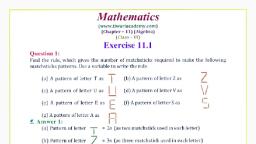
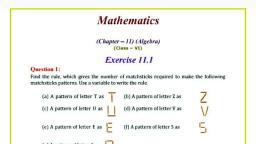
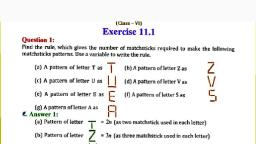
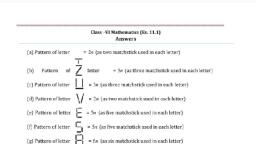
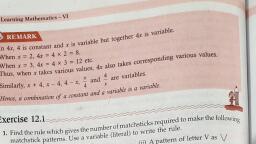
Solution: 2.2, Erasers that Manu have can be represented using a variable (y), Erasers that Tanu has = erasers that Manu have - 2, Erasers with Tanu = y - 2, , EXERCISE 11.1, , 1. Find the rule which gives the number of matchsticks required to make the following, matchsticks patterns. Use a variable to write the rule., (a) A pattern of letter T as, , From the figure we observe that two matchsticks are required to make a letter T. Hence, the, pattern is 2n
Page 9 :
• (b) A pattern of letter Z as, , From the figure we observe that three matchsticks are required to, make a letter Z. Hence, the pattern is 3n, (c) A pattern of letter U as, , • From the figure we observe that three matchsticks are required to, make a letter U. Hence, the pattern is 2n
Page 10 :
(e) A pattern of letter E as, , • From the figure we observe that 5 matchsticks are required to make a letter, E. Hence, the pattern is 5n, (f) A pattern of letter S as, , • From the figure we observe that 5 matchsticks are required to make a letter, E. Hence, the pattern is 5n
Page 11 :
• g) A pattern of letter A as, , • From the figure we observe that 6 matchsticks are required to make a letter E., Hence, the pattern is 6n, 2. We already know the rule for the pattern of letters L, C and F. Some of the letters, from Q.1 (given above) give us the same rule as that given by L. Which are these?, Why does this happen?, Solutions:, We know that T require only two matchsticks. So, the pattern for letter T is 2n., Among all the letters given in question 1, only T and V are the letters which require, two matchsticks. Hence, (a) and (d).
Page 12 :
3. Cadets are marching in a parade. There are 5 cadets in a row. What is the rule which gives, the number of cadets, given the number of rows? (Use n for the number of rows), Solutions:, Let n be the number of rows, Number of cadets in a row = 5, Total number of cadets = number of cadets in a row × number of rows, = 5n, , 4. If there are 50 mangoes in a box, how will you write the total number of mangoes in terms, of the number of boxes? (Use b for the number of boxes.), Solutions:, Let b be the number of boxes, Number of mangoes in a box = 50, Total number of mangoes = number of mangoes in a box × number of boxes, = 50b
Page 13 :
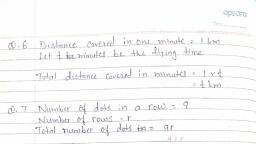
5. The teacher distributes 5 pencils per students. Can you tell how many pencils are needed, given the number, of students? (Use s for the number of students.), Solutions:, Let s be the number of students, Pencils given to each student = 5, Total number of pencils = number of pencils given to each student × number of students, = 5s, 6. A bird flies 1 kilometer in one minute. Can you express the distance covered by the birds in terms of its, flying time in minutes? (Use t for flying time in minutes.), Solutions:, Let t minutes be the flying times, Distance covered in one minute = 1 km, Distance covered in t minutes = Distance covered in one minute × Flying time, =1×t, = t km
Page 14 :
7. Radha is drawing a dot Rangoli (a beautiful pattern of lines joining dots), with chalk powder. She has 9 dots in a row. How many dots will her Rangoli, have for r rows? How many dots are there if there are 8 rows? If there are 10, rows?, Solutions:, Number of dots in a row = 9, Number of rows = r, Total number of dots in r rows = Number of dots in a row × number of rows, = 9r, Number of dots in 8 rows = 8 × 9, = 72, Number of dots in 10 rows = 10 × 9, = 90
Page 15 :
8. Leela is Radha’s younger sister. Leela is 4 years younger than Radha. Can you write Leela’s age in, terms of Radha’s age? Take Radha’s age to be x years., Solutions:, Let Radha’s age be x years, , Leela’s age = 4 years younger than Radha, = (x – 4) years, 9. Mother has made laddus. She gives some laddus to guests and family members; still 5 laddus, remain. If the number of laddus mother gave away is l, how many laddus did she make?, Solutions:, Number of laddus mother gave = l, Remaining laddus = 5, Total number of laddus = number of laddus given away by mother + number of laddus remaining, = (l + 5) laddus
Page 16 :
10. Oranges are to be transferred from larger boxes into smaller boxes. When, a large box is emptied, the oranges from it fill two smaller boxes and still 10, oranges remain outside. If the number of oranges in a small box are taken to, be x, what is the number of oranges in the larger box?, Solutions:, Number of oranges in a small box = x, Number of oranges in two small boxes = 2x, Number of oranges remained = 10, Number of oranges in large box = number of oranges in two small boxes +, number of oranges remained, = 2x + 10
Page 17 :
11. (a) Look at the following matchstick pattern of squares (Fig 11.6). The, squares are not separate. Two neighbouring squares have a common, matchstick. Observe the patterns and find the rule that gives the number of, matchsticks, , in terms of the number of squares. (Hint: If you remove vertical stick at the, end, you will get a pattern of Cs), Solution: We may observe that in the given matchstick pattern, the number, of matchsticks are 4, 7, 10 and 13, which is 1 more than the thrice of the, number of squares in the pattern, Therefore, the pattern is 3x + 1, where x is the number of squares
Page 18 :
• (b) Fig 11.7 gives a matchstick pattern of triangles. As in Exercise 11 (a), above, find the general rule that gives the number of matchsticks in terms, of the number of triangles., , Solution: We may observe that in the given matchstick pattern, the number, of matchsticks are 3, 5, 7 and 9 which is 1 more than the twice of the number, of triangles in the pattern., Therefore, the pattern is 2x + 1, where x is the number of triangles.
Page 19 :
Use of Variables in Common Rules (Geometry), 1. Perimeter of Square, The perimeter of a square = Sum of all sides, = 4 × side, = 4s, Thus, p = 4s, Here s is variable, so the perimeter changes as the value, of side change.
Page 20 :
2. Perimeter of Rectangle, Perimeter of rectangle = 2(length + breadth), = 2 (l + b) or 2l + 2b, Thus, p + 2 × (l + b) or 2l + 2b, Where, l and b are variable and the value of perimeter changes with the change in l and b., , 1. Commutativity of Addition, 5+4=9, 4+5=9, Thus, 5 + 4 = 4 + 5, This is the commutative property of addition of the numbers, in which the result remains the same, even if we interchanged the numbers., a+b=b+a, Here, a and b are different variables.
Page 21 :
Example, a = 16 and b = 20, According to commutative property, 16 + 20 = 20 + 16, 36 = 36, , 2. Commutativity of Multiplication, 8 × 2 = 16, 2 × 8 = 16, Thus, 8 × 2 = 2 × 8, This is the commutative property of multiplication, in which the result remains the same, even if we interchange the numbers., a×b=b×a, Here, a and b are different variables.
Page 22 :
Example, 18 ×12 = 216, 12 ×18 = 216, , Thus, 18 × 12 = 12 × 18, , 3. Distributivity of Numbers, 6 × 32, It is a complex sum but there is an easy way to solve it. It is known as, the distributivity of multiplication over the addition of numbers., 6 × (30 + 2)= 180 + 12 = 192, Thus, 6 × 32 = 192, A × (b + c) = a × b + a × c, Here, a, b and c are different variables.
Page 23 :
4. Associativity of Addition, This property states that the result of the numbers added will, remain same regardless of their grouping., (a + b) + c = a + (b + c), Example, (4 + 2) + 7 = 4 + (2 + 7), 6+7=4+9, 13 = 13
Page 24 :
EXERCISE 11.2, 1. The side of an equilateral triangle is shown by l. Express the perimeter of the equilateral triangle using l., Solutions:, Side of equilateral triangle = l, Perimeter = l + l + l, = 3l, 2. The side of the regular hexagon (Fig 11.10) is denoted by l. Express the perimeter of the hexagon using l., (Hint: A regular hexagon has all its six sides equal in length.), Solutions:, Side of a regular hexagon = l, Perimeter = l + l + l + l + l + 1, = 6l
Page 25 :
3. A cube is three dimensional figure as shown in Fig 11.11. It has six, faces and all of them are identical squares. The length of an edge of, the cube is given by l. Find the formula for the total length of the, edges of a cube., Solutions:, Length of an edge of the cube = l, Number of edges = 12, Total length of the edges = Number of edges × length of an edge, =12l
Page 26 :
4. The diameter of a circle is a line which joins two points on the circle, and also passes through the centre of the circle. (In the adjoining figure, (Fig 11.2) AB is a diameter of a circle; C is its centre.) Express the, diameter of the circle (d) in terms of its radius (r)., Solutions:, Diameter = AB, = AC + CB, =r+r, = 2r, Hence, the diameter of the circle in terms of its radius is 2r
Page 32 :
• Expressions, Arithmetic expressions may use numbers and all operations like addition,, subtraction, multiplication and division, , • Example, 2 + (9 – 3), (4 × 6) – 8 etc…, (4 × 6) – 8 = 24 – 8, = 16, Expressions with variable, We can make expressions using variables like, 2m, 5 + t etc….., An expression containing variable/s cannot be analyzed until its value is given.