Page 1 :
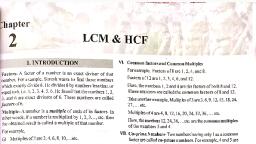
w that the result of, is oa multi, Plication is called product. The numbers that, , ’ plied are cali, ed th, ¢ factors and multiples in pol factors of the product. We have learned, , Previous grade. Let us study more about, , , , rAcTORS, ctnow that for every mi, oe i ultiplication fact, there are two division facts, a : 3 'SQ Multiplication fact, and 3 are the factors of the 6, , , , ioe ae 3=6ore6+2=3and6+3=2, ae dete any remainder. Thus, the factors ofa, , iy divides there Weer ietaelees r. So, a factor can be defined as a divisor that, io cee can be obtained by two methods—(\) by, , , , , , , , , Example 1: Find the factors of 18., , Solution:, By multiplication (ii) By division, 18+1=18 = 1and 18 are factors, , => 2 and 9 are factors, , => 3 and 6 are factors, , 1«18 = 18 => 1nd 18 are factors, , , , 29 =18= 2 and 9 are factors 18+2=9, 3x 6 = 18=>3 and 6 are factors 18+3=6, Thus. 1. 2, 3, 6, 9 and 18 are all factors of 18, , Properties of Factors, 5 a factor of every number. It is the, , illed the universal factor., , Every non-zero number is a fac, _zero number is les, , smallest factor of a number. It is also, , tor of itself. It is also the greatest factor., s than or equal to the number., , 3. Every factor of a non, s—1 and the number itself., , 4 Every number other than 1 has at least two factor:, , TESTS OF DIVISIBILITY, , The tests of divisibility tell you wheth, ot, without actually doing division ©, , er a number is divisible by another number, , f that number.























 Learn better on this topic














