Page 1 :
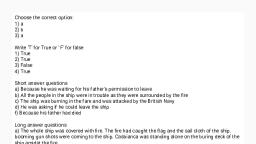
Lesson 8: Casabianca, Let’s start, , pennon/pennant, , , , , , ae, , oo, , , , , , Let’s ponder, A.1. a) The poet uses the word ‘bright’ for the child because he was standing on the burning deck, and the fire made him look so., b) Casabianca stood tall in the face of the storm and it seemed that he was born to govern it., He had inherited nobility from his forefathers. Though he was young, he looked brave and, proud to carry out the command of his father., c) The phrase ‘childlike form’ means that Casabianca appears young and has a physical form of, a child. However, what is important to note is the indomitable courage that he shows, which, is no less than that of a warrior in the battlefield., 2. a) The parts of the ship mentioned in this stanza are mast, helm and pennon., b) The phrase ‘borne their part’ means that the mast, helm and the pennon fair had played their, part quite well in the fire. The fact that they were intact until that time was praiseworthy., c) By'‘the noblest thing’, the poet means Casabianca who died in the ship., 3. All the above-mentioned characteristics apply to Casabianca., Encourage the students to pick up suitable examples from the poem to justify their answer., B. 1. The boy was standing on the burning deck., 2. The father wasn't saying anything because he was no more., 3. The boy called out to his father the second time when his father doesn't respond to his call the, first time. He asked his father if he could go., 4. As stated in stanzas 7 and 8, the sail, the shroud and the flag caught fire., 5. We know that the ship was wrecked because the flames of the fire had engulfed the ship. The, flames caught the various parts of the ship and the wind strewed the broken remains of the ship, in the sea.