Page 1 :
CONTENTS, FOREWORD ... iii, , NOTES, , FOR THE, , TEACHER ... 1, , 1. Who Did Patrick’s Homework? ... 7, A House, A Home ... 15, 2. How the Dog Found Himself, a New Master! ... 17, The Kite ... 27, 3. Taro’s Reward ... 29, The Quarrel ... 39, , NOTES, , FOR THE, , TEACHER ... 41, , 4. An Indian – American Woman in Space:, Kalpana Chawla ... 45, Beauty ... 54, 5. A Different Kind of School ... 56, Where Do All the Teachers Go? ... 67, 6. Who I Am ... 69, The Wonderful Words ... 82, 7. Fair Play ... 84, , NOTES, , FOR THE, , TEACHER ... 96, , 8. A Game of Chance ... 99, Vocation ... 109, 9. Desert Animals ... 112, Whatif ... 121, 10. The Banyan Tree ... 124
Page 2 :
Before you read, , 1, , Discuss in class: Do you like homework? Do you, do it yourself, or do you get help? What, homework do you usually have?, , Who Did Patrick's, Homework?, , 1. P ATRICK never did homework. “Too, boring,” he said. He played hockey and, basketball and Nintendo instead. His, teachers told him, “Patrick! Do your, homework or you won’t learn a thing.”, And it’s true, sometimes he did feel like, an ignoramus. But what could he do?, He hated homework., 2., Then one day he found his cat, playing with a little doll and he grabbed, it away. To his surprise it wasn’t a doll, , Nintendo: a, video game, , ignoramus: an, ignorant person,, who lacks, education
Page 3 :
8, , at all, but a man of the tiniest size. He, had a little wool shirt with oldfashioned britches and a high tall hat, much like a witch’s. He yelled, “Save me!, Don’t give me back to that cat. I’ll grant, you a wish, I promise you that.”, 3., Patrick couldn’t believe how lucky he, was! Here was the answer to all of his, problems. So he said, “Only if you do all, my homework till the end of the, semester, that’s 35 days. If you do a, good enough job, I could even get A’s.”, 4., The little man’s face wrinkled like a, dishcloth thrown in the hamper. He, kicked his legs and doubled his fists, and he grimaced and scowled and, pursed his lips, “Oh, am I cursed! But, I’ll do it.”, , HONEYSUCKLE, , britches:, breeches, or, short trousers., The writer here, spells it, for fun,, to rhyme with, the word ‘witch’s’., , dishcloth: a cloth, used for washing, dishes, hamper: a basket, with a lid, grimaced,scowled,, pursed his lips:, his face had, these expressions,, showing disgust,, anger and, disapproval
Page 4 :
WHO DID PATRICK'S HOMEWORK?, , And true to his word, that little elf, began to do Patrick’s homework. Except, there was one glitch. The elf didn’t, always know what to do and he needed, help. “Help me! Help me!” he’d say. And, Patrick would have to help — in, whatever way., “I don’t know this word,” the elf, squeaked while reading Patrick’s, homework. “Get me a dictionary. No,, what’s even better, look up the word and, sound it out by each letter.”, 6., When it came to maths, Patrick was, out of luck. “What are times tables?” the, elf shrieked. “We elves never need that., , 9, , 5., , glitch (an, informal word): a, fault in a, machine that, prevents it from, working properly;, here, hitch or, problem, , shrieked: gave a, short, high-pitched, cry
Page 5 :
10, , HONEYSUCKLE, , And addition and subtraction and, division and fractions? Here, sit down, beside me, you simply must guide me.”, Elves know nothing of human history,, to them it’s a mystery. So the little elf,, already a shouter, just got louder. “Go, to the library, I need books. More and, more books. And you can help me, read them too.”, 7., As a matter of fact, every day in every, way that little elf was a nag! Patrick was, working harder than ever and was it a, drag! He was staying up nights, had, never felt so weary, was going to school, with his eyes puffed and bleary., 8., Finally, the last day of school arrived, and the elf was free to go. As for, homework, there was no more, so he, quietly and slyly slipped out the back door., 9., Patrick got his A’s; his classmates, were amazed; his teachers smiled and, were full of praise. And his parents?, They wondered what had happened to, Patrick. He was now the model kid., Cleaned his room, did his chores, was, cheerful, never rude, like he had, developed a whole new attitude., 10., You see, in the end, Patrick still, thought he’d made that tiny man do all, his homework. But I’ll share a secret,, just between you and me. It wasn’t the, elf; Patrick had done it himself!, CAROL MOORE, , nag: one who, troubles someone, all the time by, complaining or, asking them to, do something, drag (an informal, word): something, dull and, uninteresting, , slyly: secretively, , kid (an informal, word): a child, chores: work that, must be done, everyday, often, boring, attitude: a feeling, about someone or, something
Page 6 :
WHO DID PATRICK'S HOMEWORK?, , 11, , WORKING WITH THE TEXT, Answer the following questions. (Refer to that part of the text whose, number is given against the question. This applies to the, comprehension questions throughout the book.), 1. What did Patrick think his cat was playing with?, What was it really? (2), 2. Why did the little man grant Patrick a wish? (2), 3. What was Patrick’s wish? (3), 4. In what subjects did the little man need help, to do Patrick’s, homework? (5,6), 5. How did Patrick help him? (7), 6. Who do you think did Patrick’s homework — the little man, or, Patrick himself? Give reasons for your answer. (9, 10), , WORKING WITH LANGUAGE, A., , Fill in the blanks in the sentences below with the words or, phrases from the box. (You may not know the meaning of all the, words. Look such words up in a dictionary, or ask your teacher.), out of luck, mystery, true to his word, chores, semester, between you and me, look up, 1. Some people find household ————————————— a, bore, but I like to help at home., 2. Who stole the diamond is still a ————————————— ., 3. This ————————————— we are going to have a class, exhibition., 4. ————————————— , the elf began to help Patrick., 5. Can you ————————————— this word in the dictionary?, 6. I started early to be on time, but I was ——————————— ., There was a traffic jam!, 7. She says she’s got a lot of books, but ————————————, I think most of them are borrowed.
Page 7 :
12, , B., , HONEYSUCKLE, , Use the clues given below to complete this crossword puzzle., , Across, 1., 2., 3., 4., 5., , very tired, had an angry look on the face, short trousers, a fault in a machine that prevents it from working properly, a small and naughty boy-fairy, , Down, 6., 7., 8., , work that must be done everyday, often boring, a basket with a lid, gave a short, high-pitched cry
Page 8 :
WHO DID PATRICK'S HOMEWORK?, , 13, , SPEAKING, A., , In the story Patrick does difficult things he hates to do, because, the elf pretends he needs help. Have you ever done something, difficult or frightening, by pretending about it in some way?, Tell your classmates about it., Or, Say what you feel about homework. (The words and phrases in, the boxes may help you.) Do you think it is useful, even though, you may not like it? Form pairs, and speak to each other., For example:, You may say, “I am not fond of homework.”, Your partner may reply, “But my sister helps me with my, lessons at home, and that gives a boost to my marks.”, (not) be fond of (not) take to (not) develop a liking for, (not) appeal to (not) be keen on (not) have a taste for, support assist with the aid of, help be a boon give a boost to, , WRITING, A. This story has a lot of rhyming words, as a poem does. Can you, write out some parts of it like a poem, so that the rhymes come at, the end of separate lines?, For example:, Patrick never did homework. “Too boring,” he said., He played baseball and hockey and Nintendo instead., B. Look at these sentences., 1. “Too boring,” he said., 2. Cleaned his room, did his chores., When we speak, we often leave out words that can easily be guessed., We do not do this when we write, unless we are trying to write, as we speak (as in the story).
Page 9 :
14, , HONEYSUCKLE, , So, if we were to write carefully, we would say:, �, “Homework is too boring,” he said., �, He cleaned his room and did his chores., C. Rewrite the following incomplete sentences carefully, so that, the reader does not have to guess what is left out., 1. more and more books, 2. too difficult, 3. got up late, missed the bus, 4. solved the mystery, D. Look at this cartoon by R.K.Laxman. Read the sentence given, below the cartoon. Discuss the following questions with your, partner., �, What is it about?, �, Do you find it funny? If so, why?, �, Do you think a cartoon is a serious drawing? Why or why not?, , Get on with your homework — the sums,, the composition, history, geography,, chemistry, physics — and stop reading The, Laws Against Child Labour!
Page 10 :
A House, A Home, What is the difference between a house and a home? Discuss, it with your partner. Then read the poem., , What is a house?, It’s brick and stone, and wood that’s hard., Some window glass, and perhaps a yard., It’s eaves and chimneys, and tile floors, and stucco and roof, and lots of doors., What is a home?, It’s loving and family, and doing for others., It’s brothers and sisters, and fathers and mothers., It’s unselfish acts, and kindly sharing, and showing your loved ones, you’re always caring., LORRAINE M. HALLI
Page 11 :
16, , HONEYSUCKLE, , WORKING, 1., , WITH THE, , POEM, , Do you agree with what the poet says? Talk to your partner, and complete these sentences., (i) A house is made of —————————————————––——— ., (ii) It has ————————————————————————————— ., (iii) A home is made by —————————————————––——— ., (iv) It has —————————————––——————————————— ., , 2., , Now complete these sentences about your house and home., (i) My house is —————————————————––———————, —————————————————––—————————————— ., (ii) The best thing about my home is ————————————––——, —————————————————––—————————————— ., , Lengthy Process, “So, your son is still going to, college,” a man remarked to, another. “What is he going to, be when he finally graduates?”, Replied the second: “Old”.
Page 12 :
Before you read, , 2, , You may know that the dog and the wolf are, closely related. You may also know something, about how over the centuries, human beings have, domesticated and tamed wild animals. Here is a, story about how the dog became a tame animal., , How the Dog Found, Himself a Master!, , 1. DOGS were once their own masters and, lived the way wolves do, in freedom,, until a dog was born who was ill pleased, with this way of life. He was sick and, tired of wandering about by himself, , ill pleased: (oldfashioned way of, saying) not happy
Page 13 :
18, , 2., , 3., , 4., , 5., , HONEYSUCKLE, , looking for food and being frightened, of those who were stronger than he., He thought it over and decided that, the best thing for him to do was to, become the servant of one who was, stronger than anyone on earth, and he, set out to find such a master., He walked and he walked and he met, a kinsman of his, a big wolf who was, as strong as he was fierce., “Where are you going, Dog?” the Wolf, asked., “I am looking for someone to take, up service with. Would you like to be, my master, Wolf?”, “I don’t see why not!” the Wolf said,, and this agreed upon, the two of them, went on together., They walked and they walked, and all, of a sudden the Wolf lifted his nose,, sniffed, darted quickly off the path and, into the bushes and crept deeper into, the forest. The Dog was much surprised., “What’s come over you, master?” he, asked. “What has frightened you so?”, “Can’t you see? There’s a Bear out, there, and he might eat up both of, us — you and me.”, Seeing that the Bear was stronger, than the Wolf, the Dog decided to take, up service with him, and he left the, Wolf and asked the Bear to be his, master. The Bear agreed to this readily, , kinsman: (oldfashioned word, for) a relative, fierce: violent;, frightening, take up service, with: become, the servant of, , darted: moved, quickly, suddenly, , come over you:, affected you
Page 14 :
HOW, , THE, , DOG FOUND HIMSELF, , A, , MASTER!, , and said, “Let us go and find a herd of, cows. I’ll kill a cow and then we can, both eat our fill.”, 6., They walked on and soon saw a herd, of cows, but just as they were about to, come up to it they were stopped by a, terrible noise. The cows were mooing, loudly and running in a panic in, all directions., 7., The Bear looked out from behind a, tree, and then he too ran hastily deeper, into the forest., , 19
Page 15 :
20, , “Now, why did I have to come here!”, said he to the Dog. “It is the Lion who, rules the forest in these parts.”, “The Lion? Who’s he?”, “Don’t you know? He is the strongest, beast on earth!”, “Well, then, I’ll say goodbye to you,, Bear. I want a master who is stronger, than anyone on earth!”, 8., And off the Dog went to ask the Lion, to be his master., The Lion agreed to it, and the Dog, stayed with him and served him for a, long, long time. It was a good life, and, he had nothing to complain of, for there, was no stronger beast in the forest than, the Lion, and no one dared touch the, Dog or offend him in any way., 9., But one day the two of them were, walking side by side along a path that, ran amid bare cliffs when all of a sudden, the Lion stopped. He gave a great roar, and struck the ground angrily with his, paw with such force that a hole formed, there. Then he began to back away very, quietly., “What is it, Master, is anything, wrong?” asked the Dog, surprised., “I smell a man coming this way,” the, Lion said. “We’d better run for it or we’ll, be in trouble.”, “Oh, well, then I’ll say goodbye to you,, Lion. I want a master who is stronger, than anyone on earth!”, , HONEYSUCKLE, , dared: to be brave, enough to do, something, , cliff: a steep, high, rock (often at the, edge of the sea)
Page 16 :
HOW, , THE, , DOG FOUND HIMSELF, , 10., , And off the Dog went to join the, man and he stayed with him and, served him faithfully. This happened, long, long ago, but to this day the dog, is man’s most loyal servant and knows, no other master., , WORKING, , WITH THE, , A, , MASTER!, , TEXT, , A. Discuss these questions in pairs before you, write the answers., 1. Why did the dog feel the need for a master?, (1, 2), 2. Who did he first choose as his master?, Why did he leave that master? (3), 3. Who did he choose next? (3), 4. Why did he serve the Lion for a long, time? (4), 5. Who did he finally choose as his master, and why? (9, 10), B. A summary of the story is given below. Fill in, the blanks to complete it taking appropriate, phrases from the box., a dog, stronger than anyone else, the strongest of all, a wolf, the bear, afraid of man, his own master, a lion, This is the story of —–––––—————————–, who, used to be —————————————— . He decided, to find a master —–––––––——————— . First, he found ———————————— , but the wolf, , 21
Page 17 :
22, , HONEYSUCKLE, , was afraid of –––————––——————— . The dog thought that, the bear was ————————————— . After some time the, dog met ————————————— , who seemed the strongest., He stayed with the lion for a long time. One day he realised that, the lion was ———————––—————— . To this day, the dog, remains man’s best friend., , WORKING WITH LANGUAGE, A. Each word in the box given below indicates a large number of…, For example,‘a herd of cows’ refers to many cows., Complete each of the following phrases with a suitable word, from the box., school, , fleet, , brood, , bundle, , bunch, , pack, , flock, , herd, , 1. a —————––—— of ships, , 5. a ———––———— of sticks, , 2. a ——————––— of flowers, , 6. a ——––————— of sheep, , 3. a ——————––— of chicks, , 7. a —––—————— of fish, , 4. a ———————–– of cattle, , 8. a ––——————— of wolves, , B. Make nouns from the words given below by adding –ness or –, ity. (For some words we need to add just –ty, or –y.), 1. honest —————————, , 7., , creative ———————————--, , 2. kind ——————————, , 8., , sincere ———————————--, , 3. cruel ——————————, , 9., , cheerful ——————————, , 4. calm ——————————, , 10. bitter ———————————---, , 5. sad ———————————, , 11. sensitive——————————-, , 6. active —————————----, , 12. great ———————————----
Page 18 :
HOW, , THE, , DOG FOUND HIMSELF, , A, , MASTER!, , 23, , C. Wordsearch, •, , There are twelve words hidden in this table., , •, , Six can be found horizontally and the remaining six vertically., , •, , All of them are describing words like ‘good’, ‘happy’, etc., , •, , The first letters of the words are given below:, Horizontal: H, Vertical: A, , W, , R, , F, S, , F, F, , S, L, , Q, , G
Page 19 :
24, , HONEYSUCKLE, , D. Read the following passage and do the exercises that follow., Then complete the family tree of dogs given on the facing page., , The Dog Family, The dog family is one of the 11 families that make up the Carnivores,, a large group of intelligent, flesh-eating, backboned animals. In this, group are such varied animals as bears, pandas, raccoons, cats,, hyenas, and even seal. The dog or canine family has many wild, species like wolves, foxes, coyotes, jackals, and wild dogs., The dog is the only domesticated member of the canine family, though now and then someone tames a wolf, fox or coyote as a pet., All members of the dog family are descendants of a wolf-like animal, which lived about 15 million years ago. From this distant ancestor,, the true dogs gradually developed. But nobody knows the exact, ancestor of the modern domestic dog., Several wild dogs look and behave like domestic dogs. The dingo, or wild dog of Australia is one of these. It is possible that the dingo, was a tamed dog brought to Australia long ago which then ran wild., Dogs were the first animals tamed by humans — perhaps 20,000, years ago. Tamed dogs were brought from Asia to the New World, 5,000 or more years ago. Dogs were first used for hunting., , 1. Find the opposites of these words in the text above., (i) ancestor, (ii) wild, , t—m—, , (iii) ancient, (iv) near, , ——————————, ——————, , d—————t, , (v) suddenly, , gr — — — — — — —, , 2. Complete the following sentences., (i) The dingo is ———————————————————–————— ., (ii) Dogs were the ——————————————————— animals, tamed by humans. The other animals tamed by humans, are ——————————————————————————————, (Think and name some other such animals.), (iii) The New World refers to ———————————–––————— ., Dogs were brought there from —————————–————— .
Page 20 :
W, , F, , C, , Wild, , B, , J, , Wild dog, , Do, , C, , t, , cat, , Dog, or, family, , A, , P, , H, , DOG FOUND HIMSELF, , Ra, , es, , THE, , Seal, , C, , Family Tree of Dogs, , HOW, MASTER!, 25
Page 21 :
26, , HONEYSUCKLE, , SPEAKING, Here are some points from a similar story that you might have, heard in another language. Dividing the class into two groups try, and tell the story in English. One person from each group can, speak alternately. Your teacher will help you. As you tell it, one of, you may write it down on the board., A Mouse Maiden, �, , mouse changed into a girl by a magician..., , �, , wants to marry the strongest person..., , �, , asks whether sun or cloud stronger (why?)..., , �, , but mountain stronger than clouds (how?)..., , �, , but mouse stronger than mountain (how?)..., , �, , girl asks to marry mouse, becomes a mouse again., , The Last Ride Together, There was a young man of Niger, Who went for a ride on a tiger., They returned from their ride,, With the man inside,, And a smile on the face of the tiger.
Page 22 :
The Kite, All of us like to fly kites. Have you ever tried to fly one? Read, this poem about a kite as it flies in the sky., , How bright on the blue, Is a kite when it’s new!, With a dive and a dip, It snaps its tail, Then soars like a ship, With only a sail, As over tides, Of wind it rides,, Climbs to the crest, Of a gust and pulls,, Then seems to rest, As wind falls., When string goes slack, You wind it back, And run until, A new breeze blows, And its wings fill, And up it goes!, How bright on the blue, Is a kite when it’s new!, But a raggeder thing, You never will see, When it flaps on a string, In the top of a tree., HARRY BEHN
Page 23 :
28, , HONEYSUCKLE, , WORKING, , WITH THE, , POEM, , 1. List out the action words in the poem., dive, dip, snaps, ——————, ——————,, ——————, ——————, Find out the meanings of these words., , ———————,, , 2. Read these lines from the poem:, Then soars like a ship, With only a sail, The movement of the tailless kite is compared to a ship with a, sail. This is called a simile. Can you suggest what or who the, following actions may be compared to?, He runs like —————————————––———, He eats like ——————————————–—–—, She sings like ————————————––——–—, It shines like ————————————–––———, It flies like ——————————————––———–, 3. Try to make a kite with your friends. Collect the things required, such as colour paper/newspaper, thread, glue, a thin stick that, can be bent. After making the kite see if you can fly it.
Page 24 :
Before you read, , 3, , This is a story about a thoughtful and loving son., He works hard to fulfil his parents’ wishes and, gets some unexpected help., , Taro’s Reward, 1. A YOUNG woodcutter named Taro lived, with his mother and father on a lonely, hillside. All day long he chopped wood, in the forest. Though he worked very, hard, he earned very little money. This, , chopped: cut, into pieces
Page 25 :
30, , 2., , 3., , 4., , 5., , HONEYSUCKLE, , made him sad, for he was a thoughtful, son and wanted to give his old parents, everything they needed., One evening, when Taro and his, parents were sitting in a corner of their, hut, a strong wind began to blow. It, whistled through the cracks of the hut, and everyone felt very cold. Suddenly, Taro’s father said, “I wish I had a cup of, saké; it would warm me and do my old, heart good.”, This made Taro sadder than ever,, for the heart-warming drink called, saké was very expensive. ‘How do I, earn more money?’ he asked himself., ‘How do I get a little saké for my poor, old father?’ He decided to work harder, than before., Next morning, Taro jumped out of, bed earlier than usual and made his, way to the forest. He chopped and cut,, chopped and cut as the sun climbed,, and soon he was so warm that he had, to take off his jacket. His mouth was, dry, and his face was wet with sweat., ‘My poor old father!’ he thought. ‘If only, he was as warm as I!’, And with that he began to chop even, faster, thinking of the extra money he, must earn to buy the saké to warm the, old man’s bones., Then suddenly Taro stopped, chopping. What was that sound he, , whistled through:, passed through, with a whistling, sound, cracks: narrow, gaps/openings, saké : a popular, Japanese drink, (‘sa’ is pronounced, like ‘fa’ in ‘father’, and ‘ke’ rhymes, with ‘way’), expensive: costly, , made his way to:, went to
Page 26 :
TARO’S REWARD, , heard? Could it be, could it possibly be, rushing water?, Taro could not remember ever seeing, or hearing a rushing stream in that part, of the forest. He was thirsty. The axe, dropped out of his hands and he ran in, the direction of the sound., 6., Taro saw a beautiful little waterfall, hidden behind a rock. Kneeling at a, place where the water flowed quietly,, he cupped a little in his hands and, put it to his lips. Was it water? Or was, it saké? He tasted it again and again,, and always it was the delicious saké, instead of cold water., 7., Taro quickly filled the pitcher he had, with him and hurried home. The old, man was delighted with the saké. After, , 31, , cupped a little in, his hands: took, some water in, his hands (as if, in a cup), delicious: very, tasty, pitcher: a pot, usually made of, mud
Page 27 :
32, , only one swallow of the liquid he stopped, shivering and did a little dance in the, middle of the floor., 8., That afternoon, a neighbour stopped, by for a visit. Taro’s father politely offered, her a cup of the saké. The lady drank it, greedily, and thanked the old man. Then, Taro told her the story of the magic, water fall. Thanking them for the, delicious drink, she left in a hurry. By, nightfall she had spread the story, throughout the whole village., 9., That evening there was a long, procession of visitors to the woodcutter’s, house. Each man heard the story of, the waterfall, and took a sip of the, saké. In less than an hour the pitcher, was empty., 10., Next morning, Taro started for work, even earlier than the morning before., He carried with him the largest pitcher, he owned, for he intended first of all to, go to the waterfall. When he reached, it, he found to his great surprise all his, neighbours there. They were carrying, pitchers, jars, buckets — anything they, could find to hold the magic saké. Then, one villager knelt and held his mouth, under the waterfall to drink. He drank, again and again, and then shouted, angrily, “Water! Nothing but water!”, Others also tried, but there was no, saké, only cold water., , HONEYSUCKLE, , greedily: as if, desiring more, and more, , intended: planned
Page 28 :
TARO’S REWARD, , 11., , “We have been tricked!” shouted the, villagers. “Where is Taro? Let us drown, him in this waterfall.” But Taro had, been wise enough to slip behind a rock, when he saw how things were going., He was nowhere to be found., 12., Muttering their anger and, disappointment, the villagers left the, place one by one. Taro came out from, his hiding place. Was it true, he, wondered? Was the saké a dream?, Once more he caught a little liquid in, his hand and put it to his lips. It was, the same fine saké. To the thoughtful, son, the magic waterfall gave the, delicious saké. To everyone else, it gave, only cold water., , 33, , tricked: deceived, , muttering: speaking, unclearly
Page 29 :
34, , HONEYSUCKLE, , 13., , The story of Taro and his magic, waterfall reached the Emperor of Japan., He sent for the young woodcutter, and, rewarded him with twenty pieces of gold, for having been so good and kind. Then, he named the most beautiful fountain, in the city after Taro. This, said the, Emperor, was to encourage all children, to honour and obey their parents., [a Japanese story retold], , WORKING, , WITH THE, , TEXT, , A. Answer the following questions., 1. Why did Taro run in the direction of the, stream? (5), 2. How did Taro’s father show his happiness, after drinking saké?(7), 3. Why did the waterfall give Taro saké and, others water? (12), 4. Why did the villagers want to drown Taro?, (10, 11), 5. Why did the Emperor reward Taro? (13), B. Mark the right item., 1. Taro earned very little money because, (i) he didn’t work hard enough., (ii) the villagers didn’t need wood., (iii) the price of wood was very low., 2. Taro decided to earn extra money, (i) to live a more comfortable life., (ii) to buy his old father some saké., (iii) to repair the cracks in the hut., , sent for: called
Page 30 :
TARO’S REWARD, , 3. The, (i), (ii), (iii), , 35, , neighbour left Taro’s hut in a hurry because, she was delighted with the drink., she was astonished to hear Taro’s story., she wanted to tell the whole village about the waterfall., , WORKING WITH LANGUAGE, A. Strike off the words in the box below that are not suitable., Taro wanted to give his old parents everything they needed., This shows that he was …, thoughtful, considerate, , hardworking, trustworthy, , loving, honest, efficient kind, , B. 1. “This made Taro sadder than ever.”, ‘This’ refers to, (i) a strong wind that began to blow., (ii) Taro’s father’s old age., (iii) Taro’s inability to buy expensive saké for his father., (Mark the right item.), 2. “This, said the emperor, was to encourage all children to honour, and obey their parents.”, ‘This’ refers to, (i) the most beautiful fountain in the city., (ii) rewarding Taro with gold and giving the fountain his name., (iii) sending for Taro to hear his story., (Mark the right item.), C. Arrange the words below in pairs that rhyme., Example: young – lung, money – sunny, young, wax, way, , sad, could, stop, , money, bad, sunny, , chop, sound, fast, , lung, axe, round, , last, wood, day
Page 31 :
36, , HONEYSUCKLE, , D. 1. Fill in the blanks with words from the box., lonely little hard young, thoughtful, delicious, beautiful, A ——————–— woodcutter lived on a ——————–— hillside. He, was a ——————–——— son who worked ——————–——— but earned, ——————–——— money. One day he saw a ——————–———, waterfall hidden behind a rock. He tasted the water and, found it ——————–———., 2. Find these sentences in the story and fill in the blanks., (i) This made Taro ——————–——— than ever. (3), (ii) He decided to work ——————–——— than before. (3), (iii) Next morning, Taro jumped out of bed ——————–———than, usual.(4), (iv) He began to chop even ——————–——— . (4), (v) Next morning, Taro started for work even ——————–———, than the morning before. (10), , SPEAKING AND WRITING, A. Speak the following sentences clearly but as quickly as you, can. Learn them by heart., (i) How much wood would a woodchuck chuck if a woodchuck, would chuck wood., (ii) Betty bought a bit of butter, but the bit of butter was a little, bitter so she bought some better butter to make the bitter, butter better., B 1. The story ‘Taro’s Reward’ shows that Taro is thoughtful,, hardworking and also wise. Read aloud the parts of story, that show these qualities in Taro.
Page 32 :
TARO’S REWARD, , 37, , 2. (i) Like Patrick in the story ‘Who Did Patrick’s Homework’,, Taro is helped by magic. Do you believe in magic? What, are the magical things that happen in these stories?, (ii) Which story do you like better, and why? Do you know, such stories in other languages? Discuss these questions, in class., 3. Now write a paragraph or two about these two stories, comparing, them., C. 1. Listen to these children. What are they talking about?, I think swimming is more, difficult than driving., , I think it is much, less difficult., , Anyhow, neither of, them is as difficult as, learning English., , 2. Work in groups. Come to some agreement on each of the, activities given below. Decide which is the most interesting,, dullest, most dangerous, safest, most rewarding, most exciting., cooking, , fishing, , playing football, , knitting, , dancing, , listening to music, , reading, , sewing, , mountain climbing, , walking, , swimming, , learning languages, , painting, , watching TV, , stamp collecting
Page 33 :
38, , HONEYSUCKLE, , DICTATION, 1. Your teacher will speak the words given below. Write against, each two new words that rhyme with it., 1. bed, , —–———–————, , —–———–————, , 2. wax, , —–———–————, , —–———–————, , 3. fast, , —–———–————, , —–———–————, , 4. chop, , —–———–————, , —–———–————, , 5. young —–———–————, , —–———–————, , Y uurr Country, C uunn r, Know, n w Your, 1. Which are the two states that, flank New Delhi’s borders?, 2. Name the states through which, the Narmada flows., Answers on page 40
Page 34 :
The Quarrel, It is common for brothers and sisters to quarrel, although, sometimes they may not even be able to say why they quarrel., But how long do such quarrels last? How do they end?, , I quarrelled with my brother, I don’t know what about,, One thing led to another, And somehow we fell out., The start of it was slight,, The end of it was strong,, He said he was right,, I knew he was wrong!, We hated one another., The afternoon turned black., Then suddenly my brother, Thumped me on the back,, And said, “Oh, come along!, We can’t go on all night —, I was in the wrong.”, So he was in the right., ELEANOR FARJEON
Page 35 :
40, , HONEYSUCKLE, , WORKING, , WITH THE, , POEM, , 1. With your partner try to guess the meaning of the underlined, phrases., (i), (ii), , And somehow we fell out., The afternoon turned black., , 2. Read these lines from the poem:, (i) One thing led to another, (ii) The start of it was slight, (iii) The end of it was strong, (iv) The afternoon turned black, (v) Thumped me on the back, Discuss with your partner what these lines mean., 3. Describe a recent quarrel that you have had with your brother,, sister or friend. How did it start? What did you quarrel about? How, did it end?, , K o Your, o r Country, o u try, Know, Answers, , 1. Haryana, Uttar Pradesh., Built on the banks of the Yamuna river, Delhi is, bordered on the west by Haryana and on the, east by Uttar Pradesh., 2. Gujarat and Madhya Pradesh., Rising from Bheraghat in Madhya Pradesh, the, Narmada flows westwards across Madhya, Pradesh and Gujarat into the Gulf of Cambay.
Page 36 :
4, , Before you read, In 1997, an Indian – American, Kalpana Chawla,, was part of the international crew aboard the, U.S. Space Shuttle, Columbia, becoming the first, woman born in India to go into space. Sadly, the, second mission in Columbia ended in tragedy., , An Indian – American, Woman in Space:, Kalpana Chawla, 1. A space shuttle is a spacecraft that is made, for repeated space travel (unlike a rocket), for, example, between earth and a space station., 2. Use a dictionary to do the tasks below., (i) Find out the meanings of the following words, and phrases (look up the words underlined in, the phrases)., (a) naturalised U.S. citizen ———————————, (b) space ——————————————————————, (c) frontiers of space, (d) aboard, , ———————————————, , ——————————————————————, , (e) lift off (How is it different from ‘take off ’?), ——————————————————————————, , (f) crew, , ———————————————————————, , (ii) Notice the spellings of these words in this, lesson: airplane, program. This is how these, words are spelt in American English. How are, they spelt in British English?
Page 37 :
46, , HONEYSUCKLE, , A News Report, , Tragedy in Space, U.S. Space Shuttle Columbia, breaks into flames, In an unprecedented, space tragedy, U.S. Space, Shuttle Columbia, carrying, India-born, American, astronaut, Kalpana, Chawla and six others,, broke apart in flames as, it streaked over Texas, towards its landing strip, on Saturday, 1 February, 2003, killing all seven, on board., The shuttle lost contact, with NASA at about 9 a.m., (19.30 hrs 1ST) as it came, in for landing. It was flying, at an altitude of over, , 200,000 feet and travelling, at over 20,000 km. per hour, when ground control lost, contact with the shuttle., Columbia had lifted off, on 16 January 2003, from, the Kennedy Space Center,, Florida. It had stayed, in orbit for 16 days and, the seven-member crew, conducted 80 experiments, before it began its downward, journey, which ended in, tragedy. This was Columbia’s, 28th space flight and the, shuttle was said to be good, for 100 flights., , 1. KALPANA Chawla said that she never, dreamed, as a child in Karnal, that she, would cross the frontiers of space. It was, enough that her parents allowed her to, attend engineering college after she, graduated from Tagore School., 2., After a Bachelor of Science degree in, aeronautical engineering, against great, opposition from her father, she went for, a master’s degree to the United States, of America. She later earned her Ph.D., in aerospace engineering. Kalpana, Chawla was the first Indian–American, woman astronaut to blast off from the
Page 38 :
AN INDIAN – AMERICAN WOMAN, , IN, , SPACE: KALPANA CHAWLA, , launch pad at Cape Canaveral, Florida,, and participate in a successful mission, in space. Her family from India cheered, along with staff at the Kennedy Space, Center as they watched the Columbia, lift off., 3., Kalpana was born in Karnal, Haryana,, but was a naturalised U.S. citizen,, married to flight instructor Jean-Pierre, Harrison. Besides being an astronaut,, she was licensed to fly single and multiengine land airplanes, single-engine, seaplanes and gliders. She was also a, certified flight instructor. After, , 47
Page 39 :
48, , qualifying as a pilot, Kalpana began to, consider another challenge: applying to, NASA’s space shuttle program. She was, first hired as a research scientist at, NASA. In 1994 she was selected by, NASA for training as an astronaut., 4., When asked what it was like being a, woman in her field she replied, “I really, never, ever thought, while pursuing my, studies or doing anything else, that I, was a woman, or a person from a small, city, or a different country. I pretty, much had my dreams like anyone else, and I followed them. And people who, were around me, fortunately, always, encouraged me and said, ‘If that’s what, you want to do, carry on’.”, 5., Kalpana’s first space mission in the, space shuttle, Columbia, was 15 days,, 16 hours and 34 minutes long. During, this time she went around the earth 252, times, travelling 10.45 million, kilometres! The crew included a, Japanese and a Ukranian astronaut., The crew performed experiments such, as pollinating plants to observe food, growth in space, and tests for making, stronger metals and faster computer, chips — all for a price tag of about, 56 million dollars., 6., On the Saturday night when the, news about the Columbia disaster, broke, there was shock and disbelief., , HONEYSUCKLE
Page 40 :
AN INDIAN – AMERICAN WOMAN, , IN, , SPACE: KALPANA CHAWLA, , The town of Karnal spent a sleepless, night as thousands of households, stayed glued to their television sets in, the hope that Kalpana and the crew had, somehow survived. A journalist wrote:, She was a heroine. It takes enormous, ability to become an astronaut. You need, to know a lot about everything, from biology, to astrophysics to aeronautical engineering., In this age of super -specialisation, you, must have encyclopaedic knowledge, to be an astronaut. Her achievement is, awe-inspiring., , 49
Page 41 :
50, , HONEYSUCKLE, , 7., , For millions of young Indians, the, story of Kalpana Chawla, a girl from a, small town who touched the skies, had, become an inspiration. In a message, that she sent from aboard the space, shuttle, Columbia, to students of her, college in Chandigarh, Kalpana said,, “The path from dreams to success does, exist. May you have the vision to find, it, the courage to get onto it… . Wishing, you a great journey.” There will surely, be many who start off on this journey, to fulfil their dreams., [adapted from Span, January/February 1998], , WORKING, , WITH THE, , TEXT, , A. Answer the following questions., 1. Where was Kalpana Chawla born? Why is, she called an Indian – American? (3), 2. When and why did she go to the U.S.? Who, did she marry? (2, 3), 3. How did she become an astronaut? What, gave her the idea that she could be an, astronaut? (3), 4. What abilities must an astronaut have,, according to the journalist? (6), 5. Describe Kalpana Chawla’s first mission in, space. (5), 6. What does Kalpana Chawla say about, pursuing a dream? Do you agree with her, that success is possible? (7)
Page 42 :
AN INDIAN – AMERICAN WOMAN, , IN, , SPACE: KALPANA CHAWLA, , 51, , B. Read the newspaper report to find the following facts about the, Columbia’s ill-fated voyage., l. Date and place of lift off: ————————————————————, 2. Number of astronauts on board: ———————————————––, 3. Number of days it stayed in space: ——————————————––, 4. Number of experiments done by scientists: —————————––, 5. Date of return journey: ———————————————–————–––, 6. Height at which it lost contact: ————————————————––, , WORKING, , WITH, , LANGUAGE, , A. Match the following., 1. unprecedented space tragedy, , �, , something that causes, feelings of respect and wonder, , 2. certified flight instructor, , �, , having knowledge of a wide, variety of subjects, , 3. space mission, , �, , nowadays, in these times, , 4. super specialisation, , �, , a set of jobs to be done in, space by a group, , 5. encyclopaedic knowledge, , �, , a person with the correct, qualification to teach people, to fly planes, , 6. awe-inspiring, , �, , a sad accident of a kind, that has never happened, before in space, , 7. in this age, , �, , great expertise in a limited, field or a particular subject
Page 43 :
52, , HONEYSUCKLE, , B. Use these phrases in sentences of your own, after finding out, their meanings., 1. broke apart, , 4. lifted off, , 7. cheered along, , 2. streaked over, , 5. blast off, , 8. on board, , 3. spread across, , 6. went on, , 9. carry on, , C. We add ‘un-’ to make opposites., For example, true — untrue., Add ‘un’– to the words below to make their opposites. Then look, up the meanings of the words you have formed in the dictionary., l., , identified —————————, , 6. educated ——————––———, , 2. controlled ——————–—––, , 7. interesting ——————––——, , 3. attended ————————–—, , 8. qualified —————————––, , 4. successful ———————–—, , 9. trained ——————–—–———, , 5. important —————————, , 10. answerable ———–—————, , SPEAKING, In her message to students of her college, Kalpana Chawla said, “May, you have the vision to find the path from dreams to success... Wishing, you a great journey.”, Form pairs. Use “May you...” and “I wish you/Wishing you” to wish, your partner good luck and success in, (i) a sports event,, (ii) a quiz or a competition, and, (iii) a test or examination., Be sure to thank your partner when she/he wishes you in turn. You, may also look up a telephone directory, or go to a post office, and get a, list in English and Hindi of standard phrases that can be sent in greeting, telegrams anywhere in India. Discuss which of these you might use,, and when. Compare the English and Hindi phrases for expressing good, wishes. Do you know such phrases in any other language?
Page 44 :
AN INDIAN – AMERICAN WOMAN, , IN, , SPACE: KALPANA CHAWLA, , 53, , WRITING, A. Do you have a ‘dream’, or something you very much wish to do?, Write a paragraph saying what you want or wish to do. Then say, (in another paragraph) how you think you can make your dream, come true., B. Given below are some words that are spelt differently in British, and American English. Fill in the blanks accordingly., , British, , American, , 1., , colour, , ————————, , 2., , ————————, , labor, , 3., , ————————, , traveler, , 4., , counsellor, , ————————, , 5., , centre, , ————————, , 6., , ————————, , theater, , 7., , ————————, , organize, , 8., , realise, , ————————, , 9., , ————————, , defense, , offence, , ————————, , 10.
Page 45 :
Beauty, What is beauty? Try to describe what beauty is, or list some of, the things or persons you think are beautiful., Now let us read a poem on beauty., , Beauty is seen, In the sunlight,, The trees, the birds,, Corn growing and people working, Or dancing for their harvest., Beauty is heard, In the night,, Wind sighing, rain falling,, Or a singer chanting, Anything in earnest., Beauty is in yourself., Good deeds, happy thoughts, That repeat themselves, In your dreams,, In your work,, And even in your rest., E-YEH-SHURE
Page 46 :
BEAUTY, , 55, , WORKING, , WITH THE, , POEM, , 1. The poet says, “Beauty is heard in …”, Can you hear beauty? Add a sound that you think is beautiful to, the sounds the poet thinks are beautiful., The poet, Shelley, said:, Heard melodies are sweet,, But those unheard are sweeter., What do you think this means? Have you ever ‘heard’ a song in, your head, long after the song was sung or played?, 2. Read the first and second stanzas of the poem again. Note the, following phrases., corn growing, people working or dancing, wind sighing,, rain falling, a singer chanting, These could be written as, •, •, , corn that is growing, people who are working or dancing, , Can you rewrite the other phrases like this? Why do you think the, poet uses the shorter phrases?, 3. Find pictures of beautiful things you have seen or heard of., 4. Write a paragraph about beauty. Use your own ideas along with, the ideas in the poem. (You may discuss your ideas with your, partner.)
Page 47 :
Before you read, �, , �, , 5, , Do you know these words? If you don’t, find, out their meanings: bandage, crutch, cripple,, honour, misfortune, system., Look at the pictures in this unit and guess in, what way this school may be different from, other schools., , A Different Kind, of School, , 1. I HAD heard a great deal about Miss, Beam’s school, but not till last week did, the chance come to visit it., 2., When I arrived there was no one in, sight but a girl of about twelve. Her eyes, were covered with a bandage and she, , in sight: to be seen
Page 48 :
A DIFFERENT KIND, , 3., , 4., , 5., , 6., , OF, , SCHOOL, , was being led carefully between the, flower-beds by a little boy, who was, about four years younger. She stopped,, and it looked like she asked him who, had come. He seemed to be describing, me to her. Then they passed on., Miss Beam was all that I had, expected — middle-aged, full of authority,, yet kindly and understanding. Her hair, was beginning to turn grey, and she had, the kind of plump figure that is likely, to be comforting to a homesick child. I, asked her some questions about her, teaching methods, which I had heard, were simple., “No more than is needed to help them, to learn how to do things — simple, spelling, adding, subtracting, multiplying, and writing. The rest is done by reading, to them and by interesting talks, during, which they have to sit still and keep, their hands quiet. There are practically, no other lessons.”, “The real aim of this school is not so, much to teach thought as to teach, thoughtfulness — kindness to others,, and being responsible citizens. Look out, of the window a minute, will you?”, I went to the window which, overlooked a large garden and a, playground at the back. “What do you, see?” Miss Beam asked., , 57, , kindly: friendly, plump: stout,, pleasantly fat, , responsible:, aware of their, duties
Page 49 :
58, , “I see some very beautiful grounds,”, I said, “and a lot of jolly children. It, pains me, though, to see that they are, not all so healthy and active-looking., When I came in, I saw one poor little, girl being led about. She has some, trouble with her eyes. Now I can see, two more with the same difficulty. And, there’s a girl with a crutch watching, the others at play. She seems to be a, hopeless cripple.”, 8., Miss Beam laughed. “Oh, no!” she, said. “She’s not really lame. This is only, her lame day. The others are not blind, either. It is only their blind day.”, I must have looked very surprised,, for she laughed again., 9., “This is a very important part of our, system. To make our children appreciate, and understand misfortune, we make, them share in misfortune too. Each term, every child has one blind day, one lame, day, one deaf day, one injured day and, one dumb day. During the blind day their, eyes are bandaged absolutely and they, are on their honour not to peep. The, bandage is put on overnight so they wake, blind. This means that they need help, with everything. Other children are given, the duty of helping them and leading, them about. They all learn so much this, way — both the blind and the helpers., , HONEYSUCKLE, , 7., , at play: playing, hopeless:, unfortunate;, without hope, lame day: day, on which she, acts as if she, was lame, , misfortune:, unfortunate, condition; bad, luck, , their eyes are, bandaged: they, are blindfolded, are on their, honour: have, promised
Page 50 :
A DIFFERENT KIND, , 10., , OF, , SCHOOL, , “There is no misery about it,” Miss, Beam continued. “Everyone is very kind,, and it is really something of a game., Before the day is over, though, even the, most thoughtless child realises what, misfortune is., 11., “The blind day is, of course, really, the worst, but some of the children tell, me that the dumb day is the most, dif ficult. We cannot bandage the, children’s mouths, so they really have, to exercise their will-power. Come into, the garden and see for yourself how the, children feel about it.”, 12., Miss Beam led me to one of the, bandaged girls. “Here’s a gentleman, come to talk to you,” said Miss Beam,, and left us., 13., “Don’t you ever peep?” I asked the girl., “Oh, no!” she exclaimed. “That would, be cheating! But I had no idea it was so, awful to be blind. You can’t see a thing., You feel you are going to be hit by, something every moment. It’s such a, relief just to sit down.”, “Are your helpers kind to you?” I asked., 14., “Fairly. But they are not as careful, as I shall be when it is my turn. Those, that have been blind already are the best, helpers. It’s perfectly ghastly not to see., I wish you’d try.”, “Shall I lead you anywhere?” I asked., , 59, misery: difficulty;, unpleasantness, , thoughtless:, careless, , come to talk: who, has come to talk, , awful: bad
Page 51 :
60, , “Oh, yes”, she said. “Let’s go for a, little walk. Only you must tell me about, things. I shall be so glad when today is, over. The other bad days can’t be half, as bad as this. Having a leg tied up and, hopping about on a crutch is almost, fun, I guess. Having an arm tied up is a, bit more troublesome, because you can’t, eat without help, and things like that. I, don’t think I’ll mind being deaf for a, day—at least not much. But being blind, is so frightening. My head aches all the, time just from worrying that I’ll get hurt., Where are we now?”, 16., “In the playground,” I said. “We’re, walking towards the house. Miss Beam, , HONEYSUCKLE, , 15., , troublesome: difficult
Page 52 :
A DIFFERENT KIND, , OF, , SCHOOL, , is walking up and down the, garden with a tall girl.”, “What is the girl wearing?”, my little friend asked., “A blue cotton skirt and, a pink blouse.”, “I think it’s Millie?” she, said. “What colour is her, hair?”, “Very light,” I said., “Yes, that’s Millie. She’s, the Head Girl.”, “There’s an old man tying up roses,”, I said., “Yes, that’s Peter. He’s the gardener., He’s hundreds of years old!”, “And here comes a girl with curly red, hair. She’s on crutches.”, “That’s Anita,” she said., , 61
Page 53 :
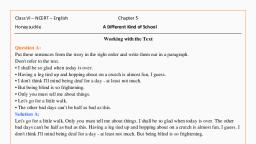
62, , HONEYSUCKLE, , 17., , And so we walked on. Gradually I, discovered that I was ten times more, thoughtful than I ever thought I could, be. I also realised that if I had to describe, people and things to someone else, it, made them more interesting to me., When I finally had to leave, I told Miss, Beam that I was very sorry to go., “Ah!” she replied, “then there is, something in my system after all.”, E.V. LUCAS, (abridged and simplified), , WORKING, , WITH THE, , TEXT, , A. Put these sentences from the story in the right, order and write them out in a paragraph. Don’t, refer to the text., �, , I shall be so glad when today is over., , �, , Having a leg tied up and hopping about on, a crutch is almost fun, I guess., , �, , I don’t think I’ll mind being deaf for a day —, at least not much., , �, , But being blind is so frightening., , �, , Only you must tell me about things., , �, , Let’s go for a little walk., , �, , The other bad days can’t be half as bad, as this., , B. Answer the following questions, 1. Why do you think the writer visited Miss, Beam’s school? (1), , gradually: slowly
Page 54 :
A DIFFERENT KIND, , OF, , SCHOOL, , 63, , 2. What was the ‘game’ that every child in the school had, to play? (9), 3. “Each term every child has one blind day, one lame day…”, Complete the line. Which day was the hardest? Why was it, the hardest? (9, 11, 15), 4. What was the purpose of these special days? (5, 9), , WORKING, , WITH, , LANGUAGE, , A. Match the words and phrases with their meanings in the box below., paragraph numbers, 1. homesick, 2. practically, , (3), (4), , 3. it pains me, , (7), , 4. appreciate, , (9), , 5. thoughtless, , (10), , 6. exercise, , (11), , 7. relief, , (13), , 8. ghastly, , (14), , almost it hurts me terrible test the strength of, understanding the difficulties wanting to be home, a welcome change not very caring, B. Re-word these lines from the story:, 1. I had heard a great deal about Miss Beam’s school., 2. Miss Beam was all that I had expected — middle-aged, full of, authority., 3. I went to the window which overlooked a large garden., 4. “We cannot bandage the children’s mouths, so they really have, to exercise their will-power.”
Page 55 :
64, , HONEYSUCKLE, , C. 1. Given below is a page from a dictionary. Look at it carefully, and, (i) find a word which means the same as ghastly. Write down, the word and its two meanings., (ii) find a word meaning a part of the school year., (iii) find a word that means examination., term noun, 1 a fixed length of time: He was made captain, of the football team for a term of one year., 2 a part of the school year: There are three, terms in a school year., terms plural noun the things you are asking, for: If you agree to my terms—free meals, and good wages—I will work for you., terrace noun, 1 a level area cut out from the side of a hill, 2 a flat area outside a house: We sat on the, terrace in the evening., 3 a row of houses joined together, terraced adjective: a terraced house, terrible adjective, 1 causing fear: We saw a terrible storm., 2 very bad: Your writing is terrible., terribly adverb: It is terribly ( = very) hot., terrify verb, (present participle terrifying, past terrified), to fill with fear: The animals were terrified, by the storm., terror noun (no plural), great fear: a feeling of terror, territory noun, (plural territories), 1 land ruled by one government: This island, is British territory., 2 an area belonging to one person or animal:, Wild animals will not allow other animals to, enter their territory., testl verb, 1 to look at something to see if it is correct, or will work properly: Before he bought the, car, he drove it to test it., 2 to ask someone questions: The teacher, tested the children on their homework., , test2 noun, an examination: I passed my driving test, today., test tube noun small thin glass tube: We, put chemicals in test tubes in our, chemistry class., text noun, 1 the words used in a book, 2 a few words from a book, textbook noun: A textbook is a book we, use to learn about something., than, (used when we compare things, in, sentences like these): My brother is older, than me. Mary sings better than anyone, else in the class., thank verb, to say we are grateful to someone: I, thanked her for the present she sent me., Thank you for the present you sent me., No, thank you, I don't want any more tea., thankful adjective very glad; grateful, thanks plural noun word used to show, that we are grateful: Thanks for helping, me. It was thanks to John (= because of, him) that we won the game., that, 1 (plural those) the one over there; the, one further away than this one: This is, my bowl; that bowl is yours., 2 (plural those) (used to point out, someone or something; used to mean the, one known or mentioned already): Did you, bring that photograph? We played football, and after that ( = next) we went home., 3 (used instead of who, whom)
Page 56 :
A DIFFERENT KIND, , OF, , SCHOOL, , 65, , 2. Now make lists of, (i) all the words on the page (plus any more that you can, think of) that begin with terr(ii) five words that may follow the last word on the page, that., (iii) write down your own meaning of the word thank. Then, write down the meaning given in the dictionary., D. A poem for you to read, All but Blind*, All but blind, In his chambered hole, Gropes for worms, The four-clawed Mole., All but blind, In the evening sky, The hooded Bat, Twirls softly by., All but blind, In the burning day, The Barn Owl blunders, On her way., And blind as are, These three to me,, So, blind to Someone, I must be., WALTER, , * as good as blind, , DE LA, , MARE
Page 57 :
66, , HONEYSUCKLE, , SPEAKING, , AND, , WRITING, , A. Make a short list of things you find difficult to do., For example:, , turning a somersault, , threading a needle, Compare your list with the others’ in the class. Can you explain, why you find these things difficult to do?, B. Look at your hands carefully. Now, write down for each finger one, action for which that finger is particularly important. For example,, the second (or index) finger helps to hold the knife down firmly, when cutting., , nt y, Know, K ow Your Country, 1. Which states border Andhra, Pradesh?, 2. Which is India’s largest island?, Answers on page 123
Page 58 :
Where Do All the, Teachers Go?, For a little child a teacher is special. It is difficult for a small, child to think of his/her teacher as an ordinary person., , Where do all the teachers go, When it’s four o’clock?, Do they live in houses, And do they wash their socks?, Do they wear pyjamas, And do they watch TV?, And do they pick their noses, The same as you and me?, Do they live with other people, Have they mums and dads?, And were they ever children, And were they ever bad?, Did they ever, never spell right, Did they ever make mistakes?, Were they punished in the corner, If they pinched the chocolate flakes?, Did they ever lose their hymn books, Did they ever leave their greens?, Did they scribble on the desk tops
Page 59 :
68, , HONEYSUCKLE, , Did they wear old dirty jeans?, I’ll follow one back home today, I’ll find out what they do, Then I’ll put it in a poem, That they can read to you., PETER DIXON, , WORKING, , WITH THE, , POEM, , 1. Answer these questions., (i) Why does the poet want to know where the teachers go at, four o’clock?, (ii) What are the things normal people do that the poet talks about?, (iii) What does he imagine about, (a) where teachers live?, (b) what they do at home?, (c) the people with whom they live?, (d) their activities when they were children in school?, (iv) Why does the poet wonder if teachers also do things that other, people do?, (v) How does the poet plan to find out? What will he do once he, finds out?, 2. What do you think these phrases from the poem mean?, (i) punished in the corner, (ii) leave their greens
Page 60 :
6, , Before you read, In this lesson we look at what we are like and, how each of us is different. We are all interesting, people in different ways and we are all good at, different things. As you read this, think about, what you are like and what you enjoy doing., , Who I Am, Part I, MANY VOICES, , RADHA, My favourite activity is climbing trees. Just outside, our house, there is a guava tree which I love to go, up. Its branches spread out, so it is simple to climb, up the tree, and I can sit comfortably in the fork of, two branches. My, mother tells me it is, not sensible for girls, to climb trees, but, one afternoon she, climbed up too, and, both of us sat there, talking and eating, raw mangoes. When, I am high up in the, tree, I feel like I can, rule the whole world.
Page 61 :
70, , HONEYSUCKLE, , NASIR, When I grow up, I, want to become a, seed collector. We, have cotton fields in, our village and every, year, my father, spends a lot of, money on buying new, seeds to grow our, cotton plants. My grandfather told me that, many years ago, he could collect the seeds, from his own plants which could be sown to, grow new plants during the next year. But, today that doesn't work so we have to spend, money to buy new seeds every single year. I, want to find out why that is so. I want to learn, how to preserve seeds so that we can use them, again and not spend money every year., , ROHIT, If I had a huge, amount of money I, would travel and, travel. I want to see, the mountains of, New Zealand because, they looked beautiful, in a magazine picture., I wish I could sail down, the Amazon river in, South America on a, raft. I want to live on
Page 62 :
WHO I AM, , the beaches of Lakshadweep and dive, down to see coral. I suppose I should, go to the Konark temple in Orissa or the, old city in Beijing in China and the, Pyramids in Egypt too, but what I, actually enjoy is seeing nature more, than old buildings., , SERBJIT, What makes me, very angry is when, people don’t believe, me when I am, telling the truth., For example, if I, tell my teacher that, I couldn’t do my, homework because, Ravi borrowed my, book and forgot to, return it. Or I tell, my parents that it, w a s n ’t m e b u t, my little brother, who started the, fight. Or if I tell my teacher that I, really did study for the test even if I, have got bad marks. They all look at, me as if they think I am telling lies., The look on their faces really angers, me. Sometimes I have to look down at, my shoes and count to ten so that I do, not show that I am angry., , 71
Page 63 :
72, , HONEYSUCKLE, , DOLMA, When I grow up, I am, going to be the Prime, Minister of India. People, always laugh when I say, that, but I am sure that I, will do it. Everyone in my, class asks me what to do, when they have a, problem, and my teacher, always trusts me when something needs, to be done in school. I want to make things, better for everyone. I want us to have good, hospitals and roads and schools. I want to, make sure that there are many good, scientists in India who will invent cures, for diseases and send a spaceship to Mars., , PETER, My favourite day is, the second Sunday of, every month. On this, day our whole family, always goes to the, cinema hall to see a, film. My father gets, the tickets in advance, and all of us — my, grandmother, my, parents, my two, brothers and I — take, the bus there. In the, interval my father
Page 64 :
WHO I AM, , 73, , buys us peanuts and I love to sit in the, darkness of the hall eating and watching, the film. Afterwards we always stop to eat, ice cream. Everyone is in a good mood and, we all feel very lucky that we are such a, happy family., WORKING, , WITH THE, , TEXT, , A. Answer the following questions., 1. Peter’s favourite day of the week is Sunday, because —————–———————————————, ——————————————————————————–—, 2. Nasir wants to learn ——————————————, ————————————————————————————, ———————————————————————––––––––, 3. Dolma believes that she can make a good, Prime Minister because ———————————, ————————————————————————––—, ———–————–––————––————––————––, B. Write True or False against each of the following, statements., 1. Peter is an only child. ——————————, 2. When Serbjit gets angry he shouts at, people. ——————————, 3. Nasir lives in the city. ——————————, 4. Radha’s mother enjoys doing things with, her. ——————————
Page 65 :
74, , HONEYSUCKLE, , Part II, MULTIPLE INTELLIGENCES, Each one of us is skilled or good at something. But do, you know that dif ferent people are intelligent in, different ways?, VISUAL INTELLIGENCE, , VERBAL INTELLIGENCE, , MATHEMATICAL, INTELLIGENCE, , You like to:, think in pictures,, create mental images, to remember things., You enjoy looking, at maps, charts,, pictures, videos, and, movies., , You like to:, use words and, language. You speak, well and think in words, rather than pictures., , You like to:, use reason, logic and, numbers. Always, curious about the, world around, you ask, lots of questions and, like to do experiments., , You are good at:, puzzle building,, reading, writing,, understanding maps,, charts and graphs, a, sense of direction,, sketching, painting,, fixing or making, objects,, understanding, pictures., You can become a:, navigator, sculptor,, artist, inventor,, architect, interior, designer, mechanic,, engineer., , You are good at:, speaking, writing, story, telling, listening,, explaining, teaching,, using humour,, understanding the, meaning of words,, remembering, information, convincing, someone of your point, of view., You can become a:, poet, journalist, writer,, teacher, lawyer,, politician, translator., , You are good at:, problem solving,, solving puzzles,, experimenting,, questioning and, wondering about, natural events, doing, mathematics, calculations, working, with geometric shapes., You can become a:, scientist, engineer,, computer programmer,, researcher,, accountant,, mathematician.
Page 66 :
WHO I AM, , 75, , Being good at your studies is one kind of, intelligence, but there are many others too. Read the, descriptions to find out which of the following types of, intelligence best describes you. Remember that there, will probably be more than one type of intelligence, which fits you., BODILY INTELLIGENCE, , MUSICAL INTELLIGENCE, , INTERPERSONAL, INTELLIGENCE, , You like to:, control your body, movements and handle, objects skillfully. You, have a good sense of, balance and can catch, or hit a ball well, and, like to dance. You like, to move around while, learning., , You like to:, play and enjoy music., You think about, sounds, rhythms and, patterns. You, immediately respond to, music either, appreciating or, criticising what you, hear., , You are good at:, dancing, physical, coordination,, sports, crafts, acting,, miming, using your, hands to create or, build. You express, emotions through your, body., , You are good at:, singing, whistling,, playing musical, instruments,, recognising tunes,, composing music,, remembering melodies,, understanding the, structure and rhythm, of music., , You like to:, understand others. You, try to see things from, other people’s point of, view in order to, understand how they, think or feel. You are a, good organiser and, manage to get other, people to cooperate and, work as a team., , You can become a:, You can become a:, dancer, athlete,, musician, disc jockey,, physical education, singer, composer., teacher, actor,, firefighter, craftsperson., , You are good at:, seeing things from, others’ view, listening,, understanding other, people’s moods and, feelings, solving, problems, cooperating, with groups, noticing, people’s moods,, communicating,, building trust., You can become a:, counsellor, salesperson,, politician, business, person, teacher., , [Based on Howard Gardner’s theory of Multiple Intelligences]
Page 67 :
76, , HONEYSUCKLE, , WORKING, , WITH THE, , TEXT, , Fill in the blanks to name the different kinds of intelligence. One has, been done for you., When I enjoy listening to people and solving their problems I use, my interpersonal intelligence., (i) When I enjoy dancing or physical activity, I use my, ————————————— intelligence., (ii) When I enjoy looking at maps and examining pictures I use, my ————————————— intelligence., (iii) When I enjoy working with numbers and solving maths, problems I use my ————————————— intelligence., (iv) When I enjoy telling a story or arguing, I use my, ————————————— intelligence., , WORKING, , WITH, , LANGUAGE, , Match the job on the left with its description on the right., (i), , Navigator, , —————, , (a) Advises people what to do about, jobs, personal problems, etc., , (ii), , Architect, , —————, , (b) Works in politics, usually by, standing for election., , (iii), , Politician, , —————, , (c), , Finds and monitors the route to, get to a place, or the direction, of travel.
Page 68 :
WHO I AM, , (iv), , 77, , Engineer, , (v), , —————, , (d) Reports on recent news for, newspaper, radio, or TV., , Computer, —————, programmer, , (e), , Plans the design of a building,, town, or city., , Athlete, , —————, , (f), , Controls and puts together a, programme of music., , (vii) Disc jockey —————, , (g), , Works in sports or activities, such as running, jumping,etc., , (viii) Composer, , —————, , (h) Designs and builds things like, roads, bridges, or engines., , (ix), , Counsellor, , —————, , (i), , Makes up notes to create music., , (x), , Journalist, , —————, , (j), , Designs the system by which, a computer runs or gives, information., , (vi), , WRITING, Write a paragraph about yourself so that people who read it will get to, know you better. You could write about yourself from any point of, view, or choose one of the following topics., •, •, •, •, , What, What, What, What, , I enjoy doing most, makes me angry, I hate to do, I want to become, , (Remember to give a reason or details of what you write about, so, that anyone reading it will understand you better.), After you have finished your paragraph affix your photo on the, sheet and display it on the wall. Read each other’s paragraphs., Did you understand someone else better after you had read what, he/she wrote?
Page 69 :
78, , WORKING, , HONEYSUCKLE, WITH, , LANGUAGE, , You Are, Stoic, determined,, patient, romantic, calm,, curious, physically tough,, unflappable., The right job needs, You Like, the right kind of, Adventure, travelling,, person. Depending on outdoors, forests,, the kind of person you trekking, wild creatures,, are — your personality rain, climbing mountains,, camping, being alone., type — you would be, You Are Good at, best suited for a, particular kind of work. Biology, outdoor activities,, keeping calm under, Find out which, duress, running long, personality matches, distances, dealing with, yours best and what, bad weather, looking at a, you would want to, wild elephant in the eye., become., You Can Become, a wildlife biologist,, zoologist, botanist,, naturalist, forester, zoo, curator, veterinary doctor,, biology teacher,, environment educator,, organic farmer, rural, community worker., , Thinker, or, Tinker?, , CREATIVE, , What’s, Your, Nature?, , ADVENTUROUS, , Read these columns about careers in environment, that is, working to, keep our world — the land, air, water and the people, animals and, plants — safe from natural and man-made dangers. Check out the, , You Are, Creative, imaginative,, artistic, a dreamer, romantic,, sensitive, liberal, cooperative,, cordial, clever, perceptive,, humorous, intuitive., You Like, Colours, good design,, outdoors, communicating,, creative writing, art and, craft, watching films,, nature walks, engaging with, social issues, travelling,, studying liberal arts., You Are Good at, Art and craft, drawing,, photography, creative, writing, painting, dreaming,, communicating ideas., You Can Become, a film maker, copy writer,, graphic designer, artist,, sculptor with a social concern, who does development, communication projects or, works for NGOs, school, teacher, community worker,, wildlife artist/illustrator,, environment educator,, communication expert.
Page 70 :
WHO I AM, , 79, , You Are, Systematic, logical,, practical, organised,, inquisitive, thorough,, outward-looking,, rational, studious,, methodical, intuitive., You Like, Building and fixing, things, finding reasons, behind phenomena,, figuring out how things, work, learning about, new technologies, doing, maths, gadgets., You Are Good at, Physics, mathematics,, chemistry, fixing and, repairing the plumbing, or electrical gadgets at, home, engineering,, fantastic structures, with Lego., You Can Become, an environmental, engineer, bio-engineer,, chemical engineer,, meteorologist, climatologist,, toxicologist, water expert,, appropriate technologist., , You Are, Confident, intelligent,, creative, gregarious,, talkative, opinionated,, alert, energetic, purposeful,, forthright, sociable, eloquent., You Like, Reading, writing, thinking, about the state of the world,, politics, cultures, arguing,, travelling to remote places,, meeting people, stating your, opinion, intellectual pursuits,, current affairs, cities., You Are Good at, Literature, history, languages,, communicating, debating,, oratory, demanding your, rights, sensitive to, injustice, interacting with, all kinds of people., You Can Become, a documentary filmmaker,, environmental lawyer,, newspaper/magazine, journalist, urban, researcher, ecological, historian, development, consultant, communications, expert, government official., , IDEALIST, , COMMUNICATOR, , INQUIRER, , personality profiles needed to be successful at different kinds of careers, in the environmental field. Find out whether you are more adventurous, than your partner, or whether your partner is a better inquirer than, others. You may wish to prepare a personality profile of yourself/your, partner. In groups, attempt some of the activities suggested at the end., , You Are, Hopeful, selfless, romantic,, radical, frank, political,, rebellious, socialist,, freethinking, restive,, passionate, visionary, helpful., You Like, To help others, to express, your concern at injustice,, social and cultural, histories, understanding, human psychology, a sense, of community, people with, social concerns., You Are Good at, Dealing with all kinds of, people, working in a team,, demanding your rights,, living frugally, making the, most of any given situation,, strategising, writing letters,, taking criticism, doing, daring acts., You Can Become, a social worker, environmental, activist, NGO representative,, rural development expert,, public interest advocate,, lawyer, communications, expert.
Page 71 :
80, , HONEYSUCKLE, , Word-finders group, , 1. Thinker becomes Tinker if we leave out, an ‘h’. Who is a tinker?, 2. Make a list of words that your, classmates want to find out the, meanings of. Then find out the, meanings by consulting a dictionary, or asking your teacher. Tell your, classmates what you have found out., , People-finders group, , Find people in the jobs mentioned, here. They may be people you know,, or people mentioned in newspapers,, etc. Make a chart., , Picture-finders group, , Get pictures or photographs of the, kinds of people, subjects, activities,, places, etc., mentioned above., , SPEAKING, A. Why does Radha’s mother tell her that it is not suitable for girls to, climb trees? Find points to agree with Radha or her mother., Plan what you will say by making notes like this:, �, , Girls should be able to climb trees if they wish, 1. ———————————————————————————————————, 2. ———————————————————————————————————, 3. ———————————————————————————————————, , �, , Girls should not be allowed to climb trees, 1. ———————————————————————————————————, 2. ———————————————————————————————————, 3. ———————————————————————————————————
Page 72 :
�, , WHO I AM, , 81, , Now divide the class into two groups. Present to the rest of the, class the opinion of Radha who thinks there is no harm in girls, climbing trees and of her mother who thinks girls should not, do this., B. Sit in a circle so that you can see each other. Each one must talk, to complete the following sentence in your own way., “What makes me very angry is ...”, Remember to listen with respect and without comment to each, person as he/she speaks., , n Your, Your Country, Cou r, Know, Cou, 1. The Hirakud Dam is built on a, major river. Name it., 2. In which state is Kanyakumari, the, southernmost tip of the mainland?, 3. Name the channel that separates, the Andaman and Nicobar Islands., Answers on page 137
Page 73 :
The Wonderful Words, Imagine a world without language. All humans speak at least, one language. The words we speak bring out our thoughts. Read, the following poem on words., , Never let a thought shrivel and die, For want of a way to say it, For English is a wonderful game, And all of you can play it., All that you do is match the words, To the brightest thoughts in your head, So that they come out clear and true, And handsomely groomed and fed—, For many of the loveliest things, Have never yet been said., Words are the food and dress of thought, They give it its body and swing, And everyone’s longing today to hear, Some fresh and beautiful thing;, But only words can free a thought, From its prison behind your eyes, May be your mind is holding now, A marvellous new surprise!, MARY O’NEILL
Page 74 :
THE WONDERFUL WORDS, , WORKING, , WITH THE, , 83, , POEM, , 1. With your partner, complete the following sentences in your own, words using the ideas in the poem., (i) Do not let a thought shrivel and die because ———————————, ————————————————————————————––––————————, (ii) English is a ————————————————————— with words that, everyone can play., (iii) One has to match ————————————————————————————, (iv) Words are the ————————————————————— of thought., 2. In groups of four discuss the following lines and their meanings., (i) All that you do is match the words, To the brightest thoughts in your head, (ii) For many of the loveliest things, Have never yet been said, (iii) And everyone’s longing today to hear, Some fresh and beautiful thing, (iv) But only words can free a thought, From its prison behind your eyes
Page 75 :
7, , Before you read, Has your best friend ever done something you, thought was wrong? What did you do then? Did, you keep quiet or did you tell your friend what, you thought?, Read this story about two friends who had to, decide what was more important — friendship, and enmity, or a sense of what is right and, what is wrong., , Fair Play, Part I, 1. JUMMAN Shaikh and Algu Chowdhry were, good friends. So strong was their bond, of friendship that when either of them, went away from the village, the other, looked after his family. Both were greatly, respected in the village., 2., Jumman had an old aunt who had, some property. This she transferred to, him on the understanding that she, would stay with him and he would look, after her. The arrangement worked well, for a couple of years. Then the situation, changed. Jumman and his family were, tired of the old relative. Jumman became, as indifferent to her as his wife, who, grudged even the little food that the old, lady wanted every day. She swallowed, these insults along with her food for a, few months. But patience has its limits., , became indifferent:, lost interest in or, did not care for, grudged: gave, unwillingly; felt, angry/ unhappy, about giving, swallowed these, insults: tolerated, them
Page 76 :
FAIR PLAY, , 3., , One day she spoke to Jumman, “My, son, it is now obvious that I am not, wanted in your house. Kindly give me a, monthly allowance so that I can set up, a separate kitchen.”, “My wife knows best how to run the, house. Be patient,” said Jumman, shamelessly. This made his aunt very, angry and she decided to take her case, to the village panchayat., 4., For many days, the old lady was seen, talking to the villagers explaining her case, and seeking their support. Some, sympathised with her, others laughed, at her and a few others advised her to, , 85
Page 77 :
86, , HONEYSUCKLE, , make it up with her nephew and his wife., At last she came to Algu Chowdhry and, spoke to him. “You know, Chachi,, Jumman is my best friend. How can I, go against him?” Algu said. “But is it, right, my son, to keep mum and not say, what you consider just and fair?”, pleaded the old lady. “Come to the, panchayat and speak the truth,” she, said. Algu didn’t reply, but her words, kept ringing in his ears., Part II, 5. The panchayat was held the same, evening under an old banyan tree., Jumman stood up and said, “The voice, of the Panch is the voice of God. Let my, , make it up: stop, quarreling; come, to an agreement, with, , mum: quiet/silent
Page 78 :
FAIR PLAY, , aunt nominate the head Panch. I will, abide by her decision.”, 6., “The Panch knows neither friend nor, enemy. What do you say to Algu, Chowdhry?” the old lady announced., “Fine,” replied Jumman hiding his joy, over this unexpected piece of luck., “Chachi, you are aware of my, friendship with Jumman,” said Algu., “I know that,” replied the aunt, “but I, also know that you will not kill your, conscience for the sake of friendship. God, lives in the heart of the Panch, and his, voice is the voice of God.” And the old, lady explained her case., “Jumman,” said Algu, “you and I are, old friends. Your aunt is as dear to me, as you. Now I am a Panch. You and your, aunt are equal before me. What have you, to say in your defence?”, “Three years ago,” began Jumman,, “my aunt transferred her property to me., I promised to support her as long as she, lived. I have done all I could. There have, been a couple of quarrels between my, wife and her but I can’t stop it. Now my, aunt is claiming a monthly allowance, from me. This is not possible. That’s all, I have to say.”, 7., Jumman was cross-examined by, Algu and others. Then Algu announced,, “We have gone into the matter carefully., In our opinion, Jumman must pay his, , 87, nominate: propose/, suggest someone’s, name for something, abide by: accept
Page 79 :
88, , HONEYSUCKLE, , aunt a monthly allowance, or else the, property goes back to her.”, 8., Now, the two friends were seldom, seen together. The bond of friendship, between them was broken. In fact,, Jumman was Algu's enemy and wanted, his revenge., , seldom: rarely, , Part III, 9. Days passed and, as ill luck would have, it, Algu Chowdhry found himself in a, tight spot. One of his fine pair of, bullocks died, and he sold the other to, Samjhu Sahu, a cart driver of the village., The understanding was that Sahu would, pay the price of the bullock in a month’s, time. It so happened that the bullock, died within a month., 10., Several months after the bullock’s, death, Algu reminded Sahu of the, money he hadn’t yet paid. Sahu got very, annoyed. “I can’t pay you a penny for, the wretched beast you sold me. He, brought us nothing but ruin. I have a, bullock. Use it for a month and then, return it to me. No money for the dead, bullock,” he said angrily., 11., Algu decided to refer the case to the, panchayat. For a second time in a few, months, preparations for holding the, panchayat were made, and both the, parties started meeting people seeking, their support., , tight spot: difficult, situation
Page 80 :
FAIR PLAY, , 12., , The panchayat was held under the, old banyan tree. Algu stood up and said,, “The voice of the Panch is the voice of, God. Let Sahu nominate the head, Panch. I will abide by his decision.”, 13., Sahu saw his chance and proposed, the name of Jumman. Algu’s heart, sank and he turned pale. But what, could he do?, 14., The moment Jumman became head, Panch, he realised his responsibility, as judge and the dignity of his office., Could he, seated in that high place,, have his revenge now? He thought, and thought. No, he must not, , 89
Page 81 :
90, , HONEYSUCKLE, , allow his personal feelings to come, in the way of speaking the truth and, doing justice., 15., Both Algu and Sahu stated their, cases. They were cross-examined and, the case was considered deeply. Then, Jumman stood up and announced, “It, is our opinion that Sahu should pay, Algu the price of the bullock. When, Sahu bought the bullock, it suffered, from no disability or disease. The, death of the bullock was unfortunate,, but Algu cannot be blamed for it.”, Algu could not contain his feelings. He, stood up and said loudly over and, over again, “Victory to the panchayat., This is justice. God lives in the voice, of the Panch.”, 16., Soon after, Jumman came to Algu,, embraced him and said, “Since the last, panchayat, I had become your enemy., Today I realised what it meant to be a, Panch. A Panch has no friend nor, enemy. He knows only justice. Let no, one deviate from the path of justice and, truth for friendship or enmity.”, Algu embraced his friend and wept., And his tears washed away all the dirt, of misunderstanding between them., PREMCHAND, [retold], , deviate: move away, from; leave
Page 82 :
FAIR PLAY, , 91, , WORKING WITH THE TEXT, A. Match the sentences under I with those under II., I, 1. Jumman and Algu were the best of friends., 2. Jumman’s aunt transferred her property to him., 3. The aunt decided to appeal to the panchayat., 4. Algu was unwilling to support the aunt., 5. Jumman was very happy to hear Algu’s name as head Panch., , II, 1. He believed that his friend would never go against him., 2. She wanted justice., 3. In the absence of one, the other took care of his family., 4. The condition was that he would be responsible for her welfare., 5. The bond of friendship between him and Jumman was very, strong., B. Who says this to whom and why?, 1. “My wife knows best how to run the house.”, 2. “But is it right, my son, to keep mum and not say what you, consider just and fair?”, 3. “What have you to say in your defence?”, 4. “I can’t pay you a penny for the wretched beast you sold me.”, 5. “Victory to the panchayat. This is justice.”, C. Answer the following questions., 1. “Then the situation changed.” What is being referred to? (2), 2. When Jumman’s aunt realised that she was not welcome in, his house, what arrangement did she suggest? (3)
Page 83 :
92, , HONEYSUCKLE, , 3. What was the villagers’ reaction when the aunt explained, her case to them? (4), 4. Why was Jumman happy over Algu’s nomination as head, Panch? (6), 5. “God lives in the heart of the Panch.” the aunt said. What, did she mean? (6), 6. What was Algu’s verdict as head Panch? How did Jumman, take it? (7, 8), 7. Algu found himself in a tight spot. What was his problem? (9), 8. Why was Algu upset over Jumman’s nomination as head, Panch? (12, 13), 9. What was Jumman’s verdict as head Panch? How did Algu, take it? (14, 15), 10. Which of the following sums up the story best?, (i) “I also know that you will not kill your conscience for, the sake of friendship.”, (ii) “Let no one deviate from the path of justice and truth for, friendship or enmity.”, (iii) “The voice of the Panch is the voice of God.”, Give a reason for your choice., , WORKING WITH LANGUAGE, A. Replace the italicised portion of each sentence below with a, suitable phrase from the box. Make necessary changes,, wherever required., look after swallow make it up keep mum go into, ease one’s conscience, as ill luck would have it, a tight spot, take chances, my heart sank, 1. The best way to avoid an unnecessary argument is to remain silent., 2. Unfortunately, the train I was trying to catch was cancelled.
Page 84 :
FAIR PLAY, , 93, , 3. He has been told not to take risks while driving a car through, a crowded street., 4. The patient needs to be properly taken care of., 5. Why don’t the two of you end your quarrel by shaking hands?, 6. I was in a difficult situation till my friends came to my rescue., 7. When I saw a pile of dirty dishes, I felt very disappointed., 8. I will examine the matter carefully before commenting on it., 9. They criticised him in the meeting but he accepted without, protest all the criticism., 10. It will free me from worry to know that I had done nothing, wrong., B. Look at the following phrases and their meanings. Use the, phrases to fill in the blanks in the sentences given below., set up, , —, , put in place or start, , set aside, , —, , save or keep for a particular purpose, , set down, , —, , write or record, , set out, , —, , start on a journey, , set in, , —, , begin and seem likely to continue, , 1. Why don’t you ————————————— your ideas on paper?, 2. A fund has been ————————————— for the soldiers’, families., 3. We should ————————————— a little money every month., 4. You should buy some woollens before winter ——————— ., 5. They ———————————— on the last stage of their journey.
Page 85 :
94, , HONEYSUCKLE, , SPEAKING AND WRITING, A. Look at the following picture. One asks a question, the other, answers it. Then the answer is noted in a form as shown below., , Do you like to, meet people?, , Yes, I do but not, always. I do have, some close friends,, though., Kindly write it, in the form., , Questions, , Yes/No, , Additional Response, , 1. Do you like to, meet people?, , Yes I do, but not, always., , I do have some close, friends, though., , 2. Do you like the No, I don’t., area you live in?, , But I have no choice., , B. Work in small groups. Ask your partner the questions given, below. If possible, ask him/her a reason for saying Yes or No., Then tick Yes/No, whichever is proper., 1. Do you have a separate room for sleep and study? Yes/No, 2. Would you prefer to live in a joint family?, , Yes/No, , 3. Do you get on with people?, , Yes/No, , 4. Do you like the area you live in?, , Yes/No
Page 86 :
FAIR PLAY, , 95, , 5. Do you find the place overcrowded?, , Yes/No, , 6. Do you use public transport?, , Yes/No, , 7. Would you like a vehicle of our own?, , Yes/No, , 8. Do you like reading?, , Yes/No, , 9. Would you like to be a teacher/doctor/engineer/, architect?, , Yes/No, , C. Now that you have completed the above project, write a brief, report stating what you did, how you did it and the conclusion., , DICTATION, Your teacher will speak the words listed below. Write against, each a word of opposite meaning., Examples:, , liquid, , solid, , hard, , soft, , 1. old, , —————————————————, , 2. wet, , —————————————————, , 3. open, , —————————————————, , 4. blunt, , —————————————————, , 5. forget, , —————————————————
Page 87 :
Before you read, , 8, , Have you ever won anything in a ‘lucky dip’ or, other such game of chance? Do you like such, games?, , A Game of Chance, 1. EVERY year on the occasion of Eid, there, was a fair in our village. Eid was, celebrated only one day but the fair lasted, many days. Tradesmen from far and, wide came there with all kinds of goods, , tradesmen:, shopkeepers or, people who have, goods to sell
Page 88 :
100, , to sell. You could buy anything from a, small pin to a big buffalo., 2., Uncle took me to the fair. Bhaiya, who, worked for us at home, came with us., There was a big crowd at the fair. Uncle, was leading us through the crowd when, he met a few of his friends. They wanted, him to spend some time with them., 3., Uncle asked me whether I would like, to look around the fair with Bhaiya till, he came back. I was happy to do that., Uncle warned me neither to buy anything, nor to go too far out while he was away. I, promised that I would wait for him., 4., Bhaiya and I went from shop to shop., There were many things I would have, liked to buy, but I waited for Uncle to, return. Then we came to what was called, the Lucky Shop. The shopkeeper was, neither young nor old. He was a middleaged man. He seemed neither too smart, nor too lazy. He wanted everybody to try, their luck. There were discs on the table, with numbers from one to ten facing, down. All you had to do was to pay, 50 paise, pick up any six discs, add up, the numbers on the discs and find the, total. The article marked with that, number was yours., 5., An old man paid 50 paise and, selected six discs. He added up the, numbers on them and found the total, was 15. He was given the article marked, , HONEYSUCKLE
Page 89 :
A GAME OF CHANCE, , 15, which was a beautiful clock. But the, old man did not want a clock. The, shopkeeper obliged him by buying it, back for 15 rupees. The old man went, away very pleased., 6., Then a boy, a little older than I, tried, his luck. He got a comb worth 25 paise., The shopkeeper looked neither happy, nor sad. He bought the comb from the, boy for 25 paise. The boy tried his luck, again. He now got a fountain-pen worth, three rupees. Then he tried a third time, and got a wrist watch worth 25 rupees., When he tried again he got a table lamp, worth more than 10 rupees. The boy was, happy and went away with a smile and a, good deal of cash., 7., I wanted to try my luck too. I looked, at Bhaiya. He encouraged me. I paid 50, paise and took six discs. My luck was, not too good. I got two pencils. The, shopkeeper bought them from me for 25, paise. I tried again. This time I got a bottle, of ink, also of little value. The shopkeeper, bought that too for 25 paise. I took a, chance for the third time. Still luck was, not with me., 8., I had hopes of winning a big prize and, continued to try my luck again and again,, paying 50 paise each time. But every time, I got a trifle. At last I was left with only 25, paise. Again the shopkeeper showed his, kindness. He said I could either play, , 101, , a trifle: an object of, little value
Page 90 :
102, , once more with 25 paise or settle the, account then and there. I played again and, the last 25 paise also disappeared., 9. People were looking at me. Some were, laughing at my bad luck, but none, showed any sympathy. Bhaiya and I went, to the place where Uncle had left us and, waited for him to return., Presently he came. He looked at me and, said, “Rasheed, you look upset. What is, the matter?”, 10. I did not say anything. Bhaiya told him, what had happened. Uncle was neither, angry nor sad. He smiled and patted me., He took me to a shop and bought me a, , HONEYSUCKLE
Page 91 :
A GAME OF CHANCE, , beautiful umbrella, biscuits and sweets, and some other little gifts. Then we, returned home., 11. Back home, Uncle told me that the, Lucky Shop man had made a fool of me., “No, Uncle,” I said, “it was just my, bad luck.”, “No, my boy,” said Uncle, “it was, neither good luck nor bad luck.”, “But, Uncle,” I said, “I saw an old man, getting a clock and a boy getting two or, three costly things.”, “You don’t know, child,” Uncle said,, “they were all friends of the shopkeeper., They were playing tricks to tempt you to, try your luck. They wanted your money, and they got it. Now forget about it, and, don’t tell anybody of your bad luck or, your foolishness.”, , WORKING WITH THE TEXT, A. Complete the following sentences from, memory choosing a phrase from those given, in brackets., 1. ————————————— was held at the, time of the Eid festival., (A big show, A big fair, A big competition), 2. Tradesmen came to the village with all, kinds of goods————————————— ., (to display, to buy, to sell), , 103
Page 92 :
104, , HONEYSUCKLE, , 3. Uncle told me ———————————————————————— while, he was away., (not to buy anything, not to go anywhere, not to talk to, anyone), 4. The owner of the Lucky Shop wanted everybody present, —————————————————————————— ., (to play the game, to win a prize, to try their luck), 5. The first time I took a chance I got —————————————–— ., (a bottle of ink, two pencils, a trifle), 6. Uncle told me that the shopkeeper had made ————————., (a fool of me, a good profit, friends with many people), B. Answer the following questions., 1. Why do you think Rasheed’s uncle asked him not to buy, anything in his absence? (3), 2. Why was the shop called ‘Lucky Shop’? (4), 3. An old man won a clock and sold it back to the shopkeeper., How much money did he make? (5), 4. How many prizes did the boy win? What were they? (6), 5. Why was Rasheed upset? (7, 8, 9), 6. In what way did the shopkeeper make a fool of Rasheed? (11), , WORKING WITH LANGUAGE, I. The words given against the sentences below can be used both, as nouns and verbs. Use them appropriately to fill in the blanks., 1. (i) The two teams have ————————————— three matches, already. (play), (ii) The last day’s ————————————— was excellent.
Page 93 :
A GAME OF CHANCE, , 105, , 2. (i) She has a lovely ————————————— . (face), (ii) India ———————————— a number of problems these days., 3. (i) He made his ————————————— in essay-writing., (mark), (ii) Articles ————————————— ‘sold’ are reserved., 4. (i) The police are ————————————— the area to catch, the burglars. (comb), (ii) An ordinary plastic ————————————— costs five, rupees., 5. (i) He gave a ————————————— in answer to my question., (smile), (ii) We also ————————————— to see him smile., 6. (i) He said he ————————————— to be invited to the party., (hope), (ii) We gave up ————————————— of his joining the party., 7. (i) The boys put up a good athletic————————————— ., (show), (ii) The soldiers ————————————— great courage in saving, people from floods., 8. (i) You deserve a ————————————— on the back for your, good performance. (pat), (ii) The teacher ————————————— the child on the cheek, to encourage her., B. Notice the use of ‘there’ in the following sentences., �, , There was a big crowd at the fair., , There were many things I’d have liked to buy., Now rewrite the following sentences using ‘there’ in the, beginning. Look at the following examples., , �, , �, , I can do nothing to help you., , �, , There is nothing I can do to help you.
Page 94 :
106, , HONEYSUCKLE, , �, , A man at the door is asking to see you., , �, , There is a man at the door asking to see you., , 1. This park has beautiful roses., 2. Your story has no fun in it., 3. We have no secrets between us., 4. My village has two primary schools., 5. This problem can be solved in two ways., C. Fill in the blanks in the paragraph below with words from, the box., huge, , big, , foolish, , interesting, , tiny, , unlucky, , last, , There was a ————————————— Eid fair in our village. We, could buy anything from a ————————————— toy to a, —————————————, , camel. I went to the fair on its, , ————————————— day with Uncle and Bhaiya. We went to, the Lucky Shop. It was very————————————— . I tried my, luck but did not win any prize. Later, Uncle told me that I was, more ————————————— than ————————————— ., , SPEAKING, , AND, , READING ALOUD, , A. 1. Suppose you are Rasheed. Describe in your own words your, visit to the fair. Do not refer to the Lucky Shop., 2. Read aloud the two paragraphs that describe the boy and, the old man at the Lucky Shop.
Page 95 :
A GAME OF CHANCE, , 107, , 3. Listen to these children. What are they talking about?, I don’t like coffee., I’d prefer tea., , Would you like, tea or coffee?, , I’d prefer coffee,, thank you., , B. Work in pairs. One of you is an agent and the other is a client, looking for accommodation in a hotel. Talk to each other. Use, the clues given below., Agent, , Client, , What sort of accommodation, would you prefer?, , I’d prefer a —————————–––—, —————————————————–––, , Would you like your own, room or would you like to, share a room?, , I’d like ——————————————–, I don’t think I’d like __________, ——————————————————––, , Would you like a room with, a television?, , Yes, I do want ————————–––, —————————————————–––, , Do you need to hire a car?, , No, thanks. I don’t need __________, No, I’d prefer —————————–—, , What sort of location are you I’d like to stay in ———————––, interested in?, —————————————————–––, Have you any other, requirements?, , Yes, I must have ———————––, Yes, give me —————————–—, No, no other requirements.
Page 96 :
108, , HONEYSUCKLE, , DICTATION, 1. Some words are given below. Listen carefully to the word from, the list the teacher speaks, and write against it another word, that has the same pronunciation but different spelling. The first, is an example., fair, buy, one, which, two, no, here, see, there, hare, nun, , fare
Page 97 :
Vocation, On your way to school or market you see many people at, work. In pairs, discuss what you have noticed. Then read, this poem. You may read it aloud with a partner, if you like., , When the gong sounds ten in the morning and, I walk to school by our lane,, Every day I meet the hawker crying, “Bangles,, crystal bangles!”, There is nothing to hurry him on, there is no, road he must take, no place he must go to, no, time when he must come home., I wish I were a hawker, spending my day in, the road, crying, “Bangles, crystal bangles!”, When at four in the afternoon I come back from, the school,, I can see through the gate of that house the, gardener digging the ground., He does what he likes with his spade, he soils, his clothes with dust, nobody takes him to, task, if he gets baked in the sun or gets wet., I wish I were a gardener digging away at the, garden with nobody to stop me from digging., Just as it gets dark in the evening and my, mother sends me to bed,, I can see through my open window the, watchman walking up and down.
Page 98 :
110, , HONEYSUCKLE, , The lane is dark and lonely, and the streetlamp stands like a giant with one red eye in, its head., The watchman swings his lantern and walks, with his shadow at his side, and never once, goes to bed in his life., I wish I were a watchman walking the street, all night, chasing the shadows with my, lantern., RABINDRANATH TAGORE, , WORKING, , WITH THE, , POEM, , 1. Your partner and you may now be able to answer these questions., (i) Who is the speaker in the poem? Who are the people the, speaker meets? What are they doing?, (ii) What wishes does the child in the poem make? Why does, the child want to be a hawker, a gardener, or a watchman?, Pick out the lines in each stanza, which tell us this., (iii) From the way the child envies the hawker, the gardener, and the watchman, we can guess that there are many things, the child has to do, or must not do., Make a list of the do’s and don’ts that the child doesn’t like., The first line is done for you., The child must, , The child must not, , come home at a fixed time., , get his clothes dirty in the dust., , ———————————————————, , ———————————————————, , ———————————————————, , ———————————————————
Page 99 :
VOCATION, , 111, , ———————————————————, , ———————————————————, , ———————————————————, , ———————————————————, , ———————————————————, , ———————————————————, , ———————————————————, , ———————————————————, , ———————————————————, , ———————————————————, , ———————————————————, , ———————————————————, , ———————————————————, , ———————————————————, , ———————————————————, , ———————————————————, , Now add to the list your own complaints about the things, you have to do, or must not do., (iv) Like the child in the poem, you perhaps have your own wishes, for yourself. Talk to your friend, using “I wish I were…”, 2. Find out the different kinds of work done by the people in your, neighbourhood. Make different cards for different kinds of work., You can make the card colourful with pictures of the persons, doing the work.
Page 100 :
Before you read, , 9, , Can you name some desert areas in India and the, world? Who do you think lives in such areas?, , Desert Animals, 1. DESERTS are the driest places on earth, and sometimes go for months, or even, years, without rain. But even the desert, animals cannot survive without water,, or for long periods in the scorching sun,, so they have had to find different ways, of coping with the harsh conditions. For, example, gerbils spend the hottest part, of the day in cool underground burrows., And strange insects called darkling, beetles are experts at catching drops of, moisture on their legs, then lifting them, into the air until the drops trickle down, into their mouths. Not all deserts are, endless seas of rolling sand dunes., Some are rocky or pebbly and dotted, with small bushes while others are, sprinkled with colourful flowers during, the spring., 2., There are more than 2300 different, kinds of snakes around the world,, ranging from just fifteen centimetres, long to more than eleven metres. Most, snakes are quite harmless — but there, , scorching: very hot, , gerbils: mouse-like, desert rodents with, long hind legs, , dunes: heaps of, sand formed by, the wind, pebbly: stony
Page 101 :
DESERT ANIMALS, , are a few that are so, poisonous they can kill a, human being with just one, bite. Most snakes lay eggs,, but there are many which, give birth to their young. In, the dry, rocky deserts of, America lives a rather evillooking snake with a very bad, reputation. Its frightening, rattle can be heard as far as, thirty metres away, and it can strike, with lightning speed., 3., But the rattlesnake, or ‘rattler’ as it, is sometimes called, prefers to avoid, people if it possibly can. It holds its tail, upright and rattles the end whenever it, is disturbed, in the hope that the, intruder will go away. However, if its, warnings are ignored — and it feels, threatened—it will coil ready to bite. But, the rattler itself cannot hear the noise, its own tail makes. Like most snakes,, it ‘hears’ things through vibrations in, the ground. If a person walks nearby, the snake can feel the movement. But if, the same person were to shout, it would, not hear a thing. Rattlesnakes are very, common and widespread animals, living, right across the American continent, from Canada to Argentina. They feed, on a variety of prey, including mice,, voles, rats, chipmunks and many other, , 113, , voles: a small, plant-eating, rodent, chipmunks: small, ground squirrels, having light and, dark stripes.
Page 102 :
114, , small animals. Rattlesnakes kill their, prey with venom. Like all snakes, they, swallow the unfortunate animals whole., Few snakes have to eat more than once, a week and some, such as the larger, pythons, can survive for a year or more, without eating., 4., Mongooses like to hunt together,, but they always keep a lookout for, dangerous predators nearby. Poking, their noses into holes, overturning rocks, with their paws and scratching the, ground with their sharp claws, banded, mongooses are very amusing animals, to watch. A common sight in many parts, of Africa, they travel in groups of about, twenty to forage for beetles, millipedes, and other small creatures., 5., They like to, hunt, together,, keeping in touch, whenever they go out, of sight behind rocks, or, bushes, by, twittering and calling., Always on the lookout, for danger — hawks,, eagles and large, snakes — they warn, one another with a, special alarm call if, they spot anything, suspicious., , HONEYSUCKLE, , predator: an animal, naturally preying, on others., , amusing:, interesting;, enjoyable., forage: search for, food.
Page 103 :
DESERT ANIMALS, , Mongooses are famous for being able, to kill snakes without getting hurt, themselves. Their reactions are so fast, that they can dodge each time the snake, strikes. They continually make a, nuisance of themselves until, after a, while, when the snake gets tired, they, quickly dive in for the kill., 7., All the female mongooses have their, kitten at about the same time. They, are raised by the whole group in a den, made inside an old termite mount or, hollow log. When most of the adults, are out looking for food, one or two, males stay behind to stand guard until, the others return for the night., 8., Another animal which lives in the, desert is the camel. Camels were, first domesticated by people many, thousands of years ago. In the wild,, camels usually live in small groups of, up to thirty animals. Camels have long,, shaggy winter coats to keep warm and, shorter, tidier coats in the summer to, keep cool. A thirsty camel can drink as, much as thirty gallons of water — that’s, about five hundred full glasses — in, just ten minutes. Normally, however,, it gets all the moisture it needs from, desert plants and can survive for up, to ten months without drinking any, water at all., , 115, , 6., , dodge: move, quickly to avoid, its enemy
Page 104 :
116, , 9., , HONEYSUCKLE, , There are two different kinds of, camel. One, known as the Dromedary,, has only a single hump; the other is, called a Bactrian camel and has two, humps. The humps help the animal, to survive in the desert, by acting as, storage containers. But they don’t, store water — as many people wrongly, believe — they are full of fat. This fat, nourishes the camels when food is, scarce. If they have nothing to eat for, several days, their humps shrink as the, fat is used up. There are many other, ways in which camels are adapted to, desert life. Their mouths are so tough, that even the sharp thorn cannot pierce, through.
Page 105 :
DESERT ANIMALS, , WORKING, , WITH THE, , 117, , TEXT, , A. 1. Talk to your partner and say whether the following statements, are true or false., (i) No animal can survive without water., (ii) Deserts are endless sand dunes., (iii) Most snakes are harmless., (iv) Snakes cannot hear, but they can feel vibrations through, the ground., (v) Camels store water in their humps., 2. Answer the following questions., (i) How do desert animals survive without water? (1), (ii) How do mongooses kill snakes? (6), (iii) How does the hump of the camels help them to survive when, there is no water? (9), B. Read the words/phrases in the box. With your partner find their, meaning in the dictionary., harsh conditions harmless survive intruder, threatened predators prey continually, Fill in the blanks in the following passage with the above words/, phrases., All animals in forests and deserts struggle to ———————————, in ———————————————— . Though most of the animals, are ——————————— , some are dangerous when ———————————., If an ————————————— is noticed, they attack or bite to save, themselves. They struggle ——————————— for food and water., Some animals are called ————————————— because they, —————————— on other animals.
Page 106 :
118, , HONEYSUCKLE, , SPEAKING, Look at these sentences., �, Deserts are the driest places on earth., �, Gerbils spend the hottest part of the day in cool underground, burrows., Now form pairs. Ask questions using a suitable form of the word in, brackets. Try to answer the questions too., Do you know, 1. Which animal is the _______________________ (tall)?, 2. Which animal runs the _______________________ (fast)?, 3. Which place on earth is the _______________________ (hot) or the, _______________________ (cold)?, 4. Which animal is the _______________________ (large)?, 5. Which is the ————————————— (tall) mountain in the world?, 6. Which is the _______________________ (rainy) place on earth?, 7. Which is the ________________________ (old) living animal?, Can you add some questions of your own?, , THINKING, , ABOUT, , LANGUAGE, , A. Look at these sentences., �, �, , Most snakes are quite harmless, but a few are poisonous., Most snakes lay eggs, but the rattlesnake gives birth to its, young., Now write five sentences like these using ‘most’ and the clues below., 1. (90% of) people are honest (10%) are dishonest., —————————————————————————————————————, —————————————————————————————————————
Page 107 :
DESERT ANIMALS, , 119, , 2. (Lots of) fruit have plenty of sugar, (some) citrus fruit are low in, sugar., —————————————————————————————————————, —————————————————————————————————————, 3. (Every soft drink except this one) has lots of ‘empty calories’., —————————————————————————————————————, —————————————————————————————————————, 4. (The majority of) films are romances, (a few) are on other topics., —————————————————————————————————————, —————————————————————————————————————, 5. (A majority of) people agree that he is a good leader, (just a few), disagree., —————————————————————————————————————, —————————————————————————————————————, B. Look at these sentences., �, �, , Animals cannot survive for long without water., So desert animals have to find different ways of coping., , The first sentence says what cannot happen or be done; the second, tells us what must, therefore, be done, what it is necessary to do., Complete these sentences using cannot and have to/has to., 1. You —————————— reach the island by land or air; you, —————————— go by boat., 2. We —————————— see bacteria with our eyes; we ——————————, look at them through a microscope.
Page 108 :
120, , HONEYSUCKLE, , 3. He—————————— have a new bicycle now; he ———————, wait till next year., 4. Old people often —————————— hear very well; they, —————————— use a hearing aid., 5. Road users —————————— do what, , they wish; they, , ————— follow the traffic rules., 6. She —————————— accept this decision; she ———————, question it., 7. You —————————— believe everything you hear; you, —————————— use your own judgement., , WRITING, Imagine you are journeying through a desert., paragraphs describing what you see and hear., , Write a couple of
Page 109 :
Whatif, Are there times when your mind fills with fear? Have you ever, thought,“What if something dangerous happens to me or the, people around me?” “What if the world stops revolving around, the sun?” “What if the sun does not rise in the morning?”, Here is a poem which talks about some more such “Whatifs”., , Last night, while I lay thinking here,, Some Whatifs crawled inside my ear, And pranced and partied all night long, And sang their same old Whatif song:, Whatif I’m dumb in school?, Whatif they’ve closed the swimming-pool?, Whatif I get beat up?, Whatif there’s poison in my cup?, Whatif I start to cry?, Whatif I get sick and die?, Whatif I flunk that test?, Whatif green hair grows on my chest?, Whatif nobody likes me?, Whatif a bolt of lightning strikes me?, Whatif I don’t grow taller?, Whatif my head starts getting smaller?, Whatif the fish won’t bite?
Page 110 :
122, , HONEYSUCKLE, , Whatif the wind tears up my kite?, Whatif they start a war?, Whatif my parents get divorced?, Whatif the bus is late?, Whatif my teeth don’t grow in straight?, Whatif I tear my pants?, Whatif I never learn to dance?, Everything seems swell, and then, The night-time Whatif strikes again!, SHEL SILVERSTEIN, WORKING, , WITH THE, , POEM, , 1. (i) Who is the speaker in the poem?, (ii) With your partner list out the happenings the speaker is worried, about., (iii) Why do you think she/he has these worries? Can you think, of ways to get rid of such worries?, 2. Read the following line., Some Whatifs crawled inside my ear, Can words crawl into your ear? This is an image. The poet is trying, to make an image of what she/he experiences. Now with your, partner try and list out some more images from the poem., 3. In groups of four discuss some more ‘whatifs’ that you experience, in your day to day life and list them out., (i) —————————————————————————————————, (ii) —————————————————————————————————
Page 111 :
WHATIF, , 123, , (iii) —————————————————————————————————, (iv) —————————————————————————————————, (v) —————————————————————————————————, (vi) —————————————————————————————————, (vii) —————————————————————————————————, (viii) —————————————————————————————————, And now write a poem of five or six lines with the ‘whatifs’ that you, have listed., , nt y, Know Your Country, Answers, , 1. Maharashtra, Karnataka, Tamil Nadu, Orissa, and Chattisgarh., 2. Middle Andaman., Situated in the Bay of Bengal, the Middle, Andaman is India’s largest island.
Page 112 :
10, , Before you read, �, , Have you seen a mongoose? You have read in, Lesson 9 that a mongoose can fight with and, kill a snake. Look at the pictures and read the, lines given along with them., , The Banyan Tree, The fight of the cobra and the, mongoose is a classic drama often, seen in India, and the outcome is, largely the same. The mongoose is, not immune to the venomous bite,, but is faster and quicker in motion, than the snake. The cobra assumes, a posture of defence and attempts to, reach the animal by a sweeping, strike, but the quick-moving, mongoose jumps out of reach and, comes at the snake from another, , direction, before the snake can, get into striking position again., This constant movement tires and, discourages the snake, and the, mongoose is finally able to leap in, close and bury its teeth in the, snake’s neck, usually severing the, joints of its vertebrae.
Page 113 :
THE BANYAN TREE, �, , 125, , You must have seen a banyan tree. This is a, story about what the author saw, as a young, boy, when he was sitting in an old banyan tree, in his grandfather’s house., , Part I, 1. THOUGH the house and grounds belonged, to my grandparents, the magnificent old, banyan tree was mine — chiefly because, Grandfather, at sixty-five, could no, longer climb it., 2., Its spreading branches, which hung, to the ground and took root again,, forming a number of twisting passages,, gave me endless pleasure. Among them, were squirrels and snails and, butterflies. The tree was older than the, house, older than Grandfather, as old, as Dehra Dun itself. I could hide myself, in its branches, behind thick green, leaves, and spy on the world below., 3., My first friend was a small grey, squirrel. Arching his back and sniffing, into the air, he seemed at first to resent, my invasion of his privacy. But when, he found that I did not arm myself with, catapult or air gun, he became friendly,, and when I started bringing him pieces, of cake and biscuit he grew quite bold, and was soon taking morsels from hand., Before long, he was delving into my, pockets and helping himself to whatever, he could find. He was a very young, squirrel, and his friends and relatives, , spy: watch secretly, , resent: dislike; feel, angry about, , morsels: small, pieces of food, delving: going, deep into
Page 114 :
126, , probably thought him foolish and, headstrong for trusting a human., 4., In the spring, when the banyan tree, was full of small red figs, birds of all, kinds would flock into its branches: the, red- bottomed bulbul, cheerful and, greedy; parrots, myna and crows, squabbling with one another. During the, fig season, the banyan tree was the, noisiest place in the garden., 5., Halfway up the tree I had built a, crude platform where I would spend the, afternoons when it was not too hot. I, could read there propping myself up, against the tree with a cushion from the, living room. Treasure Island, Huckleberry, Finn and The Story of Dr Dolittle were, , HONEYSUCKLE, , during the fig, season: the time, when figs appeared, , propping myself up:, leaning against
Page 115 :
THE BANYAN TREE, , 127, , some of the books that made up my, banyan tree library., 6., When I did not feel like reading, I, could look down through the leaves at, the world below. And on one particular, afternoon I had a grandstand view of, that classic of the Indian wilds, a fight, between a mongoose and a cobra., Part II, 7. The warm breezes of approaching, summer had sent everyone, including, the gardener, into the house. I was, feeling drowsy myself, wondering if I, should go to the pond and have a swim, with Ramu and the buffaloes, when I, saw a huge black cobra gliding out of a, clump of cactus. At the same time a, mongoose emerged from the bushes and, went straight for the cobra., 8., In a clearing beneath the banyan, tree, in bright sunshine, they came, face to face. The cobra knew only too, well that the grey mongoose, three, feet long, was a superb fighter, clever, and aggressive. But the cobra, too,, was a skilful and experienced fighter., He could move swiftly and strike with, the speed of light; and the sacs, behind his long sharp fangs were full, of deadly poison. It was to be a battle, of champions., , grandstand view:, a clear view from, the best position, (a grandstand is, a large covered, space with rows, of seats for people, to watch sports), , gliding: moving, smoothly, clump: group (of, bushes or trees), emerged: came, out, clearing: an open, space in a forest, where there are, no trees, , sacs: a part (of an, animal or plant), shaped like a bag, fangs: long sharp, teeth (of a snake, or dog)
Page 116 :
128, , 9., , Hissing defiance, his forked tongue, darting in and out, the cobra raised, three of his six feet off the ground, and, spread his broad, spectacled hood. The, mongoose bushed his tail. The long hair, on his spine stood up., 10., Though the combatants were, unaware of my presence in the tree, they, were soon made aware of the arrival of, two other spectators. One was a myna,, the other a jungle crow. They had seen, these preparations for battle, and had, settled on the cactus to watch the, outcome. Had they been content only, to watch, all would have been well with, both of them., , HONEYSUCKLE, defiance: rebellion;, resistance, dart: move quickly,, suddenly, , combatants:, participants in a, fight, spectators: those, who watch a show,, a game, etc., outcome: result
Page 117 :
THE BANYAN TREE, , The cobra stood on the defensive,, swaying slowly from side to side, trying, to mesmerise the mongoose into making, a false move. But the mongoose knew, the power of his opponent’s glassy,, unwinking eyes, and refused to meet, them. Instead he fixed his gaze at a point, just below the cobra’s hood, and opened, the attack., 12., Moving forward quickly until he was, just within the cobra’s reach, the, mongoose made a pretended move to, one side. Immediately the cobra struck., His great hood came down so swiftly, that I thought nothing could save the, mongoose. But the little fellow jumped, neatly to one side, and darted in as, swiftly as the cobra, biting the snake, on the back and darting away again, out of reach., 13., At the same moment that the cobra, struck, the crow and the myna hurled, themselves at him, only to collide heavily, in mid-air. Shrieking insults at each, other they returned to the cactus plant., A few drops of blood glistened on the, cobra’s back., 14., The cobra struck and missed. Again, the mongoose sprang aside, jumped in, and bit. Again the birds dived at the, snake, bumped into each other instead,, and returned shrieking to the safety of, the cactus., , 129, , 11., , mesmerise: here,, magically persuade, a false move: an, unwise action, , glistened: shone
Page 118 :
130, , 15., , The third round followed the same, course as the first but with one dramatic, difference. The crow and the myna, still, deter mined to take part in the, proceedings, dived at the cobra; but this, time they missed each other as well as, their mark. The myna flew on and, reached its perch, but the crow tried to, pull up in mid-air and turn back. In the, second that it took the bird to do this, the cobra whipped his head back and, struck with great force, his snout, thudding against the crow’s body., 16., I saw the bird flung nearly twenty feet, across the garden. It fluttered about for, a while, then lay still. The myna, remained on the cactus plant, and when, , HONEYSUCKLE, round: here, a, stage in a fight or, competition, , pull up: here, stop, , whipped...back:, moved...back, suddenly, snout: the nose, and mouth of an, animal
Page 119 :
THE BANYAN TREE, , 131, , the snake and the mongoose returned, to the fight, very wisely decided not to, inter fere again! The cobra was, weakening, and the mongoose, walking, fearlessly up to it, raised himself on his, short legs and with a lightning snap had, the big snake by the snout. The cobra, writhed and lashed about in a, frightening manner, and even coiled, itself about the mongoose, but to no, avail. The little fellow hung grimly on,, until the snake had ceased to struggle., He then smelt along its quivering length,, gripped it round the hood, and dragged, it into the bushes., 17., The myna dropped cautiously to, the ground, hopped about, peered, into the bushes from a safe distance,, and then, with a shrill cry of, congratulation, flew away., RUSKIN BOND, [slightly abridged], WORKING, , WITH THE, , TEXT, , A. Complete the following sentences., 1. The old banyan tree “did not belong” to, grandfather, but only to the boy, because, ——————————————————————————, ——————————————————————————, , to no avail: with, no success
Page 120 :
132, , HONEYSUCKLE, , 2. The small gray squirrel became friendly when —————————, —————————————————————————————————————, 3. When the boy started to bring him pieces of cake and biscuit,, the squirrel ——————————————————————————————, —————————————————————————————————————, 4. In the spring, the banyan tree —————————————–, and, —————————————– would come there., 5. The banyan tree served the boy as a —————————————–—–, —————————————————————————————————————, 6. The young boy spent his afternoons in the tree —————————, ————–—————————————–—————————————–———–––—, B. Answer the following questions., 1., , “It was to be a battle of champions.”(8), (i) What qualities did the two champions have? Pick out words, and phrases from the paragraph above this line in the text, and write them down., Mongoose, , Cobra, , (a) ________________, , (a) ________________, , (b) ________________, , (b) ________________, , (c) ________________, , (c) ________________
Page 121 :
THE BANYAN TREE, , 133, , (ii) What did the cobra and the mongoose do, to show, their readiness for the fight?, 2. Who were the other two spectators? What did they do? (Did, they watch, or did they join in the fight?) (10), 3. Read the descriptions below of what the snake did and what the, mongoose did. Arrange their actions in the proper order. (11, 16), (i) ceased to struggle, , �, , grabbed the snake by, the snout, , (ii) tried to mesmerise, the mongoose, , �, , dragged the snake into, the bushes, , (iii) coiled itself around, the mongoose, , �, , darted away and bit the, cobra on the back, , (iv) struck the crow, , �, , pretended to attack the, cobra on one side, , �, , refused to look into the, snake’s eyes, , �, , sprang aside, jumped in, and bit, , (v) struck again and, missed, (vi) struck on the side, that the mongoose, pretended to attack, 4., , (i) What happened to the crow in the end? (16), (ii) What did the myna do finally? (17), , WORKING, , WITH, , LANGUAGE, , A. 1. The word ‘round’ usually means a kind of shape. What is its, meaning in the story?, 2. Find five words in the following paragraph, which are generally, associated with trees. But here, they have been used differently., Underline the words.
Page 122 :
134, , HONEYSUCKLE, , Hari leaves for work at nine every morning. He works in, the local branch of the firm of which his uncle is the owner., Hari’s success is really the fruit of his own labour. He is, happy, but he has a small problem. The root cause of his, problem is a stray dog near his office. The dog welcomes, Hari with a loud bark every day., B. The words in the box are all words that describe movement. Use, them to fill in the blanks in the sentences below., dived gliding, whipped...back, , sprang darting, delving, , 1. When he began to trust me, the squirrel began —————————, into my pockets for morsels of cake., 2. I saw a cobra ———————————out of a clump of cactus., 3. The snake hissed, his forked tongue ———————————— in, and out., 4. When the cobra tried to bite it, the mongoose ——————————, aside., 5. The snake ——————————— his head ——————————— to, strike at the crow., 6. The birds ——————————— at the snake., C. Find words in the story, which show things striking violently, against each other., 1. The cobra struck the crow, his snout th — — — ing against its, body. (15), 2. The crow and the myna c — ll — — — — in mid-air. (13), 3. The birds dived at the snake, but b — — — — d into each, other instead. (14)
Page 123 :
THE BANYAN TREE, , 135, , D. Look at these sentences., • In the spring, birds of all, kinds would flock into the, banyan tree’s branches., • I would spend the afternoons, there., , • Grandfather, at sixty-five,, could no longer climb the, banyan tree., • I could hide myself in its, branches., • I could look down through the, leaves at the world below., • I could read there., , ‘Would’ tells us what the, author used to do, or what, used to happen., , ‘Could’ tells us what the, author was usually able to, do, or grandfather is now, not able to do., , Choose would and could to replace the italicised words in the following, sentences., Grandfather says, in the old days,, 1. elephants were able to fly in the sky, like clouds. They were, also able to change their shapes. They used to fly behind, clouds and frighten them. People used to look up at the sky, in wonder., 2. because there was no electricity, he used to get up with the, sun, and he used to go to bed with the sun, like the birds., 3. like the owl, he was able to see quite well in the dark. He was, able to tell who was coming by listening to their footsteps., , SPEAKING, Look at these sentences., �, �, , The tree was older than Grandfather., Grandfather was sixty-five years old., , How old was the tree? Can you guess?
Page 124 :
136, �, , HONEYSUCKLE, , The tree was as old as Dehra Dun itself., , Suppose Dehra Dun is 300 years old. How old is the tree?, When two things are the same in some way, we use as...as., Here is another set of examples., �, Mr Sinha is 160 centimetres tall., �, Mr Gupta is 180 centimetres tall., �, Mrs Gupta is 160 centimetres tall, Mrs Gupta is as tall as Mr Sinha., Use the words in the box to speak about the people and the things, below, using as...as or -er than, tall – taller, cold – colder, hot – hotter, strong – stronger short – shorter, (Notice that in the word ‘hot’, the letter ‘t’ is doubled when -er is added.), 1. Heights, , Zeba (155cm), , Ruby (150cm), , Rani (155cm), , ————————————————————————————————————————, ————————————————————————————————————————, 2. Weight Lifters, , Vijay (50kg), , Akshay (50kg), , Anwar (65kg), , ————————————————————————————————————————, ————————————————————————————————————————
Page 125 :
THE BANYAN TREE, , 137, , 3. City Temperatures, , Shimla (60), , Gangtok (60), , Srinagar (20), , ————————————————————————————————————————, ————————————————————————————————————————, 4. Lengths, , Romi’s pencil, (3 inches long), , Mona’s pencil, (5 inches long), , Raja’s pencil, (3 inches long), , ————————————————————————————————————————, ————————————————————————————————————————, 5. City Temperatures, , Delhi (430), , Chennai (390), , Nagpur (430), , ————————————————————————————————————————, ————————————————————————————————————————
Page 126 :
138, , HONEYSUCKLE, , WRITING, ‘My Favourite Place’, Read again the paragraphs of the story in which the author, describes the banyan tree, and what he used to do there. Is, there a place in your house, or in your grandparents’ or uncles’, or aunts’ houses, that you specially like? Write a short paragraph, about it, saying, •, •, •, , where it is, what you do there, why you like it, , You may instead write about a place you dislike, or are afraid of., , n Y, our Country, Cou r, Know, Your, Answers, , 1. The Mahanadi., Measuring 4800 metres, the Hirakud Dam is the, largest in the country., 2. Tamil Nadu., The merger of the Arabian sea, the Bay of Bengal and, the Indian ocean at this point is an unforgettable, spectacle., 3. Ten Degree Channel.