Page 1 :
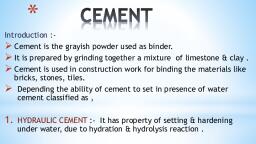
Oinoele-Jdvdu SÞaaole ddishnd PulvonieTo Chuh Jomi, , 1, 1.1, , dInsdy, , Cement, , Introduction, , Cement is an extremely fine material having adhesive and cohesive properties which provi, , a, , binding medium for the discrete ingredients., primarny, , by pulverizing clinker formed by calcinating raw-materials, consisting of lime (Ca0), silicate (SiO,). Alumina (Al,O,), and Iron oxide(Fe,0, When cement is mixed with water it forms a paste which hardens and bind aggregates (fine coarse, , Cement is a product obtained, , hard durable mass called concrete., Cements used in construction industry can be classified as hydraulic and non-hydrauliC., action, water (Due to the chemical, Hydraulic cement set and harden extremely fast in presence of, , together to form a, , which Is, , product, between cement and water known as hydration) and results in water, material, hardened, the, further protects, stable. This allows setting in wet condition or underwater and, resistance, , from chemical attack. e.g.: (Portland cement)., their products, calcination of gypsum or limestone because, Non-hydraulic cements are derived from, can, materials, render the, the addition of pozzolanic, of hydration are not resistant to water. However,, rather it, in wet condition or underwater,, cement hydraulic. Thus, it will not set, make, and, gypsum, some aggressive, carbon-dioxide in the air. It can be attacked by, sets as it dries and reacts with, of Paris., chemicals after setting. e.g.: Plaster, comes in contact with water., exothermic chemical reactions when, The cement experiences the, gravity of 3.15., a, The cement is assumed to have specific, is of 50 kg, thus volume would be, 1440 kg/m* and 1 bag of cement, Standard density of cement is, 50/1440 0.0347 ms., as 0.035 m or 35 litres., of cement can be approximated, Hence, volume of 1 bag, stones or artificially by using calcareous, either from natural cement, Cement can be manufactured, and argillaceous materials., , Calcareous, , Argillaceous, , Cement rock, , Shale and clay, , Limestone, , Blast furnace slag, , Chalk, , . Slate, , Marine shells, , Marl, , 1.2 Cement and Lime, differences may, Following points of, , ., , 2., 3., , be noted, , between ordinary cement and, , lime:, , wnereasS, gains the strength slowl., early strength, of, the, gain, for, The cemernt is used, different., color are, ood uultimate strength but lime experience, The cement and lime, material having good, both is a binding, , cement, , less, , and lime, , as, early strength, , compare, , lime, , to, , cement.
Page 2 :
UPPSC-AE, , MADE ERS, Puetos, , Civil Engineering, , 2, 1.3, , Manufacture, , of Cement, , mariufacturing of cement was first started in England by tha seined), of cement is narmed as Ordinary, The first time manufacturing, orliand, , The, , Cerment (OPC)b, , tha cement comes in contact vih water it becomes a hard mass after a cate, , mass resermbles the stone found in portland area of England, , spdin, , ecause when, hard, , The India is 2d largest manufacturing hub after China., The, , cement is manufactured by integrating the calcareous component and aroillan, , eous, , inratio 3:1., The calcareous, , components, , can, , be, , estone chalk, marine, , shells, marl where, , components can be shale clay, blast furnace slag, slate, The, , calcareoUs component, , is used to derive the, , ingredient called lime whereas, , component composed of silica, alurmina, iron oxide, and other, Cement can be manufactured either by dry process or wet, 1.3.1, , compo, , impurities., , the, , argillaceous, , process., , Dry Process, Step (): The, , material, , gathered from quarry with the help of dumper to, manufacturing plant The, rnaterial gathered is having content of limestone and, clay which is calcareous, component and, argillaceous component respectively. The material gathered is about, more than 80, is, , mm size, , Perforated curved plates, , -Inlet for feeding, , Outer casing, , Steel balls, , Steel shat, , Support, , -Support, , Outiet, Vertical Section of a Bal M, , Step (): The collected, material is fed into heavy crusher, o mm rom 80 mm and later this size materialwhere, is fedthe, into, light, size, , duced to, , crusher, (Tubemili/Ballmil), of the, marenid, , where the, , size, , reduced, , to, , 40-60 mm finally it is stored in the tank
Page 3 :
mADE ERSY, Publicaions, , Building Materials, , Cement, , 3, , r Iniet for, , feeding, Worm for feeding, , Outet funnel, , Sieve, , 2288Stel balls, , 2, , Louter casing, , Support, , Support, , Longitudinal Section of a Tube Mill, , Step, , (il):Now,, , (a), , makes the process, fast, Fuel consumption is, , the, , grinding material called raw, temperature is gradually increased mix is fed into preheater (heater before rotary kiln), tno, upto 500 C due to this, get fraction into smaller, increase in temperature the raw, size nearly (25, mm), Benefits of Preheaters:, (b), , It, , reduced because the, burning time, , of rotary kiln is, get reduced., rotary kiln where the, is 800-1000°C,, termperature, in three separate zones, respectively The product obtained is of size 8 to 10 mm frorn1000-1200°C, 1200-1500"C., Now, this, , raw mix is, , fed into, , rotary kiln is called clinker., , Rotary Kiln, , Dimensions:, Diameter, , 3m, , Length= 100 m, , Revolutions, , =, , Gradient 1 in 25 to 1 in 30., , 3 rounds in 1 minute, , Drying zone, , (800-1000°C) Nodules zone, , (1000-1200°C) Buming zone, , (1200-1500°C), , Inlet, Raw mix, , Refractory, lining, , Outlet, , Hot, air blow, , SupportedX\, , (8 to 10 mm) clinker, , ssome, , ng zone): In this zone the raw mix, is fractioned into more, Zone-1 (Drying, , dler or moisture exist in raw mix then it is also evaporated., , maller size. In this zone if there
Page 4 :
UPPSC-AE, , MADE ERS, Pbliealions, the, , Civil Engineering, , 4, zone):, Zone-2 (Nodule, of, , limestone, , takes place, , In this zone,, , major breakdown, , tne, , Superheat, , CaCO, , of raw mix occur. In this, , CaO +CO0, 1., , zone, , calcinalio, , (Lime), , (Limestone), , NOW, the raw mix which Is also called nodules is, Zone-3 (Burning zone):, roaction between ingredient of clinker occurs l.e. lime, silica, alumina, iron oxides down, e, , and the, , 2 Ca0+SiO,Ca,SiO, (C,S), , malor, , 3 Ca0+SIO Ca,Siog (CS), 3 Ca0+Al,O, Ca,Al,Og (CA), , 4Ca0+Al,O,Fe,0, (CAR), Now from, , this rotary kiln the product, , obtainea is calied dinker which is, , composed of mainr., , minor, , compounds., NOTE: The clinker obtained has, this, , high efficiency to react with water and set immediately (flash set) ton, , immediately setting of clinker in presence of water is done by adding gypsum in a, prevent, tubemil, (v) Now, the clinker is cooled upto temperature of 100°C, after, colling it is fed into tubemill whors, ere the, gypsum is also added to it, the fine grinded powder having gray colour is, obtained which, , is called, , cement., , (vi), , It is, , packed in 50 kg bag having +5% volume capacity of 0.035 m3, , (vii) Now, after packing it is transported to dealers., Calcareous Material (Lime Stone), , Argillaceous Material (Clay), , Crushing, , Crushing, , Fine Grinding in Ball mills&Tube mills, , Fine Grinding in Ball mills &Tube mills, , Storage basin, , Storage basin, , Channel, , Mixing incorrect, , Channel, , proportions, , Preheating 800° by exhaust gases, Storage tank for raW mix, , Fuel fed from lower, End (CoalNatural Gas), , Fedtorotary kiln, Clinkers are fomed, , Addition of 2 to 3%, of gypsum, , Clinkers are ground in Ball, , mill, , Cement Silos, , Packing plant, Flow, , 1.3.2, , Wet Process, , diagram of dry process, , h a wet, n, , wet, , process the heavier crushed, material is made wet in storage tank, process, the preheater is, before feealng rotary kin, not used, the mix, obtained from tubemill is directiy, fed into, rectly ted, , bemil
Page 5 :
Cement, , Building Materials, , MADE ERSY, , 5, , Publications, , Argillaceous Material (Clay), , Calcareous Material (Lime Stone), , Wash mill, , Crusher, , Storage, , Storage basins (silos), , basins (silos), , Channel, , Wet grinding mill (Ball mill), , Channel, , to make slurry, , Blending of slury to correct composition, Storage of corrected slurry, , Fuel fed from lower, End (Coal, oil or, natural gas), , Corrected slury fed to rotary kiln (from upper end), Slurry converted into clinkers, , Addition of 2 to 3%, , Clinkers are ground in Ball mill, , ofgypsum, Cement Silos, , Packing plant, Flow diagram of wet process, , Disadvantages, The process time is long., , (i), , 1.4, , The fuel, , consumption is more., , Chemical Composition of Cement, Composition, , Oxide, , (%), , Average, , Lime Ca0, , 60-65, , 63, , Silica, SiO2, , 17-25, , 20, , 3-8, , Alumina, Al,03, Iron oxide, Fe,03, , 0.5-6, , Magnesia, MgP, , 0.5-4, , Soda/or potash, , 0.5-1, , (NaO+KO), Sulphur tri-oxide, , 1-2, , 1.5, , the various, of three oxide compositions are responsible for influencing, silica and alumina., properties of cement, like lime,, with, a certain value makes it difficult to combine completely, An increase in lime content beyond, , The relative, , proportional, , other compounds., in the clinker and will result in an, Consequently, free time will exist, silica content at the expense of, clinker., , unsound cement. An increase in, , form, alumina and ferric oxide makes the cement difficult to fuse and
Page 6 :
MADE ERSY, , UPPSC-AE, , Civil Engineering, , 6, , Publcations, , Lime (CaO): 1f ime is provided in excess then the cement becomes unsound and if it is in deficienoy, noy, then the strength is reduced therefore chances of quick setting will be enhanced., , 1., , Silica (Sio,):It imparts strength to the cement due to the formation of di-calcium and tri-calcium, silicates. If it is in excess then the strength of the cement would enhanced therefore setting time, gets prolonged, hence it prevents quick setting., Alumina (A/0,): t imparts quick setting property of cement. If it is in excess then the strength of, , 3., , cement is reduced and the chances of rapid hardening would be increased. It acts as a flux and it, lower's the linker temperature., 4, , Calcum Sulphate (Caso,) : tis aretarder(admixture).Ifit is in excess then it slowdown the quick, setting which dominates to increase the strength. It is a gypsum form., , Iron Oxide(Fe,0,): Itimparts colour, harcness, and strength to the cement. If it is in excess, then, , 5., , it, , imparts more coloured to the cement (grey)., , Magnesia (Mgo): It imparts hardness and colour (yellow) to the cement, if it is in small quantity, and, if it is in excess then it, , imparts unsoundness to the cement., , Sulphur (S): If it is in reference quantity then it imparts strength to the cement and it is in excess, then the unsoundness is increased., , Alkalies (Soda and Potash), , (Na,O +K,0) : The most of the alkalies present in raw materials are, carried away by the flue gases heating and the cement contents, only a small amount of alkalies. If, they are in excess in cement then they cause a number of troubles such as, alkali-aggregate, efflorescence and staining when used in concrete, brick work or, mortar., , reaction, , masonry, , Sio,, OPC, , and, , Example-1.1 Four main oxides present in ordinary portland cement are: CaO,, AL,Og, Fe,Og. Identify the correct ascending order of their proportions in a typical, composition of, , (a) AlLO, Fe,O, CaO, Sio,, (c) Fe,Og, Al,Og, SiO, CaO, , (b), , AlLO, , Ca0, Fe,Og, , SiO, , (d) Fe,O SiO, Al,O5, Ca0, , Solution: (c), , 1.5, , Basic, , Properties of Bouge Compounds, The principle mineral, , compounds in portland, cement, 1. Tri-calcium silicate, 2. Di-calcium silicate, 3., , Tri-calcium alluminate, , 4., , Tetra-calcium alumino, ferrite, , 1., , Formula, , Name, , Symbol, , Percentage, , 3CaOiO, , Alite, , CS, , 30-50%, , 2CaOSio, 3CaOAI,O,, , Belite, , CS, , 20-45%, , Celite, , CA, , 8-12%, , 4CaOAl,O,, , Felite, , C,AF, , 6-10%, , Fe,O, , Tri-calcium Silicate (CS): It produces faster rate of, early strength to the cement and also contribute reaction with greater heat evolution, it imparts, good for ultimate strength. If it is in excess then, rapid hardening enhances.
Page 7 :
Cement, , Building Materials, , mADE ERSY, Publications, , 7, , Di-calcium Silicate (C,S): It hydrates slowly and imparts ultimate strength much. The C,3 has less, , heat of hydration therefore it is resistant against chemical attack., 3., , Tri-calcium Aluminate (C,A): It imparts fast reaction with water and it produces very high heat, , therefor it imparts more towards rapid hardening., If CA would be more then immediate setting (flash set) would be enhanced to prevent this flash, , setting gypsum is added to it during manufacturing, Tetracalcium Alumino Ferite (CAF) : It also reacts with water at faster rate and evolves heat by, , greater extent but it is more stable then C.A because if produces, Example-1.2, , The initial, , less heat compared to, , CA., , setting time of cement depends most on, , (a) tri-calcium aluminate, , (b), , tri-calcium silicate, , (c) tri-calcium alumino-ferrite, , (d), , di-calcium silicate, , Solution: (a), , of, water and may lead to an immediate stiffening, The compound CA is characteristically fast reacting with, most on CA, initial setting time of cement depends, paste, and this process is termed flash set. Hence,, , NOTE, , order of ultimate: (CS> CS> CA> CAF), water: (CA> CAF> CS> CS), Decreasing order of quickest reaction with, total heat, increase in fineness of cement. However,, Decreasing, , The rate of hydration is increased by an, in figure and, is, rate of hydration of the principal compounds shown, the, The, is, same., evolved, will, , order. CAF> CA> CS> CS, beinthefollowing descending, , 0CAF, 0.8, 0.6, , CS, , 04, 0.2, 100, , 10, , 180, , Time (log scale) - days, , Fig. Rate of Hydration of, Rate, , Pure, , Compounds, , amount of each is, compOund, if equal, of heat evolution of Bougue, , considered will be in, , following descending order, , (865, CA (865 J/gm)>CS, , J/gm) >, , CAF (420 J/gm) > CS (260 J/gm)., Heat of hydration at the given age (Jig), , Compound, , 3days, , 90 days, , 242.44, 50.16, , 434.72, 175.56, , 509.96, , C3S, , 886.16, , 1299.98, , 1354.32, , 288.42, , 409.64, , 426.36, , CS, CgA, , CA, , Heat of Hydration, , 13 years, 246.62
Page 8 :
8, , UPPSC-AE, , CivilEngineeting, , Development of strength of four Bougue bortipourids 6o Gettietn iti at, , 60, , 40, , aueultzuaztuzeea, , GAF, , 7 28, , 160, , 360, , Ago days, Fig., , Example-1.3, , hydration, (a), (c), , Developmenit of strenglh of Pure Goripotunle, , Which of the following shows the, CORFRECT, , of Portland cement, , compounds?, , CA> C,AF > C,S>CS, CA> C,S> C,S> C,AF, , (b), , CA>CAF> C,S> G,S, , (d) CAF> CA>, , Solution: (d), , The rate of hydration is, increased by an increase in, same. The rate of, hydration of the principal, , 1.6, , G3> C3, , fineness of cernent., , compounds, , descending order, , deGrsasing order of rste d, , is shown in, , Howevst, total heat Gvoved is te, figure and will be in fhe folcwing, , CAF>GA>C,S> CS, , Hydration of Cement, The, , chemical reaction of cement with, water is roferrod as, The reaction of, hydration of cement, cement and water is, exothermic, reaction i.e. heat is liberated in, quantity and this liberated heat is called, a, heat, of, The, water, , added, , during hydration, , to the cement will, to forma, , leads, , calcium silicate, , to, , hydration., , ovolution of heat, the, C,S and C,S reacts witn wa, , hydrate, with Ca(OH), hydrate is responsible for along, good properties of cement concrete., having binding property whereas, The cai, the, , The calcium silicate, , Silicate hydrate is, cement concrete because, The, , it is, , Ca(OH),, responsible for lack of durability, of, , is not, , a, , desirable produci, , Ca(OH), also reacts with sulphur, concrete., in water or soil to, present, with CA and, form, C,AF to cause a deterioration of, CaSO,, concrete this effect is called, , CgS+Water, , CS+Water, , considerats, , C-S-HGel +Ca(OH), , C-S-H Gel Ca(OH)2, +, , Binding proprty, , Ca(OH)+ Sulphur, , Durability, , CaSO, +CA, , Which further rea, , sulphate attack.
Page 9 :
MADE ERSY, , Building Materials, , Publications, , Cement, , 9, , CaSO +CaAF, Product, Saity nature), , Deterioration, of concrete, Durability, , decreases, , To reduce sulphate attack:, 1, , 2, , Sulphur content in water (Les), CA and CAF (Jes), , NOTE, The total amount of water required for complete chemical reaction between cement and water, , is 38%. If the gel pores/voids in cement exist where 15% of water is required to fill the voids, and gel pores and this percentage is taken by weight., , 1.7, , Types of Cement, There are diferent types of cement as classified by the Bureau of Indian Standards (BIS):, Ordinary Portland Cement, , (a) 33 grade - IS: 269-1989, (b) 43 grade - IS: 8112-1989, (c) 53 grade - IS: 12269-1987, Gi), , Rapid Hardening Cement - IS: 8041-1990, , (i) Extra Rapid Hardening Cement, , (iv), (v), , Low Heat Portland Cement- IS: 12600-1989, Portland, , Slag Cement- IS:, , 455-1989, , (vi) Portland Pozzolana Cement-IS: 1489-1991 (Part 1 and 2), (vil) Sulphate Resisting Portland Cement- IS: 12330-1988, (vii) White Portland Cement - IS: 8042-1989, (ix) Coloured Portland Cement - IS: 8042-1989, (x) Hydrophobic Cement- IS: 8043-1991, 6452-1989, (xi) High Alumina Cement IS:, 6909-1990, (xii) Super Sulphated Cement-IS:, -, , (xii) Special Cements, (a) Masonry Cement, , (b), , Air Entraining Cement, , (c) Expansive Cement, , (d), 1.7.1, , Oil Well Cement, , Ordinary Portland Cement (0PC), It is obtained, , by Pulverizing argillaceous, , and calcareous material in correct proportion., , known, of artificial cement and most commonly, Portland cement is most common variety, , (Ordinary Portland Cement)., , as, , O.P.C.
Page 10 :
mADE ERS, , UPPSC-AE, , Civil Engineering, , 10, , Public, , It is available in 3 grades:, , (a) OPC-33 grade (1S: 269-989), , (b) OPC-43 grade (IS:8112-1989), (c)OPC-53grade (1S: 12269-1987, The number 33, 43, 53 corresponds to 28 days characteristic, compressive strenathth ntof cementa, obtained from standard test on cement sand mortar (1:3) specimens., The OPC 33 is recommended for concrete mix having, These are most commonly used in, concrete, , general, , sulphates., Due to high fineness,, , strength upto 20 N/mm2i.e. M2n, , construction, where there is no ev, , the, , workability of concrete increases for a given water-cement, ratio. iS, classified the OPC gradewise from "A to F" based on 28, days compressive, strength as follows, Itis presently available in three, different grades viz. OPC 33, OPC 43 and, OPC 53. The, 43 and 53, to, numbers a, has, , S10262, , correspond the 28 days (characteristic) compressive, strength of, from standard tests on, cement-sand mortar specimens., It is used in, general concrete construction where there is no, to, exposure, , ground water., 1.7.2, , s 33, , cement as obtains, ained, , sulphates in the soil orin, , Rapid Hardening Cement (RHC), It is finer than, It, , ordinary Portland cement., , contains more, , The 1 day, , C,S and less C,S than the OPC., , strength of this cement is equal to the 3, days, of OPC with the, The main, same water, advantage of rapid hardening cement is strength, cement ratio, that, thus saving, shuttering may be removed much, considerable time and, earlier, , Rapid hardening cement is also, , the minimum delay., , Cost, , of, , Extra Rapid, It is, , used for road work where, it is, , Rapid hardening cement is, , It can be, , 1.7.3, , expenses., , imperative to open the road trafic with, , nearly 10-15% more than OPC., , safely exposed to frost as it, , Hardening Cement (ERHC), , matures, , obtained by mixing, calcium chloride, (not, cement) with rapid, hardening, cement., Addition of, , more, , quickly., , exceeding 2%, , by weight of the rapid, hardeni, , CaCl, imparts quick setting, properties in extra rapid, hardening cement., setting, hardening and evolution, of, heat, very suitable for, in, concreting in cold weathers. the early period of hydration man, The 1 or 2 day, strength of extra, The acceleration, of, this cement, , cement., The gain of, , rapid hardening cement, , strength disappears with age, , rapid hardening cement, , are, , and 90 days, , nearly the same., , is 25% more, than that, , strength of extra rapid, , of rapid nardiening, , hardening cenic, rapid hardening cement, is, Maximum time of, using this cement is 20prohibited in prestressed concrete, construction, minute for mixing,, transporting, placing and o, Use of extra
Page 11 :
MADE ERSY, , Building Materials, , Publlcations, , 1.7.4, , Cement, , 11, , Low Heat Cement (LHC), It is a Portland cement which is obtained by reducing the more rapidly hydrating compounds, Cgs, and CA and increasing C,S., As per the Indian Standard specifications, the heat of hydration of low-heat cement shall be as, follows:, 7, , days-not more than 65 calories per gm, 28 days- not more than 75 calories per gm, , Since the rate of gain of strength of this cement is slow, hence adequate precaution should be taken, , in its use such as with regard to removal of formwork, etc., LHC is used in massive construction works like abutments, retaining walls, dams, etc. where the, , rate at which the heat can be lost at the surface is lower than at which the heat is initially generated., It has low rate of gain of strength, but the ultimate strength is practically the same as that of OPC., , 1.7.5, , Portland Blast Furnace Slag Cement, This cement is made by intergrinding Portland cement clinker and granulated blast furnace slag, The proportion of the slag being not less than 25% or more than 65% by weight of cement., , The slag should be granulated blast furnace slag of high lime content, which is produced by rapid, quenching of molten slag obtained during the manufacture of pig iron in a blast furnace., , In general blast furnace slag cement is found to gain strength more slowly than the ordinary Portiand, , cement, The heat of hydration of Portland blast furnace slag cement is lower than that of OPC. So this cement, , concreting but is unsuitable for cold weather., in, It has fairly high sulphate resistance, rendering it suitable for use, , can, , be used for, , mass, , environments, , exposed, , to, , sulphates (in the soil or in ground water)., cement is used., It is used for all purpose for which ordinary Portland, concrete structure such as dams, foundations, Because of its low heat evolution, it can be used in mass, and bridge abutments., , 1.7.6, , Portland Pozzolana Cement (PPC), It, , can, , be, , produced, , either, , addition of gypsum or, , by grinding together, , Portland cement clinker and, , cement and fine, by blending uniformly Portland, , pozzolana with the, , pozzolana., , of pozzolana may vary from 15 to 35% by weight of, As per the latest amendment, the propotion, was 10 to 25%., cement clinker. Earlier, it, no, a siliccious or aluminous material which in itself possess, A pozzolanic material is essentially, divided form and in the presence of water reacts with calcium, in, cementitious properties, which finely, process at ordinary temperature to produce compounds, hydroxide, liberated in the hydration, This is known as pozzolanic action i.e., , possessing, , cementitious, , properties., , Ca(OH), +, , Pozzolana, , +Water, , C-S-H(gel), , for manutacture of Portland, , used, The pozzolanic materials generally, ash, 1489 part 2 of 1991), , clay (IS:, , Flyash, fuel., , or fly, , in a, isa waste material generated, , (IS:, , 1489 part 1 of, , thermal pOwer, , pozzolana cement are calcined, , 1991), , used as, station, when powdered coal is, , a
Page 12 :
12, , mADE ERS, , UPPSC-AE, , Cvil Engineerin9, , PPC produces less heat of hydration and offers greal resislance lo lhe allack ofineut, than OPC, PPCis paticularly usetul in marine and hydraulle consiruclions, and ofher mass conorelssto, , The disadvantage of using PPC is that the reduotion in alkalinily redluoes he resistanseto, of steel reinforcement, But consldering the fact that Ppd signlioanly improves the petinet, concrete, thereby increases the resistance to corosion of reinforcement., This cement has, lime., , higher resistance to chemical agencies and to sea Waler because, besauss ofof aks, abseneed, , It evolves less heat and its initial, , strength, , is less but final, , slrengin, , OPC., It has lower rate of, , average compressive strength of cement mortar (1:3) at, , 0, , at 1 day + 1 hr, , 16 MPa (Minimum), , 2 hr, , 22 MPa (Minimum), , (i) at 28 day + 4 hr, , 1.7.7, , days onWard) is sau, , development of strength than OPC,, , The, , Gi) at 7 day, , (28, , 33 MPa (Minimum), , Acid Resistant Cement (ARC), An acid resistant cement is, , composed of the following:, () Acid resistant aggregates such as, quartz, quartzites, etc., i) Additive such as NaSiF (This accelerates, , 1.7.8, , hardening)., , il) Solution of sodium silicate or soluble, glass (sodium silicate is a binding, material)., The addition 0.5% of linseed oil or 2% of, cerussite increases resistance to water, also., , Sulphate Resisting Cement (SRC), The Portland cement with low, CA and CAF and ground finer than OPC is known, as sulphate, resisting cement and generally CS and, C,S kept about 45 % each., This cement is, sulphate-resistant because the disintegration of harden concrete, chemical reaction of CA with soluble, sulphate lime MgSO, CaSO, and Na,SO, is caused by the, The setting time are same as, inhibited., that of OPC., The compressive, strength of the cubes should be as, 3, , Day +, 7 Day +, , 1 hr, , =, , 2 hr, , =, , 28 Day +4 hr, , follows:, , N/mm?, 16 N/mm2, 10, , =, , 33, , N/mm, , This cement is, , "sulphate resistant" because the, disintegration of concrete caused by the reacio, CA in hardened cement with a sulphate salt from, outside, , It is used in, , is, , inhibited., , marine structures,, sewage treatment works, and in, soil is infested with, sulphates., , However, recent research indicates, that the, environments where chlorides are, present., , use, , of, , of, , foundations and basemeniswhere, , sulphate resisting cement is not bene, , cial in
Page 13 :
mADE ERSY, , Cement, , Building Materials, , 13, , Publications, , 1.7.9, , Coloured Cement (White Cement), The process of manufacturing white cement is the same but the amount of iron oxide which is, , responsible for greyish colour is limited to less than 1 per cent., Sodium Alumino Ferrite (Cryolite) Na, AlF is added to act as flux in the absence of iron oxide, The properties of white cement is nearly same as OPC., , Whiteness of white cement is measured by 1SI scale or Hunter's scale., The whiteness should not be less than 70% on ISI scale and on Hunter's scale it is generally 90%, The strength of white cement is much higher than what is stated in IS: 8042-1989, the code for, white cement., Grey colour of OPC is due to the presence of iron oxide. Hence in white cement, Fo,O, is limited to, 1%. Sodium Alumino Ferrite (Cryolite) Na,AlF is added to act as flux in the absence of iron oxide, , 1.7.10 High Alumina Cement (HAC), It is very different in composition from Portland cement., In this cement the CA content is very low due to which it is resistant to sulphur attacks and, chemical attacks., Its sets quickly and attains higher ultimate strength in a short period. Its strength after 1 day is, , about 40 N/mm and that after 3 days is about 50 N/mm, It is characterized by its dark colour, high early strength, high heat of hydration., The raw materials used for its manufacture consists of limestone (or chalk) and bauxite which is a, , special clay with high alumina content., The bauxite is an aluminium ore. It is specified that total alumina content should not be less than 32, per cent and the ratio, , by weight of alumina to the lime should be between 0.85 and, , 1.30., , It is resistant to freezing and thawing., It has an initial setting time of 3.5 hours and final setting time of about 5 hours., , High alumina cement is very expensive to manufacture., It is used where early removal of the formwork is required., monocalcium, Its rapid hardening properties arise from the presence of calcium aluminate, chiefly, of Portland cement, aluminate (AlL,O,. CaO), as the predominant compound in place of calcium silicates, in the case of Portland cement., and for setting and hardening there is no free hydrated lime as, It must not be mixed with any other type of cement., 1.7.11, , Quick Setting Portland Cement, In the manufacture of this cement, gypsum content is reduced to get the quick setting property., added., Also small amount of aluminium sulphate is, It is ground much finer than OPC., It sets quickly but does not harden quickly., time 5 minutes, Final setting time 30 minutes., Initial, , setting, , =, , =, , under water., It is used when concrete is to be laid, , 1.7.12 Masonry Cement (IS: 3466), mixture of Portland cement or blended hydraulic cement and plasticizing, other materials introduces, limestone or hydrated or hydraulic lime) together with, , Masonry cement consists of a, materials, , (such as, , to enhance one or more, , properties such as setting time, workability,, , water retention, and, , durability.
Page 14 :
14, , mADE ERSY, , UPPSC AE, , CvilEngineering, , shrinkAgG and walerretentively, , workability, reducGs, work el0, Thie eement ia uaed for masonry worke, plaster, Masorniry construction, work but used far, eonorele, for, used, be, He cemernt muet not, to lime rmo, rtar, incorporales all he good properties, mortar,, making, for, uaed, Masenry eement when, cement morlar, and diecalde al the nen ldeal properties of, Additen of these maleriala gives good, , 1.7.13 Super Sulphated Cement (SSC), calcium sulphate (10-15%), t ie made fom well granulated blast furnace slag (80-85%),, cement,, cement (1%) and ia ground finer than the Portland, h this cement CA, which ia susceptible to sulphates is limited to less than 3.5%, , and Portlant, , of extra iron oxide beforefiring thie, combines With alumina which would otherwise form CaA, instead forming CAF Which is not affected, , Sulphate resieting cement can alao be produced by the addition, , by sulphates., It should be used in places with temperature ls below 40°C,, , Compresslve strength should be as follows:, 3Day& 1 hr=15 N/mm, , 7 Day 2 hr= 22 N/mm, 28 Day& 4 hr, , =, , 30, , N/mm, , It has low heat of hydration, It is used for construction of dams and other mass concreting works., , Concrete made from super sulphated cement may expand if cured in water and, may shrink if the, , concrete is cured in air., , It has high resistance to chemical attack., , 1.7.14 Air, , Entraining Cement (AEC), This cement is made by mixing a small amount of an air, entraining agent with OPC clinker at the time, of grinding., It is manufactured by mixing a small amount of, air entraining agent i.e. 0.1%, to 0.3% with OPC, clinker at time of grinding, It, , offers, , good workability due to which it is having higher initial, setting time than OPC., It is having lesser final, setting time as compared to OPC, due to, which it offers resistance to, freezing and thawing, Air entrainment, etc., , improves workability and W/c ratio can be reduced, , It is, , yet not been covered by Indian Standard, Some of the air entraining agents are:, ), , so, , which in turn reduces, shrinkage, , far., , Alkali salts of wood resins., , (i) Synthetic detergents of the, alkyl-aryl sulphonate type., (ii) Calcium lignosulphate., , produces tough, tiny, discrete, non-coalescing air, bubbles at, concrete which will modify the, properties of plastic concrete with the time of mixing, It, , and bleeding., , in the, , respect to workability,, , body of, , segregation
Page 15 :
MADE EASY, , Building Materials, , Cement, , -Publicatlona, , 15, , 1.7.15 Hydrophobic Cement, It is obtained by intergrinding OPC with 0.1-0.4 per cent of water repellant fim-forming substance, Such as oleic acid or stearic acid, The water repellant film formed around each grain of cement reduces the rate of deterioration of the, , cement during long storage, transportation, or under unfavourable conditions, The properties of hydrophobic cement are nearly the same as that of OPC, The cost of this cement is norminally higher than, , OPC, , Hydrophobic cement also features greater water resistance and water impermeability, Example-1.4, , Which one of the following cement is best for the marine works?, , (a) Blast surface slag cement, (c) Low heat Portland cement, , (b) High alumina cement, (d) Rapid hardening cement, , Solution: (a), Example-1.5, , For road pavements, the cement generally used is, , (a) ordinary Portland cement, (c) low heat cement, , (b) rapid hardening cement, (d) blast furnace slag cement, , Solution: (b), , Since in roads, high early strength is required. So, rapid hardening cement is used, Example-1.6, , The major compounds in Ordinary Portland Cement responsible for its, , strength are:, , (a) Dicalcium silicate and Tetracalcium alumino ferrite, (b) Tricalcium silicate and Dicalcium silicate, (c) Tricalcium aluminate, (d) Tetracalcium alumino ferrite, Solution: (b), C,s (Dicalcium Silicate) and CS (Tricalcium Silicate) together constitute about 70-80% of the cement and, control the most of strength giving properties., , 1.8 Testing of Cement, 1.8.1, , Field Tests for Cements, Colour: Grey colour with a light greenish shade., Physical Properties: Cement should feel smooth when rubbed in between the fingers., , If hand is inserted in a bag or heap of cement, it should feel cool., lfa small quantity of cement is thrown in a bucket of water, it should sink and should not float on, , the surface., Presence of lumps: Cement should be free from lumps.
Page 17 :
MADE ERSH, , Building Materials, , Publeations, , Cement, , 17, , The normal (standard) consistency of a cement paste is defined as that consistency which will, permit a Vicat plunger having 10 mm diameter and 50 mm length to penetrate a depth of 33 to, 35 mm from the top (or 5 to 7 mm from the bottom) of the mould., , Vicat Apparatus:, Vicat apparatus assembly consists of a plunger 300 gm in weight with a length of 50 mm and, diameter of 10 mm and a mould which is 40 mm deep and 80 mm in diameter., There are two attachments for the plunger viz.:, 0, , Asquare needle with 1 mm cross-section which is attached to the plunger for initial setting time, test., , i) A needle with an annular collar of 5 mm diameter which is used for final setting time., Test Procedure:, To prepare the paste, take weighed quantity (300 g) of cement and place it in a crucible., , Mix a weighed quantity of water (approximately 24% by weight of cement) for the first trial., The time of mixing or gauging should not be less than 3 minutes nor more than 5 minutes and, gauging time should be counted from the time of adding water to the dry cement until commencing, , to fill the mould., The Vicat mould is flled with the paste, which is levelled off at its top., The mould is placed under the Vicat plunger., The vicat plunger is brought down to touch the surface of paste in the mould and quickly released, , allowing it to sink into the paste by its own weight., Take the reading by noting the depth of penetration of the plunger., Similarly conduct the trials with increasingly water/cement ratios till such time the plunger penetrates, for a depth of 33 to 35 mm from the top (or 5 to 7 mm from the bottom)., That particular percentage of water which allows the plunger to penetrate only to a depth of 33 to 35, , from the top (or 5 to 7 mm from the bottom) is known as the percentage of water required to produce, a cement paste of normal (standard) consistency., This percentage is generally denoted by P, This test should be conducted at a constant temperature of 27° + 2°C and a constant humidity of 90%., , 1.8.2.3, , Initial Setting Time Test, It is the time elapsed between the moment that the water is added to the cement, to the time that the, , paste starts losing its plasticity., The test procedure is as follows:, 0, , Take 300 gm of cement and make a cement paste of consistency 0.85 P, , (i) Attach the square needle to the Vicat plunger and lower it gently to make contact with the, surface of test block and quickly release it., , (Gi) When the needle penetrates only to a depth of 33 to 35 mm from the top (or 5 to 7 mm from the, bottom), the test is completed., Initial setting time should not be less than 30 minutes for OPC and 60 minutes for low heat cement., , 1.8.2.4, , Final Setting Time Test, , The final setting time is the time elapsed between the moment the water is added to the cement and, the time when the paste has completely lost its plasticity and has attained sufficient firmness to, resist certain definite pressure.
Page 18 :
MADE ERS, , UPPSC-AE, , Civil Engineering, , 18, , Publeatt, , The test procedure is as follows:, make a cement, , paste of consistency of 0.85 P, , ) Take 300 gm of cement and, annular collar., a needle with, (i) Replace the square needle by, the surface of test block., attachment to gently cover, Lower, the, it), (iv), , If the needle makes, , an, , impression, while the, , annular collar of the attachment, has attained such, , finally set. Thus, the paste, more than 0.5 mm., needle does not pierce through the paste, , cement, , The final, , is considered to be, , setting time should not be more, , fail., , hard0o,, s tha the, , than 10 hours., , NOTE, Significance of initial and final setting time:, (a), , till final seting has take place., Concrete once place should not be disturbed, where concrete is prepared to the placine, The transportation of concrete from the place, Ang, , (b) concrete required some finite time that should be within the initial setting time, , of, , (c) Final setting time test is done because the concrete should achieve the desired strenathas, early as possible so that the shuttering, 1.8.2.5, , can, , be removed and reused., , Soundness Test, Soundness of cement indicates that the cement paste, once it has set, does not undergo appretiah, Clabe, , change in volume causing concrete to crack., , The cement having some quantity of free lime, magnesia and excess sulphates undergoes laroe, di, cracks., , changes in volume as the time elapses tending to, The soundness of cement is determined either by 'Le Chateliers method' or by means of Autoclave'test, cause, , No satisfactory test is available for assessment of soundness due to excess of calcium sulphate, but its content can be easily determined by chemical analysis., , (a), , Le Chatelier's Method:, 165mm, 30 mm diameter, , 0.5 mm, Split not more than 0.5 mm, , 30 mm, , Le-Chatelier apparatus for finding soundness of cement, , mm in, , The Le Chatelier's apparatus consists of a small split cylinder of spring brass. It iS du165mm, , diameter and 30 mm high. On either side of the split are attached two indicatorarmis i, long with pointed ends., , Take 100 gm of cement and make a cement paste of consistency 0.78 P., , Fillthe cement paste in the mould and keep it on a glass plate., .Cover the mould on the top by another glass plate., , The whole assembly is immersed in water at a temperature of 279-32°C and kept there o, , hours
Page 19 :
MADE EASY, , Cement, , Building Materials, , Publlcations, , 19, , The assembly is taken out after 24 hours and the distance between the indicator polnts is, , measured., , The mould is then immersed in a water bath., The water of the bath is brought to boiling point with the mould submerged in 25 to 30 minutes, and kept boiling for 3 hour., The mould is taken out from water and allowed to cool., , Distance betweenthe points is then measured., The difference between the two measurement represents the expansion of cement, , The Le Chatelier's method detects unsoundness due to free lime only., T h i s method of testing does not indicate the presence and after effect of the excess of magnesia, , and calcium sulphate., The expansion of cement must not exceed 10 mm for OPC, rapid hardening and low heat Portland, cements by this method., OPC, Rapid Hardening Cenent, Low Heat Cement, PPC can have maximum expansion less, than 10 mm whereas high alumina cement and super sulphated cement can have maximum, , expansion less than 5 mm., (b) Autoclave Test:, Indian Standard specification recommends that a cement having a magnesia content of more, , than 3 per cent shall be tested for soundness by autoclave test which is sensitive to both free, magnesia and free lime., In this test, a cement paste of 25 mm x 25 mm x 250 mm is placed in a standard autoclave., Now, the steam pressure inside the autoclave is raised at such a rate so as to bring the gauge, pressure of the steam to 21 kg/cm2 in 1 hour to 1 hour 15 minutes from the time the heat is turned, on., , This pressure is maintained for three hours., The autoclave is cooled and length of the specimen is measured again., T h e expansion should not exceed 0.8%., For OPC (33, 43, 53); SRC; PPC, RHC, LHC, Slag cement, 1% for masonry cement., 1.8.2.6, , Strength Test, , (a) Compressive Strength Test:, The compressive strength of the hardened cement is the most important of all the properties., Take 185 gm of standard sand (Ennore sand), 55 gm of cement (i.e. ratio of cement to sand is, , 1:3) and mix them with a, , trowel for, , Add water of quantityy, , one, , minute., , % of combined weight of cement and sand where P is the, , percentage of water required to produce a cement paste of normal consistency., This time of mixing should not be less than 3 minutes and not more than 4 minutes., Immediately, after mixing, the mortar is filled in a cube mould of size 7.06 cm. The area of the, , face of cube should be 50 cm2, Compact the mortar either by hand compaction in a standard specified manner or on the vibrating, , equipment for 2 minutes. (vibrations, , =, , 1200 + 400, , vibrations/minute)
Page 20 :
ADE ERS, , UPPSC-AE, , 20, , Civil Engineering, Keep the compacted, humidity for 24 hours., After 24 hours,, , mould at a, cube in the, , temperature, , of 270 t 2°C, , mould and immersed, removed from the, the cubes are, , andat, , PublieNoh, , least 90%, , in clean, , relath, , resh water ung, , taken out for testing., , 7, 3, 28cdo, strength at 1 day, days, days and, Three cubes are tested for compressive completion of vibration., reckoned from the, period of testing being, of the strengths of the threa., shall be the average, compressive strength, , where the, , cubes for each, , The, , period respectively., 16 Mn., OPC at 3 days, 7 days and 28 days is 1e, MPa,, The compressive strength of 33 grade, and 33 MPa respectively, on cubes by using compressive testinas, Load applied gradually as 0 to 35 N/mm/min, (UTM machine)., (b) Tensile Strength Test:, , 22 MPa, , Cement, , The tensile strength of cement may, be obtained by Briquette test., , of cement and sand is, gauged in the proportion of 1:3 by, , A mixture, , Elevation, 38.10 mm, , 38.10 mm, , weight., The percentage of water to be used is, , calculated by the formulaE, where P is percentage of water, required to produce a paste of, , - 50.80 mm-, , 12.70 mm, , 12.70 mm, , 76.20 mm, , standard consistency., , Plan, , .The mix is filledin the briquette, , Standard biquette, , moulds and the surface of the mould, , is finished with the blade of a trowel, Briquette mould is then kept for 24 hours at a temperature of 270, having 90% humidity., The, , 2°C and in an atmosphere, , briquettes (6.45 cm) are then kept in clean water and are taken out before testing., , .Six briquettes are tested and average tensile strength is calculated., Load is, , applied steadily and uniformly, starting from zero and increasing at the rate of 0.7 N/m, , in 12 seconds., , OPC should have, , 1.8.2.7, , a, , tensile, , strength, , of not less than 2 MPa and 2.5 MPa after 3, , respectively., Generally tensile strength is 10-15% of compressive strength., Load applied steadily or uniformly from 0 to 0.7, N/mm2 in 12 second., , and 7 0ay9, , Fineness Test, , Fineness is the measure of the size of the cement, area per unit mass)., The rate of hydration and, , of particles., , particles in terms of specific surtace (.6., , hydrolysis and the subsequent setting of cement depends upon, , lis, , urtace, , SS
Page 21 :
MADE ERSY, , Cement, , Building Materials, , 21, , Publications, ne rate of gain of strength is rapid for finer cement, though the final strength is not affected by, , fineness., , Fineness of cement is measured in terms of its specific surface, There are three methods for testing fineness viz., , () Sleve method or particle size distribution method, (i) Air permeability method (Nurse and Blaine's method), (Gil) Sedimentation method or Wagner's turbidimeter method, (a) Sieve Method:, 100 gm of cement, , sample, , is taken and air set lumps, if any, in the sample, , are broken with, , fingers., , The sample is placed on a 90 micron sieve and continuously sieved for 15 minutes., The residue should not exceed the limits specified below:, % Residue by weight, , S.No. Type of cement, , 0, (), , Ordinary Portland cement, , 10, , Rapid hardening cement, , 5, , (il) Portland pozzolana cement, , 5, , (b) Air Permeability Method:, Dry air, , Cement, Capillary tube, 0.8 mm bore, , 280 cm long, , Permeability, cell, , Flowmeter, , cm, , approx, , Manometer, , Pemeability apparatus with, , manometer and flow meter, , Fineness of cement is represented by specific surface i.e. total surface area in cm2 per gram of, cement.
Page 22 :
22, , UPPSC-AE, , Civil Engineering, Fineness can, , be estimated either by using, , Pubiicattons, , Lea and Nurse alr, , Blaine's air permeability apparatus., lo determine the fineness, a, , MADE ERSY, , ww.wwww, , cm height, cementsample of2, , Is, , permeabiliny apparatus, , or by usino, , perforations is 40 u) and air pressure is applied., and, the permeabillty cell, The manometer is connected to the top of, , ofthe permeability cellis then slowly, , The rate of flow is, , so, , adjusted that the flowmeter, , ated plate (sze, , placea ona perforated plato, , of, , The lower end, , or, , the air is, , turned on, , ofthe manom., ometer, pressure difrerence (h,) of 30-50, 50 cm., , connected to the other end, , shows, , a, , ., , The reading in manometer (h,) is recorded., I h e process is repeated till the ratio hh attains a constant value., The specific surface is given bythe expression, 14, S=, , where,, , d1-, , A, , KL Vh2, , Lis thickness of cement layer, , A is area of cement layer, , dis density of cement, h, is flowmeter reading, , yis porosity of cement (i.e. 0.475), , h, is manometer reading, , Kis flow meter constant, , (c) Wagner Turbidimeter Test:, The cement is dispersed uniformly in a rectangular glass tank filled with kerosene., Parallel light rays are passed through the solution which strike the sensitive plate of a photoelectric, cell., , The turbidity of the solution at a given instant is measured by taking readings of the current, generated by the cel., , By recording the readings at regular intervals while particles are falling in the solution, it is, possible to secure information regarding the grading in surface area and in size of particle., Readings are expressed in cm/gm., 1.8.2.8, , Heat of Hydration Test, Heat is evolved, , during hydration of cement, the amount being dependent on the relative, , of clinker compounds., , quantiues, , The apparatus used to determine the heat of, hydration of cement is known as calorimeter., of, 60 gm cement and 24 ml of distilled water are mixed, for 4 minutes at a temperature, , betwedi, , 15-25°C, Three, , specimen glasSs vials, , 100 mm, , x, , 20 mm are, , wax., , The vials, , are, , then stored with mixture in, , filled with this mixture, corked and sealed, wi, , a vertical position at 270 +2°C, respective heat of solution of hydrated cel ent, , The heat of hydration is obtained by, subtracting the, from the heat of solution of unhydrated cement, , calculated nearest to 0.1 calorie., The heat of solution of hydrated cement is calculated, by using calorimeter., The heat of hydration for low heat Portland cement, should not be more than 66 and 75 gm tor, 7 and 28 days respectively., calyg
Page 23 :
Cement, , Building Materials, , mADE ERSY, , 23, , Publications, , 1.8.2.9, , Specific Gravity Test, The specific, , gravity of cement is obtained by using Le Chatelier's, , flask., , Long seasoning is the chief cause for low specific gravity in an unadulterated cement, The flask isfilled either with kerosene free of water or naphtha having, 0.7313 to a point on the stem between zero and 1 ml mark, , The flask is then immersed in a, , a, , specific gravity not less than, , constant temperature water bath and the, , A weighed quantity of cement is then introduced in small amounts at the, , reading is recorded., same, , temperature as that, , of the liquid., flask is rolled in, all the cement, the stopper is placed in the flask and the, free the cement from air until, inclined position, or gently whirled in a horizontal circle so as to, further air bubbles rise to the surface of liquid., immersed in water bath and the final reading is recorded., The flask is, After, , introducing, , an, no, , again, The difference between the first and the final reading represents the volume of liquid displaced by, the weight of cement used in the test., , Weight of cement (in gms, Specific gravity= Weignt of displaced volume of liquid (in m), The specific gravity of Portiand cement is generaly about 3.15., , Specific gravity is not an indication of quality of cement. It is used in calculation of mix proportions, , Example-1.7, , of, Match the apparatus for conduct of test in List 1 with the property, , cement in List 2., List 1, , List 2, , 1.Soundness test, A Vicat's apparatustest, B.Le-Chatelier's apparatus 2. Fineness, C. Briquette test method, , D.Air permeability method, , 3 . Seting time, 4. Tensile, , strength, , (a) A-3, B-1, C-4,, , D-2, , (b) A-4, B-1, C-3, D-2, , (c) A-4, B-3, C-1,, , D-2, , (d) A-3, B-4, C-2, D-1, , Solution: (a), Soundness test:, (a) Le-chatalier apparatus, (b) Autoclave method, Fineness test:, (a) Sieve method, , (b) Air permeability method, (c) Wanger turbidity method, Setting time:, Vicat's apparatus, Tensile strength test:, (a) Briquette test, , (b) Split tensile strength test