Page 1 :
HISTORY (ANCIENT), , 1|P a g e, , CREATIVE CIRCLE, Konung Mamang, Wangkhei Road Near Traffic Point
Page 2 :
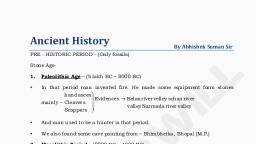
HISTORY (ANCIENT), , 1 - INDIAN PRE-HISTORY, INTRODUCTION, The idea of pre-history is barely 200 years old. And, so is the word pre-history; it was first used by M., Tournal in 1833., • Dr. Primrose rediscoverd Indian pre-history by, discovering prehistoric implements (stone knives, and arrow heads) in 1842 at a place called Lingsugur, in Karnataka., • Robert Bruce was another person who enriched our, knowledge about Indian prehistory when he, discovered a large number of prehistoric sites in, South India and collected Stone Age artifacts., • These early efforts could not place India on the, prehistoric map of the world., • Sir Mortimer Wheeler's efforts in 1921, resulted in, our knowledge of the entire pre historic culture, sequence of India, putting India firmly on the world, map of prehistory., • As regards the early man; no fossils of early man have, been found in the entire subcontinent, but their, presence is indicated by stone tools dated around, 250,000 BC. Earliest traces of human activity in India, go back to the second Inter-Glacial period between, 400,000 and 200,000 B.C., PALEOLITHIC ERA, (500,000 B.C.–8000 B.C.), •, , , , •, , •, , •, , •, , •, , The Palaeolithic Age commenced from the time when, the earliest man learnt the art of making stone tools., The greatest achievement of the earliest man could, be traced to his learning as to how to make a fist, hatchet, the spear and the fire., In India, the Palaeolithic Age developed in the, Pleistocene period or the Ice Age and was spread in, practically all parts of India except the alluvial parts, of Ganga and Indus., Food gathering and hunting were the main, occupations of the people of this phase and, Palaeolithic men learnt to use animal skins for, wrapping their dead bodies., Man during this period used tools of unpolished,, undressed rough stones and lived in caves and rock, shelters. They had no knowledge of agriculture, fire, or pottery of any material and mainly used hand axes,, cleavers, choppers, blades, scrapers and burins. Their, tools were madeof a hard rock called ‘quartzite’ and, hence Palaeolithic men are also called ‘Quartzite, Men’., Homo sapiens first appeared in the last of this phase, and the Palaeolithic man belonged to the Negrito, race., Sir Robert Bruce Foot discovered the first Palaeolithic, stone tool in the Indian sub-continent near Madras in, 1863 A.D. The discovery of Indian Pre-history got a, boost after the Yale-Cambridge expedition in 1935, under De Terra and Patterson., The Paleolithic stage has been divided into Lower, Palaeolithic, (250,000-100,000, B.C.),, Middle, , •, , •, •, •, , •, , •, , •, , •, •, , •, , Palaeolithic (100,000-40,000 B.C.) and Upper, Paleolithic stage (40,000-10,000 B.C.) primarily, based on tool typology and technology and also, according to the nature of change in the climate., The tools of the lower Paleolithic stage are mainly, hand axes, cleavers, choppers and chopping tools and, covered the greater part of the Ice Age. In this period, the climate became less humid., The middle Paleolithic age tools are mainly based on, flake industries., The upper Paleolithic stage is characterized by burins, and scrapers and a warm and less humid climate., Agewise the lower Paleolithic extended upto 100,000, years ago, middle Paleolithic extended upto 40,000, years ago and upper Paleolithic up to 10,000 BC., The Son and the adjacent Belan valley (Mirzapur, UP), provide a sequence of artifacts from lower Paleolithic, to Neolithic., Situated around Bhimbedka hill, in central India near, Hoshangabad on the Narmada River, the caves and, rock shelters have yielded evidence of Paleolithic, habitation., At Bhimbetka near the Narmada, a series of, rockshelters have been excavated from caves. This, site lacks in Chopper and Abbevillian hand axes., During middle palaeolithic age, Pithecanthropus or, Homo erectus evolved. But this cultural stage was, dominated by Neanderthal Man., The upper Palaeolithic culture belongs to the last, phase of the Ice Age. This culture is marked by the, appearance of new flint industries and the evolution, of Homo sapiens or the modern man., At Chopani-Mando in the Belan valley of the Vindhyas, and the middle part of the Narmada valley, a, sequence of occupation from all the three stages of, the Paleolithic to Neolithic stage have been found in, sequence. Chopani Mando is an important site where, fossil animal bones have been found., , Mesolithic Era, (8000 B.C.–6000 B.C.), •, , •, , •, , •, , Although major changes began to appear around, 10,000 B.C. the Mesolithic era seems to have started, around 9000 B.C. and 8000 B.C. with the folding up of, the Ice Age and continued at certain places till 4000, B.C., In this age, climate changes brought about changes in, the fauna and flora and made it possible for human, beings to move to new areas. Since then there haven’t, been major changes in the climate., The Mesolithic era is characterized by the reduction, in the size of well established tool types from the, archaeological point of view with a decrease in size of, some artifacts and the presence of a higher, proportion of ‘geometric’ microliths., Microliths, first discovered from the Vindhyan rock, shelters by C.L. Carlyle in 1867; are the characteristic, , 2|P a g e, , CREATIVE CIRCLE, Konung Mamang, Wangkhei Road Near Traffic Point
Page 3 :
HISTORY (ANCIENT), , •, , •, , •, •, , •, , •, •, , tools of the era comprising of pointed, cresconic, blades, scrapers, etc. all made of stone. These are very, small in size with their length varying from 1-8 cm., Blackened blade, core, point, triangle, lunate and, trapeze are the main Mesolithic tools. However some, tools used earlier like choppers, burins and scrapers, continue., The hunting implements are spears with multiple, barbs apparently obtained easily by attaching, microliths. The crude material is chert, agate,, carnelian and quartz., Bagor, a Mesolithic site in Rajasthan on the river, Kothari is the largest Mesolithic site in India also from, where systematic burials of skeletons have been, found., Tapti, Narmada, Mahi and Sabarmati river basins in, Gujarat have yielded many Mesolithic sites., Langhnaj in Gujarat is the first discovered site in the, arid zone to demonstrate the development of a, Mesolithic culture., The site of Chopani Mando in Allahabad provides a, continuous sequence from late upper Palaeolithic to, late Mesolithic stage with crude handmade pottery., Here round hut floors were found., In Peninsular India the Mesolithic industry is basedon, milky quartz. A new feature in the tool industryis the, appearance of ‘D’ shaped, transverse arrowhead., A large number of animal bones were found in the, rock-shelters of Adamgarh in Madhya Pradesh which, indicate domestication of animals only, not a pastoral, economy., , Lifestyle, •, , •, •, •, , •, , •, •, , The age represents the hunting-gathering nomadic, pastoral stages of human social evolution as the, people lived on hunting, fishing and food gathering., At a later stage, they also domesticated animals., The people of this age achieved their special, adaptation as early as 8000 B.C. which coincides with, the same in both Europe and Africa., The last phase of this age sawYthebeginning of plane, cultivation., The Palaeolithic age does not yield any information, about the religious practices of the people but with, the Mesolithic age the first archaeological information, about them becomes available. The burials and rock, paintings give us ideas about the development of, religious practices., Some Mesolithic sites like Bhimbetka, Adamgarh,, Pratapgarh and Mirzapur are famous for their rich art, and paintings. Animals are the most frequent subjects, of all these paintings with the most frequently, represented ones being deer or antelope whereas, paintings of tigers and monkeys are rare., Animal headed human figures also appear., This is also the period when we find evidence of, carefully burying the dead, which shows the, beginning of belief in life after death., , Neolithic Era, (6000 B.C.–1000 B.C.), • In the world context, the Neolithic age began around, 9000 B.C. but in the Indian context it began in 7000, , •, , •, , •, , •, •, , •, , •, , •, , •, , •, , •, , B.C. Mehrgarh in Baluchistan is the only site, belonging to that period., Regular Neolithic attributes have been found from, around 5000 B.C. and in South Indian context, Neolithic settlements appeared around 2500 B.C., The principal features of Neolithic culture are crop, cultivation, animal husbandry and settled life. The, last two coming into existence in the last phase of, Mesolithic culture., During this period people depended on stone, implements but used stones other than quartzite for, making tools which were more lethal, more finished, and more polished. The phase is known for grinding, and polishing of tools., The stone tools can be studied under two groups:(a), Ground and polished stone implements and (b)small, and chipped stone tools., Ground and polished stone implements are, associated with the Neolithic culture because of their, links with food-producing stage and domestication of, animals., Small and chipped stone tools had been continuing, from earlier Mesolithic levels which are generally, termed as microliths., The Neolithic people at certain point of time started, making potteries. On this basis Neolithic culture has, been divided into aceramic Neolithic and ceramic, Neolithic ages., At certain Neolithic levels we get the evidence of use, of metal (copper being the earliest metal). Such levels, are termed as Chalcolithic level., Important sites of this age are Burzahom and Gufkral, in J&K (famous for pit dwelling, stone tools and, graveyards, in, houses),, Maski,, Brahmagiri,, Tekkalakota in Karnataka, Paiyampatti in Tamil Nadu,, Piklihal and Hallur in Andhra Pradesh, Garo hills in, Meghalaya, Chirand and Senuwar in Bihar (known for, remarkable bone tools), Amri, Kot diji, etc., In Baluchistan , sites of Neolithic age include Kili Ghul, Muhammad, Rana Ghundai, Anjira, Siah-damb and, Mundigak., In the Indus system the most Neolithic site is at, Mehrgarh in the Kacchi Plain regarded as the ‘bread, basket’ of Baluchistan. The Neolithic stratum at, Mehrgarh seems to have emerged from a locally, established Mesolithic substratum., , Lifestyle, •, , •, •, , •, , In the northern Himalayas, the best known Neolithic, site is Burzahom in Kashmir where the earliest, occupation was characterized pit dwellings with, conical roofs. The site also gives evidence of a, rectangular chopper of a kind not known in India., In Burzahom sometimes dogs and wolves were found, buried with their owners., Later on, there comes evidence of mud brick houses,, copper arrow heads and a number of burials and, graves with goods. This phase also yield a stray, painted pot showing a typical early Indus buffalo, deity., Gufkral, literally ‘the cave of the potter’ is another, important Neolithic site in Kashmir where the earliest, , 3|P a g e, , CREATIVE CIRCLE, Konung Mamang, Wangkhei Road Near Traffic Point
Page 4 :
HISTORY (ANCIENT), , •, •, , •, , •, , seize yield pit dwellings without pottery. However in, subsequent phases coarse grey pottery was used and, a large number of bone tools occur., People domesticated sheep, goats and oxen and, animal remains of early periods corroborate it., Cultivation of wheat, barley, fruits, corn like ragi and, horsegram and lentils have been reported from, the beginning and between 6000 B.C. and 5000 B.C., there was a pattern of subsistence based on wheat,, barley, sheep, goats and cattle., The remains of charred grains of paddy husk and, wheat are quite visible at Chirand in Bihar, the handmade pots as well., The people of Kachar Hills of Assam lived in mudwalled houses and their hand-made pots were, decorated with basket impressions., , •, , Koldhiwa and Mahagara lying south of Allahabad, have thrown evidence of many strata of circular huts, alongwith a crude handmade pottery. The most, interesting find is evidence of rice suggested around, 5440 and 4530 B.C. which is the oldest evidence of, rice not only in India but also anywhere in the world., , •, , Instances of earlier cave dwelling have also been, discovered with walls decorated of scenes of hunting, and dancing., Neolithic man also knew the art of making boats and, could weave cotton and wool to make cloth., In the later phase of the Neolithic stage people led a, more settled life and lived in circular and rectangular, houses made of mud and reed., , •, •, , CHALCOLITHIC PERIOD, •, , •, , •, , •, , •, •, •, , The end of the Neolithic period saw the use of metals, of which copper was the first. A culture based on the, use of stone and copper arrived called the Chalcolithic, phase meaning the stone-copper phase., The first full-fledged village communities evolved in, the Chalcolithic phase which was chronologically, antecedents to Harappan people. Rafique Mughal of, Pakistan named there settlements as Early Harappan, culture., Though some Chalcolithic cultures are contemporary, of Harappan and some of pre-Harappan cultures but, most Chalcolithic cultures are post-Harappan., Though Chalcolithic cultures mostly used stone and, copper implements, the Harappans used bronze (an, alloy of copper and tin) on such a scale that Harappan, culture is known as a Bronze Age Culture., Apart from stone tools, hand axes and other objects, made from copperware were also used., The evidences of relationship with Afghanistan, Iran, and probably Central India and visible at Mehargarh., The Chalcolithic culture at many places continued till, 700 B.C. and sometime around 1200 B.C. the use of, iron seems to have begun in the Chalcolithic level, itself. The use of iron subsequently revolutionized the, culture making, progress and by 800 B.C. a distinct Iron Age came into, existence., , , , , , , The Chalcolithic people used different types of, pottery of which black and red pottery was most, popular. It was wheel made and painted withwhite, line design., The Chalcolithic people were not acquainted, withburnt bricks and generally lived in thatched, houses.It was a village economy., They venerated the mother goddess andworshipped, the bull., , Sites, Important sites of this stage are spread inRajasthan,, Maharashtra, West Bengal, Bihar,Madhya Pradesh,, etc., The Chalcolithic culture in Rajasthan is known asB, anas culture after the river of the same name andis, also known as Ahar culture after the typesite., In the Malwa region the important Chalcolithicsites, are Nagda, Kayatha, Navdatoli, and Eran.Mudplastered floors are a prominent feature ofKayatha., The Kayatha culture is characterized by a sturdyredslipped ware painted with designs in chocolate,, colour, a red painted buff ware and a combed, warebearing incised patterns., The Ahar people made a distinctive black-andredware decorated with white designs., The Malwa ware is rather coarse in fabric, but hasa, thick buff surface over which designs are madeeither, in red or black., The Prabhas and Rangpur wares are both, derivedfrom the Harappan, but have a glossy surface, dueto which they are also called Lustrous Red Ware., Jorwe ware too is painted black-on-red but has amatt, surface treated with a wash., The settlements of Kayatha cutlure are only a fewin, number, mostly located on the Chambal and, itstributaries. They are relatively small in size and, thebiggest may be not over two hectares., In contrast to small Kayatha culture settlementsthose, of Ahar cultures are big. At least three ofthem namely, Ahar, Balathal and Gilund are ofseveral hectares., Stone, mud bricks and mud were used for, theconstruction of houses and other structures., Excavations reveal that Balathal was a wellfortifiedsettlement., The people of Malwa culture settled mostly onthe, Narmada and its tributaries. Navdatoli, Eranand, Nagada are the three best known settlementsof, Malwa culture. Navadatoli measures almost10, hectares, and, is, one, of, the, largest, Chalcolithicsettlements., It has been seen that some of these sites werefortified, and Nagada had even a bastion of mudbricks.Eran, similarly had a fortification wall witha moat., The Rangpur culture sites are located mostly onGhelo, and Kalubhar rivers in Gujarat., The Jorwe settlement is comparatively larger, innumber., Prakash, Daimabad and Inamgaon are some ofthe, best known settlements of this culture. Thelargest of, these is Daimabad which measured 20hectares., From Mesolithic culture onwards, all the culturetypes, coexisted and interacted with each other., , 4|P a g e, , CREATIVE CIRCLE, Konung Mamang, Wangkhei Road Near Traffic Point
Page 5 :
HISTORY (ANCIENT), Lifestyle, The Chalcolithic people built rectangular andcircular, houses of mud wattled-and-daub. Thecircular houses, were mostly in clusters. Thesehouses and huts had, roots of straw supported onbamboo and wooden, rafters. Floors were madeof rammed clay and huts, were used for storagealso., People raised cattle as well as cultivated both, Kharifand Rabi crops in rotation. Wheat and barley, weregrown in the area of Malwa. Rice is reported to, havebeen found from Inamgaon and Ahar. These, peoplealso cultivated jowar and bajra and so also, kulthiragi, green peas, lentil and green and black, grams., Religion was an important aspect which, interlinkedall Chalcolithic cultures. The worship of, mothergoddess and the bull was in vogue. The bull, cultseems to have been predominant in Malwa, duringthe Ahar period., A large number of these both naturalistic as well, asstylised lingas have been found from most of, thesites, of, Chalcolithic, settlements., The, naturalisticones may have served as votive offerings,, but thesmall stylised ones may have been hung, aroundthe neck as the Lingayats do today., The Mother Goddess is depicted on a huge storagejar, of Malwa culture in an applique design. She isflanked, by a woman on the right and a crocodileon the left, by, the side of which is represented theshrine., Likewise, the, fiddle-shaped, figurines, probablyresembling Srivatsa, the symbol of Lakshmi,, theGoddess of wealth in historical period represent, amother Goddess., In a painted design on a pot, a deity is shown, withdishevelled hair, recalling Rudra., A painting on a jar found from Daimabad showsa, deity surrounded by animals and birds such astigers, and peacocks. Some scholars compare itwith the, ‘Shiva, Pashupati’, depicted, on, a, seal, fromMohenjodaro., Two figurines from Inamgaon, belonging to lateJorwe, culture, are identified as proto-Ganesh, whois, worshipped for success., Several headless figurines found at Inamgaonhave, been, compared, with, Goddess, Visira, of, theMahabharata., Fire-worship seems to have been a very, widespreadphenomenon among the Chalcolithic, people ofPre-historic India as fire-altars have been, foundfrom a large number of Chalcolithic sites, duringthe course of excavations., The occurence of pots and other funerary, objectsfound along with burials of the Malwa and, Jorwepeople indicate that people had a belief in life, afterdeath., The, Chalcolithic, farmers, had, made, considerableprogress in ceramic as well as metal, technology.The painted pottery was well made and, well firedin kiln, it was fired at a temperature, between 500-700°C., In metal tools we find axes, chisels, bangles,, beads,etc. mostly made of copper. The copper was, obtained,perhaps, from the Khetri mines of, Rajasthan., , , , , , , , Gold ornaments were extremely rare and have, beenfound only in the Jorwe culture., An ear ornament has been found from Prabhas inthe, Godavari valley also., The find of crucibles and pairs of tongs of copperat, Inamgaon in Maharashtra shows the working, ofgoldsmiths., Chalcedony drills were used for perforating beadsof, semi-precious stones., Lime was prepared out of Kankar and used, forvarious purposes like painting houses and, liningthe storage bins, etc., , 5|P a g e, , CREATIVE CIRCLE, Konung Mamang, Wangkhei Road Near Traffic Point
Page 6 :
HISTORY (ANCIENT), , 2 - INDUS VALLEY CIVILIZATION, Origin and Phases, The Indus Valley civilization was an, ancientcivilization thriving along the Indus river, and theGhaggar-Hakra river in what is now, Pakistan andnorth-western India. Among other, names for thiscivilization is the Harappan, civilization in referenceto the first excavated city, of Harappa., An alternative term for the culture is SaraswatiSindhu civilization based on the fact that most, ofthe Indus Valley sites have been found along, theGhaggar-Hakra river., R.B. Dayaram Sahni first discovered Harappa(on, Ravi), in, 1921., R.D., Banerjee, discoveredMohenjodaro or ‘Mound of the Dead’, (on Indus)in 1922. Sir John Marshal played a, crucial role inboth these., Harappan civilization forms part of the, protohistory of India i.e. the script is there, but it, cannotbe deciphered and belongs to the Bronze, Age., The Indus valley civilization gradually, developedto a full-fledged civilization which has, been established through a continuous sequence, of stratanamed as Pre-Harappan, Early, Harappan, Mature Harappan and Late Harappan, stages or phases., The long term indigenous evolution of this, civilization which obviously began on the, periphery of the Indus Valley in the hills of, eastern Baluchistanand then extended so far into, the plains, can bedocumented by an analysis of, four sites which havebeen excavated in recent, years: Mehargarh, Amri, Kalibangan and Lothal, which reflect the sequenceof the four important, phases or stages in pre andproto history in the, north-west region of the Indiansub-continent., The sequence begins with the transition, ofnomadic herdsmen to settled agriculturists, ineastern Baluchistan (First Phase), continues, withthe growth of large villages and the rise of, townsin the Indus Valley (Second Phase), leads to, theemergence of the great cities (Third Phase),, andfinally, ends with their decline (Fourth, Phase)., Mediterranean, Proto-Australoid, Mongoloids, andAlpines formed the bulk of the population,, thoughthe first two were more numerous., More than 100 sites belonging to this, civilizationhave been excavated., According to radio-carbon dating, it spread, fromthe year 2500-1750 B.C., Copper, bronze, silver and gold were known, butnot iron., Geographical Extent, Covered, parts, of, Punjab,, Sindh,, Baluchistan,Gujarat, Rajasthan and some parts of, Western U.P.It extended from Manda in Jammu in, the northto Daimabad in the south and from, Alamgirpurin western U.P. to Sutkagendor in, Baluchistan inthe west., , , , , , Major sites in Pakistan are Harappa (on riverRavi, in, west, Punjab),, Mohenjodaro, (on, Indus),Chanhu-Daro (Sindh), etc. In India the, majorsites are Lothal, Rangpur and Surkotda, (Gujarat),Kalibangan, (Rajasthan),, Banawali, (Hissar) andAlamgirpur (western U.P.), The largest and the latest site in India is, Dholavirain Gujarat. Dr. J.P. Joshi and Dr. R.S., Bisht wereinvolved in it., , Town Planning, The Indus Valley people were primarily, urbanpeople. Elaborate town-planning following, theGrid System. Roads were well cut dividing, thetown into large rectangular or square blocks., Lampposts at intervals indicate the existence of, street lightening. Flanking the streets, lanes and, by-laneswere well-planned houses. The streets, were quitebroad varying from 9 feet to 34 feet in, breadth., Burnt bricks of good quality were used for, buildingmaterial except in Rangpur and, Kalibangan. Elsewhere in the contemporary, world mud brickswere used. No pottery-kiln was, allowed to be builtwithin the four walls of the, city., Houses were often of two or more storey,, ofvarying sizes but were quite monotonous – a, squarecourtyard around which were a number of, rooms. The windows faced the streets and the, houses hadtiled bathrooms. It is especially, noteworthy thatalmost every house had its own, wells, bathrooms, courtyards, drains and, kitchens., There was a good drainage system and drains, weremade of mortar, lime and gypsum and, coveredwith large brick slabs for easy cleaning, whichshows a developed sense of health and, sanitation. Every house had its own soak-pit, which collectedall the sediments and allowed, only the water toflow into the street drain. House, drains emptiedthemselves into the main drains, which ran underthe main streets and below, many lanes. There werespecial trenches, constructed outside every city forthe rubbish to, be thrown in them., The towns were divided into two parts:, Upperpart or Citadel and the Lower part. The, Citadelwas an oblong artificial platform some 3050 feethigh and about some 400-200 yards in, area. It wasenclosed by a thick (13 m in Harappa), crenelated mud brick wall. The Citadel comprised, of public buildings whereas the lower part, comprised ofpublic dwellings., In Mohenjodaro, a big public bath (Great Bath), measuring 12 m by 7 m and 2.4 m deep has, beenfound. Steps led from either end to the, surface, with changing rooms alongside. The, Great Bathwas probably used for ritual bathing., Lamp posts at intervals indicate the existence, ofstreet lighting., , 6|P a g e, , CREATIVE CIRCLE, Konung Mamang, Wangkhei Road Near Traffic Point
Page 7 :
HISTORY (ANCIENT), , , There were special series constructed for, thetravelers and a system of watch and word at, nightalso existed., , Political Organization/ Municipalities, There is no clear idea of the political, organizationof the Indus valley people. Perhaps, they were moreconcerned with commerce and, they were possiblyruled by a class of merchants., Also there was an organization like a, municipalcorporation to look after the civic, amenities of thepeople., Economic Life Agriculture, The Indus people sowed seeds in the flood, plainsin November, when the flood water, receded, andreaped their harvests of wheat and, barley in April, before the advent of the next, flood which indicatedagriculture and knowledge, of calendar reading., The people grew wheat, barley, rai, peas,, sesamum, mustard, rice (in Lothal), cotton, dates,, melon, etc.The Indus people were the first to, produce cottonin the world., In Kalibangan, fields were ploughed with, woodenploughs., Domestication of animals was done on a large, scale.Besides the cattle, sheep, pigs, camels, cats, and dogswere domesticated. Horses weren’t in, regular usebut elephant was. Remains of horse at, Surkotdaand dogs with men in graves in Ropar, have beendiscovered., Produced sufficient to feed themselves. There, wasno exchange of foodgrains/export or import., Food grains were stored in granaries. Eg., InHarappa and Mohenjodaro., Trade and Commerce, Well-knit external and internal trade. There was, nometallic money in circulation and trade was, carriedthrough Barter System., Weights and measures of accuracy existed, inHarappan culture (found at Lothal). The, weightswere made of limestone, steatite, etc. and, weregenerally cubical in shape., 16 was the unit of measurement (16, 64, 160,, 320)., Flint, tool-work,, shell-work,, banglemaking(famous in Kalibangan), etc. were, practiced. Rawmaterials for these came from, different sources:gold from north Karnataka,, silver and Lapis Lazulifrom Afghanistan and Iran,, copper from Khetri andBaluchistan, etc., Bead making factories existed in Chanu daro, andLothal. They were items of export., A dockyard has been discovered at, Lothal.Rangpur, Somnath and Balakot functioned, asseaports., Sutkagendor, and, Sutkakoh, functionedas outlets., The inland transport was carried out by, bullockcarts., Every, merchant, or, mercantile, family, probablyhad a seal bearing an emblem often of a, religiouscharacter, and a name or brief, , , , description, on oneside. The standard Harappa, seal was a square oroblong plaque made of, steatite stone. The primarypurpose of the seal, was probably to mark theownership of property,, but they may have alsoserved as amulets., The Mesopotamian records from about 2350, B.C.onwards refer to trade relations with, Meluhha, the ancient name of the Indus region., Harappanseals and other material have been, found atMesopotamia. There were also instances, of tradewith Sumer, Babylonia, Egypt, etc., , Art and Craft, The Harappan culture belongs to the Bronze, Ageand bronze was made by mixing tin and, copper.Tools were mostly made of copper and, bronze. Formaking bronze, copper was obtained, from Khetriin Rajasthan and from Baluchistan, and tin fromAfghanistan., The people of this culture were not acquainted, withiron at all., The Indus Valley people had achieved a great, skillin drawing the figures of men, animals and, variousother objects of nature and were fully, conversantwith the art of craving with figures on, ivory, soapstone, leather, metal and wood, proving their artisticacumen., Cotton fabrics were quite common and woollens, were popular in winter., One male figure or a statue shows that, generallytwo garments were worn and the, female dress wasmore or less like that of a male., The Indus valley people were very fond, ofornaments (of gold, silver, ivory, copper,, bronzeand precious stones) and dressing up., Ornamentswere worn by both men and women,, rich or poor.Women wore heavy bangles in, profusion, largenecklaces, ear-rings, bracelets,, figure-rings, girdles, nose-studs and anklets. The, Harappans were expertbead makers., They were fully conscious of the various fashions, ofhair-dressing and wore beards of different, styles., Harappan Seals, Potter’s wheel was in use. The Indus, ValleyPottery was red or black pottery and the, peopleindulged in dice games, their favorite, pastimebeing gambling., The, Harrapans, most, notable, artistic, achievementwas their seal engravings especially, those ofanimals. The red sandstone torso of a, man isparticularly impressive for its realism., Howeverthe most impressive of the figurines is, the bronzeimage of a dancing girl (identified as a, devdassi)found at Mohenjodaro., Maximum number of seals discovered is made, ofsteatite with the unicorn symbol being, discoveredon the maximum number of seals., For their children, the Harappans made cattletoyswith moveable heads, model monkeys which, couldslide down a string, little toy carts and, whistlesshaped like birds all of terracotta., , 7|P a g e, , CREATIVE CIRCLE, Konung Mamang, Wangkhei Road Near Traffic Point
Page 8 :
HISTORY (ANCIENT), Religious Life, The main object of worship was the Mother, Goddessor Shakti. But the upper classes, preferred a God– nude with two horns, much, similar to PashupatiShiva. Represented on the, seal is a figure withthree horned heads in a yogic, posture, surroundedby an elephant, a tiger, a, rhinoceros and belowhis throne is a buffalo. Near, his feet are two deer.Pashupatinath represented, the male deity., The elaborate bathing arrangement marking, thecity of Mohenjodaro would suggest that, religiouspurification by bath formed a feature of, the IndusValley people., Phallus (lingam) and yoni worship was, alsoprevalent., Many trees (pepal), animals (bull), birds, (dove,pigeon) and stones were worshipped., Unicornswere also worshipped. However no, temple hasbeen found though idolatry was, practiced., At Kalibangan and Lothal fire altars have, beenfound., Although no definite proof is available, withregard to disposal of the dead, a broad view, is thatthere were probably three methods of, disposingthe dead – complete burial (laid, towards north),burial after exposure of the body, to birds andbeasts, and cremation followed by, burial of theashes. The discovery of cinerary urns, and jars,goblets or vessels with ashes, bones or, charcoalmay however suggest that during the, flourishingperiod of the Indus valley culture, the, third methodwas generally practiced. In, Harappa, there is oneplace where evidence of, coffin burial is there. Thepeople probably, believed in ghosts and spirits asamulets were, worn., Dead bodies were placed in the northsouthorientation., It appears from excavations that the people ofthis, culture were well-versed with surgery., Forexample, some evidences have come from, bothKalibangan and Lothal hinting at head, surgery.Otherwise, they used to take recourse to, blackmagic, amulets etc., Script, The, script, is, not, alphabetical, but, pictographic(about, 600, undeciphered, pictographs)., The script has not been deciphered so far,, butoverlaps of letters show that it was written, fromright to left in the first line and left to right, in thesecond line. This style is called, ‘Boustrophedon’., End/Decay, The Harappan culture lasted for around, 1000years., The invasion of the Aryans, recurrent floods, (7floods), social breakup of Harappans,, Earthquakes,successive alteration in the course, of the riverIndus and the subsequent drying up of, , the areasin and around the major cities, etc. are, listed aspossible causes for the decline of the, Indus ValleyCivilization., Important Sites of the Indus Valley Civilization, 1. Harappa, • Harappa is situated in Montogomery district, ofPunjab (Pakistan). Excavations at the site have ledto, the following specific findings:, • Two rows of six granaries with brick platforms; 12, granaries together had the same area as the Great, Granary at Mohenjodaro., • Working floors, consisting of rows of circular brick, platforms lay to the south of granaries and were, meant for threshing grain., • Evidence of coffin burial and cemetery ‘H’ culture., • The dead were buried in the southern portion of the, fortified area, called cemetery R-37., • Single room barracks just below the walls of the, citadels for the labourers and factory workers., • It has been identified with Hari-Yupiya which is, mentioned in the Rigveda., • Evidence of direct trade and interaction with, Mesopotamia., • Discovery of a red sandstone male torso and, • Stone symbols of female genitals., • Almost 36% of the total seals excavated in the Indus, Civilization are excavated from Harappa alone., • Other discoveries include Bronze image of an ‘ekka’, (vehicle) and a seal with the representation of the sign, of ‘swastika’ on it., 2. Mohenjo-daro, • Also known as the ‘Mound of the dead’, it lies in, Larkana district of Sind (Pakistan). Some of the, specific findings during the excavations of, Mohenjodaro include:, • A college, a multi-pillared assembly hall., • The Great Bath, • A large granary (the largest building of, Mohenjodaro) which suggests extreme centralization, as the ruling authorities must have first brought the, agricultural produce here and then redistributed it., • A piece of woven cotton alongwith spindle whorls, and needles., • Superficial evidence of a horse or an ass., • A pot-stone fragment of Mesopotamian origin., • Evidence of direct trade contact with Mesopotamia., • A bronze dancing girl., • Evidence of violent death of some of the inhabitants, (discovery of human skeletons put together)., • A seal representing Mother Goddess with a plant, growing from her womb, and a woman to be sacrificed, by a man with a knife in his hand., • A bearded man, • A seal with a picture suggesting Pashupati Mahadev., • This city is also an extreme example of conservatism,, as despite having been flooded almost nine times, they, never tried to shift to a safer place. Rather, they came, back to the original site whenever the water table, receded. Nor did they ever try to build strong, embankments to protect themselves from floods., , 8|P a g e, , CREATIVE CIRCLE, Konung Mamang, Wangkhei Road Near Traffic Point
Page 9 :
HISTORY (ANCIENT), 3. Alamgirpur, • The famous Harappan site is considered the eastern, boundary of the indus culture. Although the caves, found here resemble those at other Harappan sites,, other findings suggest that Alamgirpur developed, during the late-Harappan culture., • The site is remarkable for providing the impression, of cloth on a trough., , • Evidence of double burial (burying a male and a, female in a single grave) found in three graves, whereas in Kalibangan one such grave has been found., • Evidence of games similar to modern day chess and, • An instrument for measuring 180, 90, 45 degree, angles (the instrument points to modern day, compass)., , 4. Kalibangan, • Kalibangan was an important Harappan city. The, word Kalibangan means ‘black bangles’. A ploughed, field was the most important discovery of the early, excavations. Later excavations at Kalibangan made the, following specific discoveries:, • A wooden furrow, • Seven fire altars in a row on a platform suggesting, the practice of the cult of sacrifice., • Remains of a massive brick wall around both the, citadel and the lower town (the second Harappan site, after Lothal to have the lower town also walled., • Bones of a camel., • The skull of a child found suffering from, hydrocephalus., • A tiled floor which bears intersecting designs of, circles., • A human head with long oval eyes, thick lower lips,, receding forehead and straight pointed nose., • Evidences of two types of burials: Burials in a, rectangular grave and Burials in a circular grave., , 7. Amri, • Amri also gives evidence of pre-Harappan, settlement. However it lacks the fortification plan of, the pre-Harappan phase. A spectacular feature of Amri, is that it gives the impression of existence of, transitional culture between pre and post Harappan, culture., • Important findings at Amri include the actual, remains of rhinoceros, traces of Jhangar culture in late, or declining Harappan phase and fir altars., , 5. Kot-Diji, Kot-Diji is known more as a pre-Harappan site. It, gives the impression of a pre-Harappan fortified, settlement. Houses were made of stone. The remains of, Kot-Diji suggest that the city existed in the first half of the, third millennium B.C. Excavations at the site suggest that, the city was destructed by force., 6. Lothal, Lothal was an important trade centre of the, Harappan culture. The town planning in Lothal was, different from that of Harappa and Mohenjodaro. The city, was divided into six sections. Each section was built on a, wide platform of unripe bricks. Each platform was, separated by a road with width ranging from 12 feet to 20, feet. Excavations at Lothal led to some specific, discoveries which include:, • Remains of rice husk (the only other Harappan, citywhere the rice husk has been found is Rangpur, near Ahmedabad)., • An artificial dock yard., • Evidence of a horse from a doubtful terracotta, figurine., • Impressions of cloth on some of the seals., • Evidence of direct trade contact with Mesopotamia., • Houses with entrances on the main street (the, houses of all other Harappan cities had side entries)., • A ship designed on a seal., • A terracotta ship., • A painting on a jar resembling the story of the, ‘cunning fox’ and the ‘thirsty crow’ narrated in, Panchatantra., , 8. Chanhu-daro, • Excavations at Chanhu-daro have revealed three, different cultural layers from lowest to the top being, Indus culture, and the pre-Harappan Jhukar culture, and the Jhangar culture., • The site is especially important for providing, evidences about different Harappan factories. These, factories produced seals, toys and bone implements., • Through excavations, the evidence of bead maker’s, shops has come to light., • It was the only Harappan city without a citadel., • Some remarkable findings at Chanhu-daro include, bronze figures of bullock cart and ekkas, a small pot, suggesting an inkwell, footprints of an elephant and a, dog chasing a cat., 9. Ropar, • Ropar is a Harappan site from where remains of preHarappan and Harappan cultures have been found., • Buildings at Ropar were made mainly of stone and, soil., • Important findings at the site include pottery,, ornaments, copper axes, chert blades, terracotta, blades, one inscribed steatite seal with typical Indus, pictographs, several burials interred in oval pits and a, rectangular mud brick chamber., • There is also an evidence of burying a dog below the, human burial (Though the practice was prevalent in, Burzahom in Kashmir, it was late in the Harappan, context., 10. Banawali, • Situated in Hissar district of Haryana, Banawali has, provided two phases of culture during its excavations:, the pre-Harappan (Phase I) and the Harappan (Phase, II)., • Though Phase II belonged to the Harappan period,, chess board or grid pattern of town planning was not, always followed as in other Harappan sites., • The roads were not always straight nor did they cut, at right angles., • It also lacked another important feature of the, Harappan civilization – a systematic drainage system., • High quality barley has been found in excavations., , 9|P a g e, , CREATIVE CIRCLE, Konung Mamang, Wangkhei Road Near Traffic Point
Page 10 :
HISTORY (ANCIENT), • Other important material remains include ceramics,, steatite seal and a few terracotta sealing with typical, Indus script, ear rings shaped like leaves of a peepal, tree and terracotta bangles., 11. Surkotda, • Situated in Kutch (Bhuj) district of Gujarat and, excavated by J.P. Joshi in 1972, Surkotda was an, important fortified Harappan settlement., • This site is important because it provides the first, actual remains of horse bones., • A cemetery with four pot burials with some human, bones has also been found., • A grave has been found in association with a big rock, (megalithic burial), a rare finding of the Harappan, culture., 12. Sutkagendor, • Sutkagendor situated in Sindh (Pakistan) was an, important coastal town of the Indus civilization., • Excavations of Sutkagendor have revealed a twofold, division of the township: the Citadel and the Lower, City, it is said that Sutkagendor was originally a port, which later cut off from the sea due to coastal uplift., , 10|P a g e, , CREATIVE CIRCLE, Konung Mamang, Wangkhei Road Near Traffic Point
Page 11 :
HISTORY (ANCIENT), , 3 - THE VEDIC CIVILIZATION, • We know about the Aryans in India from thevarious, Vedic texts, especially the Rig Veda, whichis the earliest, specimen of the Indo-European language and the chief, source of information on the history of this period., • Many historians have given various theories regarding, the original place of the Aryans. However, the Central, Asian Theory given by Max Muller, is the most accepted, one. It states that the Aryans were semi-nomadic pastoral, people around the Caspian Sea in Central Asia., • They entered India probably through the Khyber Pass, (in the Hindukush Mountains) around 1500 B.C., • The holy book of Iran ‘Zend Avesta’ indicates entry of, Aryans to India via Iran., • The early Aryans did not have to look routes to Indian, sub-continent; for the Harappans had crossed the high, passes of the Hindukush and reached the middle course, of the Amu Darya where they had set up a trading post at, Shortughai., • In the Rigvedic period, the nobles were advised to eat, from the same vessel as the vis for success., • Metal came to be known as Ayas and Iron as, Krishanayas (Black Metal)., • The Vedic texts may be divided into two broad, chronological strata: the Early Vedic (1500-1000 B.C.), when most of the hymns of the Rig Veda were composed, and the Later Vedic (1000-600 B.C.) when the remaining, three Vedas and their branches were composed., Early Vedic or Rigvedic Period, (1500-1000 B.C.), • The Rig Veda is a collection of prayers offered to Agni,, Indra, Varuna and other gods by various families of poets, and sages., • From Rigveda, we come to know that there were 33, gods that time who were divided into three categories, viz., heavenly gods, atmospheric god, and earthly gods., Varuna, Surya, Aditi, Savitri were heavenly gods. Indra,, Rudra, Maruts etc. were atmospheric gods. Agni, Soma,, and Prithvi were earthly gods., • Four rivers of Afghanistan are clearly described in the, Rigveda. These are: Kubha, Krumu, Gomati (Gomal),, Suvastu (swat)., • It consists of ten Mandala or books of which Book II to, VII is the easiest portion. Book I and X seem to have been, the latest additions., • In the Rigvedic period, the dead man’s soul is said to, depart to the waters of the plants., • Since the Aryans came through the mountains, which, were considered the dwelling places of their gods, these, are repeatedly mentioned in the Rigveda. Meru, a, mountain beyond the Himalayas, is a happy divine abode, in the Mahabharata and the Puranas., • The Rig Veda has many things in common with the, Avesta, which is the oldest text in the Iranian language., The two texts use the same names for several Gods and, even for social classes., • The history of the later Vedic period is based mainly on, the Vedic texts which were compiled after the age of the, Rig Veda. These include the three Vedas – Samveda,, Yajurveda, Atharvaveda and the Brahamanas, the, Aranyakas, the Upanishads and the Sutras., , • The collection of the Vedic hymns or mantras were, known as Samhitas., • For purposes of singing, the prayers of the Rigveda were, set to tune and this modified collection was known as the, Samveda Samhita., • The Yajurveda contains not only the hymns but also the, rituals which have to accompany their recitation., • The Atharvaveda is completely different from the other, three Vedas. It contains charms and spells to ward off, evils and diseases. Its contents throw light on the beliefs, and practices of the non-Aryans. Atharvaveda is the most, valuable of the Vedas after the Rig Veda for the history, and sociology., • All the Vedic literature is together called the Shruti and, they include apart from the four Vedas, the Brahamanas,, the Aranyakas and the Upanishads., • The Brahamanas are a series of texts that followed the, Vedic samhitas. Each Veda has several bhramanas, attached to it. These are ritual texts., • Brahamanas attached to the Rigveda are Aitareya,, Kaushitaki, (composed, by, Hotri, priest)., Brahamanasattached, to, Samveda, are, Jamini,, Tandyamasha,Panchavis, Chhandogya (composed by, Udgatri priest). Brahamanas attached to Yajurveda are, Satpatha Brahmana (composed by Adhvaryu priest)., Brahamanas attached to Atharvaveda are Gopatha, Brahamana., • The Brahamanas throw light on the socio-political life of, the Aryans and form a sort of explanation of their, religion, especially sacrifice. They also contain ritualistic, formulae for the respective Vedas and its priests., • The Aranyakas are forest books that are treaties on, mysticism and philosophy and are concluding portion of, the Brahamanas. They explain the metaphysics and, symbolism of sacrifice. They lay emphasis not on sacrifice, but on meditation. They are infact opposed to sacrifice, and many of the ritualistic practices. Their stress is on, moral virtues. They form a bridge between the way of the, works (karma-marga, advocated by the Brahamanas) and, the way of knowledge (gyan-marga, advocated by the, Upanishads). Some important Aranyakas are Aitreya, Aranyaka, Kaushitaki Aryanka and Taittiriya Aranyaka., • The Upanishads contain philosophical speculations., They are generally called Vedanta which means the end of, the Vedas. One reason is that they came at the end of the, Vedic period or that they were taught at the end of the, Vedic instruction. These texts were compiled around 600, B.C. and criticized the rituals and laid stress on the values, of right belief and knowledge. They emphasized that the, knowledge of the self and the atma should be acquired, and the relation of atma with Brahma should be properly, understood., • The ten Upanishads are: Ishopanishat, Kenopanishat,, Kathopanishat, Parshnopanishat,, Mandukopanishat,, Koushikopanishat,, Thaittariyopanishat,, Chandogyopanishat and Brihadaranyaopanishat. These, are commentaries appended to the Aranyakas and deal, mainly with philosophy and religion., • The Smriti are the auxiliary treatises of the Vedas or, their supplements. It refers to that literature that has, been passed on from one generation to the other., , 11|P a g e, , CREATIVE CIRCLE, Konung Mamang, Wangkhei Road Near Traffic Point
Page 12 :
HISTORY (ANCIENT), Manusmriti written by Manu is the oldest of all the, Smritis., • The Puranas are 18 in number, of which the Bhagawat, Purana and Vishnu Purana are the most important., Geographical Spread, • The early Aryans settled in eastern Afghanistan, modern, Pakistan, Punjab and parts of western U.P. The whole, region in which the Aryans first settled in India is called, the Land of Seven Rivers or Sapta Sindhava (the Indus, and the five tributaries and the Saraswati)., Political Organization, • The political organization was of monarchical form. The, tribe was known as Jan and its king as Rajan. He was the, leader in battle and protector of the tribe. His office was, not hereditary and was selected among the clan’s men., The Rajan was not an absolute monarch, for the, government of the tribe was in part the responsibility of, the tribal councils like sabhas, samitis, gana and vidhata., Even women attended gana and vidhata only., • Many clans (Vish) formed a tribe. The basic social unit, was the Kula or the family and the Kulapa was the head of, the family., • The king was assisted by a number of officers ofwhich, Purohita was the most important. Next important, functionary was the Senani (leader of the army) even, though there was no regular or standing army. The, military technique of the Aryans was much advanced. The, Aryans succeededeverywhere because they possessed, chariots drivenby horses., • There was no regular revenue system and the kingdom, was maintained by voluntary tribute (Bali) of his subjects, and booty won in battle., Social Life, • The term Varna was used for colour, the Aryans being, fair and the Dasas dark., • Family was the basic unit of society and was patriarchal, in nature. But women enjoyed equal power with men., Marriage was usually monogamous and indissoluble, but, there are a few instances ofpolyandry, levirate and widow, marriage. There are no examples of child-marriage. The, marriageable age seems to have been 16 to 17., • Both dowry and bride price were recognized during the, Early Vedic period., • The word ‘Arya’ came to refer to any person who was, respected., • Aryans were fond of soma, sura, food and dresses. Soma, was drunk at sacrifices and its use wassanctified by, religion. Sura was purely secular and more potent and, was disapproved by the priestly poets., • Throughout the Vedic period, education was imparted, orally. Unlike the Harappans, the Aryans do not seem to, have a system of writing., • The Aryans loved music and played the flute, lute and, harp. There are references to singing and dancing girls., People also delighted in gambling.They enjoyed chariot, racing. Both men and womenwore ornaments., Economy, • Their bronze smiths were highly skilled and produced, tools and weapons much superior to those of Harappa, culture. There were artisans like carpenters, weavers,, cobblers, potters, etc., , • Aryans followed a mixed economy – pastoral and, agricultural – in which cattle played a predominant part., Most of their wars were fought for cow (most important, form of wealth). Cattle were in fact a sort of currency and, values were reckoned in heads of cattle (man’s life was, equivalent to that of 100 cows), but they were not held, sacred at the time. The horse was almost as important as, the cow., • Standard unit of exchange was the cow. At thesame time, coins were also there (gold coins like Nishka, Krishnal, and Satmana). Gavyuti was used as a measure of distance, and Godhuli as a measure of time., • Reference to money lending first occurs in Shatapatha, Brahmana, which describes a usurer as Kusidin., • Lived in fortified mud settlements., • Physicians were then called ‘Bhishakas’., • The staple crop was ‘yava’ which meant barley., Religion, • The Aryans personified the natural forces and looked, upon them as living beings., • The most important divinity was Indra who played the, role of warlord (breaker of forts – Purandar and was also, associated with storms and thunder)., • The second position was held by Agni (fire-god). He is, considered an intermediary between gods and men., • Varuna occupied the third position. He personified, water and was supposed to uphold the natural order, (Rta). He was ethically the highest of all Rigvedic gods., • Soma was considered to be the god of plants. Maruts, personified the storms., • Some female deities are also mentioned like Aditi and, Usha, who represented the appearance of dawn., • Didn’t believe in erecting temples or idol worship., Worshipped in open air through yajnas., • Aryans didn’t worship animals – only gods in man’s, form., • The Asvamedha sacrifice concluded with the sacrifice of, 21 sterile cows., • From Brihadaranyaka Upanishad we get the first, exposition of the doctrine of transmigration of soul., Later Vedic Period/Painted Grey Ware, Phase (1000-600 B.C.), Geographical Spread, • They reveal that the Aryans expanded from Punjab over, the whole of western U.P. covered by the Ganga-Yamuna, doab., • In the beginning, they cleared the land by burning; later, with the use of iron tools which became common by, 1000-800 B.C., • In Later Vedic period, many great cities like Videha,, Kaushambhi,, Kasi,, Ayodhya,, Hastinapur, and, Indraprashtha etc. had sprung up., Political Organization, • Tiny tribal settlements were replaced by strong, kingdoms., • The earliest legend on the origin of kingship occurs in, the Aitareya Brahmana, one of the Later Vedic texts,, perhaps of the 8th or 7th century B.C., • During the Rigvedic period the Aryans had built only, small kingdoms, as they were always busy fighting the, non-Aryans. But now they had crushed the resistance of, the non-Aryans and had established such powerful, , 12|P a g e, , CREATIVE CIRCLE, Konung Mamang, Wangkhei Road Near Traffic Point
Page 13 :
HISTORY (ANCIENT), kingdoms as Kuru, Panchala, Kosala, Magadha, Kasi and, Anga., • Powers of the king who was called the Samrat, increased. Importance of assemblies declined. Women, were no longer permitted to attendassemblies and the, term ‘Rashtra’ indicatingterritory first appeared in this, period., • The establishment of vast empires led to the growth of, the royal power., • The Sabha and the Samiti were now not powerful, enough to check the power of the kings. The office of the, monarch had now become more or less hereditary., • A regular army was maintained for the protection of the, kingdom., • In the Rigvedic period we hear of three main assistants, of the king, i.e., the Purohita, the Senani and the Gramini., But now in addition to these officials many new assistants, of the king were present. References of Priest (Purohita),, Commander in chief (Senapati), Charioteer (Suta),, Treasurer (Sangrihita), Tax collector (Bhagdugha), Chief, queen, (Mahisi), and, the, Great, companion, (Aksavapa).They enjoyed chariot racing. Both men and, womenwore ornaments., Economy, • Their bronze smiths were highly skilled and produced, tools and weapons much superior to those of Harappa, culture. There were artisans like carpenters, weavers,, cobblers, potters, etc., • Aryans followed a mixed economy – pastoral and, agricultural – in which cattle played a predominant part., Most of their wars were fought for cow (most important, form of wealth). Cattle were in fact a sort of currency and, values were reckoned in heads of cattle (man’s life was, equivalent to that of 100 cows), but they were not held, sacred at the time. The horse was almost as important as, the cow., • Standard unit of exchange was the cow. At the same, time coins were also there (gold coins like Nishka,, Krishnal and Satmana). Gavyuti was used as a measure of, distance and Godhuli as a measure of time., • Reference to money lending first occurs in Shatapatha, Brahmana, which describes a usurer as Kusidin., • Lived in fortified mud settlements., • Physicians were then called ‘Bhishakas’., • The staple crop was ‘yava’ which meant barley., Religion, • The Aryans personified the natural forces and looked, upon them as living beings., • The most important divinity was Indra who played the, role of warlord (breaker of forts – Purandar and was also, associated with storms and thunder)., • The second position was held by Agni (fire-god). He is, considered an intermediary between gods and men., • Varuna occupied the third position. He personified, water and was supposed to uphold the natural order, (Rta). He was ethically the highest of all Rigvedic gods., • Soma was considered to be the god of plants. Maruts, personified the storms., • Some female deities are also mentioned like Aditi and, Usha, who represented the appearance of dawn., • Didn’t believe in erecting temples or idol worship., Worshipped in open air through yajnas., , • Aryans didn’t worship animals – only gods in man’s, form., • The Asvamedha sacrifice concluded with the sacrifice of, 21 sterile cows., • From Brihadaranyaka Upanishad we get the first, exposition of the doctrine of transmigration of soul., Later Vedic Period/Painted Grey Ware, Phase (1000-600 B.C.), Geographical Spread, • They reveal that the Aryans expanded from Punjab over, the whole of western U.P. covered by the Ganga-Yamuna, doab., • In the beginning, they cleared the land by burning; later, with the use of iron tools which became common by, 1000-800 B.C., • In Later Vedic period, many great cities like Videha,, Kaushambhi,, Kasi,, Ayodhya,, Hastinapur, and, Indraprashtha etc. had sprung up., Political Organization, • Tiny tribal settlements were replaced by strong, kingdoms., • The earliest legend on the origin of kingship occurs in, the Aitareya Brahmana, one of the Later Vedic texts,, perhaps of the 8th or 7th century B.C., • During the Rigvedic period the Aryans had built only, small kingdoms, as they were always busy fighting the, non-Aryans. But now they had crushed the resistance of, the non-Aryans and had established such powerful, kingdoms as Kuru, Panchala, Kosala, Magadha, Kasi and, Anga., • Powers of the king who was called the Samrat, increased. Importance of assemblies declined. Women, were no longer permitted to attend assemblies and the, term ‘Rashtra’ indicating territory first appeared in this, period., • The establishment of vast empires led to the growth of, the royal power., • The Sabha and the Samiti were now not powerful, enough to check the power of the kings. The office of the, monarch had now become more or less hereditary., • A regular army was maintained for the protection of the, kingdom., • In the Rigvedic period we hear of three main assistants, of the king, i.e., the Purohita, the Senani and the Gramini., But now in addition to these officials many new assistants, of the king were present. References of Priest (Purohita),, Commander in chief (Senapati), Charioteer (Suta),, Treasurer (Sangrihita), Tax collector (Bhagdugha), Chief, queen (Mahisi) and the Great companion (Aksavapa)., • The later vedic people used four types of pottery:black, and red ware, black-slipped ware, painted grey ware and, red ware., • Red ware for commoners was most popular and has, been found almost all over western U.P. However, the, most distinctive pottery of the period is knownas Painted, Grey Ware which comprised bowls and dishes, used, either for rituals or for eating by upper classes., Economy, • During Later Vedic period, Krishnala berry was unit of, weight and this probably led to the use of coinage. The, Nishka replaced cow as a unit of value. The Satamana, , 13|P a g e, , CREATIVE CIRCLE, Konung Mamang, Wangkhei Road Near Traffic Point
Page 14 :
HISTORY (ANCIENT), mentioned in the Brahmanas was a piece of gold weighing, a hundred Krishnalas., • Rigveda mentions only gold and copper or bronze but, Later Vedic texts mention tin, lead, silver and iron., • In addition to the cultivation of barley, wheat and rice,, many new grains such as sesame (Tila) and beans began, to be cultivated during this period and great progress was, doubtlessly made in the methods of cultivation, Religion, • Rituals and formulae became prominent in the cult of, sacrifice., • According to the scheme of four stages, life did not begin, with one’s physical birth, but with the second birth which, was after the investiture ceremony or Upanayana. The, age of Upanayana was 8 years for Brahmanas, 11 years, for Kshatriyas, and 12 years, for Vaishyas., • Shatpatha Brahmana says that east, west, north, south;, all should be given to priests as fee., • Indra, Varuna, Surya and Agni lost their importance., Prajapati (the creator) became supreme. Vishnu came to, be conceived as the preserver and protector of the people., • Some of the special orders came to have their own, deities e.g. Pushan responsible for well being of the cattle,, became the God of the Shudras., • Towards the end of the period, began a strong reaction, against the sacrificial cults and rituals with the, composition of the Upanishads which valued right belief, and knowledge more than anything else., The Vedic Literature, The Vedas, • The word ‘veda’ comes from the root ‘vidi’ signifying, knowledge., • Vedas are also known as ‘Shruti’ (to hear) as they were, passed from generation through verbal transmission., • Harappa is known in Vedas as ‘Haryupriva’., • They are four in all – rigveda, samaveda, yajurveda and, atharveda., • The first three Vedas are known as ‘Tyari’ or ‘trio’. Each, veda is further subdivided into Samhitas., • The phrase ‘Arya’ and ‘Shudra’ appearing in the Vedic, literature perhaps meant only to distinguish those who, were theoretically qualified for the firecult from those, who were not., Rig veda, • Oldest religious text in the world. Must have been, composed around 1700 B.C., • A collection of hymns. Were recited at the time of, sacrificial rites and other rituals with utmost devotion., • Contains 1028 hymns (1017+11 valakhilyas) and is, divided into 10 mandalas., • II to VII are the earliest mandalas, each of which is, ascribed to a particular family of seers (rishis) –, Gritsamada, Visvamitra, Vamadeva, Atri, Bhardwaj= and, Vashistha. VII Mandala is ascribed to the Kanvas and, Angiras. IX is the compilation of Soma hymns., I and X are considered the later additions., • The X Mandala contains the famous Purushsukta which, explains that the four varnas (Brahmans, Ksatriya,, Vaishya and Shudra) were born from the mouth, arms,, thighs and feet of the creator, Brahma., , • Words in Rig Veda: Om (1028 times), Jan (275 times),, etc. 250 hymns are dedicated to Indra while 200 are, dedicated to Agni., • The third Mandala contains the Gayatri Mantra, (addressed to the sun/Savitri – goddess associated with, Surya)., • Saraswati is the deity river in Rig Veda and is referred to, 8 times while the Sindhu/Indus is referred to 18 times., • There is a reference to prison (urva) in the Rigveda and, also to fetters of iron. Ordeal of the red-hot axe is, mentioned only once in the Chhandogya Upanishad as, part of criminal procedure., Samveda, • Derived from the root ‘Saman’ i.e. ‘melody’. It is a, collection of melodies., • It has 1603 verses but except 99 all the rest have been, borrowed from Rig Veda., • Contains ‘Dhrupada Raga’ which is the oldest ofthe, ragas., Yajurveda, • Deals with the procedure for the performance of, sacrifices., • There are two main texts of Yajurveda: White Yajurveda, (or Shukla Yajurveda) and Black Yajurveda (or Krishna, Yajurveda). The former contains mantras and the latter, has commentary in prose., Atharvaveda, • Entirely different from three other Vedas., • Divided into 20 kandas (books) and has 711 hymns–, mostly dealing with magic (along with personal problems, of people)., • Atharvaveda refers to king as protector of Brahmanas, and eater of people., • From the point of view of Vedic rituals, Atharvaveda is, the most important., The Brahamans, • They explain the hymns of the Vedas in an orthodox, manner., • Each Veda has several Brahmans attached to it., • The most important is ‘Satpatha Brahmana’ attached to, Yajurveda which is the most exhaustive and important of, all. It recommends ‘One Hundred Sacred Paths’., The Aranyakas, • Called ‘forest books’, written mainly by the hermits, living in the jungles for their pupils., • These are the concluding part of the Brahmanas., • Deals with mysticism and philosophy. Opposed to, sacrifice and emphasized meditation., • Form a bridge between ‘Way of Work’ (Karma Marg), which was the sole concern of the Upanishads and the, ‘Way of Knowledge’ (Gyan Marg) which the Brahmanas, advocated., The Upanishads, • The word means ‘to sit dowm near someone’ and, denotes a student sitting near his guru to learn., • Called Vedanta (the end of the Vedas) firstly because, they denote the last phase of the vedic period and, secondly because they reveal the final aim of the Vedas., • They are the main source of Indian philosophy., , 14|P a g e, , CREATIVE CIRCLE, Konung Mamang, Wangkhei Road Near Traffic Point
Page 15 :
HISTORY (ANCIENT), • There are 108 Upanishads., • They also condemn the ceremonies and the sacrifices., • They discuss the various theories of creation of the, universe and define the doctrine of action (karma)., • Mandukyu Upanishad is the source of ‘Satya Mevya, Jayate’., Smritis, • Explains rules and regulations in the vedic life., • Main a r e M a n u s m r i t i , N a r a d s m r i t i ,, Yagyavalkyasmriti and Parasharsmriti., • Dharmasutras contain social laws popularly known as, ‘Smriti’. Earliest Dharmasutra is the Manusmriti which is, also called Manav Darshan., Vedangas, • Six Vedangas are Shiksha which deals with, pronunciation, Kalpa which deals with rituals, Vyakarana, which deals with grammar, Nirukta which deals with, etymology or phonetics, Chhanda which deals with meter, and Jyotisha which deals with astronomy., Epics, • The period that lies between the Rigvedic period and, the rise of Buddhism in India i.e., 2000 to 700 B.C. has, been designated by some as the Later Vedic Period and by, some as Epic Age., • Though the two epics – the Mahabharata and the, Ramayana were compiled later, they reflect the state of, affairs of the later Vedic Period., • The Mahabharata, attributed to Vyasa is considered, older than the Ramayana and describes the period about, 1400 B.C.; compiled from the tenth century B.C. to the, fourth century A.D. It is also called Jaisamhita and, Satasahasri Samhita and has one, lakh verses and is divided into eighteen books with the, Harivansa attached to it at the end., • The Ramayana attributed to Valmiki has 24,000 verses., Its composition started in the fifth century B.C. and passes, through five stages; the fifth stage ending in the 12th, century A.D., , 15|P a g e, , CREATIVE CIRCLE, Konung Mamang, Wangkhei Road Near Traffic Point
Page 16 :
HISTORY (ANCIENT), , 4 - BUDHISM & JAINISM, Causes for the Growth of Buddhism, and Jainism, • The Vedic rituals were expensive and the sacrifices, prescribed were very complicated and had lost their, meaning., • The caste system had become rigid., • Supremacy of the Brahmins created unrest., • All the religious texts were in Sanskrit, which was not, understandable to the masses., Buddhism, Buddhism is the middle way of wisdom and compassion., It stands for three pillars:, • Buddha – its founder, • Dhamma – his teachings, • Sangha – order of Buddhist monks and nuns., Five Great Events of Buddha’s Life and, their Symbols, • Birth – Lotus and bull, • Great renunciation – Horse, • Nirvana – Bodhi tree, • First Sermon – Dharmachakra or wheel, • Parinirvana or death – Stupa, The Buddha, • Also known as Sakyamuni (the Sage of the Sakyas), Jina, (the Victorious) or Tathagata (one who has reached the, truth)., • Born in 563 B.C. on the Vaishakha Poornima Day at, Lumbini (near Kapilavastu) in Nepal., • His father Suddhodana was the Saka ruler., • His mother (Mahamaya, of Kosala dynasty) died after 7, days of his birth and he was brought up by his, stepmother Gautami., • Buddha was married at 16 to Yashodhara and enjoyed, married life for 13 years and had a son named Rahula., • After seeing an old man, a sick man, a corpse and an, ascetic, he decided to become a wanderer., • Left his palace at 29 (with Channa, the charioteer and, his favourite horse, Kanthaka) in search of truth (also, called ‘Mahabhinishkramana’ or the Great renunciation), and wandered for 6 years., • He first meditated with Alara Kaiama. But he was not, convinced that man could obtain liberation from sorrow, by mental discipline and knowledge. His next teacher, was Udraka Ramputra. He then joined forces with five, ascetics – Kondana, Vappa, Bhadiya, Mahanama and, Assagi, who were practicing the most rigorous selfmortification in the hope of wearing away their karma, and obtaining final bliss., • For six years he tortured himself until he was nothing, but a walking skeleton. But after six years he felt that his, fasts and penance had been useless so he abandoned, these things and the five disciples also left him., • Attained Nirvana or Enlightenment at 35 at Uruvela,, Gaya in Magadha (Bihar) under the Pipal tree., • Delivered the first sermon at Sarnath at Deer Park, where his five disciples had settled. His first sermon is, called ‘Dharmachakrapravartan’ or ‘Turning of the, Wheel of Law’., , • Attained Mahaparinirvana at Kushinagar (identical, with village Kasia in Deoria district of U.P.) in 483 B.C. at, the age of 80 in the Malla republic. His death is said to, have been caused by a meal of pork (sukramad-dava),, which he had taken with his lay disciple Chunda at, Pavapuri., • His last words were: “All composite things decay. Strive, diligently!” This was his “final blowing out”, (Parinirvana). His body was cremated and his ashes, were divided among the representatives of various tribal, societies and King Ajatshatru of Magadha., The Dhamma, The Four Great Truths, • Dukkha – The world is full of sorrow and misery., • The cause of all pain and misery is desire and, attachment., • Pain and misery can be ended by killing or controlling, desire., • Desire can be controlled by following the Eight Fold, Path., The Eight Fold Path, The central theme of Buddha’s teachings is the eight-fold, path (Astangamarga) prescribed by him which consist, of:, • Wisdom – Right Faith, Right Thought,, • Moral Discipline – Right Action, Right Livelihood,, Right Speech,, • Mental Discipline – Right Effort, Right Remembrance, and Right Concentration., Belief in Nirvana, • When desire ceases, rebirth ceases and nirvana is, attained i.e. freedom from the cycle of birth and death by, following the eight-fold path., • According to Buddha the soul is a myth., Belief in Ahimsa, One should not cause injury to any living being, animal, or man., Law of Karma, Man reaps the fruits of his past deeds., The Sangha, • Consists of monks (Bhikshus and Shramanas) and, nuns., • Bhikshus acted as torch bearer of the Dhamma., • Apart from Sangha, the worshippers were called, Upasakas., Buddhist Councils, The monks gathered four times after the death of the, Buddha and the effect of these events had their effect on, Buddhism., • First Council – At Rajgriha, in 483 B.C. under the, Chairmanship of Mehakassaapa (king was Ajatshatru)., Divided the teachings of Buddha into two Pitakas –, Vinaya Pitaka and Sutta Pitaka. Upali recited the Vinaya, Pitaka and Ananda recited the Sutta Pitaka., , 16|P a g e, , CREATIVE CIRCLE, Konung Mamang, Wangkhei Road Near Traffic Point
Page 17 :
HISTORY (ANCIENT), • Second Council – At Vaishali, in 383 B.C. under, Sabakami (king was Kalasoka of Shishunaga Dynasty)., Followers were divided into Sthavirmadins and, Mahasanghikas., • Third Council – At Pataliputra, in 250 B.C. under, Mogaliputta Tissa (king was Ashoka). In this thethird, part of the Tripitaka was coded in the Pali language., • Fourth Council – At Kashmir (Kundalvan) in 72 A.D., under Vasumitra (king was Kanishka). Vice Chairman, was Ashwagosha. Divided into Mahayana and Hinayana, sects., • In Mahayana, idol worship is there. It became popular, in China, Japan, Korea, Afghanistan, Turkey and other, South East countries., • Hinayana became popular in Magadha and Sri Lanka. It, believed in individual salvation and not in idol worship., • Apart from these two there is third vehicle called, Vajrayana, which appeared in the 8th century and grew, rapidly in Bihar and Bengal. They did not treat meat, fish,, wine, etc. as a taboo in the dietary habits and freely, consumed them., • Fifth Council – In Mandalay, Burma (now Myanmar) in, 1871 and was presided over by Theravada monks in the, reign of King Mindon., • Sixth Council – In Kaba Aye in Yangoon in 1954, was, sponsored by the Burmese Government., Buddhism after Buddha, • Of all the religious remains of between 200 B.C. and, 200 A.D. so far discovered in India, those of Buddhism far, outnumber those of any other religion viz., Hinduism,, Jainism etc together., • Hieun Tsang (the Chinese traveler), in the 7thcentury, A.D. found that the Lesser Vehicle or Hinayanism is, almost extinct in most of India, and only flourishing in a, few parts of the west., • From Nalanda, the missionary monk Padmasambhava, went forth to convert Tibet to Buddhism in the 8th, century A.D., • In the 6th century AD, the Huna King Mihirkula, destroyed monasteries and killed monks., • A fanatical Shaivite king of Bengal, Sashanka, in the, course of an attack on Kannauj in the beginning of the, 7th century A.D., almost destroyed the Tree of Wisdom at, Gaya., • As late as the 5th century A.D., written scriptures were, rare and the pilgrim Fa-hien was hard put to find a copy, of the Vinay Pitaka., Buddhist Literature, Buddhist literature in Pali language is commonly, referred to as Tripitakas i.e. ‘Threefold Basket’., • Vinaya Pitaka are the rules of discipline in Buddhist, monasteries., • Sutta Pitaka is the largest and contains collection of, Buddha’s sermons., • Abhinandan Pitaka is the explanation of the, philosophical principles of the Buddhist religion., • Mahayana and Deepvamsa are other Buddhist texts., They provide information about the then Sri Lanka., • Jatakas are the fables about the different births of, Buddha., • The fundamentals of Buddhist teachings are contained, in the “Dhammacakka-Pavattana Sutta (Sermon of the, , CREATIVE CIRCLE,, , Turning of the Wheel of Law).Buddha first taught this to, his first disciples at Benaras. This contains the Four, noble truths and the Noble eight-fold path, which are, accepted as basic categories by all Buddhist sects., • Among the chief Mahayana texts is the Lalitvistara, a, flowery narrative of the life of Buddha. This test was, utilized by Sir Edwin Arnold for The Light of Asia, a, lengthy poem on the life of Buddha, which enjoyed much, popularity at the end of the last century., Causes of Decline of Buddhism, • It succumbed to the Brahmannical rituals and, ceremonies such as idol worship, etc. which Buddhism, had earlier denounced., • Revival of reformed Hinduism with the preaching of, Shankaracharya from ninth century onwards., • Use of Sanskrit, the language of intellectuals in place of, Pali, the language of the common people., • Deterioration in the moral standards among the monks, living in the Buddhist monasteries., • Attacks of Huna king Mihirkula in the sixth century and, the Turkish invaders in the 12th century A.D. which, continued till the 13th century A.D., Jainism, • Founded by Rishabhanath, the first Tirthankara., • There were 24 Tirthankara (Prophets or Gurus) and all, of them were Kshatriyas. Rishabhanath’sreference, is also there in the Rigveda. But there is no historical, basis for the first 22 Tirthankaras. Only the last two are, historical personalities., • The 23rd Tirthankara Parshwanath (symbol: snake), was the son of King Ashvasena of Benaras. His main, teachings were: Non-injury, Non-lying, Nonstealing, Nonpossession., • The 24th and the last Tirthankara was Vardhman, Mahavira (symbol: lion). He added celibacy to his main, teachings., Vardhman Mahavira, • He was born in Kundagram (district Muzaffarpur,, Bihar) in 599 B.C., • His father Siddhartha was the head of Jnatrika clan. His, mother was Trishla, sister of Lichchhavi Prince Chetak of, Vaishali., • Mahavira was related to Bimbisara., • Married to Yashoda and had a daughter named, Priyadarsena, whose husband Jamali became his first, discipline., • At 30, after the death of his parents he became an, ascetic., • In the 13th year of his asceticism, outside the town of, Jrimbhikgrama, he attained supreme knowledge, (Kaivalya)., • From now on he was called Jaina or Jitendriya and, Mahavira and his followers were named Jains. He also, got the title of Arihant i.e. worthy., • At the age of 72, he attained death at Pava, near Patna, in 527 B.C. Mahavira survived the death of his chief rival, Gosala and probably also that of the Buddha, and died of, self-starvation at the age of 72 in the little town of Pava,, near the Magadhan capital Rajagriha. It is said that at the, time of Mahavir’s death at Pavapuri, the kings of the two, , 17|P a g e, Konung Mamang, Wangkhei Road Near Traffic Point
Page 18 :
HISTORY (ANCIENT), clans viz., the Mallas and the Lichchhavis, celebrated the, lamp festival in his honour., • After the death of Mahavira, during the reign of King, Chandragupta, a severe famine led to the great exodus of, Jain monks from the Ganga valley to the Deccan, where, they established important centres of their faith. This, migration led to a great schism in Jainism. Bhadrabahu, who led the emigrants insisted on the retention of the, rule of nudity which Mahavira had established., Sthulabhadra, the leader of the monks who remained in, the north allowed his followers to wear white garments,, owing to the hardships and confusion of the famine., Hence arose two sects of the Jains: the Digambaras (skyclad i.e. naked) and the Svetanbaras (white-clad)., • Our knowledge of Jainism after Mahavira is meager., There were eleven ‘Gandharas’ but only one of them, named Sudharman survived the master and became the, first pontiff. He died 20 years after Mahavira., , • Lack of patronage from the later kings., • Jain literature is in Ardh-Magadhi and Prakrit dialects., • Due to the influence of Jainism, many regional, languages emerged out, like Sauraseni, out of which grew, the Marathi, Gujarati, Rajasthani and Kannada languages., , Teachings of Mahavira, • Rejected the authority of the Vedas and do not attach, any importance to the performance of the sacrifices., • He believed that every object even the smallest particle, possesses a soul and is endowed with consciousness., That is why they observe strict nonviolence., • The Jains reject the concept of the Universal soul or a, Supreme power as the creator or sustainer of the, Universe., • Jainism does not deny the existence of Gods but refuses, to give Gods any important part in the universal scheme., Gods are placed lower than the Jina., • Universal brotherhood (non-belief in the caste system)., • In Jainism, three Ratnas (Triratnas) are given andthey, are called the way to Nirvana. They are Right Faith, Right, Knowledge and Right Conduct., Jain Councils, • According to a Jain tradition, an oral sacred literature, had been passed down from the days of Mahavira, but, Bhadrabahu was the last person to know it perfectly. On, Bhadrabahu’s death, Sthulabhadra called a Great Council, at Pataliputra which was the First Jain Council held in the, beginning of third century B.C. It resulted in the, compilation of 12 Angas to replace the former 14 Purvas., The Digambaras rejected this canon and declared that, the original one was lost. Thus, there was a great, urgency to devise new scriptures., • The Second Council was held at Vallabhi (Gujarat) in, the 5th century A.D. under the leadership of, Devridhigani. It resulted in final compilation of 12 Angas, and 12 Upangas., Other Important Facts, • Jainism reached the highest point in Chandragupta, Maurya’s time. In Kalinga it was greatly patronized by, Kharavela in the first century A.D., • Various factors were responsible for the decline of, Jainism in India. They took the concept of Ahimsa too far., They advised that one should not take medicine when, one fell sick because the medicine killed germs. They, believed that there was life in trees and vegetables and, so refrained from harming them. Such practices could, not become popular with the common man., , CREATIVE CIRCLE,, , 18|P a g e, Konung Mamang, Wangkhei Road Near Traffic Point
Page 19 :
HISTORY (ANCIENT), , 5 - THE MAHAJANAPADAS, • From the 16th century onwards, the widespread useof, Iron in eastern U.P. and western Bihar created, conditions for the formation of large territorial states., • The new agricultural tools and implements enabledthe, peasants to produce more and the extra produce was, collected by princes to meet military and administrative, needs., • With this the ‘Janapadas’ started giving wayto, ‘Mahajanapadas’ and the land between the Himalayas, and the Narmada was divided into 16 Mahajanapadas, which are mentioned in the Buddhist literature ‘Anguttar, Nikaya’., • These are Kamboj, Gandhara, Kuru, Panchal, Chedi,, Avanti, Matsya, Sursena, Koshla, Vatsa, Malla, Vajjis,, Anga, Magadha, Kashi, Asmaka. Of these, Magadha,, Kosala or Avadh, Vatsa and Avanti were more important., • Some of these were ruled by hereditary monarch but, others were republican or oligarchial states, ruled either, by representative of the people as a whole or by nobility., • Of the non-monarchial clans, the most important was, the Vajjis confederacy of eight clans, the most powerful, of which were the Lichchavis ruling from their capital at, Vaishali., • There were matrimonial relations between the rulers, of Magadha, Kosala, Vatsa and Avanti, but they did not, prevent them from fighting with one another for, supremacy., • Ultimately the Kingdom of Magadha emerged as the, most powerful and succeeded in founding in empire., Magadha Empire (6-4 B.C.), • Magadha embraced the former districts of Patna, Gaya, and parts of Shahabad and grew to be the leading state of, the time., • It’s success was attributed to its geographical position, i.e. proximity to rich iron deposits which yielded, effective weaponry and the benefits of the fertile Ganga, soil., • Also elephants were first used in war., • Archaeologically 6th century B.C. marks the beginning, of the NBPW (Northern Black Polished Ware); a glossy,, shining type of pottery. This marked the beginning of the, Second Urbanization in India., Haryanka Dynasty, The Haryanka Dynasty was originally founded in 566, B.C. by the grandfather of Bimbisara, but the actual, foundation in the true sense is credited to Bimbisara., Bimbisara (544 B.C.-492 B.C.), • A contemporary of Buddha, he conquered Anga (east, Bihar) to gain control over the trade routes with the, southern states., • His capital was Rajgir (Girivaraja) and he strengthened, his position by matrimonial alliances with the ruling, families of Kosala, Vaishali and Modra (3 wives)., • The earliest capital of Magadha was at Rajgir, which, was called ‘Giriraja’ at that time. His capital was, surrounded by 5 hills, the openings of which were closed, by stone walls on all sides. This made Rajgir, impregnable., , CREATIVE CIRCLE,, , Ajatshatru (492 B.C.-460 B.C.), • Bimbisara’s son who killed his father and seized the, throne., • Annexed Vaishali and Kosala (annexed Vaishali with, the, help of a war engine which was used to throw stones like, catapults. Also possessed a chariot to which a mace was, attached, thus facilitating mass killings). Kosala was, ruled by, Prasenjit at the time., Udayin (460-444 B.C.), • He founded the new capital of Pataliputra situated at, the confluence of the Ganga and the Son., • It is said that Udayin was among the five successor, kings who had acquired throne by patricides; the people, of Magadha finally outraged by this, deposed the last of, the five in 413 BC and appointed Shishunaga, a viceroy of, Benaras, as king. Shishunaga Dynasty, • Founded by a minister Shishunaga who was succeeded, by Kalashoka. The dynasty lasted for two generations, only., • Their greatest achievement was the destruction of the, power of Avanti and its final incorporation into the, Magadhan empire., • The most famous event was, the capital was shifted to, Vaishali., Nanda Dynasty, • It is considered first of the non-Kshatriya dynasties., • It was founded by Mahapadma Nanda who added, Kalinga to his empire from where he brought an image of, the Jina as a victory trophy. He claimed to be the Ekarat –, the sole sovereign who destroyed all the other ruling, princes., • That the Nandas controlled some parts of Kalinga, (Orissa) is borne out by the Hathigumpha Inscription of, King Kharavela, assigned to the middle of the first, century B.C., • Alexander attacked India during the reign of Dhana, Nanda who was called Agrammesor Xandrammems by, Greek writers, in 326 B.C., • The Nandas were fabulously rich and extremely, powerful; maintaining an infantry of 2,00,000 soldiers,, 60,000 cavalry and 6,000 war elephants which, supposedly checked Alexander’s army from advancing, towards Magadha., • They had developed an effective taxation system, built, canals and carried out irrigation projects and had a, strong army., • Nandas are described as the first Empire builders in, India. The first Nanda king is described in Puranas as the, “destroyer of all Kshatriyas and a second Parasurama or, Bhargava etc”., • The Nandas were overthrown by the Maurya Dynasty, under which the Magadhan empire reached the apex of, its glory., , 19|P a g e, Konung Mamang, Wangkhei Road Near Traffic Point
Page 20 :
HISTORY (ANCIENT), Foreign Invasions and Persian, Conquests of India, • During 6th century B.C. northwestern India had been, isolated from the developments in the rest of India and, closer connections with Persian Civilization, being, politically a part of the Achaemenied Empire., • A little before 530 B.C., Cyrus (the Achaemenid, emperor of Persia) crossed the Hindukush mountains, and received tributes from the tribes of Kamboja,, Gandhara, and the trans-Indus region., • During the lifetime of Buddha, the powerful, Achaemenian emperor of Persia Darius I (522-486 B.C.), captured a portion of Punjab and Sindh. The Behistun, Inscription of 519 B.C. states that Gadara (Gandhara), was a province which sent teak., • Herodotus, the famous Greek historian, consideredas, father of history, mentions Gandhara as the 20th satrapy, or province, counted amongst the most populous and, wealthy in the Achaemmenid Empirre., • The Indian provinces provided mercenaries for the, Persian armies fighting against the Greeks in the years, 486-465 B.C., • Alexander came to India in order to reach the, easternmost parts of Darius’s empire, to the ‘problem of, ocean’, the limits of each were a puzzle to Greek, geographers and to add this fabulous country to his list, of conquests., • Herodotus mentions about a naval expedition, dispatched by Darius under Skylax (517 B.C.) to explore, the Indus. Herodotus says: “the population of the Indians, is by far the greatest of all the people that we know; and, they paid a tribute proportionately larger than the rest”., • Xerxes utilized his Indian provinces to secure an Indian, contingent to fight his battles in Greece., • There were ‘Gandharians’ as well as ‘Indians’ in his, contingent. The former bore bows of reed and short, spears for fight at close quarters, while the latter, clad in, cotton also bore similar bows and arrows tipped with, iron. These Indian troops were the first Indians to fight, in Europe., • The Persian Empire set the model for Mauryas as far as, Imperial pretensions are concerned. The prevalence in, the North-West of Kharosthi script which is only a, localized adaptation of Aramaic and written from the, right was perhaps a vestige of Persian rule., , • Alexander’s invasion opened up four distinct lines of, communication (3 by land and 1 by sea) thus exposing, India to Europe., • Due to this cultural contact, a cosmopolitan school of, art came up in Gandhara which was characterized by, sensuous art and continued till the Gupta Age., • It also paved the way for the unification of north India, under Chandragupta Maurya by weakening the small, states., • But the immediate effect of this expedition was the, destruction of tribes, which had survived from earlier, times., • The earliest instance of ‘Jauhar’ in recorded history, occurred when Alexander encountered the Sibis (a rude, tribe clad in skins) and the Agalassoi (Agrasrenis). The, latter suffered terribly for daring to resist the invader., The people of one town to the number of 20,000 men,, women, and children set their dwellings ablaze and, threw themselves into the flames., , Alexander’s Invasion, • Alexander was the son of Philip of Macedonia (Greece), who invaded India in 326 B.C. At that time North-west, India was split up into a number of small independent, states like Taxila, Punjab (kingdom of Porus), Ghandara,, etc. Except Porus who fought the famous Battle of, Hydaspas (on the banks of Jhelum) with Alexander, all, other kings submitted, meekly. Ambhi (Omphis), the king of Taxila, submitted to, Alexander in about the same time. Later, impressed by, Porus, Alexander reinstated him in power. Then, Alexander captured the tribal republic of Glauganikai, (Glachukayanaka) with its 37 towns., • When Alexander reached Beas his army refused to go, further, forcing him to retreat. To mark the farthest point, of his advance, he erected 12 huge stone altars on the, northern banks of the Beas.Remaining in India for 19, months, Alexander finally died in Babylon in 323 B.C., , CREATIVE CIRCLE,, , 20|P a g e, Konung Mamang, Wangkhei Road Near Traffic Point
Page 21 :
HISTORY (ANCIENT), , 6 - THE MAURYANS, Rise of the Mauryans, • Closeness to the source of natural resources like iron, ores enabled the Magadhan princes to equip themselves, with weapons., • Agricultural tools of iron, which increased production, and added to royal taxation alongwith the alluvial soil of, Gangatic plains and sufficient rainfall which were very, conducive for agricultural practices., • Rise of towns and use of metallic money boosted trade, and commerce, which increased royal revenue., • Use of elephants on a large scale in its war supplied by, the eastern part of the country added to the military, power., • The unorthodox character of the Magadhan Society as a, result of racial admixture., Historical Sources, • The history of Mauryas, unlike that of the earlier ruling, houses, is rendered reliable by a variety of evidences, drawn from such sources as the Buddhist and the Jain, traditions; the Kalpasuta of Jains and the Jatakas,, Dighanikaya, Dipavamsa and Mahavamsa of Buddhists, respectively., • The Arthashastra of Kautilya, the Greek accounts, the, first decipherable inscription of Ashoka (deciphered by, James Princip in 1837) and the archaeological remains., • The Puranas and Mudrarakshasa of Vishakhadutta, though belong to a later date, throw light on the history, of the Mauryans alongwith Patanjali’s Mahabhashya., Chandragupta Maurya, • Chandragupta Maurya was the founder of Mauryan, dynasty. Also known as Sandrocottus (kind towards, friends) by Greek scholars., • Brahmanical sources (Mudrarakshasa) say that the, name Maurya was derived from Mura; a Shudra woman, in the court of Nandas, and Chandragupta was son or, grandson of the woman., • Vishnu Purana also mentions him of low origin i.e. a, Shudra. But the Buddhist and Jain sources ascribed him a, Kshatriya status., • His early career is shrouded in mystery. According to, Justin, a Greek writer, he overthrew Nandas between, 325-322 B.C. According to Plutarch, he met Alexander in, Punjab and implicitly invited him to attack Nandas but, offended him by his boldness of speech., • Chandragupta occupied Magadhan throne in 321 B.C., with the help of Chanakya (Kautilya)., • He had allied with a Himalayan chief Parvartaka., • He defeated Seleucus Nicator, then Alexander’s, governor in 305 B.C. who ceded to Chandragupta the, three rich provinces of Kabul, Kandahar and Heart in, return for 500 elephants., • Seleucus probably gave one of his daughters to, Chandragupta and sent his ambassador, Megasthenes to, the Mauryan Court, who wrote an account (Indica) not, only of the administration of the city of Pataliputra but, also of the entire Mauryan Empire., • The Greek writer Justin calls Chandragupta’s army as a, “Dacoits gang”., , CREATIVE CIRCLE,, , • According to the Jain work Parishistaparvan,Chandragupta converted to Jainism in the end, years of his life and went to south near Sravanbelgola, with his Guru Bhadrabahu. It is said that he starved, himself to death here., • According to the same text, Chanakya made, Chandragupta enter into an alliance with Paravartaka, (king of Himvatakuta) and the allied armies besieged, Pataliputra., • Vishakhadatta wrote a drama Mudrarakshasa, (describing, Chandragupta’s, enemy), and, Debi, Chandraguptam in 6th century A.D., Bindusara, • Bindusara was the son of Chandragupta and was, known as Amitraghata (slayer of foes), besides the, master of the land between the two seas – Arabian Sea, and the Bay of Bengal. Succeeded Chandragupta in 297, B.C., • He continued friendly links with Syrian king Antiochus, I and is stated to have requested him for a present of figs, and wine together with a sophist to which Antiochus, sent figs and wine but replied that Greek philosophers, were not for export., • He also received a Greek ambassador Daimachos from, Antiochus I., • Ptolemy II Philadelphus of Egypt also sent an envoy, Dionysius to Bindusara’s court., • History credits him with the suppression of a revolt, and further for the redressal of grievances against the, misrule of wicked bureaucrats (dustanatyas)., • According to Tibetan Lama Taranath and Jain legends,, Chanakya was the minister of Bindusara., • There was a council of ministers of 500 members in the, court of Bindusara, which was headed by Khallatak., • Bindusara did not make any territorial conquest and, towards the time of his death he joined the Ajivika sect., Ashoka, • Ashoka (273-232 B.C.) had served as governor of Taxila, and Ujjain previously., • Ashoka is called ‘Buddhashakya and Ashok’ in Maski, edict and ‘Dharmasoka’ in Sarnath inscription. He was, also known as ‘Devampriya’ i.e. beloved of the Gods and, ‘Piyadassi’ i.e. of pleasing appearance., • His empire covered the whole territory from, Hindukush to Bengal and extended over to Afghanistan,, Baluchistan and the whole of India with the exception of, a small area in the farthest south comprising of Kerela., Kashmir and Valleys of Nepal were also included and, was the first empire to do so. Assam was not included in, his dominion., • The Kalinga War fought in 261 B.C. and mentioned in, XIII Rock Edict changed his attitude towards life and he, became a Buddhist., • He inaugurated his Dharmayatras from the 11thyear of, his reign by visiting Bodhgaya., • In the 14th year of his reign he started the institution of, Dhamma Mahamatras (the officers of righteousness) to, spread the message of Dhamma., , 21|P a g e, Konung Mamang, Wangkhei Road Near Traffic Point
Page 22 :
HISTORY (ANCIENT), • During his reign the policy of Bherighosha (physical, conquest) was replaced by that of Dhammaghosha, (cultural conquest)., • In course of his second tour in the 21st year of his reign, he visited Lumbini, the birth place of Buddha and, exempted the village from Bali (tribute) and the Bhaga, (the royal share of the produce) which were reduced to, one eighth., • He organized a network of missionaries to preach the, doctrine of Buddhism both in his kingdom and beyond., He sent them to Ceylon, Burma (sent his son Mahindra, and daughter Sangamitra to Ceylon) and other Southeast Asian regions notably Thailand., • Ashoka’s Hellenistic contemporaries were Antiochus II, of Syria, Ptolemy II Philadelphus of Egypt, Magas of, Cyrene, Antigonus Gonatas of Macedonia and Alexander, of Epirus. These are mentioned in his thirteenth Rock, Edict., • Ashoka was the first Indian king to speak directly to the, people through his inscriptions, which seem to be the, earliest specimens of Prakrit language in India., • They are mostly engraved on rocks and found not only, in Indian subcontinent but also in Afghanistan. These, inscriptions communicate royal orders. These, inscriptions were composed in Prakrit and were written, in Brahmi script throughout the greater part of the, empire. But in the north-western part they appear in, Aramaic and Kharoshthi script., • In his inscriptions following languages have been used:, Brahmi, Kharoshthi, Aramaic, Greek, etc., • The Ashokan inscriptions were generally placed on, ancient highways and threw light on the career of, Ashok’s policies and the extent of his empire., • Tarai pillars show Ashoka’s respect for Buddhism., • Ashoka in his fifth rock edict mentions that he had, several brothers and sisters. Two of these brothers are, named in Divyavadana as Susima and Vuigatasoka,, whom the Sinhalese chronicles, name as Sumana and, Tishya. The former was step-brother of Ashoka. Ashoka’s, mother was, Subhadrangi., • Ashoka does not call himself by his personal name, Ashoka in any of his inscriptions except two: these are, Maski and Gujarra inscriptions., • Ashoka died in 232 B.C. and with him departed the, glory of Mauryan Empire., Ashokan Edicts, • Major Rock Edicts These are related to administration, and ethics., 1st Rock Edict: It puts prohibition on animal sacrifices, in festive gatherings. Interestingly, only three animals (2, peacocks and 1 deer) could be used for the royal kitchen, as well instead of hundreds of them used earlier., 2nd Rock Edict: It mentions about the medical missions, sent everywhere for both men and animals by Ashoka. It, mentions Chola, Chera, Pandaya and Satyaputra and has, also a list of herbs and trees to be planted in different, areas., 3rd Rock Edict: In the 12th year of Ashoka’s, inauguration the edict enjoins a quenquennial, humiliation., , CREATIVE CIRCLE,, , 4th Rock Edict: In the 12th year of Ashoka’s reign, compares the past condition of the kingdom with that of, the present., 5th Rock Edict: It, for the first time, mentions about the, appointment of the Dhamma-mahamatras to look after, propagation of Dhamma. They were appointed in the, 13th year of Ashoka’s consecration., 6th Rock Edict: It shows his concern for the people’s, grievances for round the clock consultations or any type, of appeal and that the mahamattas should communicate, to him all the matters concerning public business even if, he is in his harem. It announces the appointment of, pativedakas, custodies morum and criminal magistrates., 7th Rock Edict:It contains the kings desire to obliterate, diversities of religious opinions and tellsus that Ashoka,, after ten years since his consecration, visited Bodhi tree,, ended all pleasure tours and instead, concentrated on, the Dhamma tours., 8th Rock Edict: It contrasts the carnal enjoyments of, former rajas with the harmless enjoyments of the king –, visits to holy places, almsgiving, respect to elders, etc., 9th Rock Edict:It shows the uselessness of all other, ceremonies except the Dhamma as it includes ethical, concepts within its fold. It basically continues the, Dhamma discourse., 10th Rock Edict:In this edict, Ashoka shows the lack of, any worldly desire except the desire to propagate, Dhamma and to see people following it., 11th Rock Edict: It suggests to people that the gift of, Dhamma is the best gift or the chiefest of charitable, donations as it brings gain in this world and merit in the, next. It is at Dhauli and Girnar., 12th Rock Edict: It expresses Ashoka’s concern for the, well-being of all other sects. In this he prefers to advance, the essence of all the doctrines. He also requests all the, officers to internalize this basic philosophy behind, propagation of Dhamma., 13th Rock Edict:In this edict, Ashoka shows his remorse, for the devastation caused by his Kalinga War. The, killing of so many families made Ashoka take resort to, cultural conquest (Dhammavijaya) rather than even, think in the future about any war and aggrandizement. It, is incomplete., 14th Rock Edict: It states that this inscription of, Dhamma was engraved at the command of the beloved of, the Gods, the king Piyadassi. It exists in abridged,, medium length and extended versions for each classes, has not been engraved everywhere. It summarises the, preceeding and is complete in itself., • Separate Edicts, First Separate Edict (Dhauli and Jaugada): Addressed to, officers of Tosali and Samapa. One royal officer will tour, every five years to see that men are never imprisoned or, tortured without good reason. The prince of Ujjain shall, , 22|P a g e, Konung Mamang, Wangkhei Road Near Traffic Point
Page 23 :
HISTORY (ANCIENT), send out a similar group of officers, but at intervals not, exceeding three years, similarly at Taxila., Second Separate Edict: Addressed to the prince at Tosali, and the officials at Samapa, it states that the officers shall, at all times attend to the conciliation of the people of the, frontiers and to promoting Dhamma among them., • Minor Inscriptions, Queen’s Edict: On the Allahabad pillar, the gift of the, second queen, the mother of Tivara, Karuvaki for, dispensing charity or any other donation., Barabar Cave Inscription:, (i) In 12th year the Banyan cave given to Ajivikas., (ii) In 12th year cave in Khalitika mountain given to, Ajivikas., (iii) The king Piyadassi, consecrated since nineteen, years., Kandhar Bilingual Rock Inscription: Greek version - king, refrains from eating meat and his hunters and fishermen, have stopped hunting. Aramic version - very few animals, were killed by Ashoka. Fishing prohibited., Bhabru Inscription: The king of Magadha, Piyadassi, shows deep respect for the faith in Buddha, the Dhamma, and the Sangha. This edict confirms Ashoka’s conversion, to Buddhism., Rummindei Pillar Inscription: In 20th year Piyadassi, visited, Lumbini and here exempted people from land tribute, (udbalike) and fixed contribution at 1/8 (atthabhagiya)., Nigalisagar Pillar Inscription: On 14th year the stupa of, Buddha Kanakamuni was enlarged to double in size., Schism Edict: At Kaushambi (Allahabad pillar), Sanchi, and Sarnath. All dissenting monks and nuns to be, expelled and made to wear robes and the laymen and, officials are to enforce this order on confession, (upostha) days addressed to officials of Kausambi and, Pataliputra., • Pillar Edicts, 1st: On 27th regional year. His principle is to protect, thorough Dhamma to administer according to Dhamma,, to please the people with Dhamma to guard the empire, with Dhamma., 2nd: Dhamma is good and what is Dhamma? It is having, few faults and many good deeds: mercy, charity,, truthfulness and purity., 3rd: One only notices one’s good deeds, does not think., Cruelty, harshness, anger, pride and many are indeed, productive of sin., 4th: In the 26th year, appointment of Rajukas over, hundreds and thousands, with independent authority, over judgement, there should be uniformity in judicial, procedure and punishment. Men who are imprisoned or, sentenced to death are to be given three days respite., 5th: In the 26th year, prohibition of killing, specificanimals and burning forest; cattle and horses, arenot to be branded. Twenty five releases of, prisonershave been made., 6th: Mention of major rock edicts, which havebeen, issued in 12th year, to honour all sects., 7th: Only in the Delhi-Topara pillar, Rajuka,Ajivikas and, Nirgrantha (Jainas) were mentioned inthis edict., Dhamma is better advanced by persuasionthan by, legislation., , CREATIVE CIRCLE,, , The Mauryan Empire after Ashoka, • Vishnu Purana gives the names of his sevensuccessors, but with no details, probably the empirewas divided into, two eastern and western parts., • The western being ruled by Kunal and later, forsometime by Samprati where Indo-Greeks began, tomake early inroads, and until 180 B.C. had, virtuallysupplanted the later Mauryas., • The eastern part being ruled by Brihadratha, fromPataliputra. He was the seventh king in, successionfrom Ashoka., • He was killed by his commander in chiefPushyamitra, Sunga, who ascended the thronein 187 B.C. The royal, dynasty founded by him isknown as Sunga Dynasty., Mauryan Administration, • A vast and highly centralized bureaucratic rulewith the, king as fountain head of all powers.The king claimed no, divine rule, rather it waspaternal despotism. Kautilya, called the kingDharmapravartaka or promulgator of, socialorder., • The highest functionaries at the centre called, tirthasand were paid fabulously. They were, Mantri,Purohita, Senapati and Yuvaraja. Besides thetwo, chief officers at the Centre were Sannidhata(treasurer), and Samaharta (tax collector)., • Kautilya again and again emphasized theimportance of, Mantriparishad., •, Kautilya, mentions, 27, superintendents, (adhyakshas)mostly to regulate economic activities. The, famouswere as follows., _ Sitadhyaksha: Super-intendent of crown land., _ Panyadhyaksha: Super-intendent of Commerce., _ Pautavadhyaksha: Super-intendent of weight, andmeasures., _ Sulkadhyasha: Superintendent of tolls., _ Samsthadhyaksha: Super-intendent of market., _ Akaradhyaksha : Super-intendent of mines., _ Rajuka : Superintendent to look after Justice., • Except the capital Pataliputra, the whole empirewas, divided into four provinces controlled by aviceroy either, a prince or a member of the royalfamily. Provinces were, sub-divided into districtsand had three main officers., • Pradesika responsible for the overall administrationof, the, district., Rajuka, was, responsible, for, revenueadministration and later judicial particularly, inrural areas and was under Pradesika., • Sub-district consisted of a group of villagesnumbering, 5 to 10 and was administered by ‘Gopa’(accountant) and, ‘Sthanika’ (tax collector). Thevillages were administered, by the village head manwho was responsible to the, Gopas and Sthanikas., • The administration of capital Pataliputra has, beendescribed by six boards consisting of five, memberseach being entrusted with matters relating, toindustrial arts, care of foreigners, registrationof births, and deaths, regulation of weights andmeasures, public, sale of manufactured goods andthe last with collecting, toll on the articles sold, thisbeing one tenth of the, purchase price., • Mauryans had a big army and there is no evidenceof its, reduction even by peace loving Ashoka., • According to Pliny, Chandragupta maintained600,000, foot soldiers, 30,000 cavalry and 900elephants., , 23|P a g e, Konung Mamang, Wangkhei Road Near Traffic Point
Page 24 :
HISTORY (ANCIENT), • According to Megasthenese, the army wasadministered, by six committees consisting of fivemembers each taken, from a board of 30 members.The six committees or the, wings of army were: thearmy, the cavalry, the elephants,, the chariots, thenavy and the transport., • Spies operated in the guise of sanyasis,, wanderers,beggars, etc. and were of two types, ‘Sanstha’and ‘Sanchari’. The former worked by, remainingstationed at a public place and later by, movingfrom place to place. These spies were integralto, the Mauryan administration. They collectedintelligence, about foreign enemies and kept an eyeon numerous, officers. The ‘prativedikas’ were thespecial reporters of, the king., • Land revenue was the main source of income of, thestate. Peasants paid ¼ of the produce as Bhaga, andextra tax Bali tribute. According to Arthashastra,the, land belonged to the king, irrigation tax wasalso levied, by the government., • Besides other taxes like Pindakara (assessed ongroup, of villages), ‘Kara’ (levied on fruits andflower gardens),, Hiranya (paid only in cash) werealso collected., • Industrial arts and crafts proliferated as a resultof swift, communication through a network ofgood and long, roads and incentives given by thegovernment., • A striking social development was the employmentof, slaves in agricultural operation on a large scale., • The sale of merchandise was supervised., • No banking system but usury prevailed. It seemsthat, the punch-marked silver coins, which carry thesymbols, of peacock and hill and regent formed theimperial, currency of the Mauryas., • Megasthenes noticed the absence of slavery. But it, is contradicted by Indian sources., • Kautilya recommends the recruitment of Vaishyasand, Shudras in the army, but their actual enrolmentis, extremely doubtfull., • In addition to the four regular castes, he refers notless, than five mixed castes by the general nameAntyavasayin, who lived beyond the pale of Aryansociety., • The position of Shudra improved somewhat forhitherto, agricultural laborers and domestic slaves.They could, now own land., • In the Mauryan period, stone culture emerged asthe, principal medium of Indian arts., • Tamralipti was one of the most important, maritimetrading centres during the Mauryan times. It, wassituated on the Eastern coast., • The animals, which are carved on the Mauryanpillars,, are: Bull, Lion, Elephant., • According to Arthashastra, a man could be slaveeither, by birth, by voluntarily selling oneself, bybeing captured, in war or as a result of judicialpunishment., Megasthenese did not find slaves inIndia., • Puranas have called Kautilya as ‘dvijarshabh’, i.e.superior brahmana. Chanakya spent last daysof his, life doing meditation in the forests nearMagadha., • ‘Sishtas’ were learned men during Mauryan times., • The trade links between India and Egypt were, sodeveloped that Ptolemy had established a portnamed, Bernis on the Red sea. India exported turtleskin, pearls,, precious and semi-precious stones,cotton and costly, wood to Egypt., , CREATIVE CIRCLE,, , 24|P a g e, Konung Mamang, Wangkhei Road Near Traffic Point
Page 26 :
HISTORY (ANCIENT), • The Greek ambassador called Heliodorous set upa, pillar in honour of Vishnu at Vidisha (MadhyaPradesh)., • The term Horshastra used for astrology inSanskrit had, been derived from the Greek termhoroscope., The Sakas or Scythians (90 B.C.), • The Greeks were followed by the Sakas, whocontrolled, much larger part of India than theGreek did., • There were five branches of the Sakas with theirseats, of power in different parts of India andAfghanistan., • They were full-fledged independent rulers.Curiously, enough called themselves Kshatraps, asankritised form, of Persian Satrap or Governor., • The King of Ujjain in 58 B.C. is said to have defeatedthe, Saka and styled himself Vikramaditya. An era called the, Vikram Samyat is reckoned from the timeof his victory, over the Sakas., • The most famous Saka ruler was Rudradaman I(130150 A.D.), who ruled in western India andis famous for, repairing the Sudarshan Lake inKathiawar, built during, the regin of ChandraguptaMaurya. It is recorded in the, first ever longinscription in chaste Sanskrit in Junagadh, whichwas issued by Rudradaman and highlighted, hisachievements., The Parthians, • The Sakas were followed by Parthians. Specialinterest, is attached to Gondophernes, in whosereign St. Thomas, is said to have come to India topropagate Christianity, and converted him to hisfaith., • The Parthians originally lived in Iran and invadedin the, beginning of the Christian era, from wherethey moved to, India. In comparison to the Greeksand Sakas they, occupied only a small territory innorth-west India in the, first century., The Kushans, • The Parthians were followed by the Kushanas, whowere also called Yuchis or Tocharians., • Wima Kadphises established the Kushana authorityas, far as Varanasi in the east, credited for issuing alarge, number of gold coins., • Kanishka (78-144 A.D.) extended his empire fromOxus, to the eastern borders of U.P (Benaras) andBokhara in, north to Ujjain in the south., • He was a great patron of Buddhism and the 4thBuddhist, council is said to have been held under his patronage., • He patronised Asvaghosa, the writer of Buddhacharita,, the biography of Buddha and Sutralankar and also, patronised Charaka, the great authority in Medical, Science who wrote Sasruta alongwith Nagarjuna who, wrote Madhyamik Sutra., • Purushpura (Peshawar) was the capital of Kushanas., Mathura seemed to be their second capital., • Kanishka controlled the famous ‘silk route‘ in Central, Asia, which started from China and passed through his, empire in Central Asia and Afghanistan to Iran and, Western Asia which formed the part of Roman empire., • Kanishka started an era known as Saka Era which, commenced from 78 A. D., • The Kushanas were the first ruler in India to issue gold, coins on a wide scale with higher degree of metallic, purity than is found in the Gupta period., • The Gandhra school of art received the royal patronage, of Kushanas., , CREATIVE CIRCLE,, , • There is a Buddhist story which says that the King of, Pataliputra, unable to raise the large indemnity imposed, on him by Kanishka, surrendered to him the alms-bowl, of Buddha, the poet and philosopher Ashvaghosha, and a, marvelous cock., • According to a legend, the Buddhist philosopher, Ashvaghosha was especially invited from Oudh to attend, the fourth Buddhist Council for systematizing and, codifying Buddhist texts., • The fourth Buddhist Council was held under the, patronage of Kanishka at the Kundalavana monastery in, Kashmir, but there is another account, which locates it in, the Kuvana monastery at Jallandhar., • According to Hiuen Tsang, the council was summoned, by Kanishka on the advice of the venerable Parsva and, he made Vasumitra its President and Ashvaghosa its, Vice-President., • This council prepared an encyclopedia of Buddhist, philosophy called the Mahavibhasha, which survives in a, Chinese translation. The language employed was, Sanskrit., Trade and Commerce, • The Greek sailor Hippalus discovered monsoons in the, year 46-47 A.D. and this discovery proved a boon for, South Indian merchants as it accelerated the trade, activity of south India with the western world., • Manu’s code, which is perhaps the most important code, of conduct of the Hindus, belongs to these centuries of, post-Mauryan phase only., • The guild system was reaching its peak during these, centuries due to opening of many trade routes for the, merchants and also because of great demand of Indian, products in the western world in these centuries. The, kings also preferred to havedeal with the guild heads, as, that would permit thekings to have regular sources of, income., • India received a huge amount of gold due to itsCentral, Asian contacts that actually came from theAltai, Mountains., • The control of the silk route by the Kushanas inthe first, century of the Christian era was verysignificant from the, point of view of the increasingprosperity of India in, these centuries. Indian traderstook great advantage of, the Kushana control overthe area through which the, West Asia bound goodshad to go through., • The Central Asians introduced better cavalry andbetter, technologies to be used by the Indians later.As is evident, from the contemporary sources, theSakas, Kushanas, etc., were excellent horsemen andthus Indians were, familiarized with the use of toestirrup, etc., • The Jain Prakrit text the Kalakacharya kathanakstates, that the Saka kings used to be called Shahi., • In the period between 2nd centuries BC to 2ndcentury, A.D., craft working made great progress,and so did cloth, making, silk weaving, making ofarms, etc. Mathura was, known for a special typeof cloth called sataka., • The Kushanas issued largest number of coppercoins in, north and north-west India., • Most important town in this phase was Ujjain, asit was, at the nodal point of two most importantroutes; one, came from Koshambi and the other onefrom Mathura., • Indo-Greeks were the first to issue coins that can, bedirectly attributed to kings or dynasties as beforethis, , 26|P a g e, Konung Mamang, Wangkhei Road Near Traffic Point
Page 27 :
HISTORY (ANCIENT), the coins could not be attributed to any dynastywith, surety., • They were also the first to issue gold coins in Indiathat, increased in number during the period of theKushanas., Art and Culture, • The post Mauryan period is an epoch of greatsculptural, achievements that marks the freedomfrom the, overpowering influence of the court inthe history of the, Indian art., • The reliefs on the gateways of the Stupa at, Bharhutwere executed during the reign of the Sungas., Here,the Bodhisattvas were represented in the, humanforms according to the needs of the stories., ButBuddha is represented only in terms of the, symbolsviz., Bodhi tree, the vajrayana, the footprints,, thewheel, the parasol, etc., • At Sanchi, the human figures become much, moregraceful and the power of the composition and, thenarration is more advanced than at Bharhut., • The Sanchi sculptures include the Jataka storiesand, many historical themes like Bimbisara leavingRajagriha, to meet Buddha, or Ashoka’s pilgrimageto the Bodhi tree,, etc., • The caryatids of Sanchi are among the finestrenderings, of the feminine figurines., • The Barhut stupa, Amravati stupas were createdduring, this phase. The stupa implied a place wherethe relic, associated with Buddha was kept., • The purpose of the Hathi-gumpha inscription wasto, record the construction of residential chamberfor Jaina, ascetics on the top of the Udyagiri hills., • Semi-divine or divine status of the kings alsooccurs in, these centuries. Kushanas introduced thispractice., • Both Gandhara schools of art and the Mathuraschool, belong to this phase. The Gandhara art wascompletely, influenced by the Greek and Romanstyles while the, Mathura art form had completelyindigenous origins., • The great period of the Mathura art also begins withthe, Christian era, and its most prolific reached itszenith, under the Kushanas., • It is at Mathura that we for the first time come, acrossmaking of images of the various Indian, divinities.The cult image gets introduced. It is the first, artform in India that was quite dominant in its, Indianethos unlike the Gandhara art, which had a lot, ofinfluence from the Greeco-Roman features., • The central Asian contact introduced the use ofburnt, bricks for flooring and that of tiles for bothflooring and, roofing., • The Sakas and Kushans introduced turbans,, tunics,trousers, heavy long coats, caps, helmets and, bootsused by warriors., • In the religious field, the Greek ambassadorHeliodorus, set up a pillar in honour of Vasudevanear Vidisa in M.P., , CREATIVE CIRCLE,, , 27|P a g e, Konung Mamang, Wangkhei Road Near Traffic Point
Page 28 :
HISTORY (ANCIENT), , 8 - EARLY HISTORY OF SOUTH INDIA, Megalithic Culture and thePre-Sangam Era, • The Neolithic-Chalcolithic amalgam which seemsto, have been round about 2000 B.C. continued uptoabout, the middle of the first millennium B.C., • It was then overlapped by the Megalithic, cultureinhabited by the megaliths builder. They are, knownnot from their actual settlement which is rare, butfrom their graves, these are called megaliths, becausethey were encircled by big pieces of stones., • About the beginning of the Christian era theMegalith, culture in South India was overlapped bywhat has been, called ‘Andhra culture’ on accountof the occurrence of, Andhra coins., • This is the time when south India had a largevolume of, trade with Roman world., • Again the culture and economic contacts betweenthe, north and the south paved the way forthe introduction of, material culture broughtfrom the north to the Deep, South by traders,conquerors, Jainas, Buddhist and some, Brahamanmissionaries., • The Vindhya Range was recognized as the, southernlimit of the Aryan land. Manu states, distinctlythat the country between the Himalayas and, theVindhyas, and, between, the, eastern, and, westernoceans comprised Aryavarta, the abode of, theAryans., • The Suttanipatta of the Buddhist canon recordsthat, teacher Bavari left Kosala and settled in avillage on the, Godavari in the Assaka country inDakshinapatha., • His pupils are said to have gone north to meetBuddha, and their route lay through Patitthana(Paithan) in the, Mulaka country, Mahishmati(Mandhata) on the, Narmada, and Ujjain. Bavariis said to have been learned, in the Vedas andperformed Vedic sacrifices., • Kautilya speaks of the pearls and muslins ofthe, Pandyan country. The name of the Pandyancapital, Madura recalls Mathura of the North,and Greek accounts,, as we have seen, narrate thestory of Herakles (in the, context, Krishna) setting, his daughter Pandaia to rule over the kingdombordering, on the southern sea., • In the Mahabharata, the story of Rishi, Agastya’sconnection, with, South, India, comes, intoprominence., • In later Tamil tradition, Agastya’s southerly marchis, accounted for by the interesting legend that onthe, occasion of Shiva’s marriage with Paravati,Agastya had, to be sent to the South to redressthe balance of the earth, which had been rudelydisturbed by the assemblage of all, the gods andsages in the North., • In the Ramayana, as they are on their wayto Agastya’s, ashrama, Rama tells his brotherLakshmana how Agastya, intent upon the good ofthe world, overpowered deadly, demon, therebyrendered the earth habitable., • A beam of Indian cedar found in the place, ofNebuchadnezzar (604-562 B.C.), the teak logsfound in, the temple of the Moon God at Ur at levelsbelonging to, about the same age or a little later, andthe Baveru Jataka, which relates the adventures ofcertain Indian merchants, who took the first peacockby sea to Babylon, all confirm, the existence of activemaritime intercourse between, South India and itswestern neighbours., , CREATIVE CIRCLE,, , • The Assyrian and Babylonian empires traded withIndia, by sea from their ports on the Persian Gulfand continued, to receive gold, spices and fragrantwoods from India., • In Chinese history, there are many references, tomaritime traders bringing typical Indian products to, China as far back as the seventh century B.C., • The Arthashastra of Kautilya gives some informationof, value about the trade between the North and theSouth in, the age of the early Mauryan Empire., • The kingdoms of South India, together with Ceylon,are, mentioned in the second and thirteenth rockedicts of, Ashoka. The list in the second edict is themore complete, and includes the names of Chola,Pandya, Satiyaputa,, Keralputa and Tambapanni(Ceylon)., • The short Damili inscriptions found in the naturalrock, caverns of the South have many features incommon with, the similar but more numerousrecords of Sri Lanka and, are among the earliestmonuments of the Tamil country, to which we mayassign a date with some confidence., • The stories of the Mahabharata and the Ramayanawere, well-known to the Tamil poets, and episodesfrom them, are frequently mentioned., • The Tolkappiyam states that marriage as asacrament, attended with ritual was established inthe Tamil country, by the Aryans., , Sangam States, 1. Chera Kingdom, The monarchies of the Cheras, the Cholas andthe, Pandyas were believed, at least in subsequentages, to be, of immemorial antiquity, and the poemsof the Sangam, attest the anxiety of all of them toconnect themselves, with the events of the Great Warbetween the Kauravas, and the Pandavas. The firstChera monarch we hear of is, Udiyanjeral (AD 130)who is said to have fed, sumptuously both the armiesof Kurukshetra, and, thereby earned for himself thetitle ‘Udiyanjeral of the, great feeding’.The son of Udiyanjeral was Nedunjeral, Adan whowon a naval victory against some local enemy, on theMalabar cost, and took captive several Yavana, traderswhom for some time he subjected to harsh, treatment,for reasons that are not clear, but, subsequentlyreleased after obtaining a heavy ransom., He is saidto have fought many wars and spent many, years incamp with his armies. He won victories against, sevencrowned kings, and thus reached the superior rank, ofan Adhiraja. He was called Imayavramban –‘He, whohad the Himalaya for his boundary’- a title, explainedby the claim that he conquered all India and, carvedthe Chera emblem of the bow on the face of, thegreat, mountainan, instance, of, poetic, exaggerationnot uncommon in these poems. His capital, is calledMarandai. He fought a war with the, contemporaryChola king in which both the monarchs, lost theirlives and their queens performed Sati.Adan’s, younger brother was ‘Kuttuvan of manyelephants’ who, conquered Kongu and apparentlyextended the Chera, power from the Western to theEastern sea for a time., Adan had two sons by differentqueens. One of them was, known as ‘the Cherawith the Kalangay festoon and the, fibre crown’, thecrown he wore at his coronation is said, to havebeen made of Palmyra fibre and the festoon on, , 28|P a g e, Konung Mamang, Wangkhei Road Near Traffic Point
Page 29 :
HISTORY (ANCIENT), itcontained Kalangay, a small black berry. It was, notaltogether to be despised for the crown had a, goldenframe and festoons of precious pearls, but why, the, king had to wear such an extraordinary tiara is, notexplained anywhere. He is said to have won, successesagainst the contemporary Adigaiman chieftain, Anjiof Tagaddur and to have led an expedition, againstNannan whose territory lay to the North of, Malabar,in the Tulu country. He too was an Adhiraja, wearinga garland of seven crowns.The other son of Adan, was Senguttuvan, ‘theRighteous Kuttuva’ (c.180),, celebrated in song byParanar, one of the most famous, and longest livedpoets of the Sangam Age. Senguttuvan’s, life andachievements have been embellished by legends, ofa later time of which there are no traces in the, twostrictly contemporary poems, both by Paranar –, thedecade on the king in the ‘Ten Tens’, and a song inthe, Purananuru., The, only, material, achievement, theycelebrate is a victorious war against the chieftain, ofMohur. Paranar also says that Senguttuvan, exertedhimself greatly on the sea, but gives no details., Hewas given a title for driving back the sea, and this, istaken to mean that he destroyed the efficiency of, thesea as a protection to his enemies who relied on it., Ifthis is correct, he must have maintained a fleet. Forthe, rest, we only learn that he was a skilled rider onhorse, and elephant, wore a garland of seven crownsas, Adhiraja, and was adept in besieging fortresses,besides, being a great warrior and a liberal patronof the arts.The, epilogue to the decade adds a number ofnew articulars,, the most important bearing on the establishment of the, Pattini Cult, i.e., the worshipof Kannagi as the ideal wife., The stone for makingthe image of Pattini, the Divine, chaste wife, wasobtained after a fight with an Aryan, chieftain andbathed in the Ganges before being brought, to theChera country. All these events are narrated, withnumerous embellishments and in epic detail in, theSilappadikaram, though whether this poem, derivesfrom the epilogue to decade, or the epilogue, fromthe epic, is more than we can say. The antiquity, andpopularity of the story of Kannagi and Kovalan, andthe probable existence of other and earlier versions, ofthe, Kannagisaga, which, preceded, the, Silappadikaramare fairly well-attested, and it is not, unlikely thatSenguttuvan took the lead in organizing the, cult ofPattini, and was supported in his effort by the, contemporary, rulers of the Pandya and Chola countriesand of Ceylon as, the Silappadikaram says.Altogether five monarchs of the, line of Udiyanjeralbelonging to three generations are, mentioned in thePadirruppattu, the number of years, they are said tohave ruled totals 201, while another, three monarchsof the collateral line are said to have, reigned for a further 58 years in all. Their reigns surely, cannot havebeen successive, and we must therefore, postulate avery considerable degree of overlapping. The, CheraKingdom must have been a sort of family estatein, which all the grown-up males had a share andinterest, what Kautilya calls kula-sangha, a familygroup, and, considers a very efficient form of stateorganization.A, similar clan-rule might also have prevailed inChola and, Pandya kingdoms in this period. Such anassumption for, the Cholas would be the best meansof explaining, , CREATIVE CIRCLE, , Senguttuvan’s interference in a war ofsuccession in, which nine Chola princes lost their lives,it would also, furnish a natural explanation for theoccurrence in the, Sangam poems of so many royalnames, all to be, accommodated within four or fivegenerations., Contemporary Chera Rulers, The heroes of the last three decades of the ‘Ten Tens’ and, their ancestors must be taken to have ruled, contemporaneously with the kings of the house of, Udiyanjeral. The first to be heard of among them are, Anduvan and his son Selvakkadungo Vali Adan, both, praised by the poets in general terms for their valour, and liberality, the father is said to have been a well-read, scholar and the son performed many Vedic sacrifices., Famous among the minor chieftains who were their, contemporaries were Ay and Pari, both celebrated in, several poems by a number of poets. Ay was the patron, of a Brahmin poet from Uraiyur, and Pari befriended and, patronized another Brahmin, Kapilar, who repaired to, the Chera court only after Pari’s death. There he was, welcomed by Anduvan’s son whom he praised in the, seventh decade of the ‘Ten of Tens’., Ay was one of the many Vel chieftains ruling in, several parts of the Tamil country. The Vels claimed to, have issued from the sacrificial fire pit legends of their, connection with Vishnu and Agastya, and of one of their, ancestors having shot down a tiger which was about to, attack a sage in the midst of his penance legends, very, similar to those of the Hoysalas in later times., The country he ruled lay round about the Podiya, hill, the Southernmost section of the Western Ghats, and, the Greek geographer Ptolemy says that one‘Aioi’ was, ruling in the country which included Cape Comorin and, Mount Bettigo. Ay seems to have been a dynastic name, borne by all the kings of the line as a prefix to their, personal names. The patron of the Brahmin poet of, Uraiyur was also called Andiran, a Sanskrit word, meaning hero. His country is described as fertile and, teeming with elephants, which he presented liberally to, his cloth of very fine texture given to him by a Naga, chieftain Nila., Andiran seems to have been a man of peace,, while the excellence of his country and his liberality from, the theme of a large number of poems, there is only one, casual reference to his success in the battlefield when he, is said to have once pursued the Kongar to the Western, Sea. On his death, the poet says, Andiran was welcomed, in the abode of the gods and the drum in Indira’s palace, reverberated at his arrival., Pari, the life long friend and patron of Kapilar,, was another Vel chieftain also noted for heroism and, generosity. His principality lay in the Pandya country, round the hillock known as Kodungunram or Piranmalai., The fame of Pari’s liberality was echoed in a later age in, the Shaiva saint Sundarmurti’s lament: ‘there is no one, ready to give, even if an illiberal patron is exalted in song, to the level of Pari’. Pari’s country is said to have, comprised three hundred villages round the fortified hill, at the centre., The fertility of the land, the strength of the hill,, and the ruler’s liberality are praised in many charming, poems, not only by Kapilar. Kapilar stood by Pari, through thick and thin when his hillock was closely, , 29|P a g e, Konung Mamang, Wangkhei Road Near Traffic Point
Page 30 :
HISTORY (ANCIENT), intercepted by the three crowned kings of the Tamil, land. Kapilar’s intelligence went far to aid Pari’s heroism, in prolonging the resistance, for instance, several other, poets say that Kapilar trained a large number of birds, (parrots according to one) to fly out from Pari’s, beleaguered fortress into the open country behind the, enemy’s lines and bring in corn to feed the city and the, army for several months! But the inevitable end came,, and in a short poem Pari’s two daughters thus bewailed, the occurrence: ‘in those days we enjoyed the moonlight, happily with father, and our enemies could not take our, hill. Now, this day, in this bright moonlight, kings with, victorious war-drums have captured the hill, and we, have lost our father.’ The reference to the victorious, drum is ironical, as Pari was not killed in open fight but, by treachery., After Pari’s death, Kapilar took charge of his two, unmarried daughters and tried without success to get, them suitably married. Of what happened subsequently, there are different accounts. A note at the end of one of, the poems in the Purananuru records that Kapilar, after, the death of Pari, left his daughters in the charge of, Brahmins and committed, suicide by starvation. The tradition recorded in a Chola, inscription of the eleventh century, however, is very, different, it mentions only one daughter who Kapilar had, given in marriage to the Malaiyaman before the former, entered the fire to attain heaven. And there exist many, songs by Kapilar on Malaiyaman Tirumudikkari of, Mullur, the excellence and easy defensibility of his, country, and his liberal patronage of poets and minstrels., Whatever may be the truth about the marriage, of Pari’s daughter or daughters, it is certain that Kapilar, neither committed suicide by starvation nor by entering, fire soon after the death of his friend and patron. In fact,, he repaired to the court of the Chera Prince, Selvakkadungo Vali Adan, the son of Anduvan, because, he was reputed to possess all the great qualities of Pari., Kapilar celebrated Adan in song and was sumptuously, rewarded for his effort., Adan’s son was Perunjeral Irumporai (c. 190), renowned for his overthrow of the stronghold of, Tagadur (Dharmapuri in Salem District), the seat of the, power of the Adigaiman chieftains. He is also said to have, subjugated a rebellious shepherd leader named Kaluvul, and captured his fortress. He was learned, performed, many sacrifices and begot heroic sons worthy of, succeeding him. His wise and righteous conduct was, such as to induce his Purohit to renounce the things of, the world and retire to a life of asceticism., Adigaiman, also called Neduman Anji, the, opponent, of Irumporai and Lord of Tagadur, was one of the ‘seven, patrons’ and the supporter of the celebrated poetess, Auvaiyar who has left many songs about him and some, about his son Pogutteline. Evidently patron and poetess, did not get on well at first start, for one poem gives, expression to Auvaiyar’s vexation at having waited a, long time for a present. Soon, however, a perfect, understanding grew up between them, the poetess is all, praise for the hero and his achievements in the field, and, undertakes a diplomatic mission to the Tondaiman on, his account., , CREATIVE CIRCLE, , On his side, Anji showed his devotion by many, valuable presents, including a rare myrobalan fruit, believed to prevent the ailments of old age and to assure, longevity. According to Auvaiyar, Adigaiman was born of, a family, which honoured the gods by puja and by, sacrifices, which introduced into the world the sweet, sugarcane from heaven, and ruled the world with great, ability for a very long time. Adigaiman fought with, success against seven opposing princes and destroyed, amongst other rebellious strongholds that of Kovalur., The Chera invasion of Tagadur, however, is not, mentioned by Auvaiyar in her poems, evidently because, she did not like to advert to the misfortunes that befell, her patron, the event formed the theme of a poem of, later times, the Tagadur Yattirai, now known only from, quotation in other works. Adigaiman was aided by the, Pandya and Chola monarchs against the Chera, but their, help made no difference to the result. The war led to, Adiaman’s acknowledgement of the suzerainty of the, Chera on whose behalf he subsequently led an, expedition against Pali, the capital of Nannan, where,, after inflicting great losses on Nannan, known as Nimili, or Minili. Auvaiyar laments his death without mentioning, its occasion, and bewails the desolation of the days that, remained to her after Adigaiman had earned his title to a, hero-stone, a clear statement that he fell on the, battlefield., The last Chera prince mentioned in the extent, portions of the ‘Ten Tens’ is Kudakko Ilanjeral Irumporai, (c. A.D. 190), a cousin of the victor of Tagadur. He is said, to have fought a battle against ‘the two big kings’, (Pandya and Chola) and Vicci, to have captured five, stone fortresses, to have defeated the big Chola who, ruled at Potti and the Young Palaiyan Maran, and to have, brought to the ancient city of Vanji much booty from, these campaigns., The mention of the Vani River flowing near the, Chera capital shows that Karuvur was in fact Vanji. The, discovery of Chera inscriptions near Karur, and of, thousands of Roman coins in Karur and its, neighbourhood and Ptolemy’s statement that the inland, city of Korura was the Chera capital also point to the, same conclusion. The recent arch aeological, excavationsat this site, especially the find of Roman, amphorae pieces conclusively prove the identity of, modern Karur with the Vanji of the Sangam Age. The, attempts to locate it in at Tiruvanjaikkalam in Kerala, may now be discarded., Another Chera prince deserving mention is ‘Sey, of the elephant look’ who had also the title, Mandaranjeral, Irumporai (c. A.D. 210). After one battle, he was captured, by his contemporary Pandya ruler Nedunjeliya, the, victor of Talaiyalanganam, but regained his freedom in, time to prevent his enemies at home from deposing him., 2. Chola Rulers, Among the Cholas, Karikala ( A.D. 190) stands out preeminent. He is described in a poem as the descendant of, a king (not named) who compelled the wind to serve his, purposes when he sailed his ships on the wide oceanpossibly a reference to the early maritime enterprise of, the Cholas. Karikala’s father was Ilanjetceni ‘of many, beautiful chariots’, a brave king and a hard fighter., , 30|P a g e, Konung Mamang, Wangkhei Road Near Traffic Point
Page 31 :
HISTORY (ANCIENT), Karikala means ‘the man with the charred leg’, a, reference to an accident by fire, which befell the prince, early in life. Other explanations for the name were, invented in later times, however, and it has also been, taken to be a compound word in Sanskrit meaning either, ‘death to kali’ or ‘death to (enemy) elephant’. Early in life, he was deposed and imprisoned. The plucky war in, which Karikala escaped and re-established himself on, the throne is well portrayed by the author of, Pattinappalai, a long poem on the Chola capital KaveriPattinam, in the Pattuppattu (Ten, Idylls). One of his early achievements was the victory in a, great battle at Venni, modern Kovil Venni, 15 miles to the, east of Tanjore. This battle is referred to in many poems, by different authors. Eleven rulers, velir and kings, lost, their drums in the field, the Pandya and the Chera lost, their glory. The Pandyan ruler was wounded severely on, his back which was the greatest humiliation for a, warrior, and from a sense of profound shame he sat, facing the north, sword in hand, and starved himself to, death. Venni, thus, marked a turning point in the career, of Karikala. His victory meant the breaking up of a, widespread confederacy that had been formed against, him. Another important battle he fought was at Vahaipparandalai, ‘the field of vahai trees’, where nine minor, enemy chieftains lost their umbrellas and had to submit., As a result of his victorious campaigns, says the, poet of Pattinappalai ‘the numerous Oliyar submitted to, him, the ancient Aruvalar carried out his behests, the, Northerners lost splendour, and the Westerners were, depressed conscious of the might of his large army ready, to shatter the fortresses of enemy kings, Karikala turned, his flushed look of anger against the Pandya, whose, strength gave way the line of low herdsmen, was brought, to an end, and the family of Irungovel was uprooted’., The Aruvalar were the people of Aruvanad, the, lower valley of the Pennar, to the North of the Kaveri, delta. Karikala is said to have prevented the migration of, people from his land to other regions evidently by, offering them inducements to stay. Karikala’s wars thus, resulted in his establishing a sort of hegemony among, the ‘crowned kings’ of the Tamil country and in some, extension of the territory under his direct rule. The, description of Kaveri-pattinam and its foreshore, which, takes up so much of the Pattinappalai, gives a vivid idea, of the state of industry and commerce at this time., Karikala also promoted the reclamation and settlement, of forestland, and added to the prosperity of the country, by multiplying its irrigation tanks. The poems also, bearevidence that the king, who was a follower of the, Vedic religion, performed sacrifices and lived well,, enjoying life to the full., In later times, Karikala became the centre of, many legends found in the Silappadikaram and in, inscriptions and literary works of the eleventh and, twelfth centuries. They attribute to him the conquest of, whole of India upto the Himalayas and the construction, with the aid of his feudatories of the flood banks of the, Kaveri. The famous scholarNaccinarkkiniyar, probably, follows a correct tradition, when he says that Karikala married a Velier girl from, Nangur, a place celebrated in the hymns of Tirumnagai, Alvar for the heroism of its warriors., , CREATIVE CIRCLE, , More open to suspicion is the story in the, Silappadikaram about a supposed daughter of Karikala’s,, named Adi Mandi, and her husband, a Chera prince, called Attan Atti. Earlier poems which mention their, names and some of the incidents attest only the relation, between Adi Mandi and Atti, but not that between her, and Karikala, nor the Chera descent of Atti. Both husband, and wife were, according to the early testimony,, professional dancers. Tondaiman Ilandiraiyan, who ruled, at Kanchipuram was a contemporary of Karikala and is, also celebrated by the poet of the Pattinappalai in, another poem in the ‘Ten Idylls’. Ilandiraiyan is said to, have been a descendant of Vishnu and belonged to the, family of Tiraiyar given by the waves of the sea., There is no hint anywhere of his being related to, Karikala or of his political subordination to the Chola, power. Nor is it clear whether it was to him or to some, other member of his line that Auviaiyar went as, Adigaiman’s ambassador. Ilandiraiyan was himself a, poet, and there are four extant songs by him, one of them, on the importance of the personal character of the, monarch in the promotion of good rule. This, understanding of the political conditions of the Sangam, age may not be closed without the mention of two other, Chola rulers, both opponents of the Cheras in war. One, was Ilanjetceni of Neydalanganal who captured two, fortresses from the Cheras known by the names of, Seruppali and Pamalur. Another was Senganan, the Chola, monarch famed in legend for his devotion to Shiva,, figures as the victor in the battle of Por against the Chera, Kanaikkal Irumporai. The Chera was taken prisoner,, asked for drinking water when he was in prison, got it, rather late, and then, without drinking it, confessed the, shame of his position in a song. Subsequently,, Poyagaiyar, a friend of the Chera monarch, is said to have, secured his release from the Chola prisons by celebrating, the victory of Senganan in a poem of forty stanzas the, Kalavali. According to this poem, the battle was fought at, Kalumalam, near Karuvur, the Chera capital. Senganan, became the subject of many pious legends in later times., It is possible that this monarch who, according to, Tirumangai, built 70 fine temples of Shiva, lived, somewhat later, say in the fourth or fifth century A.D., 3. Pandyan Kings, The Pandya king Nedunjeliyan distinguished bythe title, ‘he who won the battle at Talaiyalanganam’ may be, taken to have ruled about A.D. 210. This ruler was, celebrated by two great poets Mangudi Marudan alias, Mangudi Kilar and Nakkirar, eachcontributing a poem on, the monarch to the ‘Ten Idylls’ (Pattuppattu) besides, minor pieces in the Puram and Abham collections., From the Maduraikkanji of Mangudi Marudan, and elsewhere, we learn something of three of, Nedunjeliyan’s predecessors on the Pandyan throne. The, first is an almost mythical figure called Nediyon (‘the tall, one’), whose achievements find a place in the ‘Sacred, Sports’ of Shiva at Madura and among the traditions of, the Pandyas enumerated in the Velvikudi and, Sinnamanur plates. He is said to have brought the, Pahruli River into existence and organized the worship, of the sea. The next is Palsalai Mudukuduni, doubtless, the same as the earliest Pandya king named in the, Velvikudi grant and about whom there are several, , 31|P a g e, Konung Mamang, Wangkhei Road Near Traffic Point
Page 32 :
HISTORY (ANCIENT), poems. He is a more life like figure than Nediyon, and is, said to have treated conquered territory harshly. He also, performed many sacrifices, whence he derived his title, Palsalai meaning ‘of the many (sacrificial) halls’. It is not, possible to say what distance in time separated these, two kings from each other or from their successors., The, third, ruler, mentioned, in, the, Madduraikkanji, was, another, Nedunjeliyan,, distinguished by the title ‘he who won a victory against, an Aryan (i.e., North Indian) army’. The tragedy of, Kovalan’s death at Madura occurred in his reign, which, according to the Silappadi-karam caused the king to die, of a broken heart. A short poem ascribed to this king, puts learning above birth and caste. Nedunjeliyan of, Talaiyalangam came to the throne as a youth and soon, after his accession, he proved himself more than equal to, a hostile combination of his two neighbouring monarchs, and five minor chieftains. There exists a simple poem of, great force and beauty in which the youthful monarch, swears an oath of heroism and victory in the ensuing, fight. Despising his tender years and hoping for an easy, victory and large boot, his enemies invaded the kingdom, and penetrated to the heart of it, but, nothing daunted,, Nedunjeliyan readily took the field, pursued the invading, forces across his frontier into the Chola country and, inflicted a crushing defeat on them at Talaiya-langanam,, about eight miles North- West of Tiruvalur in theTanjore, district. It was in this battle that the Chera king ‘Sey of, the elephant eye’ was taken captive and thrown into a, Pandyan prison. By his victory Nedunjeliyan not only, made himself secure on his ancestral throne, but also, gained a primacy over the entire state system of the, Tamil country. He also conquered the two divisions, (Kurram) of Milalai and Mutturu from Evvi and a Velier, chieftain and annexed them to his kingdom., The Madduraikkanji contains a full-length, description of Madura and the Pandyan country under, Nedunjeliyan’s rule. The poet gives expression to his, wish that his patron should spread the benefits of his, good rule all over India. He makes particular mention of, the farmers and traders of a place called Muduvellilai, (unidentified) as among his most loyal subjects for many, generations. He also refers to the battle of Alanganam,, calls his patron Lord of Korkai and the warlord of the, Southern Paradavar hinting that the people of the pearlfishery coast formed an important section of his army., Passing over the many contemporaries of NedunjeliyanPandya and Chola princes and the poets who mention, them and their achievements, we must now notice a, rather protracted civil war in the Chola kingdom, mentioned by Kovur Kilar and other poets. This war was, between Nalangilli (also called Sectcenni) and, Nedungilli. The latter shut himself up at Avur, which was, being besieged by Mavalattan, the younger brother of, Nalangilli. In one poem, Kovur Kilar says that if he, claimed to be virtuous, Nedungilli should open the gates, of the fort or if he claimed to be brave, he should come, into the open and fight. He did neither, but caused untold, misery to the people of his beleagured city by shuting, himself up in a coward manner. Another poem dealing, with the siege of Uraiyur by Nalangilli himself, once more, Nedungilli being the besieged, is more considerate and, impartial, it is addressed to both princes and exhorts, them to stop the destructive war, as whoever loses, , CREATIVE CIRCLE, , would be a Chola, and a war to the finish must, necessarily end in the defeat of one party. A third poem, relates to a somewhat piquant situation. A poet,, Ilandattan by name, who went into Uraiyur from, Nalangilli, was suspected by Nedungilli of spying. As he, was about to be killed, Kovur Kilar, interceded with his song on the harmless and upright, nature of poets and thus saved him. Another poem hints, at internal dissensions in the royal family at Uraiyur,, which induced Nalangilli’s soldiers to rush to war in, utter disregard of women. Civil war seems, indeed, to, have been the bane of the Chola kingdom in this age:, Senguttuvan, as we have seen, was called upon to, intervene in another war at an earlier time., A thorough change in the political map of South, India and the definite close of an epoch seem to be, clearly implied in the Sirupan-arruppadai by Nattattanar,, one of the Pattupattu (‘Ten Idylls’). The poem has, Nalliyakkodan for its hero and he may be taken to stand, right a territory, which included Gidangil, a village near, Tindivanam. We may assign to him a date about A.D. 275,, and in his day the poet says that charity had dried up in, the capitals of the three Tamil kingdoms, and all ancient, patrons of learning and the arts were no more! There, may well be some exaggeration here, but clearly Vanji,, Uraiyur and Madura must have passed the meridian of, their prosperity and entered on a period of decline., Sangam Polity, Hereditary Monarchy: Hereditary monarchy was the, prevailing form of government. Disputed successions, and civil wars were not unknown, as we have seen, and, sometimes caused grave misery to the people. The king, was in all essential respects an autocrat whose, autocracy, however, was tempered by the maxims of the, wise and the occasional intercession of a minister, a poet, or a friend. The sphere of the state’s activity was,, however, limited, and in a society where respect for, custom was deep-rooted, even the most perverse of, autocrats could not have done much harm, indeed it, must be said that the general impression left on the mind, by the literature of the age is one of containment of the, part of the people who were proud of their kings and, loyal to them. As the people took the king for their, model, it was his duty to set up a high moral standard by, his personal conduct. In many poems he was exhorted to, keep a strict mastery over his passions in order to rule, successfully. He was to be liberal in his patronage of, religion, arts, and letters. He was to show paternal care, for his subjects and to be impartial as among different, sections of them. He held a daily durbar (nalavai) at, which he heard and set right all complaints. The onerous, character of the royal task is emphasized by a poet who, compares a king to a strong bull, which drags a cart, laden with salt from the plains to the uplands, another, affirms that theking, much more than rice or water, is the, life of the people., Brahmins were assigned an important role in, the state. They were the foremost among those (surram), on whose assistance the king relied in his daily work,, and the highest praise of a monarch was to say that he, did nothing, which pained the Brahmins. Agriculture was, the mainstay of polity and the basis of war, and a good, king was believed to be able to command the course of, , 32|P a g e, Konung Mamang, Wangkhei Road Near Traffic Point
Page 33 :
HISTORY (ANCIENT), the seasons. The ideal of the ‘conquering king’ (vijigishu), was accepted and acted on. Victory against seven kings, meant a superior status, which the victor marked by, wearing a garland made out of the crowns of the seven, vanquished rulers. The most powerful kings were, expected to undertake a digvijaya, which was a, conquering expedition in a clockwise direction over the, whole of India. The idea of a Chakravarti, ‘wheel-king’,, whose digvijaya was led by the march of a mysterious, wheel of gold and gems through the air, is mentioned in, one of the poems in the Purananuru. Another poem in, the same collection mentions the companions of a king, who committed suicide when the king died-an early, anticipation of what later became a widespread, institutionunder such names as Companions of Honour, (Abu, Zayd),, velaikkarar,, garudas,, sahavasis,, apattudavigal and so on., General Administration: The Sabha or Manram, of the king in the capital was the highest court of justice., The sons of Malaiyaman were tried and sentenced, and, later released by the intercession of Kovur Kilar, in the, Manram of Uraiyur, and Pottiyar, after the death of his, friend Kopperunjolan, could not bear the sight of the, same Manram bereft of him. The elders were doubtless, expected to have laid aside their personal quarrels when, they attended the sabha to help in the adjudication of, disputes. We may infer that the assembly was used by, the king for purposes of general consultation as well. The, Kural, clearly a post Sangam work, definitely regards the, Sabha as a general assembly dealing with all affairs. Even, less specialized, and more entangled in the social and, religious complex of village life was the Manram., Each village had its common place of meeting,, generally under the shade of a big tree, where men,, women and children met for all the common activities of, the village, including sports and pastimes. There may, also have been a political side to these rural gatherings,, the germ out of which grew the highly organized system, of village government, which functioned, so admirably in, later Chola times. Revenue System: Land and trade were, the chief sources of the royal revenue. The Ma and Veli as, measures of land were already known. Foreign trade was, important and customs revenue occupied a high place on, the receipts side of the budget. The Pattinappalai gives a, vivid account of the activity of customs officials in Puhar, (Kaveri-Pattinam)., Internal, transit, duties, on, merchandise moving from place to place were another, source of revenue, and the roads were guarded night and, day by soldiers to prevent smuggling. Moderation in, taxation, however, was impressed on the rulers by many, wise saying of the poets. If their word may be trusted,, booty captured in war was no inconsiderable part of, royal resources. The king’s share of the produce of, agriculture is nowhere precisely stated., War Policy: The streets of the capital cities were, patrolled at nights by watchmen bearing torches, and the, prison formed part of the system of administration. Each, ruler maintained an army of well-equipped professional, soldiers who no doubt found frequent employment in, those bellicose times. Captains of the army were, distinguished by the title of Enadi conferred at a formal, ceremony of investiture where the king presented the, chosen commander with a ring and other insignia of high, military rank. The army comprised the traditional four, , CREATIVE CIRCLE, , armschariots (drawn by oxen), elephants, cavalry and, infantry. Swords, bows and arrows, armour made of tiger, skins, javelins, spears and shields (including a protective, cover for the forearm) are among the weapons of offence, and defence specifically mentioned. The drum and the, conch were employed on the field for signaling and the, former to summon soldiers to arms. Each ruler and, chieftain certainly had a war drum among his insignia., Not only was it carefully guarded, but also it was bathed, periodically and worshipped with loud mantras. The, occasions for war were numerous, but we need not, suppose that the refusal of one king to give his daughter, in marriage to another was as a frequent cause of the, war as capturing enemy’s cattle. Brahmin messenger, might be sent with a formal declaration before hostilities, started., The military camp was often an elaborate affair,, with streets and roads and a separate section for the, king guarded by armed women. In this camp the hours of, day and night were announced by watchers of water, clocks, the gnomon was employed to indicate midda and, a drum beaten early morning. Campfires kept off the cold, when necessary, and there were towers at important, points from which a regular watch was maintained, against surprise from the enemy. Death in battle was, welcome to the soldier and even to his mother, for it was, held to lead him straight to heaven. To the warrior, a, peaceful death in bed was looked upon as a disgrace, and, in the families of ruling chieftains the body of a man who, died otherwise than in war was cut with the sword, and, laid on darbha grass, and mantras were chanted to, secure him a place in the warriors, heaven (virasvarga)., Soldiers who fell in war were commemorated by herostone which bore inscriptions detailing their names and, achievement, these stones were often worshipped as, godlings. Wounded soldiers were carefully attended to,, their wounds being cleaned and stitched where, necessary., Kings often took the field in person and, delighted to rejoice with the common soldiers in their, successes. On the other hand, if a king was killed or even, seriously wounded in the midst of the fight, his army, gave up the struggle and accepted defeat. The vanity of, the victor often inflicted deep personal humiliations on, his vanquished foe, the memory of which rankled and, brought on further strife. The crown of defeated kings, furnished the gold for the anklets of the victor, while a, woman’s anklet and a garment of leaves were forced on, the defeated party who was compelled to wear them, his, guardian tree was destroyed and its trunk converted into, a war-drum for the victor. The conquered country was at, times ruthlessly laid waste, even cornfields not being, spared. The Kalavali is one of the most detailed, descriptions we possess of a battlefield in the Tamil, country, and the poem supplies in a casual way much, interesting information of military affairs. The soldiers,, infantry and cavalry alike wore leather sandals for the, protection of their feet. The nobles and princes rode on, elephants, and the commanders drove in pennon, chariots. The poet says that women whose, husbandswere killed bewailed their loss on the field of, Kalumalam, unless this is more rhetoric, we must, suppose that women, at least of the higher orders,, sometimes accompanied their husbands to the fields., , 33|P a g e, Konung Mamang, Wangkhei Road Near Traffic Point
Page 34 :
HISTORY (ANCIENT), Society & Economy, • Cultural Fusion : The most striking feature of this age, was its composite character, it is the unmistakable result, of the blend of two originally distinct cultures, best, described as Tamilian and Aryan, but it is by no means, easy now to distinguish the original elements in their, purity. Some of them may be recognized, however, to, have clearly originated in Northern India and made their, way into the South during the period of its Aryanization, and later. It is doubtless that there was a profound fusion, or cultural synthesis between the Sanskritic culture of, the North and the Tamil Culture of the South in this, period., The, contemporary, literature, affords, unmistakable evidence of the friendliest reception, accorded in the Tamil country to the rich and varied, culture of the North. The fertility of the lands, watered by the river Cauvery is a recurring theme in the, Tamil poetry., The literary text ‘Purananooru’ retains the trace, of the society before it was Aryanized. It says that there, were no other Kudis (Tribes) than the four viz., Tudiyan,, Panan, Paraiyan and Kadamban, and no God worthy of, worship with the offering of paddy. The stories of the, Mahabharata and the Ramayana were well-known to the, Tamil poets and episodes from them are frequently, mentioned. The claim of, each of the three Tamil kings to feed the opposing forces, on the eve of the Great Battle has been noted already., The destruction of the three metallic forts of the Asuras, (Tripura) by Shiva, King Sibi giving away the flesh of his, body to save a dove that was pursued by a vulture, and, the struggle between Krishna and the Asuras for the, possession of the Sun are among other legends alluded, to by the authors. The presence of a great fire, underneath the ocean, Uttara-Kuru (the Northern, country) as a land of perpetual enjoyment, Arundhati as, the ideal of chastity, the conception of the threefold debtRinatraya with which every man is born, the beliefs that, the cakora bird feeds only on raindrops and that, raindrops turn into pearls in particular circumstances,, are instances of other Sanskritic ideas taken over bodily, into the literature of the Sangam period. The, Tolkappiyam is said to, have been modelled on the Sanskrit grammar of the, Aindra School., • Forms of Marriage: The Tolkappiyam states that, marriage as a sacrament attended with ritual was, established in the Tamil country by the Aryans. It is wellknown that the earliest Dharmashastras mention eight, forms of marriage as part of the Aryan code itself, the, result of a blend between Aryan and pre- Aryan forms, that prevailed in the North. These eight, forms are mentioned in the Tolkappiyam and other, works and much ingenuity is spend in accommodating, them to Tamil forms. The Tamils had a relatively simple, conception of marriage, they recognized the natural, coming together of man and woman, and the natural, differences in the manifestations of love, possibly due, ultimately to differences in the physical conditions of the, different parts of the country. Natural love between a, man and a women, along with its different forms of, expression was designated as the five tinais. They had, also names for unilateral love, Kaikkilai and improper, , CREATIVE CIRCLE, , love, perundinai. Although the people of South India, were fully acquainted with eight forms of marriage, yet, they did not paid special attention to Vedic rituals and, sacrements. Monogamy was the approved form that a, common man had to follow. However, persons of, prosperous status could marry and keep more than one, wife. Tamil damsels enjoyed the liberty to marry persons, of their choice., • Social Groups: Differences in status and economic, conditions were accepted by all as part of the established, order, and there is little evidence of any tendency to, protest or revolt against them. The poets describe with, equally intimate touches the unlettered Malavar who, thrive on robbery in the Northern frontier of the Tamil, land, the hunters (eniyar) with their huts full of bows, and shields, the homes of shepherds who produced full, quantities of curds and ghee for sale, and those of, learned Brahmins versed in the Vedas and performing, their daily ritual duties, including the entertainment of, guests. Apparently, Brahmins ate meat and drank toddy, without incurring reproach. One poem in the, Purananuru affirms that there are only four castes, (kudi), viz. tudiyan, panan, paraiyan and kadamban, and, only one god worthy of being worshipped with paddy, strewn before him, namely the hero-stone recalling the, fall of a brave warrior in battle. These castes and this, worship were of very great antiquity, perhaps survivals, from pre-Aryan times. The practice of erecting herostones and of offering regular worship to them continued, throughout the Sangam Age and many centuries after., Foreigners (Yavanas) were numerous in the ports on the, seacoast like Tondi, Musiri and Puhar (Kaveri-pattinam),, which they visited for trade. Although unable to speak, Tamil, they were employed as palace-guards in Madura, and on police duty in the streets. Curiously, wrought, lamps and wine in bottles figure prominently among the, articles of trade brought to India by the Yavanas., • Food & Beverages: No occasion was lost for holding, feast and the poets are most eloquent in their praise of, the sumptuous fare to which they were so often asked., One poet declares to his patron: “I came to see you that, we might eat succulent chops of meat, cooled after, boiling and soft like the carded cotton of the spinning, women, and drink large pots of toddy together.’ Another, speaks of wine poured into golden goblets by smiling, women decked with jewels in the, court of Karikala. Among drinks particular mention is, made of foreign liquor in green bottles, of munnir (‘triple, water’) a mixture of milk from unripe coconut, palm fruit, juice and the juice of sugar-cane, and of toddy, wellmatured by being buried underground for a long time in, bamboo barrels. The habit of eating betel leaves with, lime and areca nut perhaps came into use only after the, Sangam Age., • Position of Widows: Women are said to have given up, eating greens and bathing in cold water when their, husbands fell in battle. The lot of widows was a hard one;, they had to cut off their hair, discard all ornaments, and, only eat the plainest food. No wonder, perhaps, that, some wives preferred to die with their husbands and, earn fame as satis. The tonsure of widows, it may be, , 34|P a g e, Konung Mamang, Wangkhei Road Near Traffic Point
Page 35 :
HISTORY (ANCIENT), noted by the way, like the tying of the tali and the, marriage ceremony, was obviously a pre-Aryan Tamil, custom taken over and perpetuated into later times. The, heroism, and, devotion, of, the, sati, were, doubtlessapplauded by public opinion, but the, practicewas certainly not encouraged, much less, enforced., The perfect wife was held to be one who, at the, death of her husband, entered the burning pyre with as, little concern as if she were entering cool water for a, bath., • Other Social Activities : In the sphere of religion and, ethics the influence of Northern ideas is most marked., The practice of walking some distance to escort a, departing guest was observed by Karikala who went on, foot for a distance of ‘seven steps’ (saptapadi) before, requesting him to mount a chariot drawn by four milkwhite steeds. The slaughter of a cow, the destruction of a, foetus, and the killing of a Brahmin were accounted, heinous offences, though ingratitude, according to the, established code, was held to be even worse., • Funeral Rituals: No single method was adopted for the, disposal of the dead; both cremation and inhumation, with or without urns are freely mentioned. A widow, offered a rice-ball to her dead husband on a bed of grass, (darbha) and the pulaiyan had a part to play in this, funeral ritual. Sati was fairly common though by no, means universal., • Life Style & Culture: The richer classes dwelt in, houses of brick and mortar, the wall often bore paintings, of divine figures and pictures of animal life. Royal, palaces were surrounded by gardens tastefully laid out., Houses and palaces were constructed according to rules, laid down in the shastra, care being taken to start at an, auspicious hour carefully determined before hand. The, Nedunalvadai, one of, the ‘Ten Idylls’, contains a detailed description of the, women’s apartments in the palace of Nedunjeliyan, their, walls and pillars and artistic lamps manufactured by the, Yavanas. This is followed by an account of the equipment, of the bedroom in the palace, its ivory bedsteads and, superior cushions. High life even in those early days was, thus no stranger to refined luxuries. The wife was highly, honoured and was held to be the light of the family. The, common folk dwelt in humbler structures in the towns, and villages, while outcastes and forest tribes lived in, huts of sorts, which are also described in the poems. The, making of rope charpoys by Pulaiyans and the use of, animal skins as mats for lying on deserve to be noted., The Pattinappalai gives a vivid account of the life of the, fisher folk of Puhar, the Paradavar, including some of, their holiday amusements., Valuable hints on popular beliefs and customs, are scattered among the poems. There was much faith in, omens and astrology. One song mentions the portents,, which preceded the death of ‘Sey of the elephant look’. A, woman with disheveled hair was a bad omen. There, were fortunetellers who plied a busy trade. Children, were provided with amulets for warding off evil, and, rites were practiced which were supposed to avert the, , CREATIVE CIRCLE, , mischief of demons (pey), to bring about rain, and, produce other desired results., The banyan tree was considered to be the abode, of gods, while eclipses were held to be the result of, snakes eating up the Sun and the Moon. Crows were, believed to announce the arrival of guests, and, particularly the return of the absent husband to his, lonely wife, and were fed regularly in front of royal, palaces, as well, perhaps, as in every household. Mass, feeding of the poor was also known., • Trade & Commerce: Trade, both inland and foreign,, was well organized and briskly carried on throughout, the period; Tamil poems, classical authors and, archaeological finds in South India all speak with one, voice on this subject. The great port-cities were the, emporia of foreign trade. Big ships, we are told, entered, the port of Puhar without slacking sail, and, poured out on the beach precious merchandise brought, from overseas. The extensive bazaar of the great city was, full of tall mansions of many apartments each with, doorways, with verandahs and corridors. The family life, of the rich merchants were carried on in the upper, floors, while the lower ones were set apart for business., Besides the flags waving on the masts of ships in, harbour, various other kinds of flags advertised the, different kinds of merchandise as well, as the fashionable grog-shops. Saliyur in the Pandya, country and Bandar in Chera are counted among the, most important ports in the poems. Horses were, imported by sea into the Pandyan kingdom, and, elsewhere. The repairing of merchants ships after their, voyages are mentioned, as also lighthouses. People from, different countries gathered in the ports, and life in them, was truly cosmopolitan. The Yavanas sailed their large, ships to Musiri (Cranganore) bearing gold, and returned, laden with pepper and ‘the rare products of the sea and, mountain’ which the Chera king gave, so far the, evidence of the poems., The author of the Periplus (75 A.D.) gives the, most valuable information about this trade between, India and the Roman Empire. He mentions the ports of, Naura (Cannanore), Tyndis – the Tondi of the poems,, identified with Ponnani – and Muziris (Musiri,, Cranganore), and Nelcynda very near Kottayam, as of, leading importance on the west coast. Muziris abounded, in ships sent there with cargoes from Arabia and by the, Greeks. Nelcynda was part of the Pandyan kingdom., Bacare (Porakad) was another port on the same coast., This trade increased in volume after Hippalus, an, Egyptian pilot showed the possibility of large ships, sailing with the monsoon straight across the ocean, instead of small vessels hugging the coast and exposing, themselves to many risks. Other ports of South India, mentioned by the author in order are Balita (Varkalai), a, village by the shore with a fine harbour (Korkai) where, were the pearl fisheries of the Pandyan kingdom worked, by condemned criminals; Camara (Kaveripattinam),, Poduca (Pondi-cherry, Arikamedu) and Sopatma, (Markanam). There were three types of craft used on the, east coast, ships of the country coasting along the shore,, other large vessels made of single logs bound together,, called sangara, and those which made the voyage to, Chryse and to the Ganges which were called Colandia, and were very large. He mentions Argaru (Uraiyur) as, , 35|P a g e, Konung Mamang, Wangkhei Road Near Traffic Point
Page 36 :
HISTORY (ANCIENT), the place to which were sent all the pearls gathered on, the coast and from which were exported muslins called, Argaritic. About the ports on the east coast he, adds: ‘There are imported into these places everything, made in Damirica, and the greatest part of what is, brought at any time from Egypt comes here.’ He notes, further that a great quantity of muslins was made in the, region of Masalia (Andhra country), and ivory was a, special product of the country further North, Dosarene, (i.e. Dasarna, Odisha)., The large quantities of gold and silver coins, struck by all the Roman emperors down to Nero (A.D., 54-68) found in the interior of the Tamil land testify to, the extent of the trade, the presence of Roman settlers in, the Tamil country, and the periods of the rise anddecay, of this active commerce. Its beginnings may be traced to, the reign of Augustus, if not to an earlier time, as a, phenomenally large number bearing his stamps (and, that of Tiberius) have been found. In that reign, despite, ‘emphases’ from the Pandya ruler, this commerce was by, no means extensive or economically important. Soon,, however, it assumed new and unexpected proportions, and ceased to be a mere trade in luxuries. After the death, of Nero, the trade was not so much confined to the Tamil, land as before, but spread more evenly along the Indian, coasts, and was conducted by barter rather than with, money, the emperors subsequent to Nero not being so, well represented in the coin finds., Towards the end of the second century A.D. the, direct trade between the Egyptian Greeks of the Roman, Empire and India declined, the traffic passing into the, hands of the Arabians and, still more, the Auxumites of, East Africa. A new era commenced with the rise of, Constantinople in the fourth century A.D. Roman coins, reappeared in South India, and embassies were received, by Constantine from the people of the Maldives and, Ceylon among others. Ceylon was becoming important in, the trade of the Indian Ocean at this time, but the, activities of the Byzantine period bear no comparison, with those of the earlier age, which had drained the, Roman Empire of much of its treasure and evoked, protests from the financiers of the empire as well as its, moralists., The trade of the early Roman Empire had wide, ramifications and was bound up with much exploration, and colonization on the part Greeco-Romans and, Indians. When, after a long eclipse, the power of the, Chola kings revived in the tenth and eleventh centuries,, the seafaring instincts of the people had not deserted, them and that, in the favourable conditions then, obtaining, they attempted tasks more venturesome than, anything they had achieved in the earlier age., Internal trade was also brisk. Caravans of, merchants with carts and pack animals carried their, merchandise from place to place and from fair to fair., Salt was an important commodity of trade and salt, merchants moved with their families in carts provided, with spare axles against contingencies. Barter played a, large part in all transactions., • Cultivation & Crafts: The land was fertile and there, was plenty of grains, meat and fish; the Chera country, was noted for its buffaloes, jackfruit, pepper and, turmeric. The little principality of Pari abounded in, , CREATIVE CIRCLE, , forest produce like ‘bamboo-rice’, jackfruit, valli root and, honey. Many rural activities like the cultivation of ragi, and sugarcane and the harvesting and, drying of grain are described in the Sangam poems in a, vivid and realistic manner. Agriculture was the mainstay, of the national economy, and most of its operations were, carried on by women of the lowest class (kadaisiyar), whose status appears to have differed little from that of, the slave. The bulk of the land was owned by Vellarar,, the agriculturists par excellence, who commanded a high, social rank. The richer among them did not plough the, land themselves, but employed labourers to do it., Besides owning land, they held official posts in the civil, and military administration, and the titles vel and arasu, in the Chola country and Kavidi in the Pandya were, applied to them. They not only enjoyed the jus connubi, with royal families, but also shared with the king the, duties of war and the pleasures of the chase and of the, table. The poorer vellalars did not shun manual labour,, but worked on their own small farms, as do the, peasantry everywhere., Spinning and weaving of cotton, and perhaps also of silk,, had attained a high degree of perfection. Spinning was, then, as always, the part-time occupation of women. The, weaving of complex patterns on clothes and silk is often, mentioned in literature and, according to the Periplus,, Uraiyur was a great centre of the cotton trade. The, poems mention cotton cloth as thin as the slough of the, snake or a cloud of steam, so finely woven that the eye, could not follow the course of the thread. Scissors and, needles were known and employed in cutting hair and in, dressmaking; a kind of hair pomade (tagaram) is, mentioned also., Religious Beliefs, The Vedic religion had struck root in the South must, have become clear from the references to the costly, sacrifices performed by the monarchs of the age., Brahmins devoted to their studies and religious duties, held a high position in society, and a song of Avur Mulam, Kirar portrays in much detail the life of Vinnandayan, a, Brahmin of the Kaundinya-gotra who lived in Punjarur in, the Chola country. The followers of the Veda had often to, engage in disputations with rival sectaries, and many are, the references to such disputations proclaimed by the, flying of flags and carried on with much gesticulation of, the hands. The rival sects are not named, but they were, doubtless Jainism and Buddhism, which became more, prominent in the succeeding age. From all, Hinduism was, the dominant creed in this age. The worship of, Subramanya (Murugan) and the legendary achievements, of that deity are often alluded to. Other members of the, pantheon were Shiva, Balarama, Vishnu, Krishna,, Ardhanarisvara and Anantasayi., The details of Vishnu worship with tulasi (basil), and bell are set forth in the Padiruppattu, and the custom, is mentioned of people starving in the temple to invoke, the grace of the god. Women went with their children to, offer worship in the temples in the evenings. Asceticism, was honoured and tridandi (triple staff) ascetics are, particularly mentioned. The worship of Murugan was of, ancient origin and embodied some indigenous features, like the velandal, an ecstatic dance in his honour. Indra, , 36|P a g e, Konung Mamang, Wangkhei Road Near Traffic Point
Page 37 :
HISTORY (ANCIENT), also came in for special worship on the occasion of his, annual festival held in Puhar., The epic poems of the post-Sangam period show, that music and dancing were intermingled with religious, rites from early times, the worship of Korravai by the, hunters, of Krishna by the shepherdesses and of, Murugan by the Kuravas being the most striking, instances of this. A temple of Sarasvati is mentioned in, the Manimekalai, which also alludes to the Kapalikas, as, austere class of Shaiva ascetics., , CREATIVE CIRCLE, , 37|P a g e, Konung Mamang, Wangkhei Road Near Traffic Point
Page 38 :
HISTORY (ANCIENT), , 9 - THE GUPTA PERIOD, • After the breakup of Mauryan empire, the Satavahana, and Kushana emerged as two large Political Powers., • The Satavahana acted as a stabilizing factor in the, Deccan and south to which they gave political unity and, prosperity., • The Kushanas performed the same role in the north., • Both these empires came to an end in the middle of the, 3rd century A.D., • Kushana power in North India came to an end in about, 230 A.D. and after that, a good part of centralIndia fell to, Murundas who continued to rule till 250 A.D., • The Guptas finally overthrew Kushanas in about 275, A.D., • On the ruins of the Kushana empire arose a new empire, which established its way over a good part of the former, dominions of both the Kushanas and the Satavahanas., • This was the empire of the Guptas who may have been, of vaishya origin., • Little is known of the early Guptas; first known ruler, was ‘Sri Gupta’ probably ruling over a small portion of, north Bengal and South Bihar., • He was succeeded by his son Ghatotkacha. Both, adopted the title of Maharaja., • He married a Lichchavi princes Kumara Devi and had, her portrait engraved on his coins., Chandragupta I (319-335 A.D.), • Chandragupta was the first Gupta king who minted, silver coins after defeating Saka satraps of Ujjain and, also in the name of his queen and the Lichchhavi nation., • Chandragupta I seems to have been a ruler of, considerable importance because he started Gupta Era in, A.D. 319-20 which marked the date of his accession., • He emphasized his power and prestige by marrying, Kumara Devi, Princess of the Lichchhavi nation of Nepal., • He acquired the title of Maharajadhiraj., Samudragupta (335-375 A.D.), • Samudragupta (335-380 A.D.), called the ‘Napoleon of, India’ by Vincent Smith, enlarged the Gupta Kingdom, enormously., • The Allahabad pillar inscription composed by Harisena,, his court poet enumerates the people and countries that, were conquered by Samudragupta, which had been, divided into 5 groups., • 12 Kings were defeated in course of Samudragupts’s, dakshinapath campaign, who reached as far as Kanchi, and Pallava ruler Vishnugupta was compelled to, recognise his suzerainty. But he reinstated all the 12, kingdoms as tributary states., • Virasen was the army commander in the famous, Southern campaign of Samudragupta. In Allahabad, inscription Samudragupta describes him as the hero of, hundred battles., • In one of his coins he called himself ‘Lichchhavi duhitra’, (daughter’s son of the Lichchhavis)., • He performed Asvamedha Yajna to claim imperial title, and struck gold coins of yupa type to commemorate the, occasion., • He maintained the tradition of religious toleration,, granted permission to Buddhist king of Cylon,, , CREATIVE CIRCLE, , Meghavarman to build a monastry at Bodh Gaya; so, he, was called ‘Anukampavav’., • He was a great patron of art, adopted the title of, ‘Kaviraja’. Poets like Harisena and Vasubandhu adorned, his court; on some gold coins he was shown playing the, Veena., • On one of the coins Samudragupta is represented as, playing flute. He also patronized the Buddhist scholar, Vasubandhu and studied Buddhism under him., • Though a follower of the Brahmannical religion and, follower of Vasudeva, he was tolerant towards other, faiths. He received a missionary from the ruler, Meghavarman of Sri Lanka, seeking his permission to, build a Buddhist temple at Gaya, which he granted., Chandragupta II (380-413 A.D.), • Samudragupta was succeeded by Ramgupta but, Chandragupta II killed him and married his queen, Dhruvadevi., • Chandragupta II was also a great conqueror like his, father and his reign saw the high water mark of the, Gupta empire. Mehrauli Iron pillar inscription claims his, authority over North- Western India and a good portion, of Bengal., • Chandragupta II’s daughter Prabhavati was married to, the Vakataka King, Rudrasena II who died very soon., • The sea-borne trade with Europe brought, Chandragupta II in close contact with Europe through, Egypt., • Chandragupta is represented as killing a lion on his, coins unlike his father who is shown killing a tiger., • Though Fa-hien (the Chinese pilgrim) travelled, extensively in Chandragupta’s empire and records the, prosperity during this time, it is interesting to note that, the Chinese pilgrim never recorded the name of the king, because he was totally preoccupied with the study of, Buddhism., • Chandragupta II Vikramaditya was the first among the, Gupta kings to issue gold coins. These coins were, modelled on the silver coins issued by the Sakas of, western and central India., • Virasena’s Udyagiri cave inscription refers to his, conquest of the whole world., • He defeated the last of the Saka ruler Rudra Simha III, and annexed the territories of western Malwa and, Gujarat. He was also called ‘Vikramaditya’. He also took, the title of Simhavikrama., • Chandragupta II made Ujjain the second capital of the, empire., • He strengthened the empire by matrimonial alliance,, married his daughter Prabhavati to a Vakataka Prince, Rudrasena II, he himself married a Naga princes ‘Kuber, Naga’., • He was also a man of art and culture, his court at Ujjain, was adorned by ‘Navratna’, including Kalidasa,, Amarsinha, Fa-hien, Acharya Dinganaga, etc., • Virasena was the Court Poet and Minister of, Chandragupta II., • Fa-hien, the Chinese traveller, came during the time of, Chandragupta II., , 38|P a g e, Konung Mamang, Wangkhei Road Near Traffic Point
Page 39 :
HISTORY (ANCIENT), Kumaragupta I (413-455 A.D.), • He assumed the title of Mahendraditya., • Founded the Nalanda University., • He was a worshipper of Lord Kartikeya (son of Lord, Shiva)., • Kumargupta I introduced a new type of coins of gold., One of them figures the God Kartikeya ridding on his, peacock on the reverse, and the king feeding a peacock, on the obverse., • The first Huna attack took place during Kumargupta I., He was very old that time. The aged Kumargupta died, when the crown prince was still in the field in A.D. 454 or, 455., • Kumargupta performed Asvamedha sacrifices, but we, do not know of his any military success, though he, maintained the vast empire intact., • Towards the close of his reign, the empire was attacked, by the Pushyamitra tribe., • By 485 A.D. the Hunas occupied eastern Malwa and a, good portion of Central India., • Although the Huna power was soon overthrown by, Yasodharman of Malwa, the Malwa prince successfully, challenged the authority of the Guptasand set up pillars, of victory commemorating his conquest of almost the, whole of Northern India., Skandagupta (455-467 A.D.), • One of the gold coins of the king Skandagupta depicts, the king as standing with a bow in one hand and an, arrow in the other with a Garuda standard in front of, him. To his right is Goddess Laxmi facing the king with a, lotus in her hand., • He restored the Sudarshana Lake., • Skandagupta repulsed the ferocious Hunas twice, this, heroic feat entitled him to assume the title of, Vikramaditya., • Sakandagupta’s successors proved to be weak and, could not resist the Huna invaders, who excelled in, horsemanship and possibly used stirrups made of metal., Fall of the Gupta Empire, • The weak successors of Skandagupta could not check, the growing Huna power and feudatories rose in Bihar,, Bengal, M.P., Vallabhi, etc., • Mihirkula was the most famous Huna King. Hieun, Tsang mentions him as a fierce persecutor of Buddhism., He was defeated by Yashodharman, one of the, feudatories of the Guptas in Malwa., • Later Guptas of Magadha established their power in, Bihar, alongside them the Maukharies rose to power in, Bihar and U.P. with their capital at Kannauj, the, Maitrakas of Vallabhi established their authority in, Gujarat and Western Malwa., • In North India the Pushyabhutis of Thaneshwar, established their power in Haryana and they gradually, moved to Kannauj., • The Gupta state may have found it difficult to maintain, a large professional army on account of the growing, practice of land grants for religious and other purposes,, which was bound to reduce their revenues., • Their income may have further been affected by the, decline of foreign trade., , CREATIVE CIRCLE, , • Loss of Western India deprived the Guptas of rich, revenues from trade and commerce and crippled them, economically., • The migration of a guild of silk weavers from Gujarat to, Malwa in A.D. 473 and their adoption of non-productive, professions show that there was not much demand for, silk., • Decline of trade led to decay of towns, the post- Gupta, period witnessed the ruin of many old commercial cities., • The later Guptas, though they ruled in Magadha till, about the eight-century, were not genealogically, connected to the Imperial Guptas., Trade and Economy, • Kalidasa gives good description of the market towns., • The volume of trade with China greatly increased, during Gupta period and the Chinese silk was called, ‘Chinansuka’ in India., • Indian muslin was said to have created a great demand, in the city of Rome., • At Kaveripattinam, the Yavana section of the city, overflowed with prosperity., • At Arikamedu, a sizeable Roman settlement and a, Roman factory was discovered (it was known for, Muslin)., • Barygaza or Broach was the largest port on the western, coast., • Glass production started in the Gupta period., • Indian embassies visited the Roman Empire in the, reigns of Aurelian, Constantine, Julian, and Justinian, and, Alexandria became an important meeting place for the, inhabintants and traders of India and Rome., • Varahmihira paid tribute to Greek astronomers by, saying that they deserve as much respect as our own, rishis., • Indians were the first in the world to advocate the, internal use of mercury. It is mentioned by Varahmihira, along with iron. The Indian surgeon performed, lithotomy and could remove the external matter, accidentally introduced into the, body e.g. iron, stones, etc., • Gold coins were called Dinars and silver coins were, called Rupyakas., Political Organization, • In contrast to the Mauryas, the Gupta kings adopted, pompous titles such as ‘Parmeshwar’ ‘Maharajadhiraja’, and ‘Param-bhattaraka’ which signify that they ruled, over lesser kings in their empire., • Element of divinity in kingship; kings compared with, different gods and were looked upon as Vishnu, the, protector and preserver., • Kingship was hereditary, but royal power was limited, by the absence of a firm practice of primogeniture., • Council of ministers existed; evidence of one man, holding several posts like Harisena and posts becoming, hereditary., • The most important officers were Kumaramatyas., • The empire was divided into ‘Bhukti’ placed under the, charge of an ‘Uparika’., • Bhuktis were divided into districts placed under the, charge of ‘Vishaypati’., • The sub-districts were called ‘Peth’ and the villages, were under ‘Gramika’ or ‘Mahattar’., , 39|P a g e, Konung Mamang, Wangkhei Road Near Traffic Point
Page 40 :
HISTORY (ANCIENT), • The Guptas did not maintain a vast bureaucracy like, that of the Mauryas., • ‘Kumaramatyas’ were the most important officers who, were appointed by the king in the home provinces., • Chariots receded into the background and cavalry came, to the forefront., • In judicial system, for the first time civil and criminal, laws were clearly defined and demarcated., • The most salient feature of the Gupta rule is personal, liberty. The people were left largely to follow their own, ideas and pursue their own intentions., • The Vakataka empire in the Deccan was more, centralized and united than the Satavahanas, though the, Vakatakas continued the same administrative system, and practices as it was during the Satavahanas., • In the Gupta period land taxes increased in number,, and also those on trade and commerce., • A large part of the empire was administered by, feudatories, many of whom had been subjected by, Samudragupta., • The second important fedual development in, administration was the grant of fiscal and administrative, concessions to priests and administrators. Salary was, not paid in cash., • Religious functionaries were granted land called, ‘Agarhara’, free of taxes for ever, and they were, authorised to collect from peasants all taxes, which could, have otherwise gone to the emperor., • Land revenue was about 1/7 of the produce payable, either in cash or kind., Social Organization, • The Aryan pattern of society based on ‘Varnashram, Dharma’ made its final assertion. Land grants to, Brahmanas suggest Brahaman supremacy., • Caste proliferated into numerous sub-castes, firstly, as, a result of assimilation of a large number of foreigners, into Indian society, and secondly due to absorption of, many tribal people in Brahmanical society through, process of land grants., • Though women were idealized in literature, mother, goddesses were worshipped, but in reality they were, accorded lower postion viz. pre-puberty marriage, denial, of education, treated as an item of property, etc. Though, they were allowed to listen to the Epics and the Puranas,, like the Shudras., • The position of the Shudra somewhat improved but, number of untouchables and the practice of, untouchability increased., • The first example of Sati came from Eran of 510 A.D., Sati system was very rare in the Gupta period, almost the, only recorded instance in the age being that of the, Goparaja’s wife in A.D. 510. came to light from Eran, (M.P.)., • The Vakataka period (roughly from about A.D. 250250) coincided with the most creative period of, Mahayana Buddhism., • Nagarjuna established the Shunyavada philosophy, he, infused a new life into Buddhism and helped the, eventual development of the Advaita school in the Hindu, Vedanta., • It is very likely that Kaildasa lived for some time in the, Vakataka court, as a part of the ‘Meghadduta’ must have, been composed there., , CREATIVE CIRCLE, , • Patanjali tells us that the maidservant and the shudra, women were meant for satisfying the pleasure of upper, classes., Religion, • Many legal text books were written during this period, such as the Bhagwad Gita, Yajnavalkaya Smriti, Narada, Smriti, Brihaspati Smriti, etc., • Hinduism acquired its present shape, Brahma, Vishnu, & Mahesh emerged as the supreme deity., • Devotional Hinduism got perfection and Bhagvatism, became more popular, centred round the worship of, Vishnu or Bhagvat. History was presented as a cycle of, 10 incarnations of Vishnu., • Theory of Karma and idea of Bhakti and Ahimsa, became the foundation of Bhagvatism., • Idol worship in the temples became a common feature., • Concept of incarnations or Avatara of Vishnu preached., • Various female deities such as Durga, Amba, Kali,, Chandi, etc. came to be regarded as mother goddesses., • Four ends of life were enumerated-Dharma, Artha,, Kama and Moksha, first three collectively called, ‘Triverga’, • Six schools of philosophy were perfected., • Buddhism no longer received royal patronage in the, Gupta period., • Fa-hien has given the impression that this religion was, in flourishing state., • But really it was not so important in the Gupta period, as it was in the days of Ashoka and Kanishka., Science and Technology, • Gupta period is unparalleled for its achievements in the, field of mathematics and astronomy., • Brahmagupta in 7th century developed rules, foroperating, with zero and negative quantities, he began to apply, algebra to astronomical problems. He wrote, Brahmasphutic Siddhanta in which he hinted at the law, of gravitation., • Prominent astronomers were Aryabhatta and, Varahamihira. Aryabhatta was the first astronomer who, wrote Arya-bhattiyam, found the causes of lunar and, solar eclipses, calculated the circumference of the earth, in Suryasiddhanta, which is still almost correct., • Aryabhatta described the value of first nine numbers, and the use of zero in Aryabhattiyam. He also calculatd, the value of pie and invented Algebra., • He was first to reveal that the Sun is stationary and the, earth revolves round it., • Varahamihira’s well-known work was ‘Brihatsamhita’,, it stated that the Moon rotates round the Earth and the, Earth rotates round the Sun., • He also wrote ‘Panch Siddhantika’ which gives the, summary of five astronomical books current in his time., • Romaka Siddhanta, a book on astronomy was also, compiled and was perhaps influenced by Greek ideas., • Vagbhatta was the most distinguished physician of the, ayurvedic system of medicine., • Palakapya wrote Hastyagarved, a treatise on the, diseases of elephants., • Dhanvantri was famous for Ayurveda knowledge., Literature, , 40|P a g e, Konung Mamang, Wangkhei Road Near Traffic Point
Page 41 :
HISTORY (ANCIENT), • Sanskrit language and literature made much headway, during this period. This was the language of scholars., • From this time onward we find greater emphasis on, verses than prose., • Although we get a good deal of Brahmanical religious, literature, the period also produced some of the earliest, pieces of secular literature., • The greatest Sanskrit poet and dramatist of the Gupta, age was Kalidasa, his important works wereMeghdutam, Abhijana Shakuntalam, Kumarsambhava,, Raghuvamsa, Ritusamhara, Malvikagnimitra, etc., • Vishakhadatta produced the ‘Mudrarakshasa’ and the, ‘Devichandraguptam’., • Apart from Kalidasa others were Sudraka who, authored Mrichchakatikam, Bharavi wrote Kiratarjunia,, Dandin’s Kavyadarshana and Dasakumaracharita. To this, period belong the 13 plays written by Bhasa. Most, famous was Charudatta., • Vishnu Sharma wrote Panchatantra and Hitopdesh., • All the literary works of this period were comedies and, character of higher and lower classes did not speak the, same language: women and shudra featuring in these, plays used Prakrit., • Both the Ramayana and the Mahabharata along with, various Puranas and Smrities were finally compiled., • Amarsimha wrote ‘Amarkosha’., Art and Architecture, • The Gupta craftsmen distinguished themselves by their, work in iron and bronze. Several bronze images of the, Buddha were produced., • In the case of iron objects, the best example is the, famous Iron pillar found at Mehrauli. It has withstood, rain and weather for centuries without rusting., • This period marks the beginning of temple, architecture., • Dasavatara temple at Deogarh in Jhansi is the finest, square temple with a low and squat shikhara (tower), above., • The temple at Bhitargaon near Kanpur is made of brick., • Phenomenal development in sculptural representation, of divinities at its best. Best example is provided by the, stone sculpture of Naranarayan from Dasvatara temple,, Deogarh., • Metal sculpture of a high degree is testified by the over, two metre high bronze image of Buddha recovered from, Sultanganj near Bhagalpur., • Gupta stone sculptural art was related to the Mathura, school., • Painting reached its zenith with regard to aesthetic and, technical standard as is furnished by the Ajanta Painting., • Their themes were borrowed from Jataka stories i.e., previous incarnations of Buddha and from other secular, source— ‘dying princes’, ‘Mother and Child etc., • Buddha sitting in Dharma Chakra mudra belongs to, Sarnath and the Buddha images of Bamiyan, Afghanistan, belong to the Gupta period., • Images of Vishnu, Shiva and some other Hindu gods, featured for the first time in this period., • The Ajanta painters excelled in the depiction of human, and animal figures., , CREATIVE CIRCLE, , 41|P a g e, Konung Mamang, Wangkhei Road Near Traffic Point
Page 43 :
HISTORY (ANCIENT), • In Harsha’s time, Jainism was prevalent only in the, places like Vaishali and eastern Bengal., • In spite of losses due to accidents and robbery, HieunTsang took with him to China 150 pieces of Buddha’s, bodily relics; many images of teachers in gold, silver and, sandalwood and 657 volumes of manuscripts, carried, upon 20 horses., • In this period, Tantricism in both Hinduism and, Buddhism came to the forefront., Political Organization and State, Administration, • Nothing is known of the city of Kannauj after the death, of Harsha until A.D. 730, when Yasovarman, who may, have been a Maukhari king, was ruling there., Yasovarman was a famous monarch who sent an, embassy to China in A.D. 731., • Samanta system emerged in the post-Gupta period and, by the time of Harshvardhan, it was widely prevalent all, over North India., • Harsha relied more on personal supervision than on an, organized bureaucracy., • There seems to have been a council of ministers, which, wielded real power on occasions., • According to Hieun-Tsang, the officers received their, salaries in kind, in grants of land, and were paid, according to their work., • Treason against the king was punished by lifelong, imprisonment. Taxation was light and 1/6 was them, royal share of the land revenue from the people., • The existence of a department of records and archives, shows the enlightened character of the administration., • Harsha governed empire on the same line as the Guptas, did except that his administration had become more, feudal and decentralised., • Land grants continued to be made to priests for special, services rendered to the state., • In addition Harsha is credited with the grant of land to, the officers by charters as in case the Agrahara lands., • The Chinese pilgrim Hieun Tsang informs us that the, revenues of Harsha were divided into four parts., • One part was earmarked for the expenditure of the, king, a second for scholars, a third for the endowment of, officials and public servants and a fourth for religious, purpose., • He also tells us that ministers and high officers of the, state were endowed with land. The feudal practice of, rewarding and paying officers with grants of land seems, to have begun under Harsha. This explains why we do, not have too many coins issued by King Harsha., • In the empire of Harsha, law and order was not wellmaintained., • The Chinese pilgrim Hieun Tsang, about whom special, care may have been taken by the government, was, robbed of his belonging, although he reports that, according to the law of the land severe punishments, were inflicted for crime., • Robbery was considered to be a second treason for, which the right hand of the robber was amputated. But it, seems that under the influence of Buddhism, the severity, of punishment was mitigated and criminals were, imprisoned for life., • Harsha is called the last great Hindu emperor of India,, but he was neither a staunch Hindu nor the ruler of the, whole country., , CREATIVE CIRCLE, , • His authority was limited to North India, except, Kashmir-Rajasthan, Punjab, Utter Pradesh, Bihar and, Orissa were under his direct control, but his sphere, ofinfluence spread over a much wider area., • It seems that the peripheral states acknowledged his, sovereignty. Harsha was unable to extend his power in, eastern and southern India., • In eastern India he faced opposition from theShaivite, king Shashanka of Gauda, who cut off the Bodhi tree at, Bodh Gaya. But Shashanka’s death in 619 put an end to, this hostility., • Harsha’s southward march was stopped on the, Narmada river by the Chalukyan king Pulkesin II in 620, A.D., who ruled over a great part of modern Karnataka, and Maharashtra with his capital at Badami in the, modern Bijapur district of Karnataka. Pulskesin II, bestowed the title of ‘the lord of the entire north’, on, him., • Events towards the end of Harsha’s reign are described, in Chinese sources., • T’ang Emperor of China Tai-Tsung sent an ambassador, to Harsha’s court in 643 and again in 647. On the second, occasion the Chinese ambassador found that Harsha had, died and that the throne had been usurped by an, undeserving king., • The Chinese ambassador rushed to Nepal and Assam, and raised a force with which the allies of Harsha, defeated the usurper, who was taken to China as a, prisoner., • The kingdom of Harsha Vardhan disintegrated rapidly, into small states after his death. The three border states, of Assam, Nepal and Kashmir resumed their, independence. Northern India was divided among, several Rajput States., • Village was divided into groups of 10 for the purpose of, assessment in the Deccan and in the groups of 12 or 16, in the northern region., • The power and privileges of the feudatories were, clearly on the rises in this period and the biggest, casualties were the lower classes and women., • The relationship between the village authorities and, the feudatories was clearly defined. Brahmanas were, granted tax-free lands as well as many privileges along, with it., • The beginning of the practice of making religious, grants roughly synchronizes with the date of the earliest, epic and the Puranic description of the Kaliyuga or the, age of social crisis., • Grants of land were made to the priests and the, temples, and later to royal officers, along with fiscal and, administrative immunities, which underminedthe, authority, of the state., • The fiscal concessions accompanying the land grants, included the royal right over salt and mines, which were, royal monopolies in the Mauryan period and evidently, signs of sovereignty., • Now, villages were granted in perpetuity to the, beneficiaries, often with administrative rights., • The recipients of land grants in north India were, empowered to punish thieves and other criminals; in, central and western India from the fifth century, onwards, they were also given the right to try the civil, cases., , 43|P a g e, Konung Mamang, Wangkhei Road Near Traffic Point
Page 44 :
HISTORY (ANCIENT), • The transfer of magisterial and police powers together, with fiscal rights to the donees not only weakened the, royal authority, but also led to the oppression of, peasants and inhabitants of the gift villages who were, asked to obey their new masters and carry out their, orders., • Several inscriptions indicated the emergence of, serfdom, which meant that the peasants were attached, to their land even when it was given away. Perhaps this, began in South India in the earlier period because a third, century Pallava grant informs us that four sharecroppers, were asked to remain attached to their land which was, given to the brahmanas., Hieun-Tsang’s Account, Hieun-Tsang (or Yuan Chwang) was the most celebrated, of all the Chinese pilgrims who came to India. He visited, India in the first half of the seventh century A.D. and, spent about 15 years (630-645) in the country. During, this period he travelled all over the country and, observed everything very minutely. No doubt he came to, this country with the chief aim of collecting the Buddhist, scriptures and visiting all those places connected with, the Lord, but his clever eyes left nothing unnoticed. He, retuned to his country with a lot of material concerned, with the Buddhist faith (such as Buddhist relics, images, of Buddha and about 657 volumes of manuscripts), but, above all he carried with him the memories of this land., After reaching his homeland, he translated all his, memories in the book-form entitled ‘Si-yu-Ki’ or the, Records of the Western world. This book is an invaluable, source of information regarding Harsha and the political,, social, religious and economic conditions of India during, his reign (or in the first half of seventh century A.D.)., According to Dr. V.A. Smith, this book is a treasure house, of accurate information, indispensable to every student, of Indian antiquity and has done more than any, archaeological discovery to render possible the, remarkable re-association (revival) of lost history. From, Hieun-Tsang’s account, the following important, information is derived regarding Harsha and the, condition of India during his time:, • Kingdom of HarshaVardhan: Hieun-Tsang spent, about eight years in Harsha’s court and consequently he, had written in detail about his character and personality., According to Hieun-Tsang, Harsha was a very generous, king who used to give a major portion of his revenue in, alms to the poor, the needy and religious men. He had, built a large number of rest houses, hospitals, stupas,, monasteries, and other works of public utility. He was a, very dutiful king who never felt tired while serving his, people. In the very words of Hieun-Tsang, “He was, indefatigable and forgot sleep and food in the discharge, of his duties.” Again, “the day was too short for him. He, was the busiest of men and devoted all his time to, promote the welfare of his people.” About Harsha’s, religious views, he writes that in the beginning he was a, worshipper of Shiva and the Sun and later on he became, a follower of Buddhism. Then, he devoted all his energies, for the spread of his faith. Hieun-Tsang writes that, Harsha led a very luxurious life and often bathed in, vessels of gold and silver. Harsha’s capital Kannauj was, known all round for its lofty structures, beautiful, gardens, tanks to clear water and museum of varieties, , CREATIVE CIRCLE, , collected from strange lands. It was a great cosmopolitan, town with one hundred Buddhist monasteries and about, two hundred deva temples; it had greatly grown in its, importance under Harsha., • Political Condition and Administration: HieunTsang has written in detail about Harsha’s, administration and the political condition of India during, his times. He has every praise for Harsha’s, administration. Harsha fully knew that in order to make, the life of his subjects happy, a good deal of personal, supervision was most essential, from time to time he, himself used to go from place to place in order to punish, the evil-doers and reward the good. Harsha’s, government was based on benign and generous, principles. Hieun-Tsang further writes, “The government, is generous, official requirements are few, families are, not registered and individuals are not subject to forced, labour-contribution”. Taxes were very light. The source, of income was the landtax, which was 1/6 of the total produce. The royal income, was spent in a very systematic way. Its onefourth part, was spent on government, one-fourth on the, maintenance of the public servants, one fourth to reward, the learned and the rest portion was reserved for, distributing gifts among holymen. The penal code was, very severe and sometimes hands, ears or nose were also, cut off. Fines were also inflicted and trial by ordeal was, also known, though it was awarded very rarely. HieunTsang, however, writes that roads were not so safe as he, himself was thrice looted and once even his clothes were, snatched away from him. According to Hieun-Tsang,, there was a special department of keeping records of all, the important events of the state. In these records, good, and bad events were recorded and instances of public, calamity and good fortune are set forth in detail. HieunTsang says that Harsha had maintained a powerful and, well-equipped army which was over two lakhs., It was comprised of 50,000 infantry, 6,000 elephants and, 100,000 horsemen., • Socio-economic Condition: From certain casual, remarks of Hieun-Tsang, we can form an idea of the, social and economic conditions of India during Harsha’s, reign. About the dress and general appearance of the, people, he writes that they wore simple dress, comprising inner clothing and outward garment which, did not involve any tailoring work. They were,, however, very fond of ornaments. Again, he writes that, most of the people go bare-footed and shoes are rare., The food of the people was very simple and pure. They, generally took milk, ghee, rice, grain and vegetables., Onions and garlics were rarely used and the use of meat, was not so common. About the architecture or house, planning of the people, Hieun-Tsang writes that their, walls were generally built of brick, and often coated with, chunam. The roofs were sometimes made of thatched, reed matting but generally there were wooden flat, roofed rooms which were often covered with tiles, burnt, and unborn. Their floors were purified with cow dung, and strewn with flowers of the season.Their houses, in, short, were ‘sumptuous inside and, economical outside.’ According to Hieun-Tsang, the, architecture of public building and Buddhist monasteries, was very remarkable. The people in those days had a, , 44|P a g e, Konung Mamang, Wangkhei Road Near Traffic Point
Page 45 :
HISTORY (ANCIENT), high sense of cleanliness. According to Hieun-Tsang,, “They are pure on their own accord and not from any, compulsion. Before every meal they must have a wash,, the fragment and remains are not served up again. The, food utensils are not passed on.” Persons who followed, unclean or disreputable occupations (like butchers,, fisherman, executioners and scavengers) had to live, outside the city., The people also led a high moral life. They were, hospitable, honest, generous and charitable. They were, afraid of doing any thing wrong and sinful. According to, Hieun-Tsang, they are of pure moral principle. HieunTsang has thrown a good deal of light on the social, customs of the people. The caste-taboos had become, very rigid and usually the people married within their, castes. According to him, ‘Relations whether by the, father’s or mother’s side do not inter marry.’ The, accursed purdah-system did not exist but the practice of, sati was, however, practiced by the people. Harsha’s own, mother Yasomati died as a sati. The chief occupation of, the people was cultivation of land, domesticating, animals, adopting various other occupations including, industries, trade and commerce. Trade was carried on, both by sea and land-routes with many neighbouring, countries, such as China and Persia. The medium of, exchange comprised not merely gold and silver coins,, but also cowries and small pearls., • Religious Condition: Hieun-Tsang was a religious, pilgrim and so he wrote in detail about the religious, condition of India in the first half of the seventh century, A.D. There were three religions-Hinduism, Buddhism, and Jainism that were flourishing side by side in India in, the seventh century A.D. About Buddhism, Hieun-Tsang, nowhere writes that it was on the decline, but from his, account that ancient seats of Buddhism like Gaya and, Kapilvastu were ruins, historians have derived the, conclusion that Buddhism was declining day by day. But, still in every big town there were many monasteries, where about 10,000 monks lived. There were many, Indian rulers (like Harsha) who patronized Buddhism. In, addition to the two main sects-the Hinayana and the, Mahayana-Buddhism had further been split up into 18, different sub-sects. About Hinduism, Hieun-Tsang writes, that it was gaining strength. India was known in China as, ‘the, country of the Brahmans.’ Hinduism had greatly, regained its superior status since the day of the Imperial, Guptas. The predominance of Hinduism was further, demonstrated by the popularity of Sanskrit which,, according to Hieun-Tsang, had begun to be commonly, used both in speaking and writing. The Buddhist teacher, had also developed a great fondness for this language of, the gods. Though Indian people followed different, religions according to their likings, yet they practiced, complete religious toleration. The followers of different, faiths lived peacefully. Harsha, no doubt, had become a, Buddhist, but he did not become a religious persecutor., While showering favours and distributing money, he, never made any distinction between a Buddhist monk, and a Brahman priest., • Educational System: From Hieun-Tsang’s account, we, come to know that there was well-organised system of, education during the reign of Harsha. Elementary, education was given in temples and monasteries where, , CREATIVE CIRCLE, , students resided with their teachers. The higher, education was provided by some well-known centres of, education which resembled more or less the modern, universities. Some of the well-known universities then, existing were those of Taxila, Ujjain, Gaya and Nalanda., The most important university was that of, Nalanda, which had its own six-storyed building. It was a, university of international fame and students from, various foreign countries usually came here for study., There were about 1,510 Professors in all who imparted, knowledge to about 10,000 students. No fees were, charged from the students and even food,, accommodation and clothes were provided free of cost, to them. The expenditure of this university was met by, the rich donations made by many Indian rulers and rich, people. Moreover, about 100 villages and their revenues, were attached with this university for meeting out its, expenses. Harsha is also said to have made rich, endowments to this university. Such a university, perhaps did not exist any where else on the surface of, the world., • Harsha’s Assemblies: Hieun-Tsang has given a vivid, description of Harsha’s assemblies. Harsha called a, special assembly at Kannauj to honour Heiun-Tsangand, to give wide publicity to the doctrines of the Mahayana, faith. In this assembly a heated discussion took place, between the Brahmans and Hieun-Tsang. In the end,, Hieun-Tsang won the day and a special procession was, organized to honour him on his success. Again HieunTsang writes that Harsha used to distribute alms among, the learned, religious men, the poor and the needy on a, large scale. One of such assemblies was held in 643 A.D., which was attended by Harsha himself. On the first day,, Harsha worshippedBuddha, on the second day the image, of Sun and on the third day adoration was offered to, Shiva., After these adorations to various deities Harsha, began his work of distributing wealth and offering gifts, to the Buddhist monks, Brahman heretics, and the poor,, the orphans and the destitute. He exhausted all his, treasury so much so that he had to borrow his personal, clothes from his sister Rajyashri., The Vakatakas, • The Vakatakas came to control parts of the Deccan and, Central India till the rise of the Chalukyas., • The founder of this Brahmin dynasty was Vindhyasakti., • The most important king was Pravarasena I who, performed 4 Ashvamedha yagnas., • He was succeeded by Rudrasen I, Prithvisen I and, Rudrasen II respectively., • Chandragupta II married his daughter Prabhavati to, the vakataka king Rudrasen II., • Rudrasen II was succeeded by Divakarasena,, Damodarasena or Pravarasena who composed a Prakrit, work titled Setubandha in glorification of Rama, though, he was a devotee of Shiva., The Abhiras, • On the downfall of the Satvahanas, the Abhira, Ishvarasena, established, himself, in, northern, Maharashtra. He started an era in A.D. 249. It is known as, Kalachuri-Chedi or Abhira era., , 45|P a g e, Konung Mamang, Wangkhei Road Near Traffic Point
Page 46 :
HISTORY (ANCIENT), • According to Puranas there were 10 Abhira kings., • From an inscription it seems that Kathika was the, family name of the Abhiras., The Shakas of Mahishaka, • It was founded by Mana after the decline of the, Satvahanas in the Deccan., The Traikutakas, • Appear to be the feudatories of Abhiras at first., • First ruler was Indradutta, who was followed by, Dahrasena, Vyaghrasena and Madhyamsena., • Aniruddhapura was the capital of this kingdom., • Vikramsena was the last known king of this dynasty., The Rashtrakutas, • Founder was Dantidurga., • Originally district officers under Chalukyas of Badami., • Their king Krishna I is remembered for constructing, the famous rock-cut Kailasha temple at Ellora. It was, constructed in the Dravidian style and elaborately, carved with fine sculptures., • Their King Amoghvarsha is compared to Vikramaditya, in giving patronage to men of letters. He wrote the first, Kanadda poetry named Kaviraj marg and Prashnottar, Mallika. He built the city of Manyakheta as their capital., • Their king, Krishna III set up a pillar of victory and a, temple at Rameshwaram after defeating the Cholas., • Rashtrakutas are credited with building the cave shrine, of Elephants. It was dedicated to shiva, whose image as, Mahesh (popularly known as Trimurti) counts among, the most magnificent art creations of India. The three, faces represent Shiva as Creator, Preserver and, Destroyer, and only Shiva is represented in 3 faces and, not Brahma, Vishnu, etc., , • Devapala’s court was adorned with the Buddhist poet, Vijradatta, the author of Lokesvarasataka., The Senas, • They ruled Bengal after the Palas., • Its founder was Samantasena. His grandson Vijayasena, (son of Hemantasena) brought the family into limelight., • The famous poet Sriharsha composed the, Vijataprasasti in memory of Vijayasena., • He was succeeded by Ballalasena. He wrote Danasagara, and Adbhutsagara., • He was succeeded by Lakshmanasena, Jayadeva. The, famous Vaishnava poet of Bengal and the author of Gita, Govinda lived at his court., • His reign saw the decline of Sena power. The invasions, of Bakhtiyar Khalji gave it a crushing blow., , Kalachuris, • In early period the Kalachuris were known as Haihayas, with Mahishmati as their capital., • Krishnaraja, the earliest known chief of this dynasty, was succeeded by his son Buddharaja., The Gangas, • Also called Chedagangas of Orissa., • Their King Narsimhadeva constructed the Sun temple, at Konark., • Their King Anantvarman Ganga built the famous, Jagannath temple at Puri., • Kesaris, who used to rule Orissa befor Gangas built the, Lingaraja temple at Bhubaneshwar., The Palas of Bengal, • In the middle of the 8th century, the Pala dynasty came, into power. Its founder was Gopala (750 A.D.) who was, elected to the throne as he had proved his valor and, capability as a leader., • Suleiman, an Arab merchant had termed the Pala, kingdom as Rumi., • Gopala was an ardent Buddhist., • He was succeeded by Devapala. He extended his, control over Pragjoytishpur (Assam). He was a Buddhist., • Balaputradeva, a King of Buddhist Sailendras ruling, Java asked Devapala for grant of 5 villages to endow a, monastery at Nalanda. He granted the request and, appointed Vikramaditya as Head of Nalanda monastery., , CREATIVE CIRCLE, , 46|P a g e, Konung Mamang, Wangkhei Road Near Traffic Point
Page 47 :
HISTORY (ANCIENT), , 11 - POST-GUPTA PERIOD IN SOUTH INDIA, From the middle of the sixth century A.D., thehistory of, South India is virtually the story of mutual conflicts, among three powers, each seeking constantly to extend, its empire at the expense of its neighbours. This went on, for about three hundred years. The three powers were, the Chalukyas of Badami, the Pallavas of Kanchi and the, Pandyas of Madurai. All of them rose into prominence in, the sixth century, but the Chalukyas quit the stage about, a century earlier than the two other powers, their place, on the political map being more or less exactly filled, from the middle of the eighth century by their, successors, the Rashtrakutas of Manyakheta (Malkhed)., Besides the main house of Badami, the Chalukyas, established themselves in two other branches, more or, less independent of the main line: the Chalukyas of Lata, and the Eastern Chalukyas of Vengi. Together with the, Gangas of Mysore, the Eastern Chalukyas took sides in, the conflicts of the three kingdoms, sometimes with, decisive results. The Cholas of the Tamil country had, practically disappeared except that a line of Telugu, rulers bearing their name and claiming a traditional, connection with their capital at Uraiyur ruled in the area, now known as Rayalaseema. Political conflict was,, however, no obstacle to cultural growth. A vast and, many-sided Hindu revival checked the spread of Jainism, and Buddhism, created a great volume of soul-stirring, devotional literature and advanced philosophic, speculations. Under the stimulus of this religious, impulse, remarkable advances were registered in, architecture, sculpture, painting and music. All these, influences overflowed into the numerous Hindu colonies, across the sea., Imperial Cholas, Vijayalaya Chola, who was probably a Pallava Vassal,, rose out of obscurity during the middle of the 9th, century C.E. Making use of the opportunity during a war, between Pandyas and Pallavas, Vijayalaya rose out of, obscurity and captured Thanjavur in 848 C.E., Sundara Chola, The Chola power recovered during Sundara Chola’s, reign. The Chola Army under the command of the crown, prince Aditya Karikala defeated the Pandyas and invaded, up to Tondaimandalam in thenorth. Uttama, son of the, previous Chola king Gandaraditya forced Sundara Chola, to declare him heir apparent. Uttama Chola’s reign was, conspicuous for, the lack of any major initiatives and he was replaced by, the great Rajaraja Chola in 985 C.E., Rajaraj Chola, Although the early Chola monarchs had captured parts of, Tondai-nadu, Kongu-nadu and Pandi-nadu, the empire, had shrunk to the area around the Kaveri Delta in the, year 985, when the 7th Chola monarch, Rajaraja, born, Arulmolivarman, assumed the throne. Rajaraja, immediately embarked on a campaign of territorial, expansion and captured Pallava and Pandya territory. He, successfully fought the Chera rulers of Kerala and, extended his rule over parts of modern Karnataka. He, captured the island of Sri Lanka as a province of the, , CREATIVE CIRCLE, , Chola empire; it remained under direct Chola rule for 75, years. Rajaraja built temples in his own name in all these, areas. He conquered the Maldive Islands in the Indian, Ocean and sent missions to the Indonesian Shrivijaya, empire. He encouraged the Shailendra monarch of Java, to build a Buddhist monastery at the Chola port of, Nagapattinam., Rajendra Chola, Rajaraja’s son Rajendra (r. 1012-1044) further, consolidated Chola power. He created a Chola, viceroyalty in Madurai, appointing his son as the first, Chola- Pandya viceregal prince. Rajendra next attacked, the Western Chalukyas and their allies. Rajendra’s reign, was marked by his expedition to the river Ganges (c., 1019 C.E.). The Chola army dashed through the, kingdoms north of Vengi and engaged the Pala king, Mahipala and defeated him. The victorious Chola army, returned with the waters of the holy Ganges. In a series, of campaigns he marched to north as to the river Ganga, (Ganges). He brought back some of its sacred water in, golden pots, emptied these into into a tank named Cholaganga and adopted the title of Gangai-konda (Capturer of, the Ganges). However, he did not assume control over, the Ganges region., The relationship with Shrivijaya deteriorated to the, point that Rajendra sent a naval expedition against the, kingdom in order to enforce acknowledgement of Chola, suzerainty. He sent two diplomatic missions to China., In 1070, after three of Rajendra’s sons and one, grandson had succeeded him, a new line of ChalukyaCholas was established when the Eastern Chalukya, prince Rajendra II (r. 1070-1125) ascended the throne., His mother and grandmother were Chola princesses., Rajendra II assumed the title of Kulottunga (Star of the, Dynasty). During his reign, Sri Lanka gained, independence from the Chola rule. However, trade, flourished with Southeast Asia. Another Chola embassy, was sent to China, together with 72 merchants. Trade, with Shrivijaya was active too. The reign of, Rajendra II was one of peace and prosperity. The Chola, empire held together well until the end of the reign of, Kulottunga III in 1216. However, it was not as extensive, as in the days of Rajaraja I and Rajendra I., As the Pandya monarchs to the south increased, in strength and a group of feudatory chieftains, aggressively pursued power in the 13th century, the, Chola Empire shrank to the region around Thanjavur., The Chola dynasty came to an end in 1279 when Rajaraja, III died and the Chola territory was easily absorbed into, Pandya rule., Chola Chalukya Wars, The History of Cholas from the period of Rajaraja was, tinged with a series of conflicts with the Western, Chalukyas. The Old Chalukya dynasty had split in to two, sibling dynasties of the Western and Eastern Chalukyas., Rajaraja’s daughter Kundavai was married to the Eastern, Chalukya prince Vimaladitya. Stemming from this Cholas, had a filial interest in the affairs of Vengi. Western, Chalukyas however felt that the Vengi kingdom was, , 47|P a g e, Konung Mamang, Wangkhei Road Near Traffic Point
Page 48 :
HISTORY (ANCIENT), under their natural sphere of influence. Several wars, were fought and neither could claim mastery over the, other. Cholas never managed to overwhelm the Kalyani, kingdom and the frontier remained at the Tungabhadra, River. These wars however resulted in a lot of bloodshed, and the death of at least one monarch (Rajadhiraja, Chola)., Administration, The, whole, empire, was, divided, into, ‘Mandalam’(province) and these in turn into’Valanadu’, or Kottam and Nadu. Village was the basic unit of, administration. The cholas are best known for their local, self-government at village level. Each village had an, assembly to look after the affairs of the village., The general assemblies were of three types:, 1. Ur- a general assembly of the village consisting of tax, paying residents., 2. Sabha or Mahasabha – consisted of a gathering of the, adult men in the Brahmana villages called ‘Brahmadeya’, and agarhara village granted to the Brahmanas and of, the and was restricted to the Brahmans of the villages., 3. Nagaram was found in trading centres alone. The, ‘Uttaramerur’ inscription (10th Century) describes how, the local Sabha functioned. There was a close contact, between the Central authority and the village assemblies., The Chola officials had only a supervisory role over these, assemblies. The Mahasabha possessed the proprietary, rights over community lands and controlled the private, lands within its jurisdiction. The judicial committee of, the Mahasabha, called the ‘nattar’ settled both civil and, criminal cases of dispute., Famous committees of the Mahasabha:, _ Variyam: Executive Committee of Sabha, _ Tottavariyam: Garden committee, _ Pon-Variyam: Gold committee, _ Eri-Variyam: Tank Committee, _ Alunganattar: Executive Committee of Ur, _ Nyayattar: Judicial Committee, _ Udasin-Variyam: Committee of Ascetics, _ Samstua-Variyam: Annual Committee, Chalukyas of Vatapi/ Badami, This dynasty rose to power in the Deccan from the 5th to, the 8th century AD and again from the 10th to the 12th, century AD. They ruled over the area between the, Vindhyachal and the Krishna River. The Chalukyas were, the arch enemies of the Pallavas, another famous, dynasty of the south., Pulakesin I, A prominent ruler of the Chalukya dynasty was, Pulakesin I. He founded the city of Vatapi (modern, Badami in Bijapur district of Karnataka) and made it his, capital. He is said to have performed Ashwamedha Yagna, to attain supremacy as a ruler. The kingdom was further, extended by his sons Kirtivarman and Mangalesa who, waged many wars against the Mauryan rulers of the, neighbouring Konkan region., The best known specimens of Chalukyan art are, the Virupaksha temple, (built by Queen Lokamahadevi in, 740 AD to commemorate her husband’s victory over the, Pallavas), and the Mallikarjuna temple bothat Pattadakal,, Karnataka., , CREATIVE CIRCLE, , Pulakesin II, Pulakesin II, son of Kirtivarman was the greatest ruler of, the Chalukya dynasty, who ruled for almost 34 years., During his long reign, he consolidated his powers in, Maharashtra and conquered parts of the Deccan, stretching from the banks of the Narmada to the region, beyond the Kaveri. His greatest achievement was his, victory in the defensive war against Harshavardhan (A, north Indian emperor with his capital at Kannauj) in the, year 620 AD. In 641 AD, the Chinese pilgrim Hiuen, Tsang, visited the kingdom and paid glowing tributes to, the king for his efficient and just rule. Pulakesin II was, defeated, and, killed, by, the, Pallava, king, Narasimhavarman in 642 AD. His capital Vatapi was, completely destroyed. Pulakesin was succeeded by his, son Vikramaditya who was also a noble and just ruler. He, renewed the struggle against his enemies and managed, to restore the former glory of his dynasty to a certain, extent. The Chalukyas were ousted by a chieftain, Dantidurga, who laid the foundation of Rashtrakuta, dynasty., Considered the greatest of the Chalukya rulers, of Badami not only because of the problems he had to, face while coming to the throne, but also because of his, subsequent military as well as diplomatic achievements., • He had to wage civil war against his uncle, Mangalesa,, who refused to hand over the power., • Though Pulakesin succeeded in defeating and killing, his uncle, this civil war shook the young kingdom and, rebellions began to appear on all sides. But he was quite, successful in the suppression of these rebellions. He, defeated the rebel feudatory, Appayika, and pardoned, his confederate, Govinda, when the latter offered his, submission., • Establishment of his suzerainty over the neighbours, such as Kadambas of Banavasi, the Alupas of south, Kanara, the Gangas of Mysore, and the Mauryas of north, Konkan. Apart from the above rulers, the Latas, Malwas, and Gurjaras also offered their submission to him, because of their fear of Harshavardhana of Kanuaj., • His clash with Harsha, in which he was able to check, Harsha’s design to conquer the Deccan., • Conquests in the eastern Deccan-southern Kosala,, Kalinga, Pistapura and the Banas of Rayalaseema offered, their submission after their defeat at the hands of, Pulakesin., • Conflict with the Pallavas of Kanchi-his first expedition, against the Pallav kingdom, which was then ruled by, Mahendravarman I was a complete success, and he, annexed the northern part of the Pallava kingdom. But, his second expedition against the Pallavas, however,, ended in complete disaster for himself as well as his own, kingdom. The then Pallava ruler, Narasimhavarman I,, who succeeded Mahendraverman, not only drove back, Chalukya armies, but also invaded the Chalukya, kingdom, killed Pulakesin II and captured Badami., • Diplomatic achievement-he sent an embassy to the, Persian king, Khusrau II, in AD 625 and also received one, from him. The reception given to the Persian mission is,, in fact, depicted in one of the famous Ajanta cave, paintings., • Visit of Hiuen Tsang – the description given by this, Chinese pilgrim of the kingdom of Pulakesin is quite, , 48|P a g e, Konung Mamang, Wangkhei Road Near Traffic Point
Page 51 :
HISTORY (ANCIENT), Nishada chieftain Prithivivyaghra who were probably, acting in collusion with the Chalukya, Vikramaditya II., Rajasimha I was succeeded by Nedunjadaiyan,, popularly known as Varaguna Maharaja I, in the year 765, A.D. He gave a crushing defeat to Pallava ruler Nandi, Varman II and his allies. He had the credit to annex the, whole of the Kongn country. He also defeated Adigaiman, of Tagadur or Dharmapuri and sent him into, confinement at Madura. He fixed his camp at Idavai in, the heart of the Pallava kingdom., Varaguna I had still other successes to his credit. He led, an expedition into Venad, South Travancore, attacked the, strongly fortified port of Vilinam and brought the, country under his rule. He also waged successful war, against the Ay, chieftain of the intervening mountainous country who, had perhaps been friendly to the ruler of Venad. As a, result of these wars, Pandya sway extended well beyond, Tiruchirapalli into the Tanjore, Salem and Coimbatore, districts, and all that lay South was under him. The, expansion continued under his son and successor, Srimarra Srivallabha (815-62) who invaded Ceylon in, the reign of Sena I (831-51), ravaged the Northern, province and sacked the capital. Eventually Sena made, terms with the conqueror and the Pandya forces quit the, island. Srimara had next to deal with, a formidable combination formed against him again, under the leadership of the Pallavas. But he was defeated, on the bank of the River Arisil. Srimara’s defeat at Arisil, was, however, not an isolated event. His aggressive, campaigns which had earned for him the title, Parachakrakolahala (Cofounder of the Circle of his, Enemies) naturally roused the hostility of his, neighbours. Sena II (851-855) of Ceylon, nephew and, successor of Sena I, had allied himself with the Pallavas, and a Pandya prince who sought his aid. This prince was, probably Srimara’s son whose claim to the throne had, been overlooked when his step-brother Viranarayana, was made yuvaraja (c.860). Sena sent an expedition into, the Madura kingdom at about the same time as the battle, of Arisil and the invasion was a complete success. The, capital was sacked, Srimmara died of his wounds, and his, son Varaguna Varman II was enthroned in his place by, the Simhalese commander in chief (862). Varguna II had, to acknowledge the overlordship of Nripatunga., Vijaynagara Empire, This was the most famous empire in the history, of southern India. The Vijayanagara empire lasted for, three centuries, thus indirectly checking the expansion of, Islamic powers in the region. According to legends as, well as historical sources, two brothers named Harihara, and Bukka (Sons of Sangama, a chieftain at the court of, the Hoysala rulers) had founded city of Vijayanagara on, the southern bank of the river Tungabhadra in the state, of Andhra Pradesh. Two famous sages Madhav, Vidyaranya and his brother Sayana became the main, source of inspiration for the foundation of a Hindu, empire in the region. Harihar became the first king of the, newly founded empire. After his death Bukka succeded, him. Bukka sent an emissary to China in 1374 as a, diplomatic move. After Bukka’s death, Harihara II (son of, Harihar) ascended the throne. He expanded his domains, by conquering almost the whole of southern India,, , CREATIVE CIRCLE, , including Mysore, Kanara, Chingalpet, Trichinopally and, Kanchivaram (modern Kanchipuram). A staunch, worshipper of Lord Shiva, Harihara II was fairly tolerant, towards the followers of other faiths too. He became the, first king of the Vijayanagara empire to assume the title, of Maharajadhiraj Rajaparmeshwara (the mighty,, sovereign, king of kings). In 1486, Vir Narasimha of, Chandragiri, (who belonged to the Tuluva dynasty) took, over the reigns of the Vijaynagar empire. His son, Krishanadev Raya has been acclaimed the greatest ruler, of Vijayanagara and one of the most famous kings in the, history of India. A great warrior, he almost invariably, won the wars which he waged throughout his period of, kingship. He was known to have treated even his, vanquished foes with honour. During the period 15111514, he captured southern Mysore, Shivasamudram, fortress and Raichur (Karnataka), defeated Gajapati, the, erstwhile king of Orissa and captured Udaigiri (Orissa),, in that order. Still later, he captured Vishakhapatnam, and abolished the authority of the rulers of Orissa. His, most outstanding achievement was the defeat inflicted, on one of the Bahamani rulers, Ismail Adil Shah on 19th, March 1520. This landmark event put an end to the, Muslim dominance in the southern part of the country., During his later years, Krishnadeva Raya strongly, focused on the organization of his empire and improving, its administration. In order to maintain friendlyrelations, with foreign powers (who were beginning to gain a, foothold in India) particularly the Portuguese, he, granted some concessions to the Portuguese governor, Alphonsde de Albuquerque. The reign of Krishanadev, Raya also witnessed, tremendous growth and development in the spheres of, literature, music, art and culture. Raya himself was an, accomplished poet, musician, scholar and extremely, well-versed in Sanskrit, Telugu and Kannada. He, patronized many poets and authors notably the, Ashtadiggajas (literally: poets of a gigantic stature) of, Telugu language., The famous scholar and wit Tenali Rama, adorned his court. During this period there was also a, spurt in art and architecture. The famous Vithalswami, temple and the Hazara temple (literally a thousand) both, at Hampi built during his reign are magnificent, specimens of Hindu Temple architecture, executed in the, Vijaynagar style of architecture. The Vijayanagar empire, witnessed the arrival of European traders (especially the, Portuguese) in India. Krishnadeva Raya encouraged, foreign trade which necessitated the use of currency. The, coins of the Vijayanagara Empire were chiefly made with, gold and copper. Most of the gold coins carried a sacred, image on one side and the royal legend on the reverse., Some gold coins bore the images of Lord Tirupatis., Bahamani Kingdom, According to historical records, a rebel chieftain of, Daulatabad, near Ellora, Maharashtra, which was under, Muhammad Bin Tughalaq, founded the Bahamani, kingdom. This chieftain, Allauddin Hassan, who was a, man of humble origins, assumed the name of Gangu, Bahamani, in memory of his Brahmin mentor. His, kingdom comprised parts of present day Karnataka,, Maharashtra, and Andhra Pradesh. South of his kingdom, lay the Vijayanagara Empire against which it had to fight, continuous wars for political reasons. The most, , 51|P a g e, Konung Mamang, Wangkhei Road Near Traffic Point
Page 52 :
HISTORY (ANCIENT), remarkable ruler of the Bahamani kingdom was Firuz, Shah Bahamani (1397-1422 AD), who fought three major, battles against the Vijayanagara Empire without any, tangible results. He was a great scholar, well-versed in, religious and natural sciences. He wanted to make the, Deccan the cultural centre of India. According to his, court poet Ferhishta, Firuz Shah was a true Muslim in, spirit, notwithstanding his vices - fondness for wine and, music, both strictly forbidden by Islam. Firuz Shah was, compelled to abdicate in favour of his brother Ahmad, Shah I, who successfully invaded Warangal and annexed, most part of it to his empire. The conquest of Warangal, proved to be a shot in the arm of the Bahamanis. The, kingdom gradually expanded and reached its zenith, under the prime ministership of Mahmud Gawan (14661481 AD). Mahmud Gawan arrived and settled down in, Bidar from Persia in the year 1453. A great scholar of, Islamic cultural traditions, he established and funded a, Madarassa (college) which was modelled along the lines, of the universities of Samarkand and Khorasan (both in, Central Asia)., One of the major problems faced by Gawan was, the unending dispute among the Bahamani nobles, who, were divided into Deccanis (old timers) and Afaqis or, Gharibs (newcomers). Since Gawan himself was a, newcomer (of Persian origin), he failed to win the, confidence of the Deccanis. His policy of conciliation, failed to stem the ongoing strife amongst the noblemen., In 1482, Gawan,a septuagenarian was executed by Sultan, Muhammad Shah, the last ruler of the undivided, Bahamani Empire. After Gawan’s death, the raging, internal factions grew more intense and various, governors declared their independence. The kingdom, finally got fragmented into five parts--- the Adil Shahis of, Bijapur, the Qutub Shahis of Golconda, the Nizam Shahis, of Ahmednagar, the Barid Shahi of Bidar and lastly the, Imad Shahis of Berar. The five kingdoms came together, to wage a war against the mighty Vijayanagara Empire, and inflicted a death-blow to it in 1565. A few years, down the line, the Imad Shahi kingdom was conquered, by Nizamshahis in 1574 AD; the Barid Shahi kingdom, was annexed by Adil Shahis in 1619 AD., , administration revolving around the assessment and, collection of land revenue. The Bahmanis of the Deccan, ultimately left behind a rich, composite cultural heritage, of Indo-Islamic art, language, besides Islamic faith and, traditions., , Shahi kings, These kingdoms continued to play a dominant role in the, politics of the region till they were eventually merged in, the Mughal empire in the 17th century. After the death of, Shivaji, Aurangzeb, the Mughal emperor, marched, southwards, finally annexing Bijapur in 1686 A.D and, Golconda in 1689 A. D; this sounded the death knell of, the Bahamani kingdom. The Bahamani period witnessed, the upsurge of secularism and communal harmony., Hazrat Banda Nawaz (1321-1422 A.D) the great Sufi, saint was patronized by the Bahamani kings and his, Dargah located at Gulbarga in Karnataka, is a famous, pilgrimage for both Hindus and Muslims alike. In the, field of architecture, the Bahamani rulers evolved a, distinct style by drawing heavily from Persian, Turkey,, and Arabic architectural styles and blending it with local, styles. One of the largest and most famous domes in the, world, the Gol Gumbaz at Bijapur and the majestic, gateway Charminar at Hyderabad and the Golconda Fort, near Hyderabad are the hallmarks of Bahamani, architecture. The main source of income of the, Bahamanis was the cultivated land, with the, , CREATIVE CIRCLE, , 52|P a g e, Konung Mamang, Wangkhei Road Near Traffic Point
Page 53 :
HISTORY (ANCIENT), , 12 - ART & ARCHITECTURE IN ANCIENT INDIA, Art of sculpture, Ancient India witnessed remarkable progress in the art, of sculpture. The three important schoolsnamelyGandhara, Mathura and Amravati grew and progressed, during ancient India. Each of these schools has occupied, a commanding place in the field of Indian sculpture and, has contributed towards its growth and fulfilment., Gandhara School, The Gandhara Art (50 B.C. - 500 A.D.) has been, called by several other names, i.e., Greeco-Roman,, Greeco-Buddhist, Indo-Greek etc., because it clearly, exhibits the influence of Roman, Greek or Hellenistic art., The patrons of this art were not the Greeks but the, Shakas and the Kushanas, who carried on and protected, the traditions and culture of their Hellenistic, predecessors in this region., The art flourished in the North Western frontier of India,, the region called the Gandhara Pradesh and therefore, it, has been named as the Gandhara School of Art. And as, the Hellenistic influence on this art is undeniable, it has, been called the Greeco-Roman or Indo-Greek Art., Besides as it was inspired by Buddhism, it has also been, called Greeco-Buddhist Art. Thus the impression of this, art was primarily Buddhism and its creators were mostly, Indians, though it was influenced by foreign art., The art pieces of Gandhara School have been, found at Bimaran, Hastnagar, Sakra Dheri, Shah-ji ki, dheri, and at the various sites of Taxila. Most of them, have been kept in the museum of Peshawar and Lahore., Amongst these art pieces the image of the Buddha are, the best specimens. The other earliest specimens are the, headless standing image of Buddha and standing Hariti, figure. They were executed in stone, stucco, terracotta, and other types of day, and appear to have been, invariably embellished with gold leaf or paint., Viewing them from a critical point, it is, concluded that the Gandhara School progressed during, 150 years of its beginning; it deteriorated in the second, century A.D. In its later stage it was affected by the, Mathura school and, when finally grown up, it affected, the art of sculpture in China and Central Asia. Its chief, characteristic is the realistic representation of human, figures, distinguished muscles of the body and, transparent garments. It is marked by the representation, of thick drapery with large and bold foldings. It is also, known for rich carving, elaborate ornamentation and, complex symbolism. The images of the Buddha were so, beautifully made that they look like the image of Apollo,, the Greek god of beauty., Now the majority of the scholars believe that the, Mathura School stands higher than the Gandhara School, and that it was free from the influence of Gandhara Art., Yet the Gandhara School of art has been recognised as, one of the best school of Indian sculpture and the images, of the Buddha which were built under its patronage are, among the best possessions of Indian art. Dr. A.L., Basham comments “The Buddhas of Gandhara School, , CREATIVE CIRCLE, , though perhaps lacking in the spirituality of those of the, Gupta period, are gentle, graceful and compassionate,, while some of the plaques are vivid and energetic.”, Mathura School, The school of art that developed at Mathura, (U.P.) has been called the Mathura School (150-300 A.D.)., Its origin has been traced back to the middle of the, second century B.C., but it was only in first century A.D., that its genuine progress began. It flourished here for, centuries and acquired the highest position in the field of, sculpture. It was so popular that at a later stage the, images, which were built here, were exported to Taxila, and even Central Asia in the West and to Shravasti and, Sarnath in the East. It also provided the basis for further, progress of the art of sculpture. The art of sculpture of, the Gupta Age, has been accepted as a developed form of, the Mathura School. The Mathura School was somewhat, influenced by the Gandhara School in the first half of, second century A.D. The images of the Buddha of the, Gandhara Art were copied here but in a more refined, way. The Gandhara composition is also evident in certain, reliefs and decorative motifs. In turn, it also influenced, the Gandhara School of art. The school was directly, influenced by Roman art as well because of its direct, links with the Roman Empire by sea route. But whatever, foreign influence it had, it was slowly given up by the, coming of the Gupta Age. It was perfectly free from it., A standing female figure of Amohini, the, standing statue of Kanishka kept in the museum of, Mathura, the statue of a slave girl kept in the museum of, Benaras and a large member of figures and images in, stone of the Buddha and Boddhisattavas, Yakshas and, Yakshinis, males and females found at Mathura and its, nearby region, have been regarded as the finest piece of, the art of sculpture. In the early stages the school was, inspired by Jainism. Afterwards the images of the, Buddha replaced them, which clearly exhibits the, influence of Buddhism on it. Not only were statues of, emperors prepared by sculpture, but the great majority, of their creation consisted of nude or seminude figures of, female Yakshinis or apsaras in erotic attitudes. The, Mathura artists also carved out images of Brahmanical, divinities. Popular Brahmanical gods, Shiva and Vishnu, were represented alone and sometimes with their, consorts, Parwati and Laxmi respectively. Images of, many other Brahmanical deities like Brahma, Surya,, Balram, Agni, Kartikeya, Kubera etc. were also executed, in stone. The distinguishing feature of the Mathura, School was that the stone which the craftsman used was, mostly spotted red sandstone found at Fatehpur Sikri, near Agra., The royal statue of Kushana kings were found, near Mathura exhibit foreign influence. The most striking, statue is that of emperor Kanishka, though it lacks its, head. It is drapped in the dress of central Asia, a long, coat and quilted boots. It is grand and solid from the, physical point of view, though technically it lacks a sense, , 53|P a g e, Konung Mamang, Wangkhei Road Near Traffic Point
Page 54 :
HISTORY (ANCIENT), of depth. The same way, the early Buddha and, Bodhisattavas of Mathura School are fleshy figures and, possess no expression of spirituality. But, afterwards,, religious feeling and spirituality were exhibited in them., Then the images exhibited not only a firm, masculine and, energetic body, but also one with grace and religious, feeling. The attempt to display spiritual strength by a, circle behind the faces to the images began with Mathura, School. Yet the most remarkable piece of the Mathura Art, are its beautiful female figures. Most of these figures are, nude or semi nude, have full round breasts, full heavy, lips and slender waists. Besides, posture of their body,, head and hands and legs are definitely erotic. Thus, their, aim is frankly sensual., Amravati School, In the region between the lower valley of the, rivers Krishna and Godavari in the South are the districts, of Amravati and Guntur where another school of, sculpture called the Amravati School (150-400 A.D.), flourished. The region had become an important centre, of Buddhism as early as 2nd century B.C. and it provided, the first incentive to this school. By the middle of the 2nd, century A.D. the school matured itself and beautiful, sculptural pieces were created. The school exerted great, influence not only on the later South Indian sculpture but, as its productives were carried to Ceylon and South-East, Asian countries, it also influenced sculptural art of those, countries. The Amravati School serves as a link between, the earlier arts of Bharhut, Gaya and Sanchi on the one, hand and the later Gupta and Pallava Art on the other., Accepting freely the principle of art for the sake, of art, the craftsmen of Amravati School created beautiful, human images, of course, images of the Buddha were, built and the great stupa of Amravati was adorned with, limestone reliefs depicting scenes of the Buddha’s life, and surrounded by free standing figures of Buddha, but, figures and statues of males and females exceed them in, number and quality. The same way, though this school, successfully depicted lone, compassion, devotion and, sacrifice yet the physical beauty and the sensual, expression commanded its art. The figures and statues, carved under this school have been regarded as the best, among the contemporaries not only from the point of, view of their size, physical beauty and expressions of, human emotions, but also from the point of view of, composition. The figures and images are so composed, that they seem to be inter-linked with each other and, present before an onlooker not distinct figures and, images but a well composed painting depicting a scene, or an event., The art of Amravati is frankly naturalistic and, sensuous. The female figures in different moods and, poses (standing, sitting, bending, flying, dancing etc.) are, its best creations. The forms of Yakshinis and the, dancing girls have full breasts, heavy lips and living flesh, and they exhibit infinite love, grace and beauty. Even, men, animals and vegetations have been treated, elegantly. And images and figures of even more than, sixteen feet in height were built here. Here feminine, beauty has been depicted more successfully than, compared to Mathura. Its main centres were Amravati,, Nagararjuna Konda and Jaggayapeta. Its artists mainly, used white marble for the construction of figure and, images., , CREATIVE CIRCLE, , The school of Mathura and Amravati closed that, chapter in the art sculpture which had started at, Bharhut, Gaya and Sanchi. The school of Mathura, accepted a human being as a distinct entity and emphasis, was laid on the depiction of physical beauty through art., The Amravati school forged ahead it. While the Mathura, school failed to exhibit sensuous desires markedly, the, Amravati School succeeded in that. Thereby, for the first, time, Indian Art of sculpture came closer to the physical, and emotional need of man. By now, Indian Art had, reached in a new stage in which physical, sensual and, emotional elements found expression. Hence, the, primary aim of the art no longer served religion but, human beings. Art is the mirror of any society. The, change of attitude in art was a part of change in attitude, of society in general., , Cave Architecture, Ajanta Caves, Concurrent with the emergence of the production of, Hindu structural temples throughout the Gupta domains,, Mahayana Buddhists entered into an extraordinarily, active period of cave excavation at a number of sites,, primarily in the Western Ghat mountains of the Deccan., The initial resurgence of cave monastery excavations, occurred under the Vakatakas. Under their ambitious, and successful King Harisena (c.460-478), these, princelings of Central India became powerful contenders, in the constant struggle for political supremacy., The king was probably not a Buddhist and it is, not known whether or not he actively patronized the, creation of monastic establishments, but his ministers, and some of his feudatory princes were devoted, followers (upasakas) who lavishly provided for the, sangha. Harisena, having secured much of the Western, Deccan, established a peaceful set of conditions for a, brief but spectacular florescence at the site of Ajanta,, where more than twenty caves, many of them major, achievements of architecture, sculpture and painting in, their own right, were excavated during the Vakataka, period. Dramatically cut into the curved mountain wall, above the Waghora River, the caves constitute virtually, complete monastic entities, including living quarters,, devotional areas and assembly halls. Although the, ephemeral objects used by the monks in their daily lives, are gone, the caves provide important insights into, Buddhist theory, practice and religious expression in art, of the period. Except for the few caves belonging to an, early phase of activity, all the caves belong to the, Vakataka period. Walter Spink, the leading authority on, Ajanta’s later phase, argues convincingly that other, writers are erroneous in their contention that such, extraordinary achievements must have taken many, decades, if not centuries, to produce; instead, he suggests, that a brief intense period of fervent activity, corresponding primarily to the relatively short span of, Harisena’s reign accounted for the production of all the, later caves. In general, the earliest Vakataka artist, activity occurred near the centre of the site (the preVakataka nucleus) and the latest activity took place, towards the two extremes., The Buddhas may be identified as forms of, Maitreya:in the top register, he is shown preaching in, his heavenly paradise, Tusita, in the centre, he is, , 54|P a g e, Konung Mamang, Wangkhei Road Near Traffic Point
Page 55 :
HISTORY (ANCIENT), depicted descending from Tusita and welcoming his de, votees into his earthly paradise, Ketumati; below, he is, seen preaching in Ketumati. As in other ante-chamber, paintings, this composition appears more formal than, those of the more free-flowing Jataka scenes of the main, cave area, a feature that may relate to their greater iconic, rather than narrative function. Light coloured figures are, silhouetted against the dark background and a, separation between the Buddha’s space and that of the, attendant figures is maintained. An interesting feature, visible here and in numerous other painting at Ajanta is, the treatment of landscape, especially mountain forms,, in crystalline, cubical shapes similar to those seen, approximately contemporaneously in sculpture. These,, however, seem to project into the viewer’s space rather, than recede behind the picture plane, creating a dynamic, relationship between the viewer and the painted world., In contrast to the more formal arrangement of the, ceilings and antechambers, the walls of the main halls, are alive with very free flowing compositions and figures, arranged in asymmetrical, crowded groupings., A detail from the Mahajanaka Jataka depicted in, Cave I shows Prince Mahajanka surrounded by a bevy of, beautiful women, crowned and bejewelled and thus, representing the epitome of princely life and possibly, reflecting contemporary patterns of dress and life during, Gupta and Vakataka times. However, the Buddhist, message of the story is clear, since Mahajanaka, relinquishes his princely life in favour of the life of a, recluse. With his hands in gesture of discourse similar to, Dharma-chakara mudra, he is depicted announcing his, intention to give up his kingdom., A Pillar from Cave 17 shows a pair of music, making dwarves inhabiting the square base. Different in, treatment from the figures already discussed, these, dwarves are created by the use of a prominent black, outline that defines the contours and details of their, forms. Such line drawings are found throughout the, Ajanta paintings, sometimes appearing in compositions, that make use of the shading and highlighting techniques, and thus it seems that such a method was simply one of, the techniques available to artists to use as they chose., The skill of the Ajanta artist as draftsmen is evident in, compositions such as this. As vital documents of, Buddhist art, the Ajanta caves can hardly be, overestimated. In a short burst of incredible artistic, activity, the patrons, together with the sculptors,, painters and iconographers, provided a concise, illustration of the general tendency in Indic art towards, embellishment and elaboration of the highest quality., Bagh Caves, A closely related and contemporaneous group of cave at, Bagh provides further evidence of Mahayana cave, architecture. Although some distance away in the, Narmada Valley, architectural, sculptural, and painting, affinities, with the caves at Ajanta are probably much, more than purely coincidental since, according to the, Dasaku-maracharita (the ten princes) written by Dandin, in the seventh century, the Vakataka King Harisena had a, son who ruled over the Bagh region. Spink claims that, this son must have ruled prior to 480 A.D., for by that, time, one Maharaja Subandhu, who is known from a, copper plate inscription found at Bagh, was ruling the, , CREATIVE CIRCLE, , region and the Vakataka line had collapsed. Spink, estimates period of florescence at Bagh to have occurred, between 470 & 480 A.D. Much ruined due to water, seepage and rock falls affecting the soft, friable, sandstone, the caves preserve little of their former, beauty. In plan, Cave 2 greatly resembles Mahayana, viharas at Ajanta, although four central pillars are, present, undoubtedly included for structural purposes, due to the weakness of the rock., The central pillars, much more massive, appearing than pillars at Ajanta, are treated differently, from others in the cave, having a spiraled fluting and, being round rather than being square or consisting of, square and round sections., The specious antechamber to the shrine bears sculptures, of Buddhas and bodhisattvas on the side and rear walls., In style, these figures are part of the broadly defined, Gupta mode, but differ from their Ajanta counterparts in, their more slender bodies and more attenuated, appearance. Instead, they seem more closely allied to, northern and north-central Indian styles of the Gupta, period. This is not surprising considering Bagh’s location, nearer to the epicentre of the Gupta art traditions., A very important characteristic of this and other, caves at Bagh is the presence of a stupa rather than a, Buddha image as the main object of veneration in the, shrine. This feature has led some scholars to conclude, that the Bagh excavations predated those at Ajanta and, that they represent a state of transition between the use, of a stupa and that of a Buddha image as an object of, veneration., Kanheri Caves, During the late fifth and sixth centuries, artistic activity, at Kanheri was resumed. A number of old caves were, modified and many new excavations were begun,, bringing the total number of caves at the site to over one, hundred and making Kanheri the most extensive caves, site in India. It is likely that the resurgence of artistic, activity was initiated due to patronage by the, Traikutakas, who came into control of the region upon, the collapse of their former overlords, the Vakatakas, as, a copper plate inscription found in front of Cave 3 and, datable to around 494 A.D. suggests., A pair of colossal Buddhas, one at either end of, the verandah of this great second century chaitya hall,, was part of the refurbishing of that cave during the late, fifth century, a date suggested by the style of the images, as well as the paleography of an associated inscription, referring to one such dedication. More than seven meters, in height, each figure stands in an arch with vidyadharas, bearing garlands above, and each displays veranda, mudra, the gesture of gift bestowal or offering, which, may be interpreted as an invitation to enlightenment., Stylistically, the figures reflect the massive, full form of, Ajanta representations and it is possible that artists who, had worked at Ajanta, or their descendants had moved to, Kanheri to begin work there., A representation of a highly unusual form of, Avalokitesvara attending a seated Buddha in Cave 41, indicates advanced and esoteric Buddhist practices at, Kanheri. Dating from approximately the late fifth or early, sixth century, the images show the bodhisattvas in an, eleven headed (ekadasamukha) form which while found, frequently in later Buddhist art outside of South Asia as, , 55|P a g e, Konung Mamang, Wangkhei Road Near Traffic Point
Page 56 :
HISTORY (ANCIENT), in Nepal, Tibet, China and Japan, is not known in the, Indic realm except at a rather late date in Kashmir and, the eastern regions. This image is thus the only artistic, documentation for the view that this iconographic type, originates in India. It may be inferred from art as well as, literature that the eleven heads, consisting of ten, bodhisattva heads topped by a Buddha head, represent, the dasabhumikas, or the ten stages of achievement of, the bodhisattva along with the final attainment of, Buddhahood., Aurangabad Caves, Not far from Ajanta, at Aurangabad, a number of, Buddhist caves were carved during different periods,, while two of these caves (1 and3) belong to the Vakataka, period and were excavated contem-poraneously with the, late Mahayana phase at Ajanta, others were created in, the latter half of the sixth century and thus represent a, stylistic and iconographic advancement from the earlier, monuments. Spink suggests that these caves (6,7 and 9), were carved when the region had come under the, control of the Kalachuris, who, he believes, were also, responsible for the major Hindu excavations at Jogesvari,, Manda¬-pesvara and Elephanta. Cave 7, dating from, around 560, seems to combine the ritual need for, circumambulation seen in the early Vakataka phase at, Ajanta with the preference for placing the shrine Buddha, against the rear wall of the chamber by creating an, ambulatory passage around the entire shrine. The, sidewalls of the passage-way open into a series of cells, while the rear wall contains two subsidiary shrines. The, ground plan suggests that the principal shrine had, simply been moved forward into the main hall of a, typical Mahayana vihara, although this may not in fact be, the way in which this form evolved. The shrines at the, rear of the prakadsinapatha, as well as the primary, shrine, each contain a sculpture of a Buddha seated in, pralamabapadasana and displaying dharmachakara, mudra., The caves of the post-Vakataka phase carry out, the iconographic program and larger monumental, figures., The, front, wall, leading, into, the, circumambulatory passage from the veranda, for, example, bears a sizable panel of a litany of, Avalokitesvara to the left of the central door of another, bodhisattva to the right. These figures demonstrate a, stylistic departure from the earlier Vakataka style,, having a new tautness to the contours of their bodies,, fuller shoulders and swelling hips., They are best compared to figures such as the, dvarapalas from Mandasor, the sculptures at Elephanta, or others of the sixth century. The hair style of, Avalokitesvara, with its tendril like curls and high piled, up appearance, is characteristic of sixth century, conventions, further showing departure from Gupta and, Vakataka trends, in addition, the treatment of the lintel, of the doorway with its multitude of miniature shrines, anticipates the architectural elaboration seen in several, later North Indian regional styles., It is appropriate that the female figure is dancing, since,, in Indic thought, dancing is one of the arts necessary for, the accomplished sexual partner and constitutes one, aspect of sexual foreplay. The full-fledged forms of the, females suggest their desirability, the intensity of desire, , CREATIVE CIRCLE, , being likened to the fervor with which the religious goal, should be pursued. In texts, the female partners are, described as being sixteen years of age and in the full, bloom of youth. It is evident that the artists attempted to, convey such a notion in their sculpture., Ellora Caves, The final phase of development of Buddhist caves in, Western India is seen at Ellora, a site near Ajanta and, Aurangabad that had already become an important, Hindu centre in the last half of the sixth century., Although the specific patronage of the Buddhist caves is, not known, they were probably excavated during the, seventh century, when the Early Western Chalukyas had, achieved supremacy in the Deccan, though not, necessarily in this region., A number of the Buddhist caves at Ellora seem, to recapitulate some of the basic architectural and, iconographic formats found at other sites, but others, suggest innovative and advanced Buddhist thinking., Cave 5, the earliest Buddhist cave at Ellora, is a, large rectangular hall, about thirty-five meters in length,, with surrounding small cells, a shrine in the centre of the, rear wall, and two other shrine areas in the centres of, the side walls., The expansion of the two side shrine areas may, be seen as further development of the plan of Cave 6, (upper) at Ajanta, although here the main hall has, become elongated. Both the rectangular, axial format and, the addition of cross-axis shrines are features that, developed in Hindu monuments of the preceding, century, such as the Shiva cave at Elephanta. The, treatment of the pillars with their cushion capitals, further suggests such a connection., The presence of three storeys or levels is one of, the most significant features of this cave. While earlier, excavations in the Western Deccan might have had, multiple storeys, these were not necessarily harmonized, into a single scheme. Cave 6, at Ajanta, for example,, consists of two separate excavations that are different in, date and may have had little inherent unity., In Ellora Cave 12 and its neighbour Cave 11 are, the result of single, unified, pre-planned arrangements,, possibly related to Buddhist practices in which three, stages might be identified: an initiation or introductory, phase, as more advanced practice, and finally, the stage, for the true acharyas, or highly developed spiritual, masters. Such use of levels in architecture is found in, Nepali Buddhism, and it is probable that the Nepali, practice was based on anIndic precedent such as this., The full range of the iconographic program that, is richly carved on all three levels of the cave can only be, sampled in a brief survey such as this; the complexity, and richness is an indication of the late phase of, Mahayana cave architecture and developments that had, been occurring in the Buddhist religion., To either side of the entrance to the shrine, antechamber are representations of the manusi, Buddhas., In contrast to the earlier Vakataka depictions, these, figures have a stiff, dry, inanimate quality characteristic, of much of the later Mahayana sculpture at Ellora, thus, representing the crystallization of form that, characterizes many post-Gupta artistic idioms, and, , 56|P a g e, Konung Mamang, Wangkhei Road Near Traffic Point
Page 57 :
HISTORY (ANCIENT), indicating that perhaps something had been sacrificed in, the fervor to achieve gigantic scale., Temple Architecture, Stone Temples, As part of the growing popularity of Hinduism, temples, dedicated to various Hindu deities were constructed, throughout northern and north-central India during the, Gupta period. Usually, these structures are classified, according to certain physical characteristics as well as, their relationship to later forms. Regional patterns may, have accounted for some of the differences between, temple types, but, in addition, ritual needs of growing, Hindu religion, as well as sectarian differences,, necessitated the development of individual types., Some of the forms reflect structures that must, have existed prior to the fifth century but which have, been lost, and others may have been completely, innovative.A few selected examples suggest the richness, of the developing forms., The form of the tower is one of the most, interesting and highly debated features in this regard,, since it’s tall apparently curvilinear shape anticipates the, developed northern style sikhara. Its damaged state,, however, precludes full analysis, and thus the place of, this temple in the development of the northern style, sikhara may never be known., The main shrine occupies the centre of a square, plinth that is accessible on all four sides by staircases, with semicircular base sometimes referred to as, moonstones. Originally, four smaller subsidiary shrines, were present, one at each corner of the plinth, so that the, temple is of the panchayatana (five-shrine) variety., The overall message of the temple is thus clearly, indicated in the sculptural program, revealed through a, sequential arrangement of the reliefs, for the, Anantasayana represents the beginning, Nara and, Narayana denote the means through which moksha may, be achieved, and the Gajendramoksha story expresses, the final result., In contrast to earlier Gupta temples, sculpture, has a much more important role in the overall scheme of, the monument, including the major reliefs as well as the, decoration of the doorway. Still, sculpture is confined to, certain areas of the temple and a balance is struck, between ornamentation and the simplicity of the, architecture., The rather large blocks of stone used to, construct the temple are easily visible, as there has been, no attempt to disguise them with the temple decoration., The beauty of the monument is carried out in, the grace and delicacy of the sculptures themselves,, which represent a high point in the development of Indic, art, reflecting what has come to be known as the Gupta, ideal. Smooth body contours, relived by moderate, amounts of jewellery, peaceful facial expressions,, graceful poses and elegant hairstyles characterize the, figures. Each composition is carefully balanced, and, seems to come alive with the deep,, three-dimensional carving. The so-called Parvati temple, at Nachna-Kuthara is approximately contemporaneous, with the Vishnu temple at Deogarh, c. A.D. 500 or, perhaps slightly later, and like it, is a notable, achievement of Gupta Art., , CREATIVE CIRCLE, , The name Parvati is undoubtedly a late, appellation,, for, the, temple, was, probably, originallydedicated to Shiva, its forms offer insight into a, completely different temple format in use at the time,, however, for it is a double-storied structure resting on a, plinth with an enclosed passage, the outer walls of which, are lost., Brick Temples & Terracottas, Although brick and terracotta have been popularly used, since the early discovery of pottery techniques in ancient, India, the fragile nature of the material has led to the, construction of a number of important monuments,, some of which have survived., The bricks temple at Bhitargaon is one of the, bestpreserved examples, in spite of the fact that it was, damaged by lightning in the last century. Its date is, difficult to fix as there is no inscriptional or other, evidence of its dedication, but on stylistic ground, a date, of the first half of the fifth century might be suggested., Burnt bricks joined by mud mortar were used in the, construction of the building, and the walls reached a, thickness of more than two meters., The temple faces east, as may be determined by, the remains of a portico on that side, and it rests upon a, square plinth (jagati). Each side of the temple has a, projecting bay, creating what is known as a triratha, (three ratha) design. The number three is obtainend by, counting the two sections to the left and right of the bay,, which form the wall of the structure itself, as well as the, outer surface of the bay, which runs parallel to them. In, five rathas, seven rathas, and other systems where, additional bays extend out from the centre of each, preceding bay, the count expands to include the length of, all new parallel wall sections formed. Such offsetting of, the walls of a temple became a standard feature in many, later schools of architecture. A secondary shrine, chamber is present above the main shrine, although this, feature is not readily apparent from the exterior because, of the rising, vertical shape of the sikhara, which is one of, the earliest extent examples of a northern style tower., Niches on the exterior of the body of the temple and the, superstructure contained sculpted panels, some of which, are missing and many of which are partially destroyed., An interesting feature of the construction in this building, is the use of true arches in the shrines and the porch in, preference to the usual Indic corbelled vault. From, examples like this, it is evident that ancient Indians knew, of the arch at an early date, but elected to use it only on, certain occasions, preferring trabeated forms. The type, of sculptural decoration used in such a temple is perhaps, best seen in a number of terracottas that are better, preserved from other temples, such as that at Ahicchatra., The present tower is probably much taller than, the original superstructure, and its pyramidal profile,, which differs from the typical, curved, northern-style, sikhara, is possibly also the result of later modifications., The type of brickwork and use of certain vaulting, techniques suggest ties to Iranian methods, possibly, introduced into the Indic region by the Kushanas., Chalukya Art, The most splendid achievement of the Chalukyas was, recorded in the realm of art and architecture. They, evolved a new style, which is known as the “Chalukyan, , 57|P a g e, Konung Mamang, Wangkhei Road Near Traffic Point
Page 58 :
HISTORY (ANCIENT), architecture”. It has been described as belonging to the, Vesara style, a combination of the South Indian or, Dravida and the North Indian or Nagara Styles. The, Chalukya art zone of Karnataka has been described by K., V. Soundara Rajan as “The Prayaga of coalescing formal, trends in temple styles.” Moreover, the building activities, of the period were, as Percy Brown observes, “clearly the, result of an enthusiasm which was religious in origin and, in intensity of purpose.”, The Chalukya monuments are broadly, grouped into two classes:(a) the rock - cut halls, and, (b) the structural temples. The excavated rock - cut halls, are found at Badami and Aihole. There are four such cave, temples at Badami. Of them the earliest and the largest is, cave No. III excavated during the reign of Mangalesa and, dedicated to Lord Vishnu. The other caves are of smaller, dimensions, and the Cave No. IV is a Jaina temple. The, Badami caves have three common features, namely, a, pillared verandah, a columned hall and a small square, cellar or Garbhagriha, cut deep into the rock., The cave temples of this age contain some, impressive sculptural specimens like Tandavamurti,, Harihara, Ardhanarishvara, Nataraja, Mahishasura, Mardini and so on. The depiction of Vishnu in his Varaha, incarnation is so full of vitality, vigor and charm that, Zimmer wrote, “The age in which it was fashioned was, one of those rare moments in the history of art in which, versatility and restraint were perfectly balanced”. There, are two excavated temples at Aihole, one Shaiva and the, other Jaina. It is said that the Chalukya genius in, excavating cave temples inspired the Pallavas., The Chief architect of the temple was Sri Gundan, Anivaritachari, who held such titles as “Anikapuravastu, Pitamaha” and “Tenkanadesiya Sutradhari”. According to, Percy Brown, “There is a bold beauty in the appearance, of the Virupaksha temple as a whole, which is best seen, in the exterior”. The main building measures 120 feet,, and the studied grouping of its parts produces a very, pleasant total effect. The heaviness of the stone work is, relieved by an increase in the amount and quality of the, sculpture, which includes the representations of Shiva,, Nagas and Naginis and the scenes from the Ramayana. As, Percy Brown observes, “The sculpture flows into the, architecture in a continuous yet disciplined stream…., The Virupaksha temple is one of those rare buildings of, the past in which the spirit still lingers of the men who, conceived it and wrought it with their hands”., Pallava Art, As in case of many other ruling families in South Asia, the, Pallavas were known in history long before they rose to, prominence. They may be traced as far back as the, second century A.D., but it is not until the latter half of, the sixth century that the family and its history become, less enigmatic, with both inscriptions and art, monuments in stone appearing to initiate a steady, tradition that lasted approximately two hundred years., The Pallavas were heirs to the Andhra region, but, expanded their territories to include much of the Tamil, area to the South., At times, their empire also reached into the, Deccan and to the frontier of Orissa. The figure style, visible in their art shows clear ties to the earlier, Buddhist traditions developed under the Satavahanas, and Iksvakus, although the Pallavas were Hindus,, , CREATIVE CIRCLE, , primarily Shaivite. The origins of their architectural, forms, however, are more difficult to assess, since, precedents in ephemeral materials are unknown and, earlier stone monuments in the Pallava regions are, scarce., It has been suggested that a strong, traditional, use of stone as a medium for funerary monuments in the, South, as seen in the long megalithic tradition,led to a, reticence to employ it in temple architecture prior to the, Pallava period. Perhaps a study of some of the caves in, the Vijayavada region may some day-shed light on the, origins of Pallava stone monuments., The burst of artistic energy under the Pallavas,, however, cannot be understood simply in terms of, precedents, for the Pallava empire was blessed with a, number of strong rulers, several of whom imposed their, personalities on the production of art. Religious, developments, particularly Bhakti cults, must have, played a major role in providing impetus to artistic, developments., 1. Early Phase, It is usually assumed that the early phase of Pallava, architecture consisted primarily of rock-cut monuments,, while the later phase is dominated by structural, buildings. As a general rule, this is true, at least in terms, of the surviving examples., However, there is evidence to suggest that, structural monuments were produced virtually from the, inceptions of the Pallava tradition and perhaps the two, phases should be considered shifts in emphasis rather, than total abandonment of one from and the supplanting, of another., Various stylistic designations of Pallava art and, architecture are traditionally associated with specific, rulers, who may have been responsible for the inception, of certain stylistic changes. In general, the developments, of the Pallava period include a progression from rather, simple forms to ones of greater complexity. This, progression has been attributed to the growing, accumulated skill on the part of the artisans over the, centuries in working the hard granite stone native to the, region. However, it is likely that the increased, complexity in style and growing elaboration of detail and, iconographic forms were also part of the pan-Indic, development of post-Gupta periods, which in general, may be said to be characterized by such a, transformation. Compared to northern developments,, however, the southern style maintains a much greater, simplicity and the changes are subtler., The earliest body of surviving architectural, monuments of the Pallava period belongs to the reign of, Mahendra Varman I, whose rule in the first three, decades of the seventh century coincided with that of, Pulakesin II of the Early Western Chalukyas. Originally a, Jain, Mahendra Varman was converted to Shaivism by, Saint Appar, and this fact is visible in the primarily, Shaivite dedications of monuments associated with him., 2. Mamalla Phase, The most famous phase of Pallava Art was that, apparently inaugurated during the reign of King, Narasimha Varman I, who is known most popularly, byhis epithet Mamalla I. This son of Mahendra Varman I, , 58|P a g e, Konung Mamang, Wangkhei Road Near Traffic Point
Page 59 :
HISTORY (ANCIENT), succeeded his father around the fourth decade of, seventh century., A memorable ruler, Mamalla I sent naval, expeditions to Sri Lanka, defeated the Early Western, Chalukyas under Pulakesin II, and captured Badami in, 642 from the Chalukyas (in retaliation for his father’s, earlier defeat by Pulakesin II), in addition to defeating, other South Indian ruling families. During his reign, the, Chinese pilgrim Hieun-Tsang visited Kanchipuram, then, a major Pallava city and capital., Although the seaport city of Mamallapuram was, named after Mamalla I, he was not its founder, for, Roman coins found in the area and descriptions by early, classical writers much as Ptolemy indicate that the town, had been famous as a seaport at least since the beginning, of the Christian era. In addition, although it has often, been assumed that the majority of monuments at the site, belong to his reign, this idea has been increasingly, challenged., However, he should be credited with stimulating, the development of Mamallapuram (City of Mamalla) as, a great seaport, vital in the dissemination of South Indian, culture to South-east Asia and commercially important in, the Indian Ocean trade network. Most of the monuments, at Mamallapuram are rock-cut, carved out of the, boulders and cliffs that abound in the area. These include, caves, monoliths and large sculpted reliefs, although, some structural buildings were also erected., In South Indian architecture, the term sikhara, refers only to this crowning member and not, as in, northern India, to the entire tower comprising the, superstructure of the vimana. Each of the levels of the, roof is decorated with a design of miniature barrel, vaulted roofs (sala) interspersed with chandrasalas, (essentially a rounded arch of the type formed by the, end of a sala), as well as plastered niches, some, of which contain half-length figures. These figures give, the impression that they are partially hidden due to the, viewer’s perspective from below, and like the freely, moving figures in the other niches, again show the, realism characteristic of Pallava Art., The two sides and rear of the lower story are, carved into a series of niches containing figures, each, separated by pilasters with bracketed capitals. This, format, of figures contained within niches separated by, pilasters and in fact, the plastered wall in general, is, typical of South Indian temple architecture from this, period forward, contrasting strongly with the wall, treatment that characterizes North Indian monuments of, the later periods., The two sidewalls have six niches each, although, in both cases, the panel nearest the front has been left, unsculpted, while the rear has only five niches. Male, attendants appear at the corners of each, while the, central niches contain images of principal deities of the, iconographic program: Vishnu in the North, Shiva, leaning in Nandi in the South and a male figure riding an, elephant in the East., This figure has been traditionally identified as, Indra on his elephant mount or sometimes,, Subrahmanya (known also as Murugan), son of Shiva,, who is associated with the elephant in South India. While, both of these interpretations bear some credibility,, another suggestion is that the figure represents AiyanarSasta, a hunter god, known only in South India., , CREATIVE CIRCLE, , Not only does Sasta commonly ride an elephant,, but also the depictions of Shiva and Vishnu on the shrine, reinforce the Sasta, interpretation since the god is, believed to be the son of Shiva and Vishnu, a birth which, occurred when Vishnu took the feminine form known as, Mohini., Rajasimha Style, Freestanding structural temples of the Pallava period, provide further information about religious and artistic, developments. The so-called Shore Temple at, Mamallapuram is thought to be a product of the reign of, Narasimha Varman II Rajasimha, who ruled from about, 700 and who is credited with giving a minor impetus to, the production of structural temple, consisting as it does, of three distinct worship areas,suggest that it was not, the product of a unified or added to after its initial, construction, although possiblystill within the reign of, the one king., A plan of the temple shows a small square Shiva, shrine, containing a linga and representation of, Somaskanda, on the western side of the temple, complex, and slightly to the north. The main temple also dedicated, to Shiva and containing a linga and relief of Somaskanda, in the central shrine, faces east and consists of a, rectangular walled enclosure, the main shrine and its, antechamber, and a circumambulatory passage between, the wall and the central building., A third shrine, dedicated to Vishnu as, Anantasayana, is aligned with the central shrine and is, located at the western end of the main temple,, connecting two Shiva shrines into a single unit. The, sculpture of Anantasayana was carved in situ from an, existing rock and this may explain part of the peculiarity, of the plan. Access to the Vishnu shrine is possible only, from the southern side of the circumambulatory passage, around the large Shiva shrine. The temple (if this term, may be used to describe all three units as a whole) is, thus oriented both to the east and the west and is, apparently dedicated to both Shiva and Vishnu., Obviously, the east-facing Shiva shrine is the most, important as indicated by its size and the fact that it has, the highest superstructure., Historically, another aspect of this temple, deserves mention. Inscriptions of the pillars of the, deatched mandapa record that the Early Western, Chalukya king, Vikramaditya II, visited the temple, and, was apparently so impressed by it that he did not carry, off its treasures as spoils of war but instead allowed, them to remain at the temple., Points to remember, Under Ashoka (or the Mauryas) all branches of the, fine arts, architecture, sculpture, art of polishing, art of, engineering and art of jewellery —made agreat, progress., The buildings that were constructed by the, Mauryasput the foreign travellers to mere, astonishment, because of their beauty, design and, execution., , 59|P a g e, Konung Mamang, Wangkhei Road Near Traffic Point
Page 60 :
HISTORY (ANCIENT), These buildings were mostly that of wood and somost, of them could not come down to us but theGreek, writers have left us impressive accounts ofthem., They tell us that the royal palaces constructed bythe, Mauryas were ‘the finest and grandest in thewhole, world.’, The Chinese traveller Fahein also remarked, thatthese, palaces are so beautiful and excellent thatthey appear, to be the creation of gods rather thanof men., The Mauryas, and especially Ashoka, built a, largenumber of stupas throughout their empire, toenhrine the relics of Buddha., Buddhist traditions credit Ashoka with building, of84,000 stupas., A stupa is a dome- like structure which is restingon a, round base and is made of brick or stone., Some of these stupas still survive and rouse, ourcuriosity even upto this day., The most famous are those of Sanchi and Barhut., The Sanchi Stupa is at present 77½ feet high and121, ½ feet in diameter., A massive stone railing, supposed to be added lateron, encloses the whole structure., Ashoka, is, also, credited, to, have, built, manymonasteries and cave dwellings for the monks., The caves were cut out of hard rocks but their, wallswere softened and polished in such a manner, thatthey still shine like a mirror., The pillar which now stands in Feroze Shah, Kotlabears such a fine polish that some observers, havebeen misled to the belief that it was made of, metalrather than of stone., For instance, Bishop Habere remarked afterseeing, this pillar, “It was a high black pillar ofcast metal.”, During the reign of Ashoka huge blocks of rockswere, cut and chiselled into monolithic andexceptionally, fine pillars, some of which were 50tones in weight, and about 50 feet in height., These huge blocks of rocks were perhaps cut fromthe, Chunar hills of hard stone., How these pillars were taken to such distant placesis, nothing less than a miracle., A high degree of knowledge of engineering musthave, been required both in cutting these hugeblocks and, later on removing them hundreds ofmiles away,, sometimes to the top fo a hill., In 1356 A.D. Feroze Shah Tughlak decided toremove, the Topra pillar from Ambala district toDelhi., It is said that he had to prepare a special carriagewith, 48 wheels and employ about 8,400 men tocarry this, one single pillar., In other words, he employed about 200 men tomove, a single wheel., Now, in place of symbols for depicting LordBuddha,, his life like statues and images began tobe made in, large numbers., The later Gandhara school, depicting on stones,scenes, from the life of Buddha is beyond doubtinspired by, Hellenic ideals., The Gandhara art is sometimes called the, GreecoBuddhist art because while its subjects and, ideasremained Indians, its style, physical features, anddress were all after the Greek fashion., , CREATIVE CIRCLE, , It has been pointed out by some historians thatthe, Indians also learnt the construction of cavesespecially, the rock-cut caves from the Greeks., Some of such caves can still be found in this, countryespecially in the North-West of India., The Indian architecture is supposed to be somewhat, affected by the Greeks but nothing definitecan be said, in this direction because no notablebuilding, belonging to the Indo-Bacterian or Indo-Parthian, rulers has yet been unearthed exceptsome, ‘unembellished (unde-corated) walls of somehouses, and a temple at Taxila.’, Some decorative styles were no doubt adopted bythe, Indian architects and builders from their, Greekcontemporaries., The Gandhara school of art occupies a high place, inthe history of the Indian Art., At one time it was thought that India had only, oneschool of art, and that was the Gandhara schoolof, Artd., It is even believed that this school of art producedfarreaching effects on the art of such distantcountries as, China, Japan and Central Asia., As most of the statues and sculptures made underthis, school have been discovered in Gandhara, thisart has, come to be called Gandhara school of Art,after the, name of the country of its origin., The Gandhara style might have been originatedunder, the Indo-Bactrian and Indo-Parthian rulersbut it was, under Kanishka that it made a rapiddevelopment., A great importance was attached to refineness and, The technique and forms applied were Greek, innature but the ideas, inspirations and subjectswere, all Indians., Chalukya rulers were not only great conquerorsbut, also great builders and patrons of art. Theywere, mostly Hindus by faith and so they build alarge, number of beautiful temples in honour of the, Some of these temples have life- like statues of, thesedeities, which are superb both in their design, andexecution., The Chalukya rulers built various types oftemplessome of them are excavated out of soilrocks. Some, are brick- temples while there areothers which are, ‘structural buildings of stonefinely joined without, mortar., Almost every little town within the Chalukya, empirehas got some remains of one temple or the, other., According to Prof. N.N. Ghosh “There is hardly, avillage (within the Chalukya boundaries) that hasnot, some remains of the Chalukyas, both the earlyand the, later ones, were great builders.”, All these temples referred to above have, specialqualities of their own. The one built at, Badamipresents one of the earliest examples of, theChalukya art., The temple, which was built by MangalesaChalukya, towards the end of the 6th century A.D.in honour of, Vishnu is completely excavated out ofsolid rocks and, shows the Chalukya art at its greatheight., Another stone temple of great merit is at, Meguti.According to Prof. Ghosh “It shows the art of, stonebuildingin its perfection.”, , 60|P a g e, Konung Mamang, Wangkhei Road Near Traffic Point
Page 61 :
HISTORY (ANCIENT), The Vishnu temple at Aihole is not only the, bestpreserved temple but it is also the most, importanttemples from the historical point of view., It contains the famous Aihole Inscription, ofVikramaditya II, which has thrown a good deal of, light on the Chalukya dynasty., This temple is also known for its extraordinary, finesculptures and tow superb high flying statues of, Devas which are excellent in design., The Virupaksha temple at Pattadakal, according, toHavell, ‘combines the statelines of the classic, designof Europe with ferried (burning) imagination, ofGothic art.’, This temple also bears an inscription of, greatimportance., The Mahadeva temple at Ittagi also bears, aninscription and has elaborately designed pillars., The Kasivisvesvara temple at Lukkundi andSaraswati, temple at Gadag are two other elaboratelydecorated, temples of the Chalukyas., An important characteristic of the Chalukyantemples, is that every attempt is made to decorateevery part of, them and consequently there is‘crowded abundance, of minute details whichcovers the surface.’, The Chalukya rulers also patronised the art, ofpainting. Both Ajanta and Ellora were situated, intheir dominions, and at least some of the, famousAjanta cave frescoes were probably executed, in thetime of the Early Chalukya rulers., , CREATIVE CIRCLE, , 61|P a g e, Konung Mamang, Wangkhei Road Near Traffic Point