Page 1 :
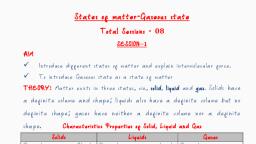
3. THE NATURE OF MATTER, Give reasons for the following statements., 1. The three states of matter are different from each other., The three states of matter are different from each other because of, difference in factors like intermolecular space, cohesive forces and, random motion of particles., 2. Solids are firm compact and almost incompressible., Because the molecules are closely packed and the force of attraction, between the molecules is more, that is why solids are hard and, incompressible., 3. Gases can be compressed easily., In a gas, the molecules are far apart from each other. So the, intermolecular space is more and intermolecular force of attraction is, very weak. That is why gases can be compressed easily., Answer in short:, 1. Define matter. Give examples., Anything that occupies space and has mass is known as matter., Examples: All substances whether living or non living are, composed of matter. Everything in the universe is composed of, matter., 2. What are solids? How are molecules arranged in matter?, Solids are a state of matter where the molecules are closely packed., Since the molecules are close the space between them is very less and, the intermolecular force of attraction is more. Molecules are not able, to move freely so they vibrate in their mean positions. It is due to this, reason solids are hard and incompressible, and thus have a definite, shape and size.
Page 2 :
3. How are molecules arranged in gases?, The molecules lie far apart from each other and hardly attract each, other in gases. Therefore the intermolecular spaces are very large., The molecules move rapidly as the intermolecular force of attraction, is very weak. As a result, gases neither have a definite shape nor a, fixed volume. The gases can be compressed easily., 4. Explain why solids are hard and difficult to compress., The molecules are closely packed in solids. The force of attraction, between the molecules is very strong and the space between them, is very small. As a result, the molecules are not able to move, freely. They vibrate about their mean positions. It is due to this, reason that solids are hard and incompressible, and thus have a, definite shape and size., Answer in detail;, 1. With the help of an activity show that matter has mass., To show that matter has mass take two balloons, a long thread, a, meter scale and a needle. Blow air in the balloons and tie their ends, with long threads of equal lengths. Using a meter scale suspend the, balloons at its two ends. Make a loop with a thread in the center of, the scale and balance the scale. Now prick one of the balloons with, a needle. The balloon that is pricked bursts and the matter scale, tilts towards the inflated balloon., This happens because of the mass of air present in the balloon. The, balloon which contains air is heavier than the busted balloon. This, shows that air has mass., 2. Write a note on states of matter., • Matter is made up of very tiny particles called atoms. An, atom usually does not exist independently.
Page 3 :
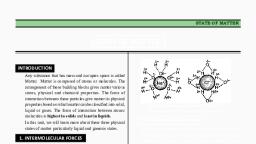
• The atoms combine to form molecules. Molecule has an, independent existence., • Matter exists in three states- solid, liquid and gas., • These three states are different because the molecules, present in them are arranged in different ways with some, space between them known as intermolecular space., • The molecules attract each other with a force called, intermolecular force of attraction., • The intermolecular force of attraction and the, intermolecular space are responsible for determining the, state of matter., 3. Give an activity to show that solids have definite volume., To observe that solids have definite volume take a small bowl, two, large bowls, a tumbler, a thread and a paper weight., Fill the glass bowl and a glass tumbler with equal quantity of, water. Place them in bigger bowls., Tie a paper weight with a long thread. Suspend the paper weight, into the glass bowl. We will observe that some water flows out of, the glass bowl into the bigger bowl. Measure the volume of water, collected in the larger bowl using a measuring cylinder. Let it be a, ml., Now remove the paper weight from the glass bowl and suspend it, into the glass tumbler. We observe that some water flows out of it, into the larger bowl. Measure the volume of water collected in the, bowl using a measuring cylinder. Let it be b ml., Compare the two volumes. We will observe that the volume of, water collected in both cases is same. This shows that solids have a, definite volume., 4. State the factors responsible for the difference in properties of, states of matter.
Page 4 :
The difference in properties of states of matter is due to, intermolecular space, intermolecular force and random motion of, particles., Intermolecular space: It is the space between the particles of, matter. This space is negligible in solids. In liquids the space is, comparatively larger than solids. In gases the space is very large., Intermolecular forces: It is the force of attraction between the, molecules of the same substance. These forces are strong in solids,, in liquids the forces are less as the molecules are loosely packed., Whereas in gases these forces are weak due to large gaps between, the molecules., Random motion of particles: Solids do not diffuse. Liquids diffuse, slowly and gases diffuse very quickly., 5. With the help of an activity show that liquids have definite volume, but not fixed shape., To observe that liquids have definite volume but not fixed shape, take a measuring cylinder, a cup, a glass bowl and some water., Take 100ml water using a measuring cylinder and pour this water, in a glass and observe its shape. Then transfer the water into a cup, and observe its shape. Finally pour water from the cup to a bowl, and observe its shape. At last measure the volume of water using a, measuring cylinder. We will observe that water takes different, shapes but when we measure the volume is same i.e. 1000ml only., This shows that liquids have definite volume but has no fixed, shape., 6. Explain the existence of three states of matter., Solids: In case of solids the molecules are very tightly packed. The, intermolecular spaces between the molecules are very small. Thus, they have very strong intermolecular force of attraction. Hence
Page 5 :
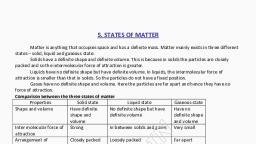
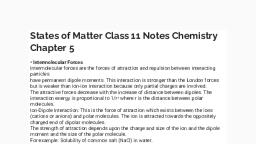
solids have a definite shape and definite volume. They cannot be, compressed., Liquids: In case of liquids the molecules are not very tightly, packed. The intermolecular spaces between the molecules are more, compared to solids. The molecules do not have strong, intermolecular force of attraction. It is due to this reason liquids do, not have definite shape but take the shape of the container vessel., They can flow. Liquids have a definite volume., Gases: In case of gases the molecules are very far apart from each, other. As the spaces are too large the intermolecular forces are, almost negligible. It is due to this reason gases do not have a, definite shape or definite volume. The gases can fill entire space, available to them. They can be easily compressed., Differentiate the following:, i), , ii), , Mass and weight:, Mass: It is the quantity of matter., It is constant everywhere., It cannot be zero., Weight: It is the amount of force of gravity acting on the mass., It varies from place to place., It can be zero if no gravity acts on the object as in outer space., Solids, liquids and gases:, Solids: They have definite shape and definite volume., Position of the molecules of solid is fixed., Solids cannot be compressed., Solids cannot flow., Solids have very small intermolecular spaces., Solids have very strong intermolecular forces of attraction.
Page 6 :
Liquids: They have no definite shape, but have a definite, volume., Position of molecules of a liquid is not fixed., Liquids can be very slightly compressed., Liquids flow from higher to lower level., Liquids have small intermolecular spaces, which is more than, the solids., Liquids have less intermolecular forces of attraction than the, solids., Gases: They have neither definite shape nor definite volume., Position of molecules of a gas is not fixed., Gas can be easily compressed., Gas can flow in all directions., Gases have very large intermolecular spaces., Gases have negligible intermolecular forces of attraction., iii) Brownian motion and diffusion:, Brownian motion refers to the zigzag movement of small, particles suspended in a medium. This movement of particles is, caused by the collision of molecules., The phenomenon of intermingling of substances by the natural, movement of their particles is called diffusion., END