Notes of 5th Sem Mech 2019-22, Power Engineering jet engine.pdf - Study Material
Page 1 :
Jet propulsion is based on Newton’s Second and third laws of motion., , Atmospheric jet engines (Air breathing Engine) require oxygen from the atmospheric air for combustion, of fuel, i.e. they are dependent on atmospheric air for combustion., The rocket engine carries its own oxidizer for combustion of fuel and is, therefore, independent of the, atmospheric air., All air-breathing jet engines operate on the Brayton cycle (open cycle mode)., The most basic form of a jet engine is a turbojet engine, , Turbojet engine:, These types of jet engines take their oxygen supply from the surrounding atmosphere. The turbojet, engine contains a diffuser at the front end, an expansion nozzle (also called propelling nozzle) at the, rear end. The energy produced consists of a combustion chamber, a fuel pump, a gas turbine, and, an air compressor. The air is compressed into the chamber; it is heated, and expanded by the fuel, combustion. It is then allowed to expand through a turbine into a nozzle, where it is accelerated to, high, speed, to, provide, propulsion.
Page 2 :
Atmospheric air enters the diffuser with the same velocity as the propulsion unit. The function of a, diffuser is to convert the kinetic energy of entering air into its pressure energy. The high-pressure, air now enters the compressor, where its pressure is increased and the temperature rises, accordingly., The high pressure and temperature compressed air now enter the spherical combustion chamber, in which the liquid fuel is injected through a ring through a pump. In the combustion chamber, the, fuel burns at constant pressure by coming in contact with hot compressed air., The hot gases thus generated in the combustion chamber now enter a gas turbine in which it, expands to produce power. It is with this power that the compressor and the fuel pump are, operated. Now, the exhaust gases from the turbine pass into the atmosphere through the, expansion nozzle.
Page 3 :
As the exhaust gases pass through the nozzle, their pressure energy is converted into kinetic, energy. The gases leave the nozzle with a very high velocity creating a reactive force or thrust in the, opposite direction. This moves the propellant unit forward., Advantages of Turbojet:, , (i) The power to weight ratio of a turbojet is about 4 times that of a propeller system having, reciprocating engine., (ii) It is simple, easy to maintain and requires lower lubricating oil consumption. Furthermore,, complete absence of liquid cooling results in reduced frontal area., (iii) There is no limit to the power output which can be obtained from a turbojet while the, piston engines have reached almost their peak power and further increase will be at the cost of, complexity and greater engine weight and frontal area of the aircraft., (iv) The speed of a turbojet is not limited by the propeller and it can attain higher flight speeds, than engine propeller aircrafts., Disadvantages of Turbojet:, , (i) The fuel economy at low operational speeds is extremely poor., (ii) It has low take-off thrust and hence poor starting characteristics., , Ram Jet Engine:, In these types of jet engines, the ramjet is the simplest of all the propulsive units. Ramjet, requires neither a compressor nor a turbine. The ramjet is the simplest type of jet engine, because it has no moving parts., It consists of three main components such as a diffuser, combustion chamber, and, expansion nozzle. The pressure of the incoming air improves to a high value by the, diffuser., This type of engine requires a hollow tube into which fuel is injected, mixed with air, and burned to, generate thrust, as shown below. The ramjet only works if it is already moving fast enough to, compress the incoming air by simply forcing it into the engine.
Page 4 :
At the start, the ramjet is moved and accelerated to about 500km/h by some booster device with, maybe a small turbo-jet unit. After high speed is attained in the ramjet, air enters into the diffuser, with the speed of the ramjet., The use of a diffuser is to convert the kinetic energy of entering air into its pressure energy. Fuel is, now injected through a fuel injection nozzle and ignited through a spark plug. Hot gases are, generated, now diffuse into the expansion chamber, and eventually leave the expansion unit, through the expansion nozzle., As the exhaust gases pass through the nozzle, their pressure energy is converted into kinetic, energy. Then, the gases leave the nozzle with very high velocity producing a reactive force or trust, in the opposite direction., The ramjet engine works efficiently only when its speed is supersonic. For this reason, this engine is, not used in aircraft; It is used in missiles., Advantages of ramjet
Page 5 :
(i) Ramjet is very simple and does not have any moving part. It is very cheap to produce and requires, almost no maintenance., (ii) Due to the fact that a turbine is not used to drive the mechanical compressor, The maximum, temperature which can be allowed in ramjet is very high, about 2000◦C as compared to about 900◦C in, turbojets. This allows a greater thrust to be obtained by burning fuel at air-fuel ratio of about 13:1,, which gives higher temperatures., (iii) The specific fuel consumption is better than other gas turbine power plants at high speed and high, altitudes., (iv) Theoretically there seems to be no upper limit to the flight speed ofthe ramjet., Disadvantages of ramjet, (i) Since the compression of air is obtained by virtue of its speed relative to the engine, the take-off, thrust is zero and it is not possible to start a ramjet without an external launching device., (ii) The engine heavily relies on the diffuser and it is very difficult to design a diffuser which will give, good pressure recovery over a wide range of speeds., (iii) Due to high air speed, the combustion chamber requires flame holder to stabilize the combustion., (iv) At very high temperatures of about 2000◦C dissociation of products of combustion occurs which will, reduce the efficiency of the plant if not recovered in nozzle during expansion., , Turboprop Engine :, , The first turboprop engine was built in Budapest in 1938. It is a type of jet engine that uses a gearing, system to connect to an aircraft propeller. Turboprop aircraft engines save fuel and spin at mediumrange speeds.
Page 6 :
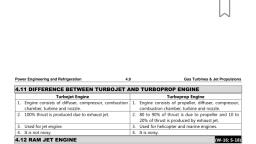
Turboprop engines are good at mid-range altitude, but their weight is likely to damage the gearing, system. A turboprop engine consists of a combustion chamber, containing pressurized air and gas, a, turbine, and a compressor., Although, modern turboprop engines have smaller propeller diameters. These engines have multiple, blades that help stabilize the aircraft at altitude. Like a turbofan aircraft engine, a turboprop engine, converts gas stream energy into mechanical power to achieve its propulsion., This propeller generates power to drive the load, accessories, and compressor. Such jet engines come, with shafts attached to the turbines that drive the propellers through a reduction gear system., Advantages of Turboprop, (i) Turboprop engines have a higher thrust at take-off and better fuel economy., (ii) The frontal area is less than propeller engines so that the drag is reduced., (iii) The turboprop can operate economically over a wide range of speeds ranging from low speeds, where pure jet engine is uneconomical to high speeds of about 800 km/h where the propeller engine, efficiency is low., (iv) It is easy to maintain and has lower vibrations and noise., (v) The power output is not limited as in the case of propeller engines., (vi) The multishaft arrangement allows a great flexibility of operation over a wide range of speeds., Disadvantages of Turboprop, (i) The main disadvantage is that at high speeds, due to shocks and flow separation, the propeller, efficiency decreases rapidly, thereby, putting up a maximum speed limit on the engine., (ii) It requires a reduction gear which increases the cost and also consumes certain amount of energy, developed by the turbine in addition to requiring more space., , Applications, , (i) The turboprop engine is widely used in commercial and military aircraft due to its high flexibility of, operation and good fuel economy. It is likely to eliminate propeller engines from moderate power and, speed aircraft.



 Learn better on this topic